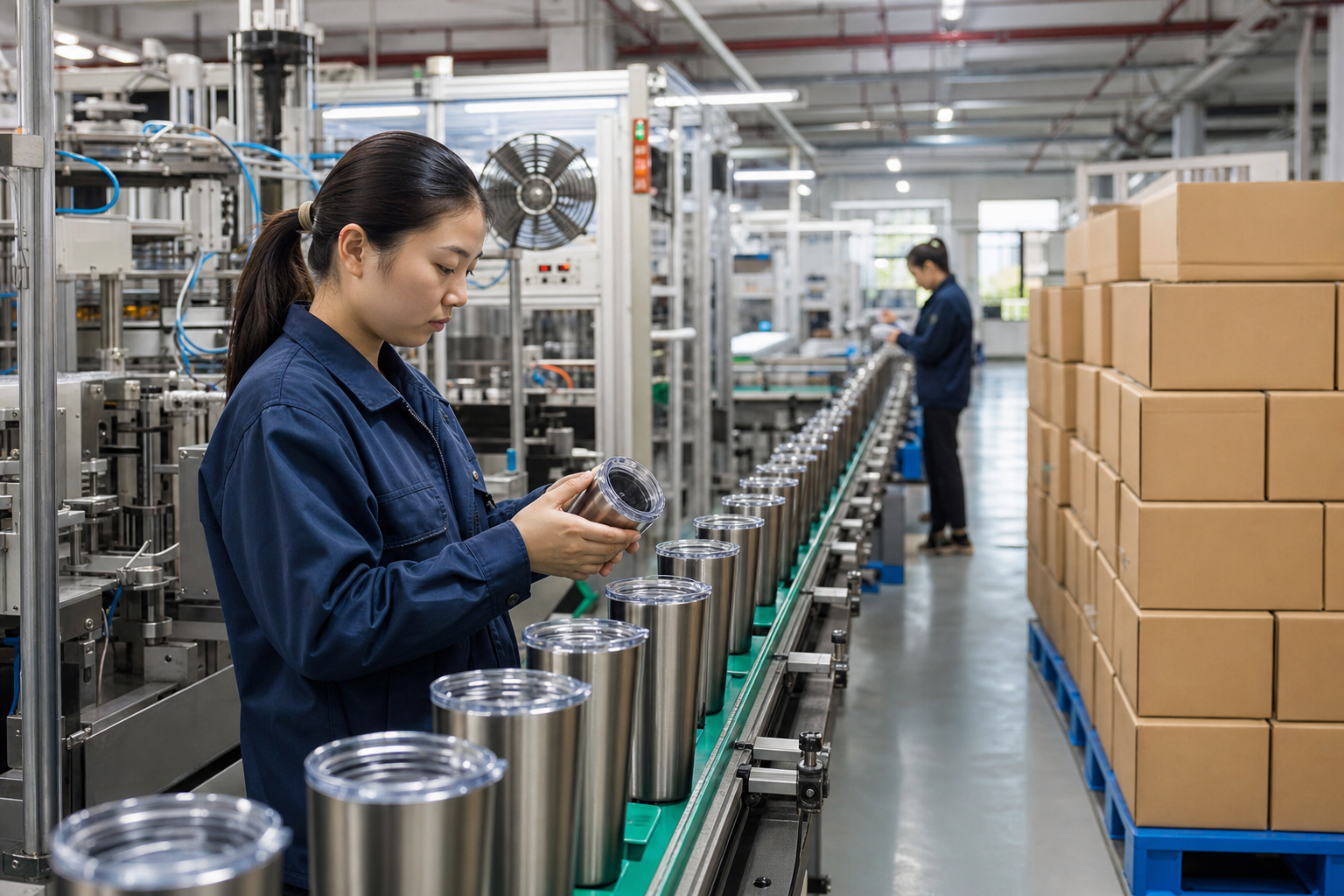
Key Takeaways
- A bulk coffee tumbler usually lands at MOQ 500-1,000 pcs per color with 18-25 day production in Zhejiang.
- 304 stainless steel with 0.4-0.5 mm wall thickness is the practical standard for most bulk travel mug programs.
- Expect FOB China pricing around USD 2.80-6.50 per unit depending on capacity, lid, coating, and print method.
- If you need coffee mug custom made or coffee mug private label work, lock the lid, finish, and packaging before sampling.
If you are buying a bulk coffee tumbler for a coffee brand, corporate gift program, or retail rollout, the real question is not “what looks good?” It is “what survives shipping, stacking, print, and daily use without killing margin.” A 0.8 mm wall instead of 0.6 mm, a lid that actually snaps at the same force, and clean carton packing decide whether the order works. We run this check on the line every day.
At BottleForge in Hangzhou, Zhejiang, we see this every week from importers who first searched for a coffee mug supplier list and then found out the hard way that a sample is easy, but 3,000 or 30,000 units with the same finish is the hard part. QC pulled the sample, checked the 304 stainless spec, and caught a logo shift of 1.2 mm before shipment. That is the point: if the supplier cannot hold AQL standards and a lead time that fits your launch date, the math does not work.
What buyers really mean by bulk
When buyers say bulk coffee tumbler, they usually mean one of three jobs: a promo run, a private label SKU for retail, or a corporate gift order with printed packaging. Those are different orders. A bulk coffee mug for a March trade show can stay simple, but a coffee mug customized for Amazon or DTC retail needs tight carton dimensions, barcode labels, and drop-test packing that holds up at 76 cm. That is why coffee mug distributors and coffee mug suppliers ask about end use first. If they skip that question, you are probably talking to a trader, not a coffee mug factory.
For most buyers, “bulk” starts at 500 pcs. At 1,000-3,000 pcs, we can still keep one print position and one lid type without the unit price jumping too much. Once you pass 5,000 pcs, a factory in Zhejiang can usually set the packing machine, carton count, and coating line schedule to trim 6-12% versus a smaller run. The line runs cleaner that way. But only if you decide early whether you want a bulk coffee travel mug, a coffee mug promotional product, or a coffee mug private labeling project.
Practical rule: do not ask for five colors, three lids, and two box styles on your first order unless you are ready to pay for the complexity. We’ve seen a PO typo turn “1,000 pcs” into “10,000 pcs” on a carton mark, and QC pulled the sample before it went any further.
Material and wall thickness matter
The best-selling bulk travel mug is still stainless steel because it keeps cost, durability, and print quality in line. For hot coffee, 304 stainless is the default, and we see that on the line every week. For low-cost programs, some coffee mug manufacturers offer 201 stainless, but the buyer should know the trade-off before signing off. A 201 body can save USD 0.20-0.35 per unit, yet it gives you less corrosion resistance and a weaker premium feel. If the customer is a coffee brand or a distributor selling into Europe and North America, 304 is usually the safer call.
Wall thickness is where a lot of coffee mug factory direct buyers get led astray. A 0.35 mm shell can pass sample review and still feel flimsy in hand. We had one buyer flag a PO typo—0.03 mm was printed instead of 0.3 mm—and QC pulled the sample before production moved. For a bulk coffee mug meant for daily use, we recommend 0.4-0.5 mm stainless on the inner and outer wall. Double-wall vacuum construction should hold coffee above 60°C for 4-6 hours, depending on fill temperature and lid design. If the tumbler has powder coat, ask for adhesion testing and a scratch protocol; we’ve seen decorative coating failures become the first complaint on coffee mug in bulk shipments.
- 304 stainless: preferred for export retail and premium corporate gift programs
- 0.4-0.5 mm wall thickness: practical balance of strength and weight
- BPA-free lid materials: PP, Tritan, or AS depending on price point
- Vacuum retention: verify with real-time thermal tests, not just a brochure claim
Lid design decides repeat sales
A bulk coffee travel mug is only as good as its lid. Buyers stare at body shape first, then the lid comes back as the problem. Leak resistance, sip feel, and complaint rate all sit there. A sliding lid works for a coffee mug promotional product, but a screw lid with a silicone gasket gives a better shot at daily commute use. We run this check on the line with 60°C water, 30 minutes inverted, 3 samples per lot. If your channel is retail, ask for a drop test, upside-down leak test, and a dishwasher statement. “No leak” is not a clear spec across coffee mug suppliers.
For corporate gifting, a simple push-on lid can pass if the mug stays in office use. For e-commerce, we push a threaded lid and seal ring. The price gap is usually USD 0.15-0.40 per unit. That is cheap insurance against returns. We’ve seen a buyer flag the lid height on a 5000 pcs order because the carton insert had been drawn for a lower profile. The math does not work if the lid breaks the package fit. If you want a coffee mug custom made to fit a cupholder, give us outer diameter, lid height, and grip zone before sampling. A 72 mm lid can miss a console that looks “standard” on paper.
Ask the factory to send lid leak test video at 60°C water, 30 minutes inverted, 3 samples per lot. If they cannot do that, they are not ready for export accounts.
Decoration options and brand control
Your decoration choice changes price, wear life, and MOQ. Screen print is still the low-cost route for a coffee mug bulk order with one or two colors. Laser engraving runs clean on stainless steel and gives a premium look, which is why buyers use it for coffee mug private label or executive-gift orders. Full-color heat transfer or UV print can look strong at launch, but we always check abrasion resistance and dishwasher exposure first. For a bulk coffee tumbler that gets handled daily, a simple logo usually beats a busy graphic. QC pulled one sample after 50 dishwasher cycles, and the edge lift told the story.
At our Zhejiang line, the choice is usually simple: one-color logo, screen print; metallic finish or dark body, laser engraving; complex artwork, UV or transfer, but only after a wear test. If you are comparing coffee mug customizable options from different coffee mug manufacturers, ask every supplier to quote the same logo size and print area. One buyer sent us a PO with “logo 50mm” on page one and “60 mm” in the remarks. The price gap was fake. This is the wrong question to ask. For a coffee mug distributor selling into retail and corporate channels, consistency matters more than shaving a few cents off the sample.
Packaging needs the same discipline. A coffee mug promotional order may ship in a white box, but a retail SKU often needs a color box, barcodes, and carton marks. If you sell on Amazon, plan the FNSKU label space early and leave room for the sticker, usually 50 x 30 mm. Late packaging changes add 2-5 days and force carton rework. We have seen that go sideways more than once. One carton spec typo can stop the line.
MOQ, price, and lead time reality
Here is the range we see on the line in China. For a standard 12-16 oz bulk coffee mug or bulk coffee travel mug, MOQ is usually 500 pcs per design. At 1,000 pcs, coating and packaging run cleaner, and the setup loss drops. FOB China pricing for stainless vacuum tumblers usually sits between USD 2.80 and USD 6.50 per unit, depending on capacity, lid type, and decoration. A basic single-wall promotional mug can land lower, but if you need a vacuum-insulated coffee mug in bulk, that price band is the one to budget against.
Lead time from a Zhejiang coffee mug factory is usually 18-25 days after sample approval and deposit, plus 5-7 days for sea freight to consolidation if you are shipping to a forwarder in China. Air freight is faster, but on small cartons it can add USD 1.20-3.50 per unit. We had one buyer flag a PO typo on the lid code and the whole shipment slipped 4 days. This is the wrong question to ask if you are chasing the lowest sample price; the real question is repeat production. A factory with 200,000 units/month capacity can still miss your schedule if artwork, packaging, and lid choice come in late.
Good sourcing discipline:
- Request a pre-production sample with actual print and final lid
- Confirm AQL 2.5 for major defects and 4.0 for minor defects
- Approve carton drop test if the order ships retail-ready
- Lock currency terms and incoterms before mass production
Compliance for Europe and North America
If you sell into Europe or North America, compliance is the gate, not a checkbox. One missing paper can stop a container at the port. A serious coffee mug manufacturer should give you food-contact material declarations, REACH paperwork for coatings and inks, and FDA-relevant statements for US buyers when asked. For stainless steel drinkware, ask for migration testing and check whether the supplier can show reports from a third-party lab like SGS or Intertek. We’ve seen a 304 stainless body sail through, then the lid insert fails because nobody checked the full build.
For corporate buyers, BSCI or a similar social audit can matter more than the unit price. A coffee mug factory direct quote means little if your retailer asks for factory audit documents later and the file is empty. In Zhejiang, the better suppliers can send audit summaries, test reports, and carton data sheets without a long back-and-forth. If the factory gets fuzzy on compliance, walk away. That is the wrong supplier for export. You do not need a lab report for every SKU, but you do need a team that handles export paperwork cleanly. That means HS code support, invoice descriptions, and packing lists that match the cartons on the floor. One PO typo on carton count can turn into a customs headache fast.
One point new buyers miss: compliance has to match the exact decoration and lid. A stainless body may pass, then a soft-touch coating or a new gasket compound changes the test scope. Ask the coffee mug factory to confirm the final production version is the same as the tested sample. QC pulled the sample, measured the lid at 87 mm, and found a different gasket spec than the one on the report. That gap is where we ship delays.
How to choose a factory direct partner
If you are comparing a coffee mug supplier list or scanning a coffee mug supplier directory, the real filter is simple: can the factory hold your spec at scale? Look for a coffee mug oem manufacturer that controls forming, vacuum sealing, coating, print, and packaging in-house, or runs them under tight process control. We’ve seen this go sideways when the chain is split across three workshops. Defects creep in fast.
Ask direct questions. No fluff.
- What is your monthly output for stainless travel tumblers?
- How many workers are on the coating line and print line?
- What is your standard sampling time?
- Can you handle one-color and full-color coffee mug custom made orders in the same week?
At BottleForge in Hangzhou, Zhejiang, we run bulk coffee tumbler programs with a typical MOQ of 500 pcs, standard production lead time of 18-25 days, and monthly output above 200,000 units across travel mug lines. QC pulled the sample with a 0.3 mm print offset once, and the buyer flagged it before packing; that is the kind of checkpoint that saves a shipment. This is the wrong question to ask if you focus only on unit price. The math does not work when a cheap quote misses your ship date for a seasonal coffee mug promotional products order or a coffee mug customized retail item with a fixed launch window.
Request a factory-direct tumbler quote today
Send your target size, logo, lid style, and order volume. We will quote from Hangzhou, Zhejiang with clear MOQ, lead time, and packaging options.
Frequently asked questions
What is a normal MOQ for a bulk coffee tumbler?
For most stainless vacuum models, MOQ is 500 pcs per design and color. If you want a custom box, special coating, or multiple lid types, 1,000 pcs is more realistic. Some coffee mug suppliers will quote 300 pcs, but the unit price usually rises 12-20% and the color match risk goes up.
How much does a bulk coffee travel mug cost from China?
For FOB China, a standard 12-16 oz bulk coffee travel mug usually costs USD 2.80-6.50 per unit. Basic promotional styles can be lower, while premium double-wall vacuum models with laser logo, powder coating, and color box can move above USD 6.00. Freight, duty, and labeling are separate.
Which print method lasts longest on a coffee mug customized order?
Laser engraving is usually the most durable on stainless steel because it removes the surface layer instead of sitting on top of it. Screen print is economical and works well for one or two colors, but abrasion can show after repeated washing. For retail or corporate gifting, we often recommend laser for premium branding.
Can I order coffee mug private label packaging with barcodes?
Yes. A coffee mug private label program can include custom boxes, barcode labels, FNSKU stickers, instruction leaflets, and carton marks. If you sell on Amazon, prepare the barcode format before sampling. Packaging changes late in production can add 2-5 days and create avoidable rework at the factory.
What tests should I ask a coffee mug factory to provide?
Ask for leak testing, vacuum retention, adhesion testing for coatings, and food-contact compliance documents. For export orders, request REACH-related declarations, and if you sell in the US, ask whether material migration testing is available. A good factory should also support AQL inspection, usually AQL 2.5 for major defects.