Key Takeaways
- A workable bulk double wall bottle MOQ in Zhejiang is often 1,000-3,000 pcs per SKU, with 35-50 days lead time after sample approval.
- 304 stainless steel at 0.4-0.5 mm wall thickness is the usual commercial sweet spot for wholesale drinkware; 316 raises cost by 15-25%.
- A proper vacuum bottle should hold 12-24 hours hot and 24-48 hours cold when built with a tested double-wall structure and 100% leak testing.
- For branded bulk drinkware, expect USD 3.20-6.80 per piece FOB China depending on capacity, finish, lid system, and logo method.
If you are sourcing a bulk double wall bottle, the hard part is not finding a supplier. It is telling a real factory from a polished sales office. A bottle can look the same in photos and still fail on vacuum retention, weld quality, or coating adhesion after 2,000 cycles. Then procurement gets expensive fast.
At BottleForge in Hangzhou, Zhejiang, we run this check every week: brand owners want a clean spec, a fixed lead time, and a price that still works after logo print and color matching. QC pulled the sample last Friday and found a 1.2 mm gap on the base weld; the buyer flagged it before we shipped the first 5,000 pcs. Start with the construction, then talk price. Skip the engineering details, and you pay for rework, returns, and distributor complaints. China has plenty of factories. Only a few keep quality stable at scale.
What buyers mean by double wall
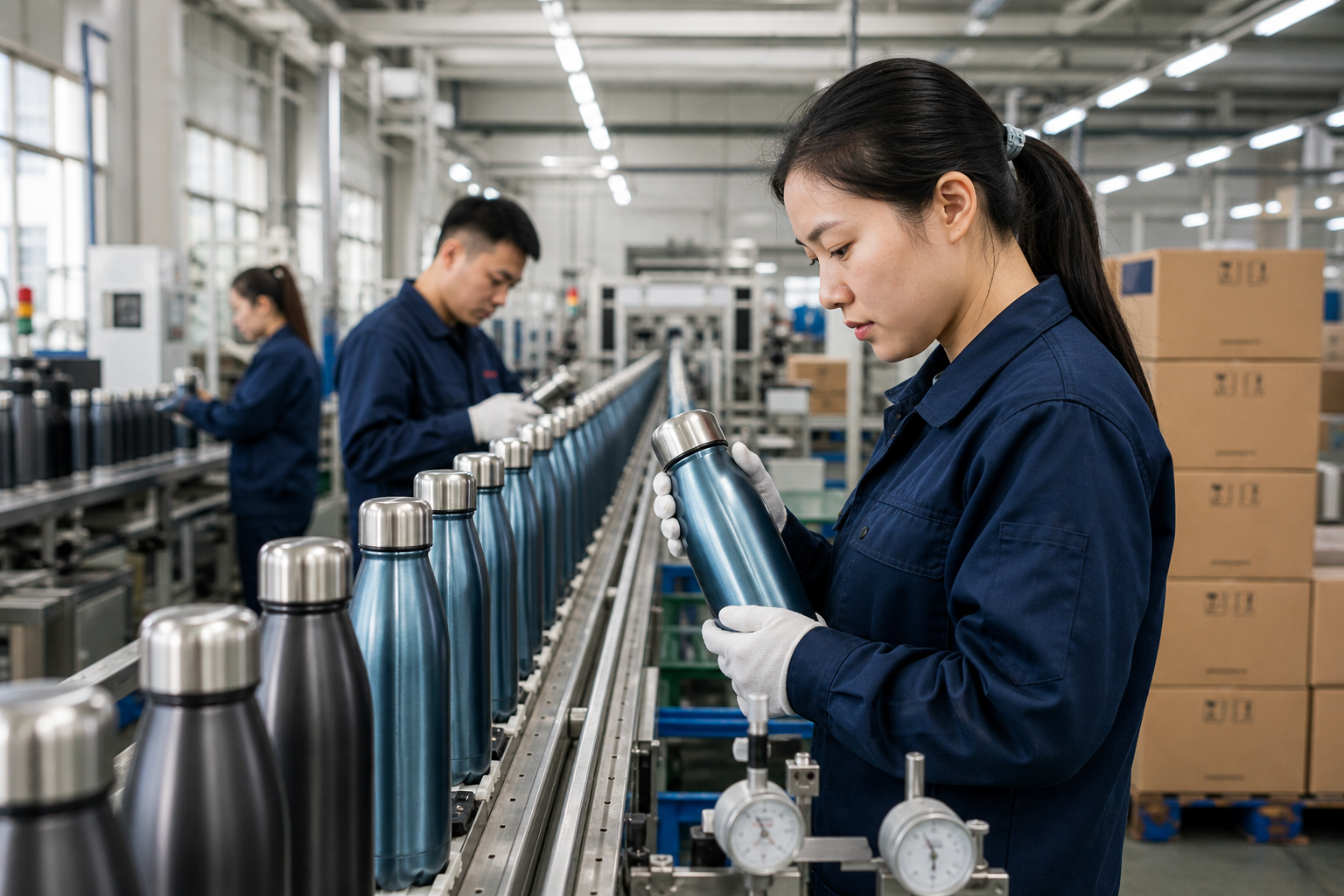
When buyers say bulk double wall bottle, they usually mean a stainless steel insulated bottle built from two shells with a vacuum gap between them. We run these on the line every week. A 500 ml sample with a 42 mm neck and a PP lid is not just a container; you are buying heat retention, condensation control, and a body that survives carton drops. The outer shell can be powder coated, painted, brushed, or left as polished steel. The inner shell usually needs food-grade 304 stainless steel, while the outer shell can also be 304 to keep corrosion risk low on humid sea freight from Ningbo to Los Angeles.
The commercial spec matters more than the sales name. A good factory in Zhejiang will state material grade, wall thickness, neck finish, and lid torque before giving a quote. QC pulled the sample and checked a 0.4 mm wall with a micrometer; that is the kind of detail that keeps the order clean. For mainstream wholesale drinkware, 0.4 mm inner and outer walls are common. If a supplier offers 0.25 mm and claims the same performance, the math does not work. Thin walls save metal but usually bring more denting, shrinkage, and weld rejects. For canteen wholesale and wholesale drinkware buyers, the bottle has to pass as a system: body, vacuum seal, lid gasket, and coating all affect field failure rates.
- Typical capacity: 350 ml, 500 ml, 750 ml, 1 L
- Common steel grade: 304 stainless steel; 316 for higher margin or special use
- Typical wall thickness: 0.4-0.5 mm
- Factory test target: 24-hour leak-free batch sampling
That is why a serious buyer does not ask only for “best wholesale drink bottle.” You ask what thermal claim, what test method, and what reject standard sit behind the price. We have seen this go sideways when the PO says 12-hour insulation, but the sample card promises 18 hours and the buyer flags it on day one.
Pricing, MOQ, and lead time
For a standard bulk double wall bottle in 500 ml, FOB China usually lands at USD 3.20-6.80 per piece. Plain body, basic screw lid, no coating, small logo — that sits at the low end. Matte powder coat, a more complex lid, laser logo, or a gift box pushes the number up fast. If the buyer asks for a bulk canteen style bottle with a sports cap or handle, add about USD 0.25-0.90, and the closure choice is what moves the price, not the bottle shell.
MOQ in Zhejiang factories is not one-size-fits-all. A stock body with custom logo often starts at 1,000 pcs per color. A fully custom shape usually needs 3,000-5,000 pcs, and that is the part some buyers push back on when they only need a test order. We run one line at about 80,000 units per month across mixed insulated bottle SKUs, but the tooling slot and coating queue still decide where your order sits. For timing, samples take 7-10 days, plain repeat orders 25-35 days, and custom printing or packaging 35-50 days after sample approval. QC pulled the sample at 1.2 mm wall thickness on one run, and that is the kind of check that keeps the schedule honest.
If you are comparing drinkware bulk offers from China, read the quote line by line. Some factories put a low number on the page and leave out carton drop test, spare lids, or logo setup. Ask for a landed cost from day one: product cost, printing, packaging, and carton loading efficiency. A bottle priced USD 0.20 lower can turn into the more expensive option once the carton count is weak and the freight bill lands in Europe or North America. We saw one PO where the buyer typed the carton size as 58 x 38 x 32 cm instead of 58 x 28 x 32 cm, and the math did not work after palletizing.
Do not negotiate only the unit price. Negotiate the failure rate, the carton count, and the repeat order terms.
Materials and construction choices
Material choice decides whether your order lands as a clean retail piece or turns into a refund case. For most wholesale drinkware runs, 304 stainless steel is the normal pick because it holds up against corrosion, forms well on the line, and keeps cost in line. We ship a lot of 18/8-style builds with 0.4 mm inner walls, and the math is straightforward. If you want a premium outdoor spec or food-contact upgrade, 316 is the stronger call, but the bill of materials usually goes up 15-25%. For the outer shell, 304 with powder coating is the workhorse.
The vacuum gap only works if seam control is tight. A Zhejiang factory should tell you the welding method, when the vacuum pumping stage starts, and how the seal is locked. QC pulled the sample on one 500 ml run and found a pinhole at the seam after the vacuum check, so this is not a theory problem. If the body finish matters, ask for coating adhesion tests and salt spray data. For coastal markets or road-salt winter routes, 48-hour salt spray on coated parts is the floor, and 72 hours is the safer call. For canteen bulk programs in school or sports channels, impact resistance matters just as much as thermal hold. A bottle that dents fast fails shelf inspection even if it keeps tea hot.
The wrong question is, "Which lid do we like?" Pick the bottle thread first, then match the lid. If you do it backward, you get cross-threading, gasket leaks, and the buyer flags replacement lid claims on the PO. We have seen this go sideways on a 28 mm neck finish because the lid drawing was signed off before the body was frozen. For best wholesale drink bottle performance, ask for the full assembly spec: lid material, gasket silicone hardness, and torque range.
- 304 stainless steel: default choice for most bulk orders
- 316 stainless steel: premium option when corrosion resistance is the priority
- Powder coating: better grip and less visible scratching
- Food-grade silicone gasket: needed for leak control
Logo, finish, and packaging
Customization turns a plain bottle into a brand asset. It also turns into the fastest way to burn margin if the spec is loose. The main logo methods are silkscreen, laser engraving, heat transfer, and embossing/debossing. For a bulk double wall bottle, laser engraving is usually the cleanest call on stainless steel. We price it around USD 0.08-0.25 per piece, depending on artwork size and fixture setup. Silkscreen runs cheaper, often USD 0.03-0.12, but we’ve seen it scuff in carton rub tests after 12 days in transit. One buyer sent a PO with the logo file named “final_final_v3,” and QC pulled the sample because the line art was off by 1.5 mm.
For wholesale canteen orders and higher-end wholesale drinkware, finish changes how the buyer reads the product before they touch it. Matte powder coat hides scratches better than glossy paint. Brushed steel looks technical, but fingerprints show fast. Soft-touch finish sells in gift sets, yet you need to test chemical resistance, since sanitizer and sunscreen can mark some coatings in one week. If you are planning drinkware wholesale for Amazon or retail chains, carton presentation is part of the job. The buyer flagged the FNSKU label on a recent run, and that single typo on the master carton caused a rework before ship-out.
Packaging has to match the route. For sea export from China, we run cartons that pass 1.2 m drop tests and stay under the pallet weight your warehouse can handle. If you sell a beer tumbler wholesale bulk or a promotional set, insert trays keep lids from scuffing better than loose packing. For gift programs, ask for a clean artwork proof and build in a 5% overage allowance for print rejects. We’ve seen this go sideways when the buyer wanted zero extra cartons and then the first color check missed by 2 mm.
If your SKU includes alcohol flask bulk or alcohol flask wholesale bulk style products in the same family, do not assume one coating system fits all. Flask bodies usually need tighter cosmetic control than general drinkware. The wrong question is “Can we use the same finish?” The real question is whether the surface holds up after tape pull, salt spray, and a 24-hour rub test.
Testing and quality control
Quality control belongs in the PO, not in a promise. We run incoming material checks on 304 stainless, in-process checks at the line, and final AQL sampling before carton close. For bulk insulated bottles, AQL 2.5 is standard for major defects; for a premium brand, we tighten leakage and cosmetic checks. Ask for 100% leak testing on assembled bottles, not a handful of random pulls.
The useful tests are plain: vacuum retention, lid leakage, coating adhesion, drop test, and dishwasher resistance if the claim is on the artwork. Thermal claims need a fixed room temperature and fill temperature, or the number has no meaning. A clean spec reads 12 hours hot at 95°C fill and 24 hours cold at 4°C fill under controlled test. If a supplier throws out 24+ hours with no condition sheet, the math does not work. We’ve seen that go sideways on a PO typo too — 95°C became 59°C, and the buyer flagged it fast.
For growler wholesale or beer growler bulk programs, pressure and seal stability matter more than on a standard water bottle. If you are sourcing beer growler wholesale bulk, ask for cap torque tests and carbonation retention guidance. The same goes for bulk growler and growler bulk orders for breweries or hotel bars. A lid that passes on a desk bottle can fail after 8 hours in a cooler at 4°C. QC pulled the sample, set the cap torque wrench to 0.8 N·m, and the weak seal showed up immediately.
We define three acceptance points:
- Pre-production sample: confirms look and function
- Inline inspection: catches coating and weld issues early
- Final AQL inspection: checks packing, logos, leaks, and count accuracy
That is the gap between a factory order and a shipment that lands clean. One gives you excuses; the other ships on time.
How to source from Zhejiang
Zhejiang still sits near the top for drinkware sourcing. The supplier base is dense, cap-and-lid factories are 20 to 40 km apart, and export paperwork is routine. If you buy from Hangzhou, Yongkang, or the nearby clusters, you can move from spec sheet to sample faster than a scattered national search. We ship a lot through this route, and it saves days when the buyer has a retail launch date breathing down the schedule.
The process should stay tight. Start with capacity, then ask for a cross-section drawing, then request samples with the exact lid and coating. Do not approve a bottle from a glossy render. For canteen wholesale and wholesale canteen buyers, ask for prior export records, test reports, and a real monthly output number. If a factory cannot state 80,000 pcs or 120,000 pcs per month without hedging, the quote is still a guess. QC pulled the sample, and we have seen a 0.8 mm wall-thickness miss sink an order after the PO typo was caught too late.
Check compliance against your market, not against the factory's sales deck. For Europe, REACH and food-contact declarations matter. For North America, check FDA food-contact positioning, California Proposition 65 sensitivity if coatings or accessories are involved, and your retailer's own checklist. BSCI or a similar audit helps when customers ask for it, but it does not replace product testing. For large bulk drinkware programs, the math does not work if you skip both compliance and commercial control. A common pushback we get is "the sample passed, so why do we need another test?" That is the wrong question to ask.
If your next order mixes alcohol flask in bulk, beer tumbler in bulk, or wholesale growler items, keep them under one supplier only when that factory actually runs the full line. If they outsource lids, laser marking, or coating, split the order. We have seen this go sideways on a 3,000-unit run when one factory promised all three SKUs and then missed the neck finish on the growler by 1.2 mm—close enough to look fine, wrong enough to stop assembly.
Commercial terms buyers should lock
Before you issue a PO, lock the commercial terms that protect margin. Start with the Incoterm. FOB China is the cleanest base for most B2B buyers because it draws the line between factory duty and freight booking. Then fix carton counts, 2% overage allowance, and whether spare lids sit in the box. We had one buyer flag a PO typo on lid quantity last season; the correction alone burned two days on the line. Spell out the remedy if a batch misses vacuum hold or color falls outside the signed-off shade chip.
For branded beer tumbler wholesale or beer tumbler wholesale bulk programs, lock the artwork approval window. If your launch is tied to a retailer calendar, a 3-day slip on proof approval can turn into a 3-week shipment delay. Put the sample sign-off date in writing and set the production freeze point. We run a UV print station that needs final files before the first 500 pcs, not after. In China, schedule discipline saves more cash than fighting over USD 0.05.
For repeat alcohol flask wholesale programs or alcohol flask wholesale bulk seasonal promotions, agree on the re-order price band before the first container ships. That keeps you from getting surprised when steel moves or the coating shop raises its rate. We saw a 304 stainless quote shift by 8% in one quarter; the buyer who had a band in writing stayed calm. Good factories in Zhejiang do not promise a magic number. They tell you which parts stay fixed, which parts move with the market, and what MOQ sits behind each price tier.
You want a supplier who can say: this model is stable, this lid is in-house, this MOQ is 3,000 pcs, and this lead time is 35 days, not 28 on a lucky week. That is the answer that keeps a procurement program alive.
Send your spec sheet for a fast quote
We can price your bulk double wall bottle, confirm MOQ, and recommend the right lid, coating, and test plan for China export.
Frequently asked questions
What is the usual MOQ for a bulk double wall bottle?
For most export-ready SKUs, MOQ is 1,000-3,000 pcs per color or per artwork version. A stock bottle with custom logo may start at 1,000 pcs, while a fully custom shape often needs 3,000-5,000 pcs. If you add special packaging, the MOQ can rise because cartons and inserts are printed separately. In Zhejiang, the best buyers define MOQ by configuration, not by vague product name.
How much should I budget per unit FOB China?
For a standard 500 ml bulk double wall bottle, budget USD 3.20-6.80 FOB China. Plain brushed or powder-coated bodies with simple lids sit near the low end. Laser logo, premium lid hardware, and gift packaging push the price up. If a quote is far below USD 3.00, check whether it excludes testing, better coating, or even a proper leak check.
Which material is best for wholesale drinkware?
304 stainless steel is the best default for most wholesale drinkware because it balances cost, durability, and corrosion resistance. Use 316 only when the market or use case truly needs extra resistance, such as marine-adjacent environments or premium positioning. A typical body spec is 0.4-0.5 mm wall thickness. Thinner than that often means more dents and higher reject rates.
What testing should I ask for before shipment?
Ask for 100% leak testing on assembled units, plus AQL 2.5 final inspection on appearance and quantity. For coated products, request adhesion testing and, if relevant, 48-hour salt spray. For thermal claims, require documented test conditions: fill temperature, ambient temperature, and duration. If you sell in Europe or North America, also request REACH or food-contact paperwork where applicable.
Can I source growler or flask styles from the same factory?
Yes, but only if the factory truly controls those molds and lid systems. A supplier that handles bulk growler, beer growler wholesale, or alcohol flask wholesale bulk orders may still be weak on insulated water bottles, or the reverse. For mixed programs, ask for separate samples, separate QC checkpoints, and separate artwork approvals. That avoids mixing up specs and shipping the wrong carton count.