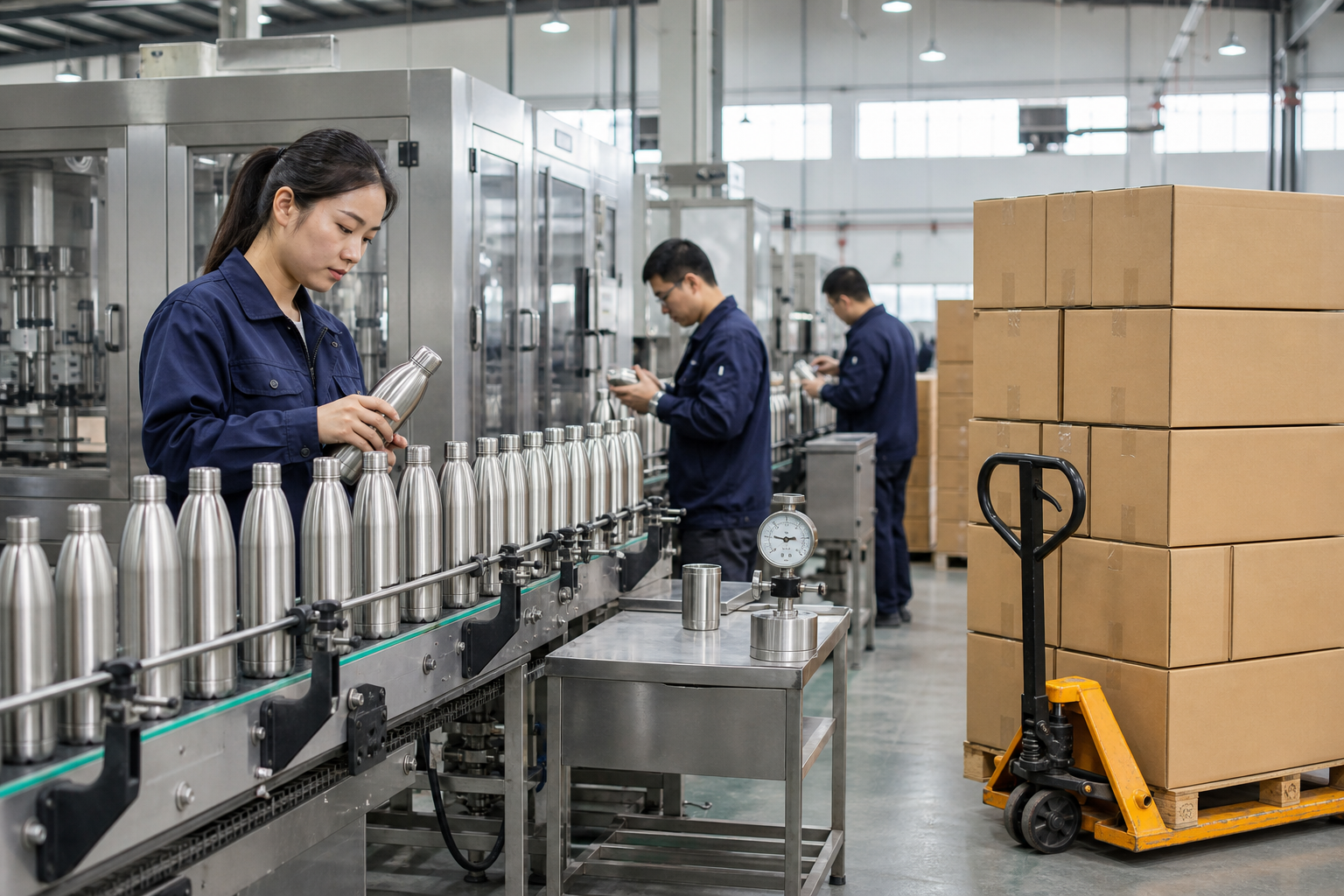
Key Takeaways
- Typical MOQ for a custom bulk double walled bottle starts at 3,000 units, with 35-45 days lead time after sample approval.
- A practical export price for 500 ml 18/8 stainless vacuum bottles is often $2.10-$4.20 FOB China, depending on finish and decoration.
- Request AQL 2.5/4.0 inspection, vacuum leak testing, and at least 12-24 hour thermal retention data before PO.
- For North America and Europe, ask for REACH, food contact compliance, and carton drop-test proof, not just a sales brochure.
If you are sourcing a bulk double walled bottle, do not treat it like a normal bottle buy. It is insulation, finish, packing, and export paperwork in one PO. A 500 ml stainless bottle can look fine in photos and still fail vacuum retention, dent in a 1.2 m drop test, or blow your margin by $0.80 per unit once printing and cartons are added.
For procurement managers and brand owners, the job is to match target price with the right steel grade, wall thickness, and factory capability. We run this every week in Zhejiang. Better factories quote MOQ, lead time, and test standards on day one; weaker ones wait until sample approval, and we have seen that go sideways when the buyer flagged a PO typo on carton count. If you are buying wholesale drinkware for retail, promotions, or Amazon, you need a sourcing method that keeps margin intact and cuts rework.
What you are actually buying
A bulk double walled bottle is not just a container. It is a vacuum-insulated build with two stainless walls, a sealed air gap, and a lid that still has to pass carton drop tests after a long ocean move. If the factory stays vague on steel grade, insulation process, or lid stack-up, your margin takes the hit. For most wholesale drinkware programs, the standard we run is 18/8 or 304 stainless steel on both walls, with 0.4-0.5 mm wall thickness on commercial models. That gives a workable balance between cost and dent resistance. QC pulled the sample, and the wrong question is always “is it cheap?”—the real question is whether the shell survives export handling.
Buyers often compare only capacity and price, but the cost drivers sit in plain sight: powder coating, laser logo, flip-lid parts, copper plating in the vacuum layer, and pack-out. A 500 ml bottle with basic color spray and one-color silkscreen may land at $2.10-$2.60 FOB. Add a custom cap, engraved logo, and a retail-style box, and you move above $3.50 fast. We have seen POs where the buyer flagged a typo on the lid color code, and that one line changed the whole quote. The math does not work if you expect wholesale canteen pricing for a premium insulated bottle.
If you need a bulk canteen or canteen wholesale program, ask whether the same shell can be adapted across 350 ml, 500 ml, and 750 ml sizes. A good Zhejiang factory will often share tooling across those three formats, which helps you build a range without resetting every cost. That matters if you plan to sell drinkware bulk assortments, not a single SKU. We run this on the line by keeping the neck finish consistent, so one cap mold can fit multiple bodies; this is where buyers either save money or get stuck chasing a new mold for no good reason.
Materials and thermal performance
Material choice decides whether your bottle feels like a brand piece or a commodity. For export programs, 304 stainless steel is the baseline for food contact; 316 comes in when the buyer wants extra corrosion resistance or a premium spec. We run into this all the time: a PO says “stainless” and leaves out the grade. That is a bad PO. Put 304 or 316 on the order, or QC will spend time chasing paperwork instead of checking the line.
Thermal performance has to be written in a way you can test. The common sales claim is 12 hours hot and 24 hours cold, but fill volume, lid type, and room temperature change the result fast. A proper supplier should show a test report with 95°C fill, cap closed within 30 seconds, and room conditions around 20°C. We’ve seen the buyer flag a claim after QC pulled the sample at 18 hours and the water was still warm, so ask for the method, not just the headline number.
For a beer growler bulk or growler wholesale line, the same rules apply, but the lid seal and mouth size carry more weight. Beer growler wholesale bulk buyers usually ask for a wider opening, a thicker body, and a cap that holds pressure better. A standard 64 oz growler may ship with a 0.5 mm shell and a heavier base for stability. That adds grams, and grams add freight cost. If you sell beer tumbler bulk or beer tumbler wholesale bulk, the shape is simpler, but lid quality still decides whether the customer keeps it or sends it back.
Ask the factory for a written retention sheet. If they cannot state fill temperature, ambient temperature, and timing, their “24-hour cold” claim is sales talk, not engineering.
MOQ, pricing, and lead time
Most buyers ask for the number first. For a standard bulk double walled bottle with one logo and a common color finish, a Zhejiang factory usually sets MOQ at 3,000 units per design. We do take 1,000 or 2,000 pcs on some lines, but the math changes fast: setup fee, higher carton cost per unit, and less room to hold the lid or coating price. QC pulled a 1,000 pcs sample run last month, and the buyer flagged the unit cost before we even packed the first carton. If you are testing a new market, fine. If you already have repeat orders, 3,000 is the cleaner number.
Lead time matters just as much. Sample lead time is usually 7-12 days. After sample approval and deposit, production runs 35-45 days for standard vacuum bottles, and 50+ days if you add complex molds, special lids, or printed gift boxes. In peak season, one coating slot alone can eat 6-7 days. We once had a PO where the buyer wrote “ship before 8/15” but forgot to confirm lid color; that typo cost them a week. If your retail launch date is fixed, place the PO earlier than you think. Late orders get expensive fast.
Price moves with details. A plain 500 ml bottle with matte paint may land around $2.10-$2.60 FOB. Laser engraving, higher-grade powder coat, and a better lid can push you to $3.20-$4.20. A bulk canteen or canteen bulk project with simpler walls may price lower, while growler bulk models with wide-mouth caps usually sit higher because the lid and body structure cost more. We run 304 stainless checks on the line, and a 0.3 mm wall difference will show up in the quote. If you are comparing drinkware wholesale offers, line up the same spec first, then look at price.
Ask for three quotes on the same shell. That is the right question. If one supplier quotes a 500 ml matte bottle and another quotes a heavier body with a soft-touch lid, the comparison is dead on arrival. We’ve seen this go sideways more than once: different steel thicknesses, different lids, different packing, then the buyer wonders why the “cheapest” offer turns into the most expensive landed cost.
Decoration and branding choices
Branding turns a plain bottle into a sellable SKU. We run silkscreen, heat transfer, laser engraving, lid embossing, and full-wrap UV print. For most wholesale drinkware programs, laser engraving is the safe pick if you want a premium look and better abrasion resistance. Silkscreen costs less, usually $0.08-$0.20 per unit cheaper, but it can scratch when the buyer puts it through rough retail handling or a dishwasher test.
If you sell alcohol flask bulk or alcohol flask wholesale bulk items alongside insulated bottles, keep the decoration plan tight. Buyers flag mixed finishes fast; it looks like two factories touched the same order. On alcohol flask in bulk, the finish tolerance is tighter because the body is smaller and one scratch jumps out at 300 mm away. On larger insulated bottles, coating consistency and logo placement carry more weight than tiny cosmetic marks. We’ve seen this go sideways on a 5,000-piece PO when one line used a different clear coat.
Ask the supplier for artwork positioning in millimeters, not “centered on body.” That instruction causes rework. A proper drawing should show logo height, wrap width, print tolerance, and color reference, with Pantone callout or a signed sample. If you are building drinkware bulk sets for retail, the carton and label need the same standard too. A misprinted master carton kills shelf appeal faster than a small bottle blemish, and QC pulled the sample on a 12 mm offset before we shipped.
For a wholesale growler or beer growler wholesale bulk order, decide early whether you want a brushed steel look, matte black powder coat, or clear coating over the base metal. The finish changes the price story. Matte usually photographs better for e-commerce, while brushed steel feels more utility-grade and less premium. We had one buyer push back on matte because the test scratch showed white lines after a 500 g rub test, and the math did not work for his brand position.
QC checks before you pay balance
Do not release the balance on photos alone. We see that mistake turn into warehouse claims. For wholesale canteen and wholesale drinkware orders, the QC checklist needs appearance, dimensions, vacuum retention, lid sealing, coating adhesion, and carton strength. AQL 2.5 for major defects and 4.0 for minor defects is common on commercial export orders, but the real job is defining major defects before the line starts. A leaking lid is major. A 1 mm print shift may stay minor. A dent on the base ring is major if it kills stacking.
Ask for a pre-shipment report with random sampling and actual measurements, not a polished album. We run a 60 cm drop test, lid open-close cycles, and white-light visual checks; QC pulled the sample and logged the numbers, not just the photos. If the order is above 5,000 units, bring in a third-party inspector in China. The better Zhejiang factories accept that without drama. The weaker ones push back hard, and that tells you plenty.
For drinkware wholesale programs sold in Europe, ask for REACH-relevant substances and food-contact paperwork. For North America, request confirmation that coatings and components are food-safe under the applicable rules, and check that the retail carton leaves barcode space and FNSKU placement if you sell through Amazon. If you are ordering beer tumbler bulk or beer tumbler in bulk for promotional use, do not skip packing: double-wall bottles need dividers or egg-crate inserts to stop rim damage. We have seen 2 mm of carton crush wipe out a full box.
One test gets ignored too often: cap torque and seal consistency across the batch. If the lid feels loose on 3% of the sample set, that becomes customer complaints later. We track it with a torque meter, and the math does not work if the gasket compression wanders. A good factory in China will reset the tooling before shipment. A poor one will say the issue is “normal.” It is not.
How to build a profitable SKU mix
The best wholesale drink bottle is the one that fits your channel economics, not the one with the fanciest rendering. If you sell retail, keep the core program tight: one 500 ml, one 750 ml, one lid family, and two colors. We ran a 2,000-piece test once, then the buyer flagged the MOQ split when the order got scattered across six SKUs. Too many variants, and your cash sits in inventory. For Amazon or DTC, a narrow range also keeps photography, listing copy, and review handling under control.
For distributors, you may need a wider mix that covers bulk growler, growler wholesale, canteen wholesale, and insulated bottle lines. The trick is not to design every product from scratch. Reuse body shapes, lids, and packaging where possible. On the line, we keep one 82 mm neck finish and swap the cap insert, which saves tooling and keeps spare parts simple. A Zhejiang factory that runs this way can build a platform approach: shared tooling, shared closures, different branding. That cuts engineering cost and speeds up replenishment.
If you are entering a new market, start with the bottle that gives the cleanest margin at the lowest defect risk. In many cases that is a 500 ml powder-coated bottle with a standard screw lid. QC pulled the sample and found one pinhole on a wide-mouth growler, so we dropped that option for the first run. It ships easier than a wide-mouth growler, takes less carton space than an alcohol flask wholesale bulk item, and is simpler than a dual-lid sports format. Once it sells, move into adjacent SKUs like wholesale canteen or beer growler wholesale bulk only after you have proof on sell-through and return rate.
Factories in China often say “everything can be customized.” Technically, yes. Commercially, no. Good sourcing is about picking the 20% of options that drive 80% of your margin. We had a PO with a typo on the lid color code once, and the math did not work until the buyer fixed it before mass production. That is how you keep the program stable across repeat orders.
Request a quote with specs, not guesses
Send your capacity, finish, lid, logo method, and target market. We will quote a real FOB number, MOQ, and lead time from China.
Frequently asked questions
What is the usual MOQ for a bulk double walled bottle?
For standard export production, 3,000 units per design is the practical MOQ at many factories in Zhejiang. Some will quote 1,000-2,000 units, but unit cost usually rises by 10%-25% because setup and packing are spread over fewer pieces. If you choose a special lid, custom mold color, or retail box, expect a higher MOQ or a tooling charge. For a repeat order, the MOQ can often drop by 20%-30% if the same shell and lid are reused.
How much should I budget per unit FOB China?
For a 500 ml 18/8 stainless vacuum bottle, a normal FOB China range is $2.10-$4.20 depending on finish, logo method, lid complexity, and packaging. A plain matte body with silkscreen is usually at the lower end. Laser engraving, premium powder coat, and gift boxing push the price up quickly. If the quote is far below this range, check steel thickness, vacuum quality, and whether the packing is export grade.
What lead time should I expect from sample to shipment?
A sample usually takes 7-12 days. After you approve the sample and pay the deposit, production commonly takes 35-45 days for a standard bulk double walled bottle. Add another 5-10 days if you need special printing, custom molds, or busy-season coating slots. For a large beer growler wholesale bulk order, plan closer to 45-55 days because the body and lid are often heavier and slower to assemble.
Which compliance documents should I ask for?
At minimum, ask for food contact compliance, material declaration, and test reports relevant to your market. For Europe, that means REACH-related declarations and food contact documentation. For North America, confirm the product is suitable for food use under applicable standards and request packaging details for retail and Amazon requirements such as FNSKU placement. Also ask for AQL inspection records, vacuum leak test data, and carton drop-test results. If the factory cannot provide these, treat that as a warning sign.
Is a wider-mouth growler a better choice than a standard bottle?
Only if your channel needs it. A wider-mouth growler or wholesale growler is better for sharing, pouring, and beer programs, but it costs more to make and ships less efficiently. A standard bulk double walled bottle is usually easier to sell in retail, promotions, and corporate gifting because it is lighter, more compact, and less likely to leak if the lid design is simple. If you want the lowest return risk, start with the standard bottle and add growler wholesale SKUs only after demand is proven.