Key Takeaways
- Most bulk fitness water bottle programs land at MOQ 1,000 to 3,000 units per color with lead times of 20 to 35 days after sample approval.
- Tritan, PP, and Eastman-style copolyester usually price from USD 1.20 to 3.80 per unit FOB China depending on lid and decoration.
- For gym use, ask for leak testing, drop testing at 1.2 m, and food-contact compliance to REACH plus FDA or LFGB as needed.
- A good Zhejiang supplier should show monthly output, AQL sampling plan, and packaging controls before you place a distributor fitness water bottle order.
If you are sourcing a bulk fitness water bottle for a gym chain, fitness brand, or distributor, the biggest mistake is treating it like a simple plastic cup. It is not. A bottle that looks fine in a catalog can fail on odor, cap torque, print adhesion, or drop resistance once you ship 5,000 units into a retail or membership program. That is how a 2 mm wall spec turns into chargebacks.
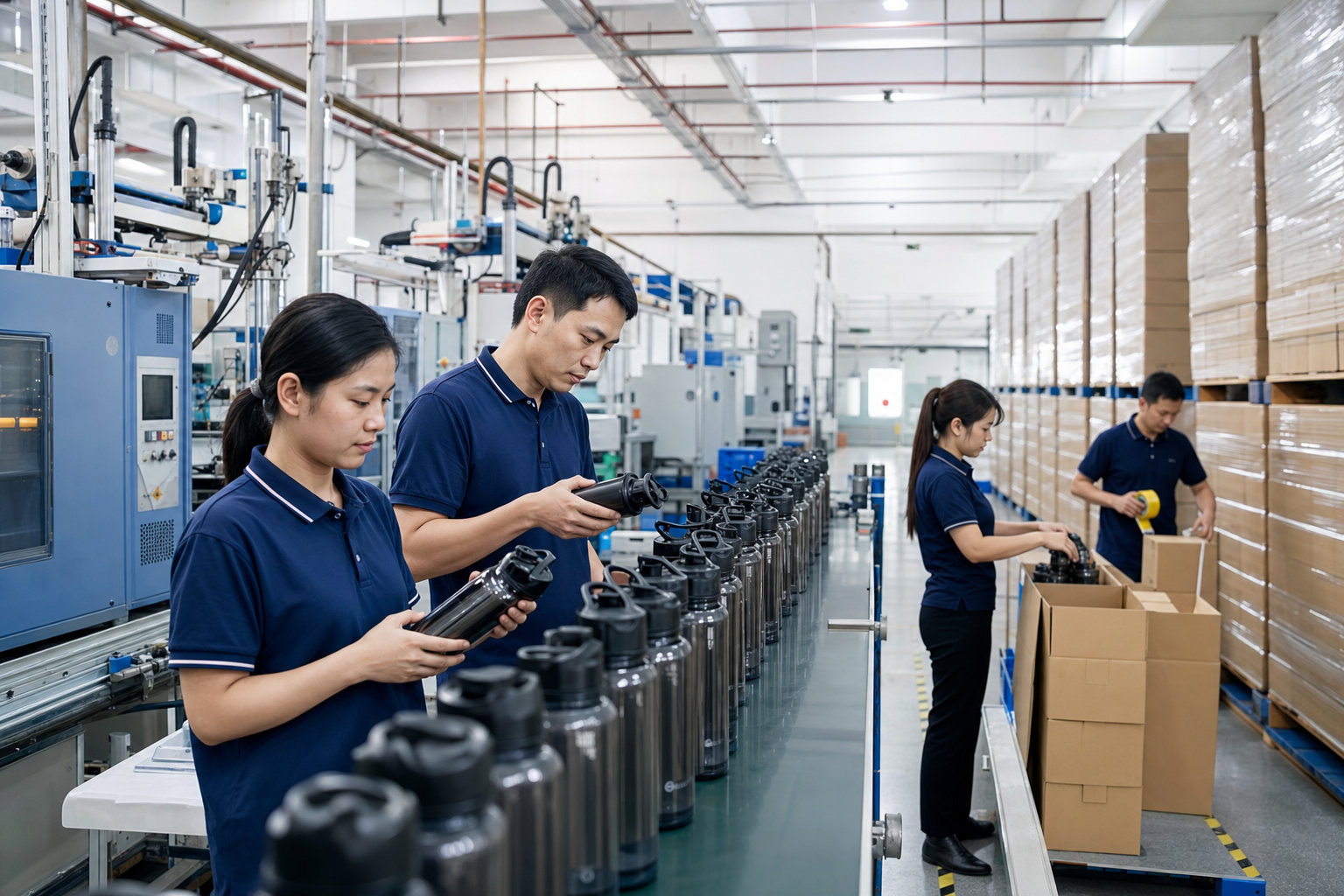
At our Zhejiang factory in China, we see this every week on the line. Buyers ask for a custom gym water bottle or custom shaker bottle, then the first sample comes back with the wrong lid thread or a logo that rubs off after 50 rub cycles. Material choice, lid structure, and decoration method can move the unit price by 8% to 30%. A buyer once pushed back on a 24 oz spec and sent a PO with the capacity typed as 240 oz. The math does not work. For a clean bulk order, define capacity, material, closure, and testing before you talk color. If you skip that step, we ship into rework, claims, and slow replenishment.
What buyers should define first
Before you ask for quotes on a bulk fitness water bottle, pin down the brief. Answer six points: capacity, material, cap style, decoration, target price, and sales channel. A 750 ml custom sports water bottle for gym retail is a different job from a 500 ml custom logo shaker bottle for protein mix programs. Skip that step and the supplier will fill gaps on their own. That usually costs time and money.
For fitness brands and gym chains, we run 500 ml, 750 ml, and 1,000 ml shapes the most. A bulk gym water bottle for class studios needs one-hand drinking, a lockable lid, and a carry loop; the hinge pin on a bad flip top can fail after 3,000 opens. A bulk shaker bottle needs a blender ball or mixing grid, a wide mouth, and a cap that keeps sealing after repeated use. If you sell through distributors, shelf stack and carton count matter. If you sell direct, put grip feel and print area first. The buyer flagged it on our last 750 ml run: the artwork looked good, but the bottle sat crooked in the master carton.
Define these before RFQ:
- Capacity: 500 ml, 650 ml, 750 ml, or 1,000 ml
- Material: PP, Tritan, AS, stainless steel, or glass
- Closure: flip top, screw cap, straw lid, shaker cap
- Decoration: silk screen, UV print, laser, heat transfer
- Target FOB: for example USD 1.50 to 2.80
- Channel: distributor fitness water bottle, gym giveaway, or retail
In China, the quote is only as good as the brief you send. We see this on the line all the time. A PO typo on one job changed 750 ml to 650 ml, and the sample room caught it only because QC pulled the sample against the carton spec. A buyer in Zhejiang knows the math. A new buyer learns it after the first round of rework.
Material choices that actually matter
Material drives performance and price. For a custom fitness water bottle, PP is the low-cost option and works for promo runs, usually around USD 0.85 to 1.60 FOB for basic shapes. We run it on the injection line all the time. It is light, recyclable in many markets, and fine for cold drinks. The trade-off is weaker clarity and a more budget look. If you want a cleaner retail shelf presence, Tritan is the safer pick. It looks clearer, takes abuse better, and fits a customizable gym water bottle sold through retail channels. Expect roughly USD 1.60 to 3.20 FOB, depending on mold complexity and lid design.
For a bulk sports water bottle used for protein mixing, PP still wins on cost, but Tritan gives better perceived value. The buyer flagged the “cheap feel” on a 1,000-piece sample, and he was not wrong. If the bottle needs hot-cold use, stainless steel makes sense, but then you are buying insulation, welding, and a different failure profile. Glass looks premium, yet breakage risk and freight cost go up fast. A 600 ml glass bottle can add 12% to 18% to carton weight versus a plastic version, and that hits landed cost hard.
What matters is wall thickness, clarity, odor control, and cap seal performance. Marketing words do not hold the bottle together. A 2.5 mm wall on a Tritan body usually feels more solid than 2.0 mm, but it also changes cycle time and cost. QC pulled the sample and checked the seal ring with a 0.02 mm gauge; that is the sort of detail that saves a claim later. If your distributor sports water bottle program needs a lower retail price, ask the factory to tune wall thickness instead of cutting quality. That is the right question, not “best price.”
Pricing, MOQ, and lead times
Real sourcing starts when you line up price, MOQ, and lead time in one sheet. A custom made shaker bottle can land at 5,000 units and look cheap, then jump hard at 1,000 because tooling, print setup, and carton allocation sit on the line as fixed cost. For standard shapes, we run MOQ 1,000 to 3,000 units per color. For a fully customized mold, MOQ usually moves to 5,000 units or more. If someone offers 300 units with deep customization, the buyer flagged it for a reason: they are probably reselling stock with a logo.
Typical FOB China pricing for a bulk shaker bottle is easy to map. Basic PP shaker: USD 1.10 to 1.80. Tritan custom shaker bottle: USD 1.70 to 3.40. Double-wall stainless shaker: USD 4.50 to 8.50. Decoration changes the math too. One-color silk screen can add USD 0.06 to 0.18 per print position, and laser engraving often adds USD 0.12 to 0.40 depending on area and setup. Packaging has its own bill: a color box can add USD 0.18 to 0.45. We had a buyer push back on a USD 0.22 box upgrade once; QC pulled the sample, and the plain mailer failed the drop test, so the extra cost was not the wrong place to spend.
Lead time is usually 20 to 35 days after sample approval for stocked components, and 35 to 50 days if you need a new lid or color matched resin. In our Hangzhou operation in Zhejiang, standard monthly output reaches 300,000 units across sports and travel drinkware, so once specs are frozen we can keep a distributor shaker bottle replenishment schedule steady. A PO typo can still slow things down; one buyer sent "Pantone 18-4005" on the first draft and corrected it to 18-4006 before the line cut steel, which saved us a week. That is the number you want before a seasonal launch. The math does not work if you wait until the campaign is already live.
Compliance and test standards
If you ship into Europe or North America, compliance is part of the deal. Ask for food-contact declarations, REACH files for the EU, and FDA food-grade statements for the US. For stainless steel runs, we also get asked for LFGB and ASTM-related reports, depending on the buyer and the retail channel. “Food safe” on a flyer means nothing. We want the report number, the lab name, and the test date.
For a bulk gym water bottle, the shop-floor checks are plain: seal test, drop test, dishwasher cycle check if the claim is on the artwork, and odor transfer test. We run inverted storage checks at 24 hours and cap torque cycles on the bench. On shaker bottles, the lid and gasket do the damage, not the body. A 1.2 mm gasket that is too soft turns into a leak; if it is too hard, the bottle starts weeping under shake pressure. QC pulled the sample, and that was the fault line.
Use AQL inspection before shipment. For appearance and function, AQL 2.5 is common. For leakage, some buyers stick to AQL 0, and the math works out because one bad carton can poison a whole gym rollout. We saw a PO with “gym botlle” typed on it, and the buyer flagged it before production started. A factory that really ships export orders will put the test method in writing, not hide behind a sales promise. Ask for it on day one.
Practical rule: if the supplier cannot explain cap torque, gasket compression, and carton drop strength, they are not ready for your retail program.
Decoration that holds up in real use
Decoration is where a lot of custom gym water bottle programs go sideways. We’ve seen a crisp logo pass sample approval, then scratch off after two dishwasher cycles or a week bouncing around in a gym bag. The choice comes down to artwork, target price, and the bottle surface. For flat bodies or low-curvature shapes, silk screen is still the cheapest and most stable. If the buyer wants a clean premium look, laser engraving works on stainless steel and some coated finishes. UV print fits full-color branding on larger print areas, but the line needs tighter process control.
For a custom logo shaker bottle, ask how the factory treats the surface before printing. Flame treatment, corona treatment, or even proper degreasing can move adhesion by a measurable margin; on one PP run, QC pulled the sample at 48 hours and found the difference straight away. On PP and Tritan, failures often show up after transit, not during first inspection. So the print looks fine in China, then flakes in a warehouse in Europe or North America. The buyer flagged it, and we had to rework the lot.
If you are building a customizable fitness water bottle program, keep decoration simple. One or two colors, one-side print, and one SKU per color keeps inventory sane for distributors. A distributor gym water bottle order with three print colors and two lid colors sounds flexible, but that turns into 6 stock-keeping combinations fast. That math does not work. Simplicity beats variety when cartons are crossing borders and the PO already has a typo on the lid code.
- Silk screen: best for 1-2 color logos
- UV print: good for gradient or detailed branding
- Laser engraving: durable, clean, premium on metal
- Heat transfer: better for wrap graphics, higher cost
How to audit a China supplier
You do not need a perfect factory. You need a factory that tells the truth. When you audit a supplier in Zhejiang or anywhere else in China, ask for production photos, in-line QC records, and a current capacity statement. We run 18 injection machines in one plant, and the math should be clear: if they claim 2 million bottles a month, ask for the shift plan, not a sales pitch. If they cannot answer basic capacity questions, do not send them your launch schedule.
Ask for a sample workflow: quotation, digital proof, pre-production sample, approval, mass production, then final inspection. A professional supplier should state exactly what triggers a new sample. A lid color change may pass with a photo check, but a gasket material change or bottle wall change should restart validation. We had a buyer flag a PO typo on the cap size once, and that 1 mm difference forced a new seal test. For a distributor fitness water bottle program, that matters because the same SKU may be reordered for 12 months.
Documents worth requesting:
- BSCI or comparable social compliance audit
- REACH or FDA food-contact support documents
- Carton drop test and sealing test records
- Photos of final packing, inner cartons, and master cartons
- Loading plan with carton count and gross weight
A good exporter in Zhejiang will also tell you what not to do. Do not pair a low-cost PP body with a tight, complex cap unless you want to pay for tooling refinement. We saw this go sideways on a 24-cavity mold: QC pulled the sample, the thread shaved, and the cap torque failed at 1.8 N·m. That is the wrong question to ask if you are trying to save 0.03 USD a set.
What a clean order process looks like
A clean bulk fitness water bottle order runs in six steps. First, you send a brief with material, capacity, lid style, and target price. Second, we quote by body material, decoration method, and packaging. Third, you sign off the sample and carton spec. Fourth, we lock the PO and deposit. Fifth, the line runs production with checks at the body, lid, and packing stations. Sixth, pre-shipment inspection checks quantity, appearance, and function before balance payment and shipment. We ship this way all the time.
For a custom sports bottle program, the paperwork has to stay tight. Put the approved sample code, print artwork version, color reference, and carton mark in the PO. QC pulled the sample once and the buyer flagged a 1 mm logo shift, because the PO had version A while the artwork file was version B. That is not a factory issue. It is a documentation issue. Get the revision right, or the line will follow the wrong sheet.
If you are a brand owner or distributor, ask for spare parts and overage planning from day one. A 2% to 3% overrun on caps or O-rings covers breakage during packing and transit, and on a 10,000-piece order that is the difference between 200 spares and a last-minute headache. We have seen this go sideways on a custom shaker bottle order when the buyer tried to save 80 USD on extras and then needed a second carton of lids by air. Keep the order system simple, repeatable, and measurable. That is how you get a supplier who stays with you.
Request your bulk fitness bottle quote now
Send your capacity, material, and logo file. We will quote FOB China pricing, MOQ, and lead time for your next gym program.
Frequently asked questions
What MOQ should I expect for a bulk fitness water bottle order?
For standard molds, most Chinese factories will ask for 1,000 to 3,000 units per color. If you need a new mold or a custom lid, MOQ often moves to 5,000 units or more. For a bulk shaker bottle with simple one-color print, 1,000 units is realistic. For a fully customized shaker bottle with special tooling, expect higher minimums and a longer approval cycle. In Zhejiang, a serious exporter should explain whether MOQ is driven by mold cost, print setup, or carton allocation. Always ask for MOQ by SKU, not just by total order value.
How much does a custom gym water bottle cost FOB China?
A basic PP custom gym water bottle often lands at USD 0.85 to 1.60 FOB China. Tritan versions usually sit around USD 1.60 to 3.20, depending on lid design and print method. If you add a premium flip cap, carry loop, or full-color UV print, the price rises quickly. A custom logo shaker bottle with a mixing ball usually costs more because the lid system has more parts. Your best price will depend on order size, packaging, and whether the supplier is using stock components or a new mold.
What tests should I require for a custom sports water bottle?
At minimum, require leak testing, drop testing from 1.2 m, odor testing, and food-contact compliance documents. For Europe, ask for REACH support; for the US, ask for FDA food-grade documentation. If the bottle is stainless steel, some buyers also request LFGB. For a custom sports water bottle used in gyms, the cap and gasket should be tested for torque and repeated opening. If you are sourcing a custom shaker bottle, pressure from shaking makes lid failure more likely, so the seal needs extra attention. Ask the factory to show test reports, not just verbal claims.
How long does production take in China or Zhejiang?
For stocked components and approved artwork, lead time is usually 20 to 35 days after sample approval. If you need new colors, a special cap, or a fully custom shape, plan on 35 to 50 days. During peak season, add a buffer of 7 to 10 days. A Zhejiang supplier with stable monthly output should be able to keep reorder timing consistent once your specifications are frozen. For a distributor sports water bottle program, consistency matters more than a one-time fast quote. Late replenishment costs more than a slightly higher FOB price.
Can I get a custom shaker bottle with my logo and color matched lid?
Yes, and that is a common request for fitness brands. A custom shaker bottle can be decorated with silk screen, UV print, or laser depending on body material. Color matching for the lid is possible, but it may increase MOQ and extend lead time by 7 to 15 days because the factory may need a dedicated resin batch. If you want a customized shaker bottle for a chain gym or distributor program, keep the first run simple: one body color, one lid color, one logo placement. That reduces risk and makes replenishment easier.