Key Takeaways
- A standard bulk glass bottle program usually starts at 3,000-5,000 pcs MOQ, with lead time around 25-35 days after sample approval.
- For export, ask for AQL 2.5/4.0 inspection, REACH or LFGB documentation when needed, and carton drop-test results.
- Pricing for plain glass bottles often lands around USD 0.35-1.20/pc EXW depending on capacity, wall thickness, and closure type.
- If you need wholesale drinkware in Europe or North America, carton strength, pallet pattern, and cap torque matter as much as decoration.
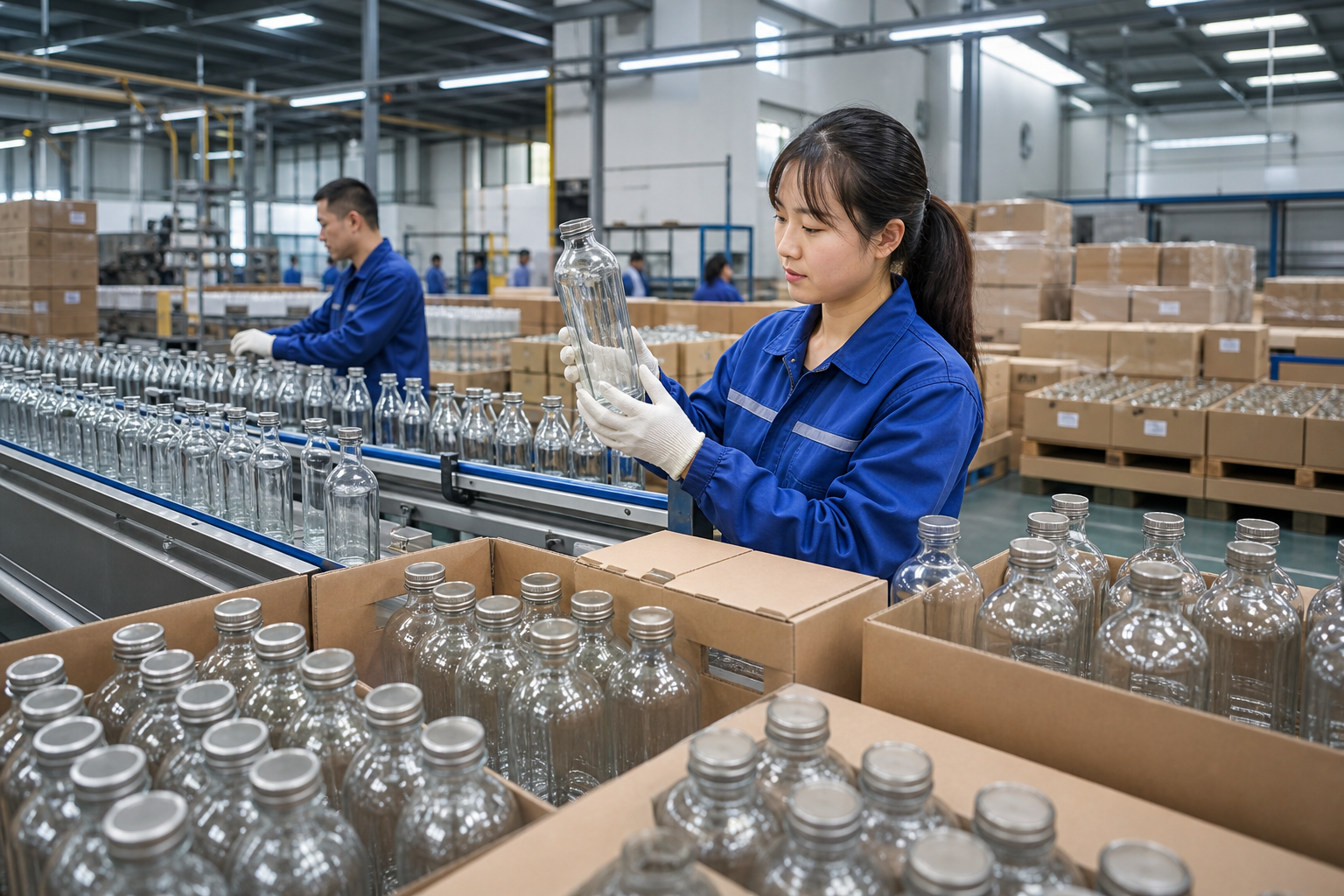
If you are buying a bulk glass bottle program for retail, hospitality, or promotion, do not treat glass like plastic with a label on it. Glass breaks on impact, packs with less forgiveness, and fails in transit for different reasons. A good buyer checks wall thickness, annealing, cap fit, drop performance, and carton design before talking color or print. That is the difference between a clean rollout and a stack of claims.
At BottleForge in Hangzhou, Zhejiang, we see this every week from procurement teams in Europe and North America. One buyer flagged a 2 mm wall spec as “too heavy” on the PO, then came back after QC pulled the sample and the bottle toppled in a 1.2 m drop test. Our line runs about 500,000 units per month across glass and stainless programs, with MOQ from 3,000 to 5,000 pieces depending on mold and decoration. The math does not work if the quote looks cheap but the carton fails or the REACH and food-contact paperwork slips. If you are sourcing wholesale drinkware from China, especially a bulk glass bottle or wholesale growler, you need a supplier who speaks in numbers, not slogans.
What buyers mean by bulk glass bottle
When a buyer says bulk glass bottle, we usually see three asks on the table: a standard reusable bottle for water or juice, a bulk growler for craft beer programs, or a printed promo bottle for retail and event runs. Same family, different spec. On our line, the first thing we check is bottle neck finish, wall thickness, and whether the closure actually seats on a 28 mm mouth or whatever the buyer called out.
For procurement, this is not a bottle-vs-canteen debate. The real question is whether one mold can cover bulk canteen, canteen wholesale, and drinkware wholesale without blowing up tooling cost or MOQ. If you need a best wholesale drink bottle for an outdoor brand, borosilicate makes sense because it handles thermal shock better. If you need shelf-ready retail glass, soda-lime with tight wall control is the cleaner math. We’ve seen buyers push for the cheaper glass, then QC pulled the sample after a hot-fill test cracked two out of ten.
In Zhejiang, and across China, a real factory does not price by vibes. We quote by capacity, mouth finish, decoration method, and carton pack-out. A 500 ml plain bottle with a metal cap is a different cost base from a 750 ml embossed wholesale growler with a swing-top closure. If you are comparing bulk drinkware or drinkware bulk offers, ask for technical drawings and the cap spec, not just photos. We had one PO last month with “750ml” typed as “750 ml” in the drawing and “705 ml” in the order note—the buyer flagged it before the line ran, which saved a remake.
Materials and thickness that affect price
Most buyers start with capacity and regret it later. The glass grade and wall thickness decide breakage rate, carton weight, and how the bottle looks on the shelf. Soda-lime glass is the standard line for wholesale drinkware, used for water bottles, milk bottles, and promo jars. Borosilicate runs 20% to 40% higher, but it takes hot-fill and dishwasher cycles better. We had one buyer flag a PO because they wrote “soda lime” with no spec; QC pulled the sample, and the difference showed up fast under the gauge.
Wall thickness is one of the few specs you can measure in 30 seconds and use in price talks. A 500 ml bottle at 2.0-2.5 mm works for light retail use. If the buyer wants a heavier hand feel, 3.0-4.0 mm adds weight and shelf presence, but freight jumps fast. For a beer growler bulk order, the body often needs more glass than a standard water bottle, especially on a 32 oz or 64 oz swing top. This is the wrong question to ask if someone only says “make it stronger” without giving the target wall.
Practical price bands, EXW China:
- Plain 500 ml soda-lime bottle: USD 0.35-0.60/pc at 5,000 pcs
- Printed or frosted bottle: USD 0.55-0.95/pc
- Heavy growler with closure: USD 0.90-1.80/pc
- Borosilicate bottle with custom lid: USD 1.20-2.50/pc
If a quote lands far below these ranges, check three things: whether the closure is included, whether the glass is first-grade, and whether the carton passed export drop test. We’ve seen this go sideways on a 12,000 pcs order where the buyer saved USD 0.08 and paid for 2.3% breakage. A cheap bottle that arrives cracked is not cheap.
MOQ, lead time, and sample control
MOQ is where a lot of programs stall. A custom mold for a bulk glass bottle or wholesale canteen usually starts at 3,000 to 10,000 pcs per SKU, depending on the shape and whether we already have the mold on the shelf. For a stock shape, some Zhejiang factories will go lower, but the unit price goes up and the decoration choices get tighter. If you want alcohol flask bulk or alcohol flask wholesale with a custom logo, the quote will carry setup charges for screen print or engraving. Last month, a buyer pushed for 1,200 pcs; the math did not work.
Lead time is where new buyers lose weeks. A normal plan is 7-10 days for sample confirmation, 15-20 days for mold adjustment and pre-production, and 25-35 days for mass production after deposit, if the order is clean. Add 7-10 days when the job needs a new cap, silicone sleeve, or special decoration. On the line, one missing Pantone code can stop the job cold. Send vector files, Pantone references, carton marks, and label dimensions at the start. We ship faster when the artwork is tidy.
We run three sample stages: plain sample, decorated sample, and packed sample. That third one is the real check. QC pulled the sample last week and checked carton fit, divider strength, and whether your beer tumbler bulk or beer tumbler wholesale order will hold up in a rough freight lane. One bad pallet can wipe out the margin on a good order. The buyer flagged a 2 mm gap, and we fixed it before mass production.
Testing and compliance for export
For Europe and North America, compliance starts at the drawing table. We run food-contact projects with REACH paperwork, LFGB where the buyer asks for it, and California Prop 65 awareness for the US channel. If you sell into hospitals or school canteens, ask for traceability down to raw material lot, furnace batch, and decoration ink batch. We’ve had a buyer flag a missing ink lot on a 20,000-piece order, and the shipment sat until we matched it.
QC needs visual inspection, dimensional checks, closure fit, and leak testing on the line. For a bottle sold as wholesale drinkware, we usually set AQL 2.5 for major defects and 4.0 for minor defects. That means you define the defect list in black and white: crack, chip, bubble cluster, print shift, cap failure. No loose language. A caliper reading off by 1.2 mm can turn into a dispute later, so write the limit into the PO.
Drop testing is not optional for export cartons. A carton that survives a 60 cm corner drop can still blow open on a pallet edge if the divider is weak. If your program is for drinkware wholesale in retail chains, ask the factory to show the inner-pack layout, carton compression data, and pallet stacking plan. We ship a lot from Zhejiang, and we’ve seen a 5-ply box look fine until QC pulled the sample after 12 drops and found a crushed shoulder. The math does not work if the pack is built on hope.
One rule we keep using: if the bottle looks premium but the carton is thin, the freight claim will find you.
Closures, decoration, and pack-out
A glass bottle is only half the product. The closure decides whether the customer gets leaks, odor, or a premium feel. For a bulk canteen or canteen bulk program, we run stainless caps, bamboo caps, PP lids, and swing tops. On a bulk growler job, the swing-top hinge and the silicone gasket matter more than the bottle wall. QC pulled a sample at 2.1 mm neck finish, and a weak seal on a growler wholesale order turns into returns fast. The math does not work.
Decoration changes the unit cost. Silk screen printing is cheaper than laser engraving on big runs, while laser gives a cleaner finish on clear glass. Frosting, color spray, decal work, and UV print all add cost and scrap risk. We have seen a buyer flag a PO because the logo line was 1.5 mm off-center. For bulk drinkware going into retail, keep the art simple: two colors, one logo position, done. The same rule holds for alcohol flask in bulk programs, where the mark has to stay readable after handling and carton rub.
Pack-out gets ignored, then freight damage shows up at destination. We often see the bottle approved while the insert, carton grade, and pallet pattern are left blank. A 24-pack with molded pulp dividers can cost a little more than a plain tray, but we have tracked breakage dropping from 8% to 3% on export lanes. For beer growler wholesale bulk and retail export orders, that is the right spend. One PO typo on the pack count can throw the whole line off, so we check every carton code before we ship.
Negotiating price without buying trouble
The cleanest way to negotiate a bulk glass bottle order is to split the quote into glass unit price, closure price, decoration price, inner pack, outer carton, and freight terms. If you ask for one landed number, you lose the comparison. A Zhejiang supplier can look dearer on unit price and still land cheaper if the carton is stronger and the breakage rate stays under 1.5% on the line.
Ask for two or three options. Say 500 ml plain bottle at 5,000 pcs, the same bottle with one-color screen print, and the same bottle with frosted finish plus custom cap. Then you see where the cost sits. If a factory only pushes one version, the math does not work. QC pulled the sample, and the buyer flagged the cap OD at 28 mm against the PO, so that kind of detail saves time.
For alcohol flask wholesale bulk, beer growler in bulk, or beer tumbler wholesale bulk sourcing, the cheapest supplier often trims wall thickness or cap quality, then hides the gap in freight. Ask for carton weight, gross weight per case, and pallet count per 20GP or 40HQ. We run that check on every export job. A typo like 12.5 kg written as 15.2 kg on the packing list has burned more than one buyer, so this is the wrong question to ask if you only chase the lowest unit price.
When a custom project makes sense
Not every buyer needs a custom mold. If you are launching fast, a stock shape is the smarter move. If your brand needs a signature silhouette, an embossed logo, or a mouth finish no off-the-shelf bottle can give you, then custom tooling can pay back in 1 to 2 seasons. Volume decides it. A custom wholesale growler or wholesale canteen only makes sense when you can repeat the order, not when you are testing one carton and hoping.
We usually quote custom mold cost at USD 800-3,000, depending on cavity count and neck detail, with sample turnaround at 15-25 days. On the line, we check the shoulder angle with a gauge and the base wall with a caliper before we say yes. A buyer once sent a PO with the mouth finish typoed as 28 mm instead of 38 mm. The math did not work, and we stopped it before tool steel was cut. A serious factory in Hangzhou or Zhejiang should tell you early whether the shape can be molded, whether it stacks in a 1.2 m carton, and where the draft angle will bite.
For buyers building a broad catalog of wholesale drinkware, a mixed program usually works better: one stock bottle for volume, one premium bottle for margin, one seasonal limited edition. That keeps cash free and avoids dead molds sitting in the warehouse. We ship this way all the time. For a first run, keep it plain, prove sell-through on the first 5,000 pieces, then add the custom line if the buyer keeps reordering.
Get a factory quote with real specs
Send your capacity, artwork, closure, and target MOQ. We will quote your bulk glass bottle program with clear unit pricing, pack data, and lead time.
Frequently asked questions
What is the usual MOQ for a bulk glass bottle order?
For most export projects, MOQ is 3,000-5,000 pcs per SKU if you use an existing mold. A fully custom bottle can move to 8,000-10,000 pcs, especially if you want a new closure or special decoration. In Zhejiang, many factories can support mixed styles, but each color, size, or cap variant usually counts as a separate SKU. If you need a small test order, ask for stock shapes first; custom tooling is not the place to start with 500 pcs.
How much does a wholesale growler cost from China?
A basic 32 oz or 64 oz wholesale growler in soda-lime glass may cost USD 0.90-1.80/pc EXW at 5,000 pcs, depending on wall thickness, closure type, and decoration. If you add a premium swing-top, frosting, or embossing, the price rises quickly. For beer growler wholesale bulk programs, packaging matters too; a stronger carton can add 5% to 12% to unit cost but reduce breakage enough to protect margin.
Which compliance documents should I request?
For Europe, ask for REACH-related material declarations and, when relevant, LFGB-aligned food-contact support. For North America, request food-contact declarations, production traceability, and any Prop 65-related awareness if your channel requires it. You should also ask for an inspection report with AQL levels, usually 2.5 for major defects and 4.0 for minor defects. If the bottle is for food or beverage use, get batch-level traceability on glass and decoration ink.
What is a realistic lead time for drinkware wholesale production?
If the mold already exists and artwork is ready, 25-35 days after deposit is realistic for mass production. Add 7-10 days for samples and 7-10 days if you need mold adjustment or a new closure. For a custom alcohol flask wholesale bulk or beer tumbler wholesale bulk program, total timing can reach 45-60 days if you include tooling and approval cycles. Chinese factories in Zhejiang can move quickly, but only when your files and specs are complete.
How do I reduce breakage in shipping?
Use a carton tested for export, not just a nice-looking box. Ask for internal dividers, corner protection, and a pallet plan. A 60 cm drop test is a minimum starting point, but you should also check compression strength if the cartons will be stacked. In many bulk drinkware shipments, moving from loose packing to molded pulp dividers can cut transit damage by 30% to 50%. That is often worth more than saving USD 0.03 on the bottle itself.