Key Takeaways
- Most bulk glass water bottle programs start at 3,000 pcs MOQ and 25-35 days lead time after sample approval.
- Borosilicate glass is the safer choice for hot-fill or thermal shock, typically 1.8-2.2 mm wall thickness for retail bottles.
- For export, ask for REACH, LFGB, and an AQL 2.5/4.0 inspection plan before you place the PO.
- A well-managed China supplier should quote FOB, carton specs, and closure torque data, not just bottle price.
If you are sourcing a bulk glass water bottle for a wellness brand or a sustainable retail line, the first mistake is treating glass like a commodity. It is not. A clean program usually comes down to three things: glass grade, closure fit, and carton packing. We’ve seen a 0.8 mm wall spec pass samples and fail once the line started shipping 18,000 units a month. The buyer flagged it after the first pallet showed chips at the bottle neck, and the math stopped working fast.
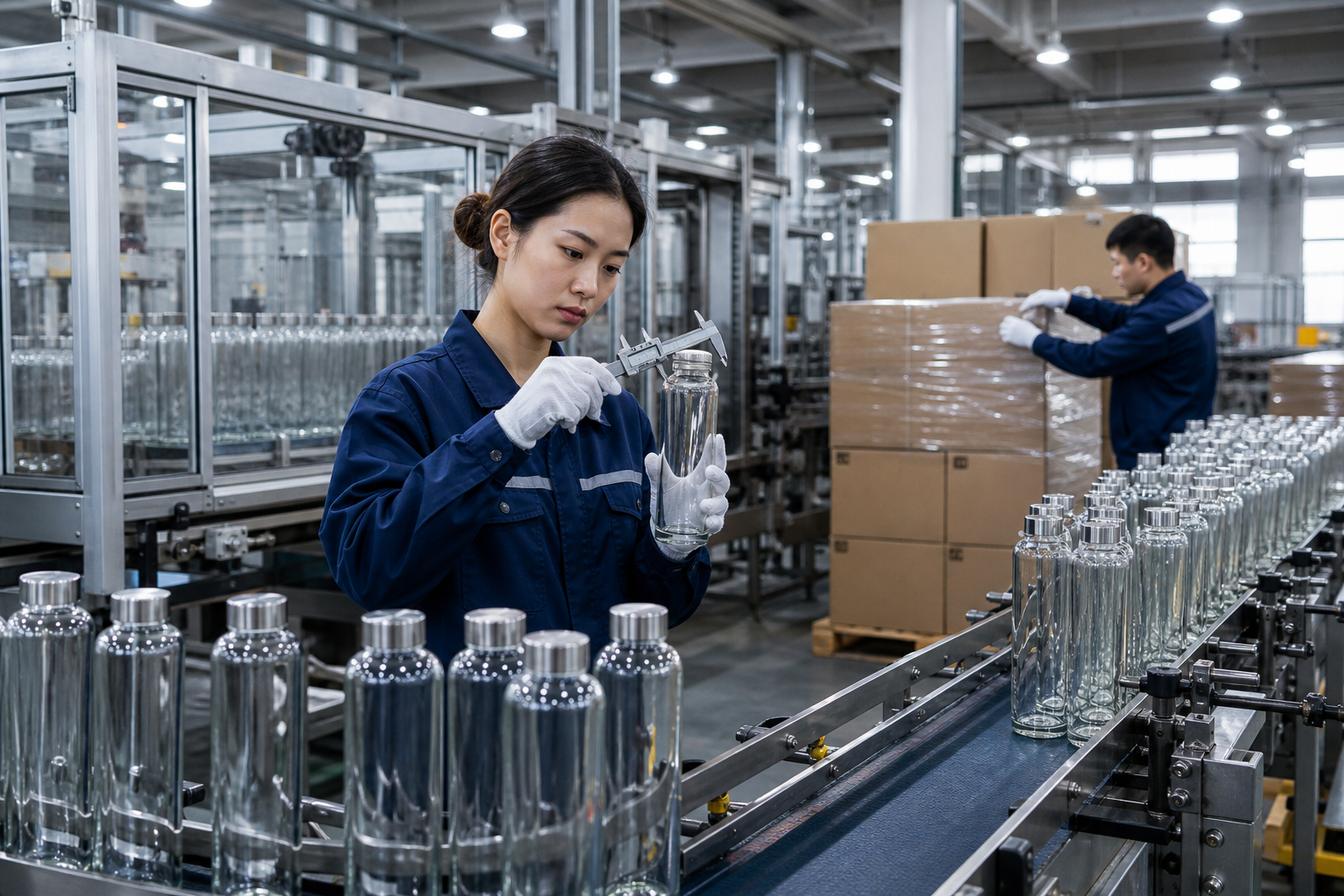
You need to think like a buyer and a shipping engineer at the same time. A real borosilicate glass bottle factory will ask about wall thickness, thermal shock, decoration method, and drop-test requirements before quoting. Good sign. BottleForge runs glass and accessory programs at 300,000 units per month, with a typical MOQ of 3,000 pieces per SKU, and custom lead time is usually 25 to 35 days after sample approval. QC pulled the sample on a caliper at 2.2 mm, not 2.0 mm, and that kind of detail beats sales talk every time.
What makes a good bulk bottle
A good bulk glass water bottle program starts with the glass, not the label art. For wellness brands, we usually ship 350 ml to 750 ml straight-wall or lightly tapered bottles, and borosilicate makes sense if the bottle will see hot tea, citrus infusions, or sharp temperature swings. Soda-lime costs less, but it gives you less room for error. On one line last month, QC pulled a sample that cracked after a hot-fill test, and the buyer flagged it before we packed the carton. If you want a premium line, the extra USD 0.12 to 0.35 per unit for borosilicate is usually the right call.
Check the geometry. A 1.8 mm wall works for lighter retail packs, while 2.0 mm to 2.2 mm gives a heavier hand feel and better break resistance. Neck finish matters too: 28 mm and 38 mm are the common sizes, depending on lid style. If this is for a distributor borosilicate glass bottle program or a distributor glass water bottle assortment, do not chase a fancy custom neck unless the volume is there. We ran a 6-cavity mold change on a small PO once, and the first run picked up extra defects at the shoulder; the math did not work. Special tooling can add 7 to 15 days and raise the scrap rate on run one.
What to specify up front:
- Capacity in ml and usable fill volume
- Glass type: soda-lime or borosilicate
- Wall thickness target: 1.8 mm, 2.0 mm, or 2.2 mm
- Neck finish and closure type
- Packaging: single box, inner divider, master carton
Buyers often spend too much time on the bottle photo and not enough on tolerances. A 1.5 mm height variance sounds small, but on a pallet of 2,400 units, it can throw off carton fit and slow the line. We had a PO typo once where the buyer wrote 375 ml on the spec sheet and 350 ml on the carton art, and the whole batch stalled in QC until it was corrected. A serious borosilicate glass bottle manufacturer will give you a dimensional tolerance sheet, not just a sample picture.
Choosing borosilicate over soda-lime
For a borosilicate glass bottle bulk order, the main reason to pick borosilicate is thermal shock resistance. It takes hot-to-cold swings far better than soda-lime. If the bottle will hold infused water, tea, or go from filling line to chilled shelf, borosilicate is the safer commercial call. That is why a lot of retailers ask for a custom borosilicate glass bottle instead of a standard soda-lime piece.
There is a branding side too. Borosilicate reads cleaner when the wall is clear and the finish is tight. A 2.0 mm wall on a 500 ml bottle usually gives a solid hand-feel without making it a brick. We normally see unit weights around 230 g to 320 g, depending on capacity and shape. Heavier is not the win some buyers think it is; freight jumps fast. On a 40HQ, adding 40 g per bottle can move landed cost more than a small decoration upgrade. We had one buyer push back on that math, then QC pulled the sample and the 280 g version still passed the hand-feel test.
Where buyers get it wrong
Some buyers ask for a customizable borosilicate glass bottle and then stack on too many parts: bamboo lid, silicone sleeve, infuser, printed logo, gift box, unique neck. Each one is workable. All at once, they slow the line and usually add 10 to 18 days to lead time. If the first run is for retail shelf stock, keep it simple and stable. You can roll out a customized borosilicate glass bottle in round two after sell-through data comes back. We saw one PO with a neck spec typed as 28 mm instead of 28.5 mm; that small typo turned into a week of sample rework. This is the wrong question to ask if you start with 6 add-ons before the pilot run clears.
Practical rule: if the bottle will be used daily, borosilicate is worth the extra cents. If it is only for cold water and looks, soda-lime may be enough.
In Zhejiang, plenty of factories can make both types, but not every plant is disciplined on annealing and wall consistency. Ask for thermal shock test data, usually 120°C differential for higher-spec borosilicate lines, plus a breakage report from pilot production. We run this kind of check with a gauge and a caliper on the line, because the brochure never shows you a weak shoulder or a bad anneal. That tells you more than a polished brochure.
How customization affects cost
A custom glass water bottle is priced by more than glass volume. We run the numbers by decoration, lid material, gasket type, pack-out, and freight. A plain clear 500 ml bottle with one-color silk screen and a standard PP lid usually lands around USD 0.85 to 1.45 FOB China at moderate volume. Switch to a stainless steel lid, laser logo, or silicone sleeve, and the same item jumps to USD 1.60 to 2.80 fast. The buyer flagged a PO typo on “5000 pcs” versus “500 pcs” once, and the cost gap was no joke.
If you are comparing a borosilicate glass bottle customizable program against a stock bottle, ask for a line-by-line quote: glass body, closure, decoration, and packaging. This is the right way to see where the money goes. A good borosilicate glass bottle supplier or borosilicate glass bottle vendors will price spare lids and gaskets too, since those are the parts that come back first when a carton gets opened in a warehouse. QC pulled the sample, checked the gasket groove, and found a 0.3 mm mismatch that would have turned into complaints later.
- Silk screen: economical for 1-2 colors, good on straight walls
- Laser engraving: clean on metal lids, slower on curved caps
- Frosted finish: premium look, but spray thickness must stay even
- UV print: strong branding, confirm abrasion resistance with a rub test
For a customized glass water bottle sold through e-commerce, packaging drives the cost as much as the bottle itself. A retail-ready box with divider can add USD 0.12 to 0.40, but it often cuts breakage and return claims. We ship a lot of these, and a 1 m drop test at the outer carton level is the number that matters, not a nice photo on the sample table. For wholesale stores, a simple display tray often beats a full-color retail box. The math doesn't work any other way.
What a factory should show you
Talk to a borosilicate glass bottle factory in China, and start with capability, not color or logo. Can they hold annealing at the right curve, keep print registration within 1.0 mm, match the lid thread, and load cartons without crush marks? That is the real test. A solid borosilicate glass bottle manufacturer should show photos from the forming line, the sample lab, and the packing area, plus BSCI, ISO 9001, REACH, and LFGB where applicable. We had one buyer flag a PO typo on the cap size, 38 mm vs 39 mm, and the line had to stop for half a day.
Ask for the production sequence and the inspection plan. On a normal export order, the plant should run incoming glass checks, inline dimensional checks, random leak testing if closures are involved, and final AQL inspection. AQL 2.5 for critical defects and 4.0 for major defects is common, though some brand owners push tighter limits. If the supplier cannot tell you what counts as critical, major, and minor, the math does not work. QC pulled the sample on one run and found a 1.6 mm neck drift; that kind of miss turns into trouble at packing.
In Zhejiang, factories are usually more export-focused and more direct about paperwork. A clean sample room is not enough. Ask for:
- Capacity per day and monthly output
- Typical MOQ per SKU
- Lead time for samples and bulk production
- Defect rate from the last run
- Carton drop-test or transport-test results
We also check whether the factory uses molded or hand-finished processes for special shapes. Some borosilicate glass bottle manufacturers can run custom profiles, but not every line stays stable on tight curves or long shoulders. A straight shape usually gives better consistency and lower breakage in transit. We’ve seen this go sideways on a 250 ml bottle with a 28 mm neck finish; the buyer wanted a fancy contour, then the line started rejecting 7 out of 100 pieces.
Packing and shipping realities
Glass does not forgive weak packaging. A bulk borosilicate glass bottle order can look cheap at the factory gate and still turn expensive on the water if the carton spec is soft. We see this on the line all the time. Build the carton structure, divider material, and pallet pattern for transit first, shelf appeal second. For export from China, double-wall master cartons with molded pulp or cardboard dividers are the safer call. If the bottle is premium and brittle, inner boxes earn their keep.
For sea freight, we need the carton count per pallet, stack height, and gross weight. A 500 ml glass bottle packed with a lid weighs 350 g to 450 g in retail-ready packaging. That changes the 40HQ loading plan and the stacking limit. If you are a borosilicate glass bottle distributor or borosilicate glass bottle wholesale buyer, the math gets ugly fast when packing adds 8% to 12% more cubic meters. We had one buyer flag a PO typo on carton count, and the shipment had to be reworked before sailing.
Ask the supplier to run a transport test. A proper set should include:
- 1 m drop test for retail cartons
- Compression test for stacked cartons
- Vibration test for long-haul sea freight
- Leak test on closure assemblies
If you sell into retail chains or through distributors, get pallet labels, carton marks, and barcode placement locked before mass production starts. Rework at destination costs more than clean setup in China. QC pulled the sample once and found the barcode 3 mm off spec; the buyer rejected the pallet map on the spot. We ship from Zhejiang every week, and this is the wrong question to ask after production starts.
Buyer questions that change the quote
The fastest way to get a usable quote from a borosilicate glass bottle supplier is to answer the questions that drive cost. A borosilicate glass bottle distributor usually wants fast replenishment and fewer stockouts; a brand owner cares about logo placement and color match; a distributor borosilicate glass bottle buyer often asks for mixed SKUs and tighter carton counts. Different job, different quote.
Before you ask for a sample, send a spec sheet with capacity, target weight, logo method, lid finish, box type, annual forecast, and destination port. We run this every week, and the PO typo that causes trouble is usually small: “5000” becomes “500.” If MOQ is unclear, ask for stock and custom pricing in one email. A plain bottle can start at 2,000 pcs, while a custom mold or custom lid usually starts at 3,000 to 5,000 pcs. The math is not about order size alone; tooling risk and line time change the number.
Useful questions to ask any borosilicate glass bottle vendors or borosilicate glass bottle suppliers:
- What is the sample lead time in days?
- What is the breakage rate in final packing?
- Can you provide REACH and LFGB test reports?
- Do you support FOB, CIF, or DDP?
- What spare parts can you supply for 6 months?
If you want a promotional SKU, keep the price and decoration simple. A borosilicate glass bottle promotional item should sell through, not turn into a custom-engineering job. QC pulled the sample with a 0.6 mm lid gap last month, and the buyer flagged it before shipment. Standard bottle, stable lid, clear carton spec, repeatable run from China—that is the setup that ships clean.
Request a factory quote with your exact specs
Send capacity, target wall thickness, lid style, and destination port. We will quote FOB China with MOQ, lead time, and packing details.
Frequently asked questions
What MOQ should I expect for bulk glass water bottle orders?
For a standard bulk glass water bottle, many China factories quote 2,000 to 3,000 pcs per SKU. If you need custom shape, custom lid, or special printing, 3,000 to 5,000 pcs is more realistic. For stocked borosilicate bodies with custom decoration, the MOQ can stay lower, but the lid and packaging still drive the minimum. If your forecast is below 1,000 pcs, expect a higher unit price, often 15% to 30% more, because setup costs do not disappear.
How much does a custom glass water bottle cost FOB China?
A basic custom glass water bottle in moderate volume often lands around USD 0.85 to 1.45 FOB China for a 500 ml clear bottle with simple branding. Add borosilicate glass, a premium lid, or retail box, and the range can move to USD 1.60 to 2.80. Complex decoration or accessory sets can push higher. Freight, duties, and inland trucking are separate. If a supplier gives you only one lump sum, ask for a split quote by body, lid, print, and carton.
Is borosilicate really better than regular glass for retail?
Yes, if your product will face temperature changes or daily use. Borosilicate glass handles thermal shock much better than soda-lime glass. For a premium retail bottle, 1.8 mm to 2.2 mm wall thickness is common, and 2.0 mm is a good middle ground. It costs more, usually by USD 0.12 to 0.35 per unit, but breakage risk is lower and the perceived quality is better. For cold-only bottles, soda-lime can still work if the price target is tight.
What export compliance should I ask for?
For Europe and North America, ask for REACH, LFGB where relevant, and a clear food-contact declaration. If the bottle has metal, silicone, or plastic parts, get test coverage for all contact materials, not just the glass. Ask the factory for ISO 9001 and BSCI if you need social compliance. For quality control, request an AQL plan, usually AQL 2.5 for critical defects and 4.0 for major defects. If you sell on Amazon, ask for carton marks and FNSKU placement guidance too.
How do I reduce breakage in shipping?
Start with the carton design. Use double-wall master cartons, dividers, and a pallet pattern that limits overhang. A 1 m drop test on the retail carton is a sensible baseline. Ask the supplier for a vibration or compression test if your route is long. Keep the bottle shape simple and avoid unnecessary height if the carton footprint is small. On a 40HQ, a 5% packaging improvement can save more money than a 3% unit price reduction because breakage and freight both drop.