Key Takeaways
- A bulk growler bottle usually starts at MOQ 500-1,000 units in China, with 30-45 days lead time after sample approval.
- 304 stainless steel at 0.5-0.6 mm wall thickness is the practical baseline for beer growler bulk orders.
- A real wholesale growler quote should include lid type, coating method, carton spec, and test standard such as REACH or LFGB.
- If you sell in the US or EU, ask for AQL 2.5/4.0 inspection, drop testing, and torque checks before shipment.
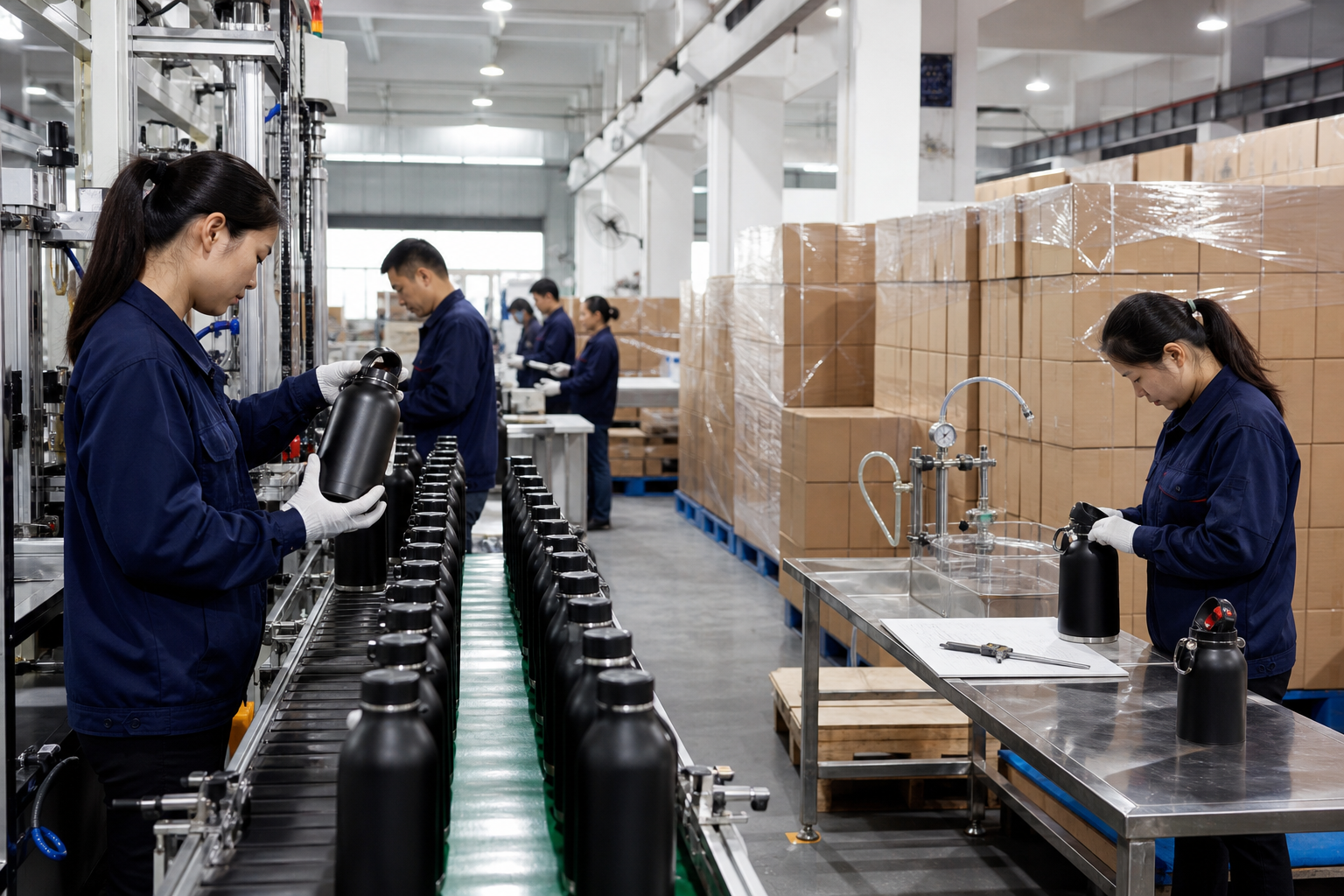
If you are sourcing a bulk growler bottle for retail, hospitality, or promo programs, style is not the first issue. The real test is simple: will it hold carbonation, survive 50 wash cycles, and still look clean after 500 units sit on a shelf? We run this every week in Zhejiang, and the gap between a signed sample and stable mass production is where most orders go sideways.
For procurement managers and brand owners, this is a technical buy, not a generic drinkware purchase. Wall thickness, stainless grade, lid sealing, coating adhesion, and carton strength matter more than a low unit price. We have seen buyers push for a cheaper quote, then flag a lid leak after QC pulled the sample at 2.5 bar. If you want wholesale growler or wholesale drinkware without later claims, ask for MOQ, lead time, testing standard, and tolerance in writing. The math does not work any other way.
What buyers mean by bulk growler bottle
When buyers search bulk growler bottle, they usually mean a reusable container for beer, cold brew, kombucha, or event drinks, not a single retail growler. We get this request every week. In B2B sourcing, it often sits next to bulk drinkware, drinkware wholesale, and sometimes bulk canteen programs when the mouth is wide and the bottle is meant for hospitality. Stainless steel leads the line because it takes repeated handling, truck loading, and return cycles better than glass.
Start with the use case. A 64 oz beer growler wholesale order for a taproom is a different job from a retail gift SKU, and the math does not work if you treat them the same. If the bottle will be sold online, you need tighter cosmetic control and packaging that survives courier drops. If it is going to a chain restaurant or brewery, leak resistance and label space matter more than a gift box. A good factory in Zhejiang will ask about fill temperature, carbonation level, and whether the cap needs a tamper ring. QC pulled the sample, checked the gasket, and those are the questions that tell you the line knows what it is doing.
Buyers often mix up these terms:
- bulk growler: the product itself, usually 32 oz to 64 oz
- growler wholesale: commercial purchase for resale or chain use
- beer growler in bulk: volume order for a project or launch
- canteen wholesale and wholesale canteen: often similar stainless bottle sourcing, but with different market positioning
Choose the right material and gauge
For a bulk growler bottle, the material decides the scrap rate. If you want a beer container for repeated use, 304 stainless steel is the standard starting point. We run 0.5 mm to 0.6 mm on the body for most export orders. 201 stainless can cut the unit price, but it is the wrong call for a brand program that ships into Germany, the US, or any market where rust complaints come back fast. We tell buyers the same thing on the line: if the budget is tight, reduce decoration first, not steel grade.
Wall thickness changes how the bottle survives packing. A body below 0.4 mm looks fine in a catalog photo, then QC pulled the sample and found a dent after one carton drop test from 80 cm. Use 0.5 mm to 0.6 mm for the shell, with a reinforced base if the bottle is tall or wide-mouth. If you are buying beer tumbler bulk or beer tumbler wholesale as a related range, keep the same steel grade and the same finish family; mixed finishes on one shelf look like a rushed PO, and we have seen that go sideways.
For liquid contact, ask for the papers that match your market. LFGB is often requested for Germany, while REACH is expected across the EU. In the US, buyers usually ask for food-contact declarations and migration test reports. A serious factory in China should hand over material certificates, coating data, and batch traceability without drama. If they miss that, the math does not work, no matter how low the quote looks.
Do not buy a growler on appearance alone. A shiny sample and a safe production spec are two different things.
Lid sealing and carbonation risk
The lid is where a lot of bulk growler orders go wrong. A beer growler is not a casual water bottle. It has to hold against leaks, pressure swing, and rough retail handling. If you plan to ship carbonated drinks or sell bottles that get refilled at breweries, ask for a tested sealing system from day one. The usual choices are stainless screw caps with silicone rings, swing-top closures, and double-seal lids with gasket compression. On one line last spring, QC pulled a sample that looked fine but failed at the cap edge after a 3-meter carton drop.
For most wholesale drinkware programs, a stainless screw cap with a food-grade silicone gasket is the safer call. We run that setup because it is easier to inspect, easier to replace, and easier to assemble at scale. Swing-top closures look premium, but they add parts and the hinge or wire tension can drift. The buyer flagged a PO once because the spec said 0.8-1.2 N·m, then the supplier shipped caps that sat at 0.6 N·m; the math does not work. If you are sourcing beer growler wholesale bulk or wholesale growler for retail, ask for a torque test and leak test on every production batch. A lid that passes one sample can still fail when 5,000 units go out in summer heat.
We recommend adding these checks to your PO:
- Leak test with inverted hold for 24 hours
- Torque range on screw caps, typically 0.8-1.2 N·m depending on design
- Drop test from 80-100 cm on carton-packed samples
- Seal material verification for silicone or TPE components
If the bottle is positioned as an alcohol flask bulk item or alcohol flask wholesale bulk for spirits promotions, the closure needs even tighter attention because smell transfer and vapor seepage turn into customer complaints fast. We have seen a 2 mm gasket mismatch create that problem in a 10,000-piece run, and it came back on the line before shipping.
MOQ, price bands, and lead time
Buyers usually ask for price first. That is the wrong question to ask. Start with what the quote actually covers. For a basic 18/8 stainless bulk growler bottle at 500-1,000 pcs, a Zhejiang factory will often land at USD 1.80-3.60 per unit, based on capacity, coating, lid type, and packing. Add silk screen, laser engraving, or a custom carton, and the number moves fast. For premium powder coating or two-color branding, we see USD 3.80-6.50 or more. QC pulled the sample, checked the lid gap at 0.8 mm, and the buyer still asked why the quote changed. The math works that way.
Our line in Zhejiang can run about 120,000-180,000 units per month across bottle lines, but that does not mean your order ships tomorrow. We still need queue time, tooling review, and sample sign-off. Typical MOQ is 500 pcs per color for stock tooling and 1,000-3,000 pcs for custom bodies or lids. Lead time is usually 30-45 days after sample approval, plus 20-35 days for ocean freight to North America or Europe depending on port and route. We had one PO with a typo on the lid spec, and that alone pushed the schedule by 4 days.
If you are comparing drinkware bulk and drinkware wholesale offers, check whether the quote includes:
- FOB Ningbo or FOB Shanghai terms
- One decoration method, such as silk screen or laser engraving
- Standard export cartons and inner boxes
- Replacement allowance for defect rate
Low pricing often hides weak packaging or a loose inspection plan. We have seen that go sideways. A carton drop test at 80 cm tells you more than a nice price sheet, and it saves nothing if the buyer flags damaged goods and asks for chargebacks later.
Branding that sells without causing defects
For a bulk growler bottle, branding has to help the bottle move on shelf, not slow the line. Silk screen printing, laser engraving, and one-color pad print are the safest options we run. Powder coating with a logo knock-out can work too, but the color match needs tighter control. We had a brewery buyer flag a red logo drifting by 1.5 mm on a 64 oz sample, and that small shift was enough to trigger a reprint. For taproom sales, laser engraving looks clean and wears well. For e-commerce, strong contrast prints usually photograph better and keep the SKU looking sharp in search results.
With beer growler wholesale or beer growler wholesale bulk orders, lock down the Pantone code, placement drawing, and color tolerance before mass production starts. Zhejiang factories can print cleanly, but only when the artwork is final and the pre-production sample is signed off. We run a 48-hour cure, then check adhesion with tape pull testing; that step catches weak ink before it turns into a claim. If you want a premium shelf look, specify gloss at 10-20 GU for matte finishes or higher for a brighter coat. The buyer asked for a “soft matte” once, then sent a glossy reference photo. The math does not work unless you define the finish first.
For buyers moving between canteen bulk and canteen wholesale programs, keep the branding system tight. One lid color, one body finish, one logo position. That setup cuts rejects faster than running three decoration zones on the same SKU. We saw a PO typo once—“Pantone 186C” was written as “Pantone 168C”—and QC pulled the sample before the line printed 5,000 pcs wrong. If you plan to sell on Amazon or a similar platform, FNSKU labels and carton scan rates matter just as much as the print itself. Clean branding is also a packing job.
Inspection, compliance, and shipping
Before you sign off a bulk order, put the inspection plan in writing. For wholesale drinkware bound for Europe or North America, we run AQL 2.5 for major defects and AQL 4.0 for minor defects, then check carton count, barcode readability, and crush risk on the same lot. If the surface is painted, ask for cross-hatch adhesion testing. If it touches food, request the migration report or compliance file for your market. QC pulled a sample from the line, and that 1 bad carton out of 80 is the sort of thing that turns into a claim later.
In China, a factory can hand over a certificate and say “tested.” That answer is too thin. Ask for the test standard, issue date, lab name, and whether the report covers the exact color code and coating batch. For EU orders, REACH and LFGB are the usual checkpoints. For US orders, the papers need to match the buyer’s import file. If you resell as wholesale canteen or wholesale drinkware, the retailer may ask for carton drop test data and pallet specs. We’ve seen a PO with a wrong shade name on page 2, and that typo forced a fresh test run.
Shipping can make or break the job. A stainless beer growler in bulk packed in thin inner cartons can land with dented shoulders and scratched lids. The fix is simple: export-grade cartons, dividers, and a pallet pattern that fits the warehouse dock. A solid FOB quote from Zhejiang should list carton dimensions, net weight, gross weight, and CBM. If those numbers are missing, the math doesn’t work. On one 2,400-piece order, a 5 mm carton wall and a tighter pallet stack saved the buyer from a damage claim before the containers even left Ningbo.
How to brief a factory correctly
The fastest way to burn a sourcing round is to ask for a “nice growler” and hope the supplier fills in the blanks. We run quotes faster when the brief is clean. Give capacity, material, wall thickness, lid type, finish, and target market up front. Then add order volume, target FOB price, and whether this is for bulk canteen cross-sell, brewery retail, corporate gifts, or e-commerce. A Zhejiang factory can price it properly when the use case is clear; if you leave that out, the math does not work.
A solid RFQ for alcohol flask wholesale or alcohol flask wholesale bulk projects should include a dimension drawing, logo file, color reference, packaging spec, and compliance list. Last month QC pulled a sample at 0.6 mm because the buyer flagged a lid mismatch on the PO, so the drawing mattered more than the sales talk. If you are comparing best wholesale drink bottle options across categories, keep the spec sheet fixed from one item to the next. Then you can compare them side by side. The supplier should come back with material grade, production method, sample charge, MOQ, and lead time, no绕圈子.
Use this short checklist in your RFQ:
- Target capacity: 500 ml, 750 ml, 1 L, or 64 oz
- Material: 304 or 201 stainless steel
- Wall thickness: 0.5 mm, 0.6 mm, or higher
- Decoration: print, laser, powder coat
- Compliance: REACH, LFGB, food-contact declaration
Put those five points on one page, and the reply gets usable fast. We have seen this go sideways when a buyer sent “same as last year” with no drawing, then spent two weeks fixing a wrong cap spec. A real factory answers with numbers, not smoke.
Request a growler quote with real specs
Send capacity, material, logo method, and target market. We will price your bulk growler bottle order with MOQ, lead time, and test plan.
Frequently asked questions
What is the usual MOQ for a bulk growler bottle from China?
For a standard stainless bulk growler bottle, MOQ is usually 500 pcs per color and 1,000 pcs for custom lids or special finishes. If you want a new mold, expect 3,000 pcs or a mold fee of USD 800-2,500 depending on complexity. In Zhejiang, a well-run factory can often support mixed SKUs across a 120,000-180,000 units/month line, but your specific color and packaging still need queue time. If a supplier offers 100 pcs with heavy customization, check whether they are quoting a stock item instead of true production.
What price should I expect for wholesale growler orders?
For a basic 18/8 stainless wholesale growler, a realistic FOB China range is USD 1.80-3.60 per unit at 500-1,000 pcs. Add powder coating, laser engraving, or premium packaging and the price can rise to USD 3.80-6.50 or more. A swing-top closure typically costs more than a standard screw cap. If you see a quote far below that range, inspect the steel grade, wall thickness, and carton spec. Low prices often mean thinner material, weaker coating, or less testing.
Which material is better for beer growler bulk: stainless steel or glass?
For most B2B programs, stainless steel is the safer choice. It handles transport better, resists denting better than glass breakage, and supports repeat use. Use 304 stainless steel and a wall thickness around 0.5-0.6 mm for reliable results. Glass can work for premium retail, but it raises breakage risk and packaging cost. If your customer base includes breweries, events, or e-commerce, stainless is usually the better wholesale drinkware choice because claims and returns stay lower.
What compliance tests should I request for Europe and North America?
Ask for REACH for the EU and LFGB if your buyer needs German food-contact evidence. For the US, request a food-contact declaration and any migration test report that matches the exact material and coating batch. Also ask for AQL 2.5/4.0 inspection, leak testing, and drop testing on packed cartons. If the bottle has coating or printing, request adhesion test results. The key is that the report must match the final production color and finish, not just the sample.
Can I use one growler design for canteen wholesale and drinkware wholesale?
Yes, if the design is technically simple and the branding strategy is aligned. Many buyers use one base bottle platform for canteen wholesale, drinkware wholesale, and even beer growler wholesale bulk programs. The smart move is to keep the same body tooling, then vary lid type, color, and logo. That reduces setup cost and keeps MOQ manageable. If you need a retail-ready assortment, separate the packaging spec so the product can move between bulk canteen channels and direct-to-consumer channels without rework.