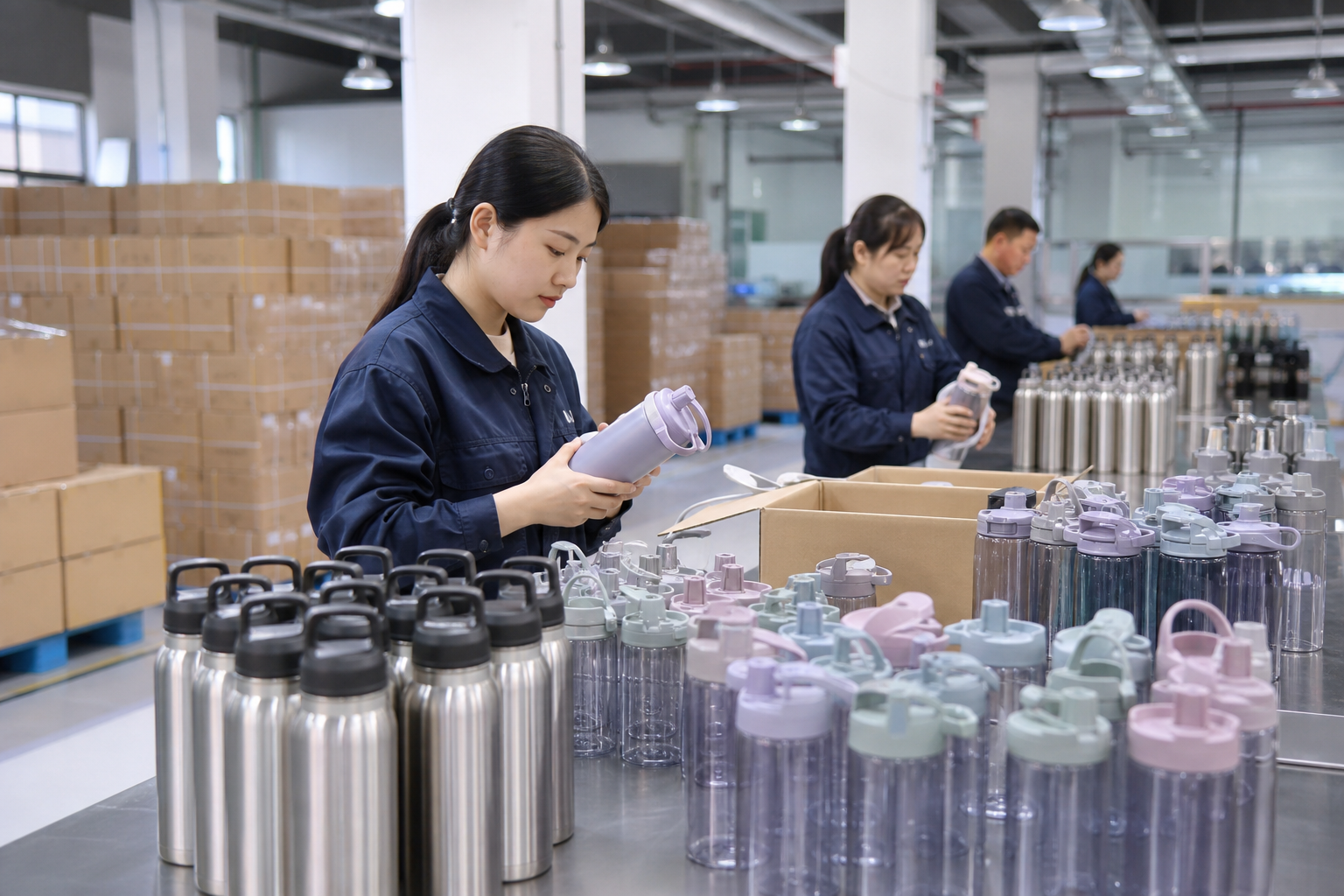
Key Takeaways
- A bulk hydration bottle order is usually priced from USD 0.85 to 4.20 depending on material, size, and decoration.
- Common MOQ in Zhejiang for custom drinkware bulk runs starts at 3,000 pcs; complex closure sets can require 5,000 pcs.
- Lead time is typically 20-35 days after sample approval, plus 7-20 days for ocean freight.
- For EU and US markets, ask for REACH, FDA/LFGB, and AQL 2.5 / 4.0 inspection records before you confirm a PO.
If you are sourcing a bulk hydration bottle, the hard part is not finding a factory. It is locking spec, price, compliance, and delivery terms before the first PO lands. A 0.18 USD cap swing or a 7-day delay on cartons can blow up margin fast. We saw a buyer flag a PO typo on closure color, and the rework ate two days on the line.
Buyers in Europe and North America often ask the wrong question: “What is your lowest price?” That is the wrong question to ask. The better one is: “What material, wall thickness, closure, and test standard will survive retail, Amazon, or distributor replenishment?” At our Zhejiang factory in China, we run over 300,000 units per month, with common MOQs starting at 3,000 pcs for custom colors and 5,000 pcs for printed logos, because that is where tooling, decoration, and QC stay sane. QC pulled the sample last week and found a 0.3 mm neck variation; that kind of miss is why cheap quotes often go sideways.
Start with the use case
Before you compare factory quotes, lock the use case. A bulk hydration bottle for a gym chain is a different build from a school retail bottle or an internal giveaway. Capacity, lid style, insulation, and decoration method all move the cost. We run a 500 ml single-wall Tritan bottle at about USD 0.90-1.40 EXW in large volume; a 750 ml stainless-steel vacuum bottle usually lands at USD 3.20-4.20, depending on steel grade, lid design, and carton spec. QC pulled the sample on the line last week and found a 1.2 mm wall variance on a clear Tritan body, which is enough to shift the quote.
If you want the best wholesale drink bottle for your channel, match the bottle to how the buyer uses it. Office users want one-hand opening and a low leak risk. Retail buyers care about gloss, print sharpness, and how the carton looks on shelf. Distributors watch cube efficiency and breakage rate. That is why we ask for the sales channel first. It keeps spec drift off the table. A bulk canteen for campus resale may need a wide mouth and a thicker wall, while a canteen wholesale run for a fitness brand may care more about weight and the carry loop than insulation. The buyer once flagged a PO typo on “750ml” versus “700ml”; that 50 ml changed the tooling discussion fast.
Practical rule: do not quote a bottle before you define capacity, body material, lid material, and decoration area. Those four items drive most of the price. A 38 mm lid opening and a 45 mm opening are not the same job, and the math does not work if you guess.
Choose the right material
Material is where a lot of drinkware wholesale jobs go sideways. You are not buying a bottle alone; you are buying a cost, weight, and failure-rate decision. Tritan runs light and clear, and buyers like the retail look, but it sits above PP on landed cost. PP is cheap and does the job, though it looks plain unless the mold texture is clean. Stainless steel gives better shelf appeal, yet it adds weight, welding steps, and vacuum testing on the line. For a bulk hydration bottle program, the right call comes down to target price and how hard the bottle gets handled. We had a buyer flag a PO once because the 0.8 mm spec was typed as 0.08 mm; the math does not work.
- Tritan / copolyester: clear or tinted, common for school and fitness bottles, often 0.7-1.2 mm wall thickness.
- PP: low cost, injection molded, good for canteen bulk orders where unit price matters more than a premium feel.
- Stainless steel 304: standard for insulated bottle programs; ask for 18/8 or 304 body spec and confirm the gauge or wall build.
- Glass: better for desk use, not for rugged distribution; usually needs silicone sleeve and stronger outer packaging.
If your brand needs a bulk drinkware range, split the material by channel, not by guesswork. A 500 ml PP bottle fits volume accounts. A 750 ml stainless model works better with retail buyers. That gives you cleaner margin control and fewer price fights. We ship both from Zhejiang every week, and the line can do it, but QC must pull separate samples for each material family or you end up comparing apples to a vacuum bottle. One carton drop test at 80 cm tells you more than a polished sample ever will.
MOQ and pricing reality
Most buyers ask for a lower MOQ. The line still runs on fixed costs. On a bulk hydration bottle order, the real price drivers are mold amortization, decoration setup, and packaging. A one-color silk screen usually adds USD 0.05-0.12 per unit; laser engraving on stainless adds USD 0.10-0.25, depending on artwork size and fixture setup. Full-color wrap printing and custom gift boxes move the number up fast. We had one buyer flag a PO typo on the carton count, and that tiny mistake turned into a reprint headache.
For reference, many Zhejiang factories will quote these ranges on bulk drinkware:
- PP sports bottle: USD 0.45-0.85 at 10,000 pcs
- Tritan bottle: USD 0.90-1.80 at 5,000-10,000 pcs
- Stainless insulated bottle: USD 3.20-4.20 at 3,000-5,000 pcs
- Growler bulk / beer growler bulk: USD 4.50-9.00 depending on capacity, cap, and finish
Do not ignore carton loading and master carton strength. A cheap bottle with weak packaging becomes a claims problem, and the math does not work. We check carton drop-test results at 70 cm, and we want a clear spare-parts policy before we ship. A smart factory will quote the MOQ for replacement lids separately, because cap stock is often the bottleneck on repeat orders. QC pulled the sample on one run after the outer carton failed a 5-layer board check.
Compliance is not optional
If you sell into Europe or North America, compliance is not a paperwork exercise. It decides whether the carton clears customs or sits in a bonded warehouse for 3 weeks. For a bulk hydration bottle, we ask for test reports before sampling ends. For the EU, that means REACH, LFGB where applicable, and migration testing for food contact parts. For the US, we need FDA food-contact documentation. If the program includes stainless vacuum bottles, we also check ASTM-related performance tests when the buyer asks for them, plus vacuum retention and thermal hold data. QC pulled one lid sample at 95°C and the seal held; that is the kind of proof buyers trust.
We keep one buyer file for each SKU, nothing fancy:
- Material declaration for body, lid, gasket, and straw
- Test reports from the last 12 months
- AQL inspection plan, usually AQL 2.5 for major defects and 4.0 for minor defects
- Artwork approval record and signed golden sample
Do not accept “compliant” as a sentence. Ask for document numbers, lab names, and dates. We have seen a PO typo on the report number stall a shipment for 8 days, so this is the wrong question to ask on trust alone. In Zhejiang and across China, good suppliers keep the file ready because export buyers ask for it every week. If a factory hesitates to share a report, treat it as a warning sign. A real supplier does not hide the file behind sales talk.
Decoration and branding choices
Branding changes unit cost and scrap risk. A one-color logo on a wholesale canteen is a different job from a wrap print on a curved insulated body. We run both on the line. If the artwork has fine lines, a 1-color silk screen can blur at scale unless mesh tension stays in spec and the ink viscosity is checked before every shift. Laser engraving gives a clean mark on 304 stainless steel, but on coated surfaces with low contrast it looks thin. Pad printing works on small lids and handles, yet wear resistance still needs a rub test, not a promise.
For alcohol flask bulk or alcohol flask wholesale orders, finish quality matters because the buyer is often selling a gift, not just a container. The same goes for beer growler wholesale and beer tumbler wholesale programs, where the box and the print close the deal before the spec sheet does. If you are sourcing growler wholesale or wholesale growler products for bars and breweries, ask for neck finish consistency and cap torque testing. We had a buyer flag a PO with “caps tight” written in the notes; that tells us nothing. A cap that backs off by 0.3 N·m after 12 days in transit becomes a leak claim later.
Ask for print position tolerances in millimeters, not “centered nicely.” That wording starts disputes. We usually lock in ±2 mm for body print position and keep a signed artwork proof before mass production. QC pulled the sample, measured the logo offset with a vernier caliper, and found 1.8 mm drift on the first run. The math works when the spec is clear; otherwise everyone argues after shipment.
Factory control and delivery
Your supplier’s real value shows up in process control, not in the sample room. A credible bulk hydration bottle factory should show incoming inspection logs, in-process checks, and final inspection data. Ask how they test lid sealing, drop resistance, color consistency, and carton compression. On our line, QC pulled the sample with a 3 m drop test and a 30 kg carton compression check. For a stainless bottle line, you should see vacuum leak checks and thermal performance records. For a plastic bottle line, you should see material lot traceability and odor control verification.
Lead time usually runs 20-35 days after sample approval, but only if artwork is frozen and packaging is standard. Add 7-15 days if your cartons are custom printed. New molds push the schedule out further, and the math does not work any other way. The factories in Hangzhou and broader Zhejiang move fast, but they still wait on steel, resin, and carton supply. We’ve had a buyer flag a PO typo on the lid color code, and that single line cost two extra days. If you need a rush order, state it early and ask what can ship first as a partial. That beats chasing a perfect full container with a late sailing.
“The cheapest quote is usually the one that forgot to include one of the three things that matter: packaging, compliance, or replacement parts.”
That is not a slogan. It is how bulk drinkware projects fail in real life. We saw it on a 5,000-piece order where the outer carton spec was missing 5-layer board, and the boxes crushed in transit. If you want reliable drinkware bulk replenishment, build your schedule around frozen specs and a signed pre-production sample, then keep a buffer for freight and customs clearance.
Send your spec sheet and get a real quote
Give us your capacity, material, logo method, and target market. We will quote a bulk hydration bottle plan that fits your margin and compliance needs.
Frequently asked questions
What is a normal MOQ for a bulk hydration bottle?
For standard custom drinkware, a normal MOQ is 3,000 pcs for color or logo customization and 5,000 pcs for more complex builds like insulated stainless models. Simple stock-color PP bottles can sometimes start at 1,000 pcs, but the unit cost will be higher. If you need custom packaging, expect the MOQ to rise because carton printing and insert cards add setup cost. In Zhejiang, factories often quote lower MOQs to win the order, then charge more for each added option. Always ask whether the MOQ is per color, per artwork, or per size.
How much should I budget per unit?
A practical budget for a bulk hydration bottle is USD 0.45-0.85 for basic PP, USD 0.90-1.80 for Tritan, and USD 3.20-4.20 for stainless vacuum models at reasonable volume. A growler bulk project or beer growler wholesale order can land higher, often USD 4.50-9.00 depending on finish and capacity. Decoration adds cost: one-color print may add USD 0.05-0.12, while laser engraving can add USD 0.10-0.25. Freight, duties, and packaging are separate, so do not use EXW pricing as your landed cost.
What compliance documents should I request?
For EU-bound wholesale drinkware, ask for REACH, food-contact declarations, and migration tests if the product touches food or beverage. For the US, request FDA food-contact documentation. If you are buying stainless steel or insulated products, also ask for thermal performance and leak test records. A strong factory should provide material declarations for the bottle body, lid, gasket, and straw, plus a recent AQL report. We recommend AQL 2.5 for major defects and 4.0 for minor defects. If the supplier cannot provide dated reports, pause the order.
How long does production usually take?
Most bulk drinkware orders take 20-35 days after you approve the golden sample and artwork. Stock packaging can shorten that, while custom boxes, new molds, or multi-step decoration can push it beyond 40 days. If you also need cargo-ready palletization, add a few more days. For urgent replenishment, ask the factory whether they can split shipment by SKU or color. In China, especially Zhejiang, better factories manage monthly output in the hundreds of thousands of units, but your order still moves only as fast as the slowest custom element.
What is the difference between canteen wholesale and wholesale growler orders?
A canteen wholesale order usually focuses on lightweight carry, lower cost, and daily hydration, often in PP or Tritan. A wholesale growler or beer growler wholesale project is more about volume, sealing, and presentation, because the product may hold beverages for transport or retail display. Growlers often need stronger caps, thicker walls, and better carton protection. The pricing and QC are different too. If you mix the two in one sourcing brief, the factory may quote the wrong spec and your margin will suffer. Keep each channel separate in your RFQ.