Key Takeaways
- A realistic MOQ for a bulk hydration flask is often 3,000 pcs per SKU, with 25–35 days lead time after sample approval.
- Stainless 18/8 body thickness typically runs 0.4–0.6 mm; anything thinner can dent easily in retail and FBA channels.
- For export orders, ask for AQL 2.5/4.0 inspection, REACH paperwork, and leak testing at 0.3–0.5 bar.
- A factory in Zhejiang with 300,000 units/month can still fail you if it cannot repeat cap torque, coating adhesion, and carton drops.
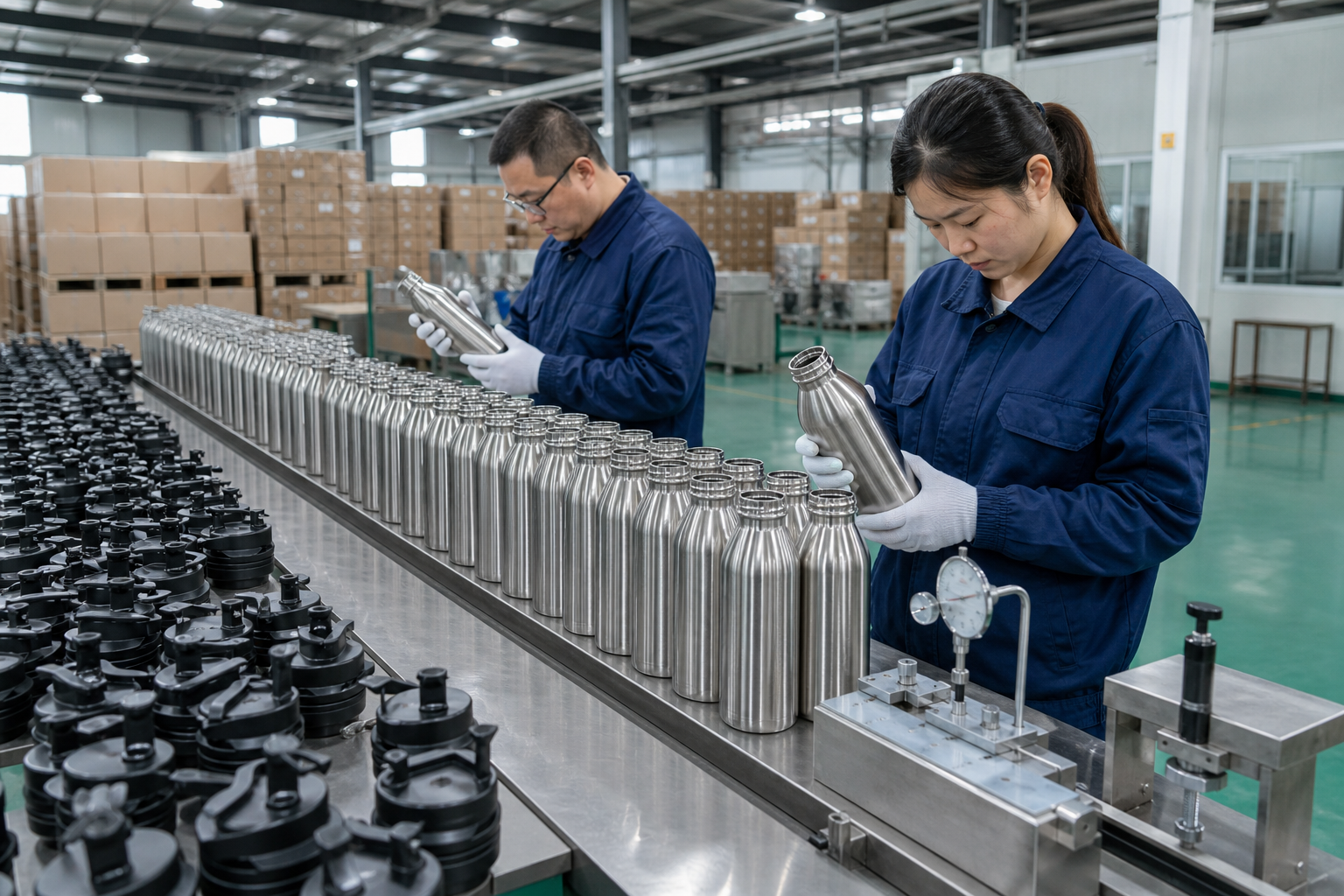
If you are sourcing a bulk hydration flask, design is not the first problem. Control is. Wall thickness, leak rate, coating durability, and repeatability across 5,000 or 50,000 units decide whether the order ships clean or turns into a mess. We run into this all the time in Zhejiang: a sample looks fine on the bench, then QC pulled the sample from line 3 and found the cap failed after 2,500 open-close cycles.
Procurement should treat a flask order like a technical buy, not a catalog pick. The right bulk drinkware supplier should put material grade, capacity tolerance, MOQ, lead time, and test standards in writing before the PO lands. We’ve seen buyers flag a 0.5 mm wall-thickness gap and a typo on the capacity line, and the math does not work if you miss that early. If you are buying canteen wholesale, drinkware wholesale, or a bulk canteen program for retail, sports, or corporate gifting, landed cost usually moves more on specs and test results than on the headline unit price.
What buyers mean by hydration flask
In B2B sourcing, bulk hydration flask usually means a reusable bottle with a secure closure, made for daily carry, sports, travel, or school use. Buyers also say bulk canteen, wholesale canteen, or canteen bulk order. Same product, different buying desk. We see the term shift again when a chain buyer sends a PO for “drinkware wholesale” and the item lands in a gift program or on a retail shelf. The use case drives the spec, not the label.
If you sell to outdoor channels, you are usually in a bulk drinkware program with powder coating, a carabiner lid, and a body that takes a few knocks on the line. Campus stores want a lighter bottle, a clean imprint panel, and carton math that does not blow up landed cost. For alcohol flask bulk or beer tumbler bulk, we switch lids, finishes, and compliance checks; QC pulled the sample on one 304 stainless run because the buyer flagged a lid torque issue at 1.8 N·m. A Zhejiang supplier should ask about end use before quoting. Otherwise the carton spec misses the market by a mile.
- Retail hydration: 500 ml to 1,000 ml
- Promotional canteen wholesale: 350 ml to 750 ml
- Growler wholesale: 32 oz, 64 oz, or custom volume
- Alcohol flask wholesale bulk: usually smaller formats with tighter decoration limits
Specs that decide the price
Buyers often stare at the lid photo and miss the cost drivers. For a stainless steel bulk hydration flask, the quote moves with material grade, body thickness, vacuum structure, and finish control. 304 stainless steel is the usual starting point for the inner wall, and the outer body often runs 0.4 mm to 0.6 mm. Double-wall vacuum build costs more, but it keeps temperature longer and cuts returns. We ship a lot of these, and if the drawing does not show the wall spec, the price is a guess.
Decoration changes the number too. Silkscreen is still the cheapest route at volume, often USD 0.12 to 0.30 per color per unit for a simple logo. Laser engraving costs more, usually USD 0.20 to 0.60 based on area and setup. We had a buyer flag a PO with “standard logo” written in the notes, and the sample came back wrong because nobody defined the print size. If you want a beer growler bulk order with matte powder coat, expect a higher scrap rate on color matching than on raw stainless. Ask the factory to quote by spec line, not by “standard model.” The math does not work any other way.
Typical price drivers:
- Material grade: 201 vs 304 vs 316 stainless
- Wall thickness: 0.4 mm, 0.5 mm, or 0.6 mm
- Finish: painted, powder coated, polished, or wrapped
- Cap type: screw lid, straw lid, flip lid, or carry loop
- Decoration: one-color print, multi-color print, or laser
MOQ, lead time, and factory scale
For a normal private-label bulk hydration flask, 3,000 pcs per color or 3,000 pcs per SKU is the working MOQ. Once you ask for custom molding, a special cap, or a packed set, the number usually moves to 5,000 to 10,000 pcs. We run into this on the line all the time: a buyer pushes for 500 pcs, then wonders why the quote looks ugly. The math does not work. Tooling, setup, and labor get spread over too few pieces, so the unit price jumps hard. That is a sample run, not a program you can scale.
Lead time matters just as much. A steady China factory can usually finish production in 25 to 35 days after sample sign-off and deposit. Add 7 to 12 days for ocean freight to most West Coast ports, then budget more for inland delivery. A 300,000 units/month plant can still miss your launch if the line is packed with canteen wholesale and beer tumbler wholesale bulk orders. QC pulled the sample, found a carton print typo once, and the whole ship date slipped two days. Ask for the current production calendar. A promise is cheap.
“Capacity without scheduling discipline is not capacity. It is just a number on a brochure.”
For procurement teams, the better question is not “Can you do 50,000?” but “Can you lock 10,000 units for week 18, with QC hold points and carton artwork approved by week 14?” We’ve seen this go sideways when the PO says 10,000 and the packing file says 10,800. That is why the factory scale question needs numbers, dates, and a real slot on the schedule. That is how professional drinkware wholesale programs stay on track in China.
Testing and compliance buyers should demand
Do not let a supplier hide behind “food grade” as if that closes the file. It does not. For bulk drinkware shipped to Europe and North America, ask for the actual pack: material declarations, REACH compliance for coatings and accessories, and migration test reports where the product needs them. For one export run, QC pulled the sample at the packing table because the coating batch number on the drum did not match the report. For North America, some buyers also ask for CPSIA-style support on a kids line, or FDA-related declarations for food contact items. The paperwork follows the market and the build, not the other way around.
For quality control, set the acceptance plan before the PO goes to the line. AQL 2.5 major and 4.0 minor is common for private label drinkware wholesale orders. For leak testing, write the pass/fail in plain language: no leakage after inversion for 2 minutes at room temperature. For caps that see higher load, add pressure testing. We have seen the wrong question get asked here. The issue is not whether a factory says “passed,” it is whether the test holds up on the filling bench. For a growler bulk or beer growler wholesale program, lid seal consistency matters more because carbonation and truck vibration expose weak closures fast.
- Leak test: inversion or pressure-based method
- Drop test: 1.0 m or 1.2 m carton and unit test
- Coating adhesion: crosshatch where applicable
- Carton compression: important for export pallets
China factories that work export accounts should show these controls without drama. If they cannot, move on. We once caught a PO typo on the carton mark, one missing digit that would have broken the shipment at customs, and the same supplier had no AQL record at the inspection desk. That is the kind of gap that turns into a late night. Ask for the reports, check the numbers, and make the factory prove it on the line.
Choosing the right product family
Not every buyer needs the same bottle. A wholesale growler for a taproom program is a different animal from an alcohol flask wholesale bulk order for a gift set, and neither should be treated like a beer tumbler wholesale bulk SKU for e-commerce. If the channel is Amazon or retail, we care about FNSKU space, carton repeatability, and labels that stay flat on a 3 mm seam. If the channel is promotion, the math is simple: keep the unit cost down and give the imprint enough room to read. If the channel is premium gifting, finish, hand feel, and box presentation carry the sale. The buyer who asks for one bottle to do all three jobs is asking the wrong question.
For outdoor and sports lines, the usual answer is a double-wall stainless bottle with a screw lid that passes a 1.5 m drop test and a coating that does not chip at the rim. For a wholesale canteen or canteen wholesale program, a wider mouth often wins because people want easier cleaning and faster ice loading. For beer growler in bulk or beer growler wholesale bulk, the closure and neck geometry matter more than the decorative finish. QC pulled the sample after a lid torque test at 18 N·cm, and that saved us from a leak issue on the line. Pick the family first, then tune the details.
Match product to channel:
- Amazon and retail: tight carton specs, FNSKU-ready labeling, consistent color batch
- Corporate gifting: custom logo, premium packaging, lower visual defect tolerance
- Outdoor and sports: impact resistance, grip texture, lid reliability
- Taproom and beverage brands: volume accuracy, seal performance, washability
How to negotiate a cleaner quote
Clean quoting saves time on the line. Ask every supplier to break out product price, print cost, packaging cost, test cost, and freight terms. If you need a bulk hydration flask with a custom box, split the bottle and the carton line by line so you can see where the margin sits. We have seen a quote look 8 percent cheaper, then the buyer flagged a 0.4 mm thinner carton, a lower-grade cap, and no test report.
Negotiation works better when you talk in process terms. For example: “I need 10,000 pcs, 2 colors, 1 logo, FOB Ningbo, AQL 2.5, leak test on 100 percent of units, 35-day production after approval.” That tells the factory exactly what to run, and it cuts the usual game of a low base price with extras added later. Ask for one sample from the production mold, not a hand-finished prototype; QC pulled the sample on our side, and the gap can be 5 to 12 percent in final appearance. The wrong question to ask is “can you do better on price?”
For a serious program, push for annual pricing tiers. At 30,000 pcs, the unit cost on a canteen wholesale line can drop by 6 to 15 percent versus a 3,000 pc order, especially if decoration stays constant. We ship these orders all the time. If the buyer wants the same engraving, same cap, and the same 18/410 closure, the math is clear: volume changes the quote, not the spec.
Request a factory quote with exact specs
Send your capacity, lid style, logo method, target MOQ, and packaging needs. We’ll price it with clear lead time, QC terms, and export-ready paperwork.
Frequently asked questions
What is a realistic MOQ for bulk hydration flask orders?
For most private-label programs, 3,000 pcs per SKU is a realistic starting point. If you want custom tooling, unusual lids, or special packaging, plan for 5,000 to 10,000 pcs. For simple logo changes on an existing mold, some Zhejiang factories can accept 1,000 pcs, but the unit cost may rise by 15% to 30%. Ask whether the MOQ is per color, per design, or per carton spec, because those are not the same thing.
How much should I budget per unit?
A basic 18/8 stainless bulk hydration flask can start around USD 2.20 to 3.80 FOB China for mid-volume orders, depending on capacity, lid, coating, and print. A powder-coated double-wall model with a carry lid may land around USD 3.80 to 6.50. If you need premium box packaging or laser engraving, add USD 0.30 to 1.20. Freight, duty, and last-mile fulfillment are separate and can change the landed cost by 20% or more.
What quality checks should I require before shipment?
Use an agreed AQL, commonly 2.5 major and 4.0 minor, plus leak testing and carton drop testing. For a drinkware wholesale program, request material certificates, visual inspection, and torque checks on caps. For coated products, ask for adhesion and color comparison against your approved master sample. If the product is for retail or Amazon, also require barcode placement review and carton dimension confirmation so FNSKU labeling or warehouse intake does not fail.
Can one factory handle beer growler wholesale and hydration flasks?
Yes, if the factory has stainless forming, vacuum welding, and multiple lid assembly lines. In Zhejiang, many plants can switch between a bulk hydration flask, a beer growler bulk model, and a wholesale canteen line. The real question is not whether they can make them, but whether they can keep leakage under control and hold consistent coating quality. Ask for recent export references, monthly output, and whether they run separate QC checkpoints for lids and vacuum bodies.
What shipping term is best for a new buyer?
FOB Ningbo or FOB Shanghai is usually the cleanest choice for a new buyer sourcing from China. It keeps the factory responsible up to the port, while you or your forwarder control international freight. If you want less complexity, some suppliers will quote DDP, but make sure duty, brokerage, and last-mile fees are itemized. For a first bulk drinkware order, FOB helps you see the real product cost before freight swings change the quote.