Key Takeaways
- Typical MOQ for a custom logo infuser bottle is 1,000-3,000 pcs, with lead time around 25-35 days after sample approval.
- A factory direct infuser bottle in China often prices at USD 1.20-3.80 per unit depending on material, lid type, and print method.
- For export, ask for REACH, LFGB, and BPA-free declarations; for North America, keep ASTM or FDA-related documentation ready.
- The infuser basket mesh, lid seal, and drop test matter more than the bottle shape if you want low return rates.
If you are buying a bulk infuser bottle for a wellness brand or hydration startup, the hard part is not finding a factory. It is getting a sample that still matches the 20,000th piece on the line. We run this every week in Zhejiang. A decent-looking bottle is easy. Holding the infuser basket tolerance, lid seal, and print after a 45-day run is the part that separates a clean order from a headache.
You also need to pin down what you are selling. Is it a bulk fruit infuser bottle for retail, a bulk tea infuser bottle for steeping, or a custom infuser bottle built for a gym bag and daily drops? Those are different builds, and the numbers change with them: wall thickness, mesh spec, and leak test pressure all move. The buyer flagged a PO once because the artwork said “tea infuser” while the spec sheet called for a fruit insert. That typo cost a week.
What buyers actually need
Start with use case, not color. A retail wellness brand usually needs a customizable fruit infuser bottle with a clean body, a 55 mm wide mouth, and a fruit chamber that rinses out in one pass at the wash station. A bulk tea infuser bottle is different: you need a finer mesh basket, a lid that stays neutral after hot water, and fill tolerance for repeated 90 C pours. Fitness buyers care more about grip, leak resistance, and cup-holder fit than how much fruit sits inside. Color comes last.
That is why a custom made infuser bottle should follow the drinking routine. For cold-brew fruit water, 700 ml or 24 oz is the usual range. For tea, 500-650 ml sells better because it is easier to carry and steep. On the line, we check bottle diameter, infusion tube length, mesh hole size, and lid torque before we sign off. A factory that knows the job will ask about beverage temperature, target retail price, and carton weight before quoting. If it skips those questions, the math does not work.
For distributors, the language matters too. A distributor fruit infuser bottle order is usually not a one-off custom project. You want a factory infuser bottle that can be reordered in the same spec six months later. That means standard tooling, stable resin supply, and a clean artwork file for the custom logo infuser bottle. If the PO has one wrong digit in the bottle code, the buyer flags it and the schedule slips. Too bespoke turns into higher cost and 12 days becomes 18 on the next run.
Materials and build choices
The material choice sets the project. On bulk infuser bottle jobs, we usually run Tritan, PETG, AS, or PP parts with a stainless steel or silicone insert. Tritan is the safer pick for a premium custom infuser bottle because it takes impact better and still looks clear after repeated washes; on the line, QC pulled a 1.8 mm sample that stayed stable after 50 dishwasher cycles. PETG costs less and fits a price-driven fruit infuser bottle bulk order, but confirm heat resistance and crack behavior before you sign off. AS gives good clarity, though it is more brittle than Tritan. The cheap option looks fine until the buyer flags stress whitening on the neck.
For hot tea, a factory tea infuser bottle often needs a stainless steel mesh basket, usually 304 stainless, with a weave fine enough to keep loose leaves out of the drink. For cold fruit water, the basket can use larger mesh or slots. If the opening is too large, strawberries and mint clog the flow. If it is too fine, water moves slowly and users say the bottle “doesn’t infuse.” That is a design miss, not a customer problem. We had one PO where the spec called for a 0.6 mm mesh and the first sample came in at 1.2 mm, so the buyer pushed back before mass production.
- Body thickness: 1.6-2.2 mm is common for Tritan bottles in the 500-750 ml range.
- Lid seal: silicone gasket should be food-grade, usually 40-60 Shore A.
- Insert material: 304 stainless steel or BPA-free PP depending on price target.
- Closure: screw cap with lock or flip-top; avoid loose snap lids for export unless tested heavily.
If you sell into the EU, ask for REACH and LFGB-related paperwork for every food-contact part. For North America, still request full material declarations and test records. China has plenty of capable plants, but the paperwork is not automatic. A serious Zhejiang factory will already know which files your customs broker and retail customer want, and if they do not, that is the wrong supplier to trust. We see this go sideways when a PO typo changes the resin code and nobody catches it until the lab report comes back.
MOQ and pricing reality
Let’s talk numbers, because this is where most buyers burn a week. A typical MOQ for a custom logo infuser bottle from a factory in Zhejiang is 1,000 pcs for a stock mold with new print, or 3,000 pcs if you want custom color, custom packaging, or a modified lid. If someone offers 300 pcs with full customization, you are paying a sample-production hybrid price. We’ve seen that go sideways on the line when the buyer expected wholesale terms and the factory was still hand-checking every cap torque.
For a factory direct infuser bottle, ex-works or FOB pricing usually lands in a wide band: USD 1.20-1.80 for a basic PETG unit, USD 1.80-3.20 for a Tritan model, and USD 2.80-3.80 or more for a premium custom tea infuser bottle with stainless basket, lock lid, and printed carton. Printing method matters. One-color silk screen on a simple cylindrical body is cheap. Laser engraving on a metal accent or premium lid costs more, and it is not always the right call for a colorful wellness brand. If you want a customized infuser bottle with full-wrap graphics, plan for higher setup cost and a lead time that can stretch from 12 days to 18 days.
From a procurement angle, ask the supplier to split the quote into body, lid, insert, print, and box. That is how you see where the money goes. A distributor infuser bottle program often fails because the buyer only sees one unit price and cannot move the spec levers. We had a PO last month with a typo on the carton count, and QC pulled the sample before packing. A better factory fruit infuser bottle quote will show standard carton, color box, mailer box, and set packaging. Then you pick the pack that fits the channel and avoid paying for retail details you do not need.
In Zhejiang, the best suppliers are usually not the cheapest ones. They are the ones that can repeat a 30-day production cycle with the same seal, same print registration, and same drop-test result.
Customization that sells
Your custom fruit infuser bottle needs more than a logo. If you are building a brand, the bottle should look like it belongs in the range, not like a generic cup with your name on it. We usually lock the stack at body color, lid color, logo position, volume mark, carton, and a grip texture if the mold allows it. A single-color print can look clean if the layout stays tight and we test adhesion with a tape pull. A full-wrap design gets ugly fast when it crosses a seam or the shoulder radius. QC pulled a sample last week because the art shifted 2 mm after shrink. That is the kind of miss the buyer flags in minute one.
For a customizable fruit infuser bottle, decide early where the brand sits: bottle body, lid, or both. The lid usually wins for repeat branding because it takes fewer scratches on the line. If you are building a customizable tea infuser bottle for gifting or a retail set, the box matters almost as much as the bottle itself. Ask the factory about custom insert colors, 500 ml or 700 ml mark lines, and embossed volume lines if the mold can carry them. Those details make the piece feel planned, not pulled from stock. We run this check with a caliper and a print proof before we open the bulk order.
Be careful with claims. A customized fruit infuser bottle for wellness should not sound like a medical product, and this is the wrong question to ask if someone wants stronger wording. Keep the copy practical: hydration, flavor infusion, tea steeping, daily use. If you are a distributor, ask for a distributor fruit infuser bottle program with stable reorder color standards, Pantone matching where the cap resin allows it, and approved print proofs before mass production. We have seen batches drift by a half shade when the resin lot changes, and the buyer flagged it after the first 3 cartons. One typo on a PO can do the same damage.
Testing and export compliance
If you are shipping out of China or reselling in Europe and North America, testing is not optional. We run hot-fill checks on a bulk tea infuser bottle for lid warp, gasket compression, odor transfer, and seal integrity after thermal cycling at 80°C. A fruit infuser bottle bulk order for cold drinks still needs drop testing, leak testing, and dishwasher exposure checks if you want to print “dishwasher-safe” on the carton. We had a buyer flag that claim on a PO once, and the sample failed after 10 cycles. Do not print the claim before the test report lands on your desk.
A practical export checklist for a custom infuser bottle includes:
- Food-contact material declaration
- REACH compliance for EU-bound orders
- LFGB where required by your retailer or importer
- BPA-free statement backed by material data
- Drop test at 1.2 m or your retail standard
- Leak test under upright and inverted conditions
For a North American buyer, the paperwork often sits in customs, marketplace review, or retail onboarding. If you sell on Amazon, have carton labels, FNSKU placement, and case pack dimensions ready before the freight leaves China. We ship a lot of 24-count and 48-count master cartons, and barcode direction matters. The line has seen a typo on a PO turn into a full relabel job. If the supplier does not know FBA packing, your receiving team pays for repacking labor and chargebacks later.
In Zhejiang, a mature factory usually runs QA against AQL 2.5 for appearance and 4.0 for critical leakage defects, but you should put your own acceptance standard into the PO. We use a go/no-go plug gauge on the cap thread and keep a leak rack at 1,000 ml fill level. The math does not work if the buyer stays vague. China can make solid drinkware, but consistency starts with a clear defect limit, not a product name.
How to choose a factory partner
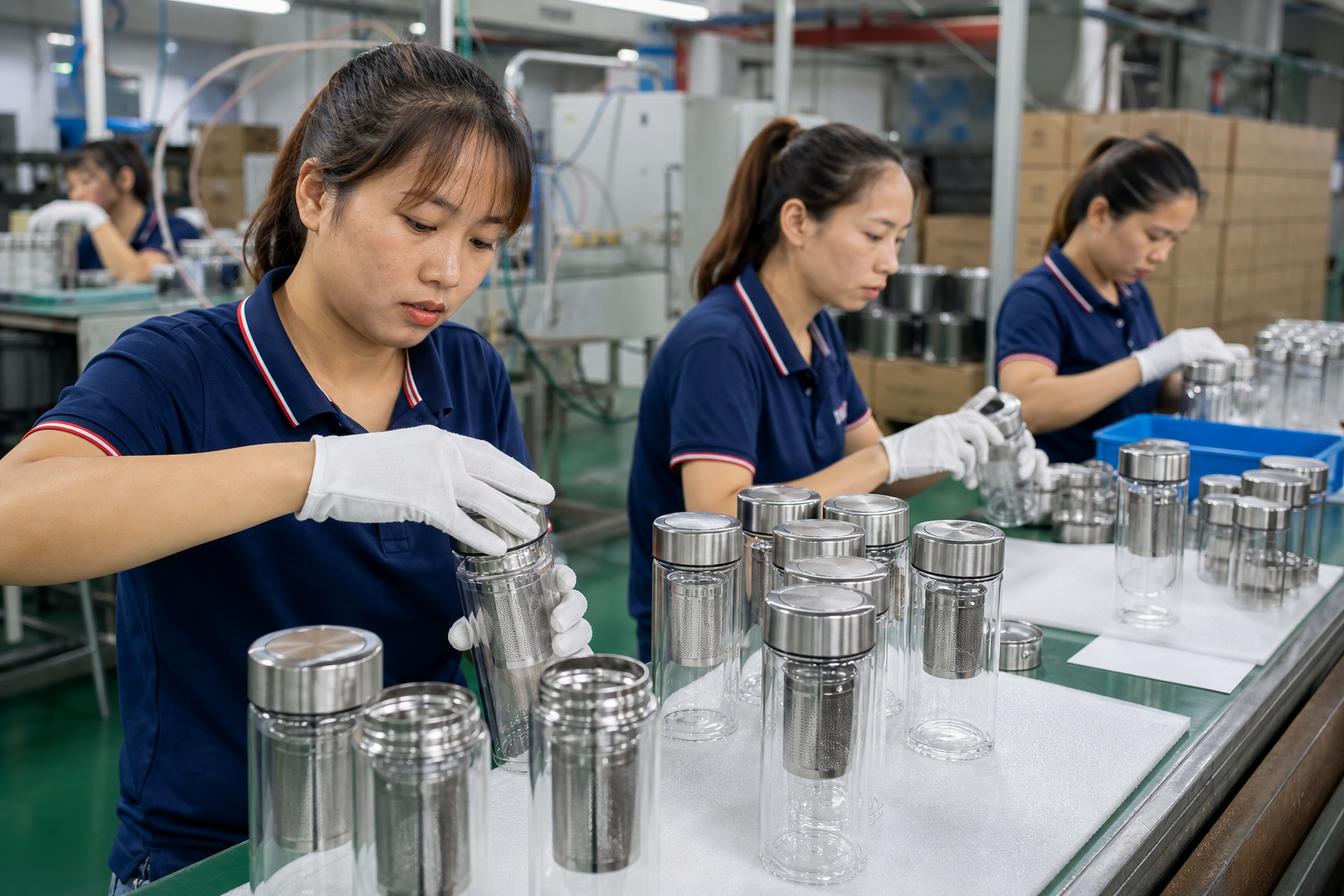
Not every supplier calling itself a factory direct infuser bottle source is a real factory. Some are trading companies with decent English and a sample room. That is fine if they can run the project, but you need to know who owns tooling, production, and QC. Ask for a factory audit, photos of the injection molding line, and monthly output records. A serious plant in Zhejiang may run 200,000-500,000 units per month across several drinkware lines. That scale matters when you need repeat orders or seasonal replenishment without a gap on the shelf.
When you evaluate a factory infuser bottle partner, ask straight questions: Who owns the mold? Can you lock the Pantone color? What is your standard lead time after deposit and sample approval? Which parts are made in-house, and which parts are outsourced? We once saw a buyer flag a PO because the cap color was written as “green” instead of the Pantone code. That kind of typo turns into a delay fast. A good supplier answers cleanly. A weak one keeps saying “no problem” and never gives a real timeline.
For distributors tea infuser bottle programs, reliability matters more than novelty. You want stable cartons, predictable MOQs, and a clear re-order path. A factory fruit infuser bottle line that keeps 95% on-time shipment is more useful than a flashy custom shape that misses the truck. If your business runs on quarterly promotions, ask whether the plant can hold raw material stock for 30 days or support a rolling forecast. QC pulled the sample, checked the lid torque at 0.8 N·m, and found the carton failed edge crush on one batch. That is the real export advantage, not marketing noise.
Request a custom infuser bottle quote today
Send your target volume, lid style, and logo file. We will quote MOQ, lead time, and export-ready specs from our Zhejiang factory.
Frequently asked questions
What is the usual MOQ for a bulk infuser bottle order?
For most custom infuser bottle projects, the MOQ is 1,000 pcs for logo-only work on an existing mold and 3,000 pcs if you want custom color, custom packaging, or a modified lid. A very simple stock run can sometimes start at 500 pcs, but the unit price will be higher. In Zhejiang, factories often quote faster when the design stays close to a standard body. If you need multiple SKUs, ask whether the MOQ applies per color or per total order. That changes your cash flow more than the unit price does.
How much does a factory direct infuser bottle cost?
A factory direct infuser bottle usually costs USD 1.20-1.80 for basic PETG, USD 1.80-3.20 for Tritan, and USD 2.80-3.80+ for premium tea versions with stainless inserts and better packaging. Printing, box style, and lid complexity affect the final price. If you want a custom logo infuser bottle with one-color silk screen, the setup cost is low. If you want multi-color wrap graphics or special finishing, expect a higher tooling or printing charge. Always ask for FOB breakdown by part, because one quoted number hides too much.
Is Tritan better than PETG for a custom fruit infuser bottle?
Usually yes, if you are selling mid-range or premium retail. Tritan is clearer, more impact-resistant, and holds its appearance better after repeated washing. PETG is cheaper and can work for a fruit infuser bottle bulk order aimed at value retail, but it is less forgiving with heat and stress. For a bulk tea infuser bottle, Tritan is also safer when your buyers use hot water. If your target retail price is under USD 12, PETG may be acceptable; above that, Tritan is easier to justify. Ask for actual material certificates, not just a sales claim.
What compliance documents should I request from a China supplier?
For Europe, ask for REACH and LFGB-related documentation for all food-contact parts, plus a food-contact material declaration. For North America, request material data, BPA-free confirmation if applicable, and any relevant test reports for migration, leakage, and durability. If you sell on Amazon or through a distributor channel, keep carton dimensions, case pack counts, and barcode specs on file. A reliable China factory will already have some of this ready. If they cannot produce documents within 24-48 hours, that is a warning sign. Zhejiang suppliers with export experience usually move faster on paperwork.
Can I order a customized infuser bottle with my own packaging?
Yes. Most factories can make a customized infuser bottle with branded color boxes, mailer boxes, and instruction inserts. The packaging MOQ is often tied to the bottle MOQ, but print setup may add 7-10 days to lead time. If you are selling as a distributor fruit infuser bottle, ask for master carton labels, FNSKU placement, and barcode verification before shipment. For retail, a strong box can lift perceived value by more than the material upgrade does. Just keep the box size practical; oversized packaging increases freight costs fast, especially on air shipments from China.