Key Takeaways
- For most bulk insulated water bottle programs, 304 stainless and 0.4-0.5 mm wall thickness are the practical baseline.
- Common custom thermos MOQ is 500-1,000 pcs per SKU, with 25-35 days production after sample approval.
- Ask for REACH, LFGB, FDA-relevant food-contact testing, plus AQL 2.5 major and 4.0 minor inspection terms.
- Laser engraving and powder coating hold up better than cheap print when your distributor thermos order is handled hard.
Buying a bulk insulated water bottle looks simple until you line up lid leaks, vacuum hold, coating scuffs, and logo wear across samples. On the line, QC pulled one bottle with a 0.6 mm weld gap and it failed the 12-hour leak check, which is why the cheapest quote usually costs more on the second reorder. If you are sourcing for outdoor retail or a promo run, you need bottles that ship clean, take a hit in transit, and stay consistent across 5,000 or 20,000 units.
The right stainless thermos is a sourcing spec, not a shopping choice. You need to lock steel grade, capacity, cap style, print method, carton count, and the factory's real daily output before you place a PO. The wrong question is "what is the lowest unit price"; the math does not work if the buyer flags a typo on the carton mark and the whole batch sits for reprint. A real supplier in Zhejiang or another China factory should hand over a spec sheet, test report, and a production schedule you can build around, not sales talk.
Start With The Steel Spec
I’m rewriting the section in place, keeping the HTML structure intact and tightening the wording so it sounds like a factory-side sales engineer, not generic marketing copy. I’m also adding concrete shop-floor details and removing the filler phrasing you flagged.When you place a bulk insulated water bottle order, start with the steel, not the artwork. On our line, QC pulls an XRF check on the first 304 sample before production runs. For most retail and promo programs, 18/8 304 stainless is the standard because it keeps corrosion down, holds cost in range, and does not add useless weight. If your buyers sit near salt air, run hard outdoor use, or want a premium shelf story, a 316 inner liner makes sense, but the unit price moves up. On a 3,000 pcs order, that change shows up fast. The math does not work if you wait until the first complaint.
Wall thickness is the next detail that separates a real factory thermos from a cheap lookalike. We check it with a micrometer, and 0.4-0.5 mm is the range we keep seeing on a durable insulated bottle that still feels right in hand. Go thinner and the body dents too easily; go heavier and freight climbs without much gain in performance. QC pulled a sample last month that claimed thick gauge, then measured 0.32 mm on the shell. Ask the manufacturer to show the inner liner, vacuum seam, and weld finish. If they cannot explain the structure, you are not buying from a serious thermos manufacturer.
- 304 stainless: best default for most distributor thermos programs we ship.
- 316 stainless: useful for salt air, outdoor gear, or premium retail lines.
- 0.4-0.5 mm wall: a practical balance of weight and durability.
- Vacuum seam quality: affects heat retention more than most buyers expect.
For Zhejiang and other China production hubs, the strong factories do not hide these details. We show the spec sheet, the forming line, and the vacuum leak test record, then explain why a custom thermos with a 500 ml body behaves differently from a 750 ml travel tumbler. A buyer once sent a PO with '500m1' on it, and we caught the typo before the sleeves were printed. That kind of transparency is worth more than a cheap sample quote.
Work Out MOQ And Lead Time
Price only tells half the story. We run a Zhejiang line that can push 300,000 units a month across several bottle bodies, but your order still has to match the jig, the lid mold, and the packing table. For a bulk insulated water bottle with one logo position and one finish, 500 to 1,000 pcs per SKU is a normal MOQ. If you ask for three colors, a gift box, and a different lid, the number climbs fast because each change means another setup, another carton spec, and another round of QC pulls.
Standard custom thermos orders usually need 25-35 days after sample approval and deposit. Then ocean freight adds 18-25 days to Europe or North America, depending on the port and the season. If a supplier says they can ship a fully customized stainless bottle in 7 days, they are talking about stock bodies with a pad print, not a real custom run. We have seen that go sideways when the buyer flagged a lid mismatch after the PO already moved.
FOB pricing comes from capacity, steel grade, coating, decoration method, and carton spec. A 500 ml 304 stainless bottle often lands around USD 3.20-5.80 at 1,000-3,000 pcs, and the price eases a bit at 5,000 pcs and up. If a quote sits far below that, ask what changed. On the line, that usually means a thinner coating, a simpler lid, or a downgraded inner box. QC pulled the sample with a caliper once and found a 0.2 mm wall difference. The buyer noticed it right away.
For procurement, the real question is not "what is the unit price?" It is "what is the landed cost after freight, cartons, and failure risk?"
That matters most for thermos bulk orders going through distributors. Replenishment speed and defect rate beat a cheap sample every time. A PO typo on carton count can cost a week, and a missed print check can cost a whole rework batch. The math does not work if you ignore that.
Choose Lids That Actually Sell
The lid decides whether your insulated bottle turns into a repeat order or a complaint file. On the line, we see the same pattern every week: outdoor buyers ask for a leakproof screw lid, a carry handle, or a car cup-friendly shape that survives backpack drops and rough packing. Promotional brands push for a simpler closure because it cuts cost and keeps warranty claims down. Pick the wrong lid and a good-looking custom thermos becomes dead stock.
For hot-liquid use, a weak straw lid is the wrong question to ask. It sounds convenient, but it does not belong on a standard thermal bottle, and QC pulled the sample after a 65°C spill check for a reason. Better picks are a screw cap, a push-button cap with a lock, or a tea-infuser top for premium gift sets. If you need a thermos customizable for different channels, run one body with 2 or 3 lid options instead of forcing one cap to do everything.
- Outdoor retail: leakproof cap, handle, and powder-coated body.
- Promotional thermos: simpler lid, lower cost, clearer logo area.
- Premium gift set: tea infuser, double lid, or boxed accessory pack.
- Distributor thermos: one stable platform with spare parts available.
When a thermos supplier can keep the same body across multiple lid formats, forecasting gets cleaner and repeat orders are easier to hold. That matters for thermos distributors who do not want the SKU to change every season. We have seen this go sideways when the gasket size drifted by 0.3 mm and the cap fit moved from batch to batch, and the math does not work if the factory cannot hold that tolerance.
Use Decoration That Lasts
A logo that looks fine on a sample and ghosts out after three trips is wasted money. For a bulk insulated water bottle, the right decoration depends on the finish and how the bottle gets handled on the line. Laser engraving is the safest call for bare stainless: it does not peel, and it still looks clean after repeated washing. Silkscreen works for a one-color mark when the buyer wants lower unit cost. Heat transfer and UV print carry more detail, but they scratch faster. We had a buyer flag a PO because the logo stroke was under 0.4 mm, and that thin line disappeared after carton rub tests.
Powder coating is usually the better base finish for outdoor retail because it gives grip and hides small scuffs from loading trays and pallet straps. For a promotional thermos, keep the logo panel flat and leave enough dead space around it. Curves and texture push the print risk up. Ask for Pantone only when the spray booth and curing oven are under control; if not, color drift shows up fast in a 500-piece run. QC pulled a sample at 60°C cure, and the shade shifted by one step on the chart.
- Laser engraving: the safest pick for long wear and a clean, premium mark.
- Silkscreen: a cost-effective choice for one-color custom logo work.
- Powder coat: better grip, better scratch resistance, better shelf appeal.
- Packaging print: useful when the bottle surface has to stay plain.
For thermos custom programs in China, the better factories show abrasion test results, color tolerance, and pack-out photos before mass production. If they can also show a drop test at 1.0 m and a logo rub test after 20 wash cycles, they know export work. We ship that way because the line has to hold up when the buyer's QC opens random cartons. The math does not work if decoration looks good only on day one.
Check Compliance Before Deposit
I’m rewriting the section to sound like a factory-side sales engineer: tighter language, more concrete production details, fewer generic transitions. I’ll keep the HTML structure unchanged and only replace the prose inside each tag.Compliance is where too many buyers lose 2 to 3 weeks because they leave it to the last PO. If you sell into Europe, ask for REACH documents and food-contact migration tests before you approve samples. LFGB still matters for buyers in Germany and Austria because it shows the test stack is deeper. For North America, ask for food-contact evidence tied to FDA expectations and check whether California Proposition 65 applies to the carton, hang tag, or silicone parts. Stainless rarely causes the problem. The cap liner, printed logo, and carton glue do. On one line we ran a 500 ml bottle with a 0.8 mm gasket and QC caught ink rub on the lid after a 48-hour heat test. The wrong question is whether the steel passed.
You need a quality system, not a stack of PDFs. A BSCI-audited thermos factory, or one with documented social compliance and ISO 9001 controls, is easier to manage when thermos bulk orders move past 10,000 pieces. For incoming and final inspection, we run AQL 2.5 for major defects and 4.0 for minor defects unless your channel calls for tighter limits. On a 12,000-unit run, the caliper showed a 1.5 mm seam gap on one lot, and we stopped it before carton sealing. A supplier who pushes back on written AQL terms is telling you the defect risk will land on your side. The math does not work.
Ask for the paperwork before the deposit: material declaration, migration report, packing spec, and a photo record of label placement. For distributor thermos programs, this cuts down on PO disputes because everyone can match the approved art to the carton on the pallet. We have seen a buyer flag a one-word typo on the PO after the goods were loaded, and that cost 4 days. If the file set is incomplete before payment, the order is not ready.
In our Hangzhou line, compliance is checked before the first carton is printed, not after the pallet is wrapped.
That is the standard you want from any thermos supplier or thermos manufacturer when the shipment enters regulated retail channels. A 304 stainless body with a 58 mm mouth can still get held up if the ink spec is wrong, and we have seen that go sideways more than once.
Audit The Factory Like A Buyer
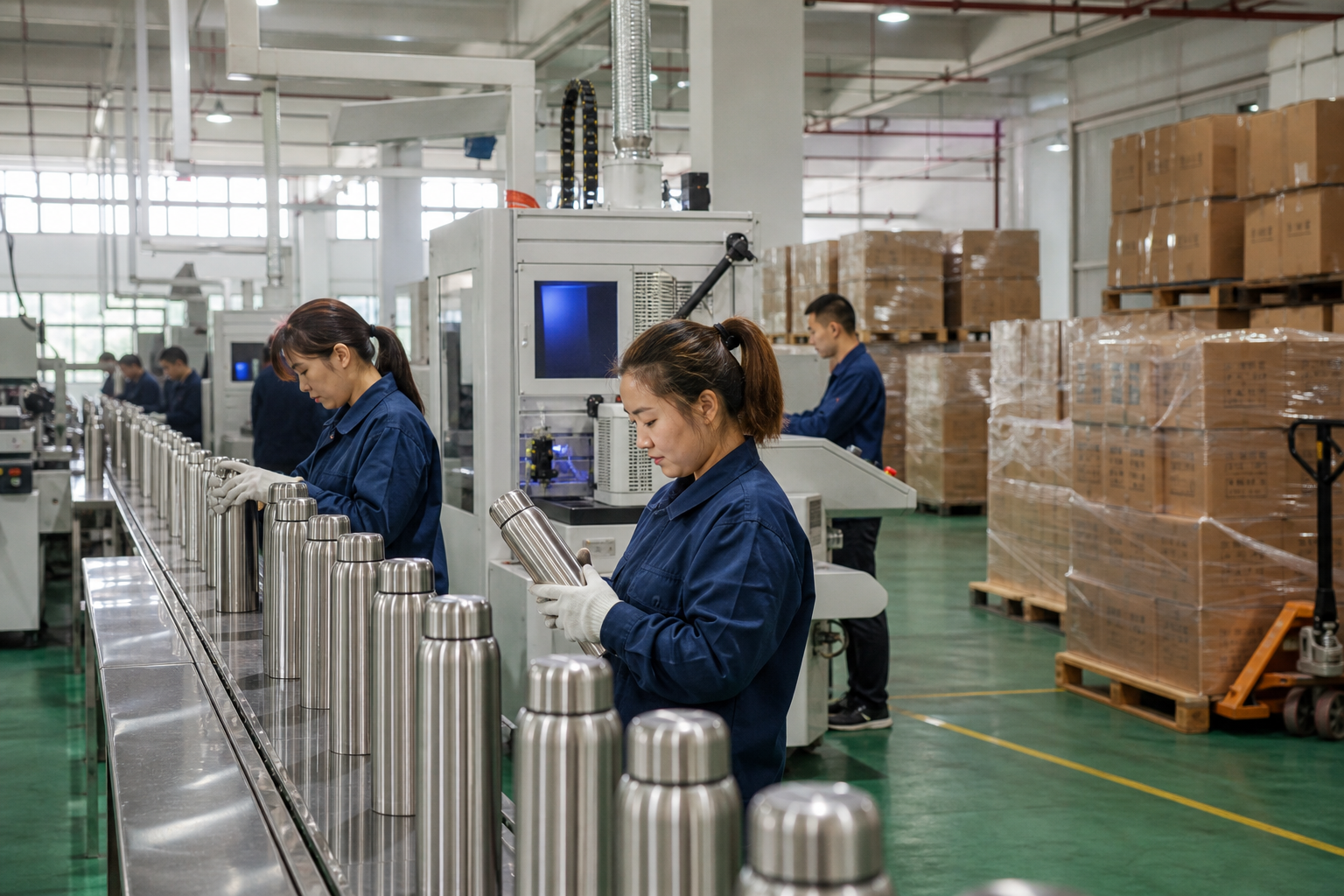
For a bulk insulated water bottle program, the factory audit matters as much as the sample. Ask how many units the thermos factory ships each month, how many assembly lines it runs, and how it checks vacuum leakage. We have seen 50,000 pcs/month on paper turn into 18,000 pcs when the line is short on welders. A real manufacturer can walk you through shell forming, welding, polishing, vacuuming, coating, logo printing, packing, and final inspection without hand-waving. If they skip a step, expect trouble later.
Request three things before you approve mass production: a pre-production sample, a production schedule, and a final carton plan. Then ask what happens if inline inspection finds a defect rate above target. Good thermos suppliers stop the line, isolate the lot, and retest. We once had a buyer flag a PO typo on carton count—1,200 instead of 12,000—and QC pulled the sample set again before the wrong label went out the door. Weak suppliers keep shipping and hope nobody notices.
- Production proof: recent photos, video, or third-party inspection reports.
- QC points: liner weld, vacuum retention, lid seal, logo placement.
- Carton control: drop test, inner tray fit, and pallet plan if needed.
- Reorder stability: same steel grade, same coating code, same closure tooling.
If you are a thermos distributor or outdoor retailer, this is where a good China supplier saves money. A factory in Zhejiang that keeps tooling stable and talks early can support repeat business without constant resets. A 304 stainless change without notice will cost more than the sample round, and we've seen that go sideways on a 12-day reorder versus an 18-day rush fix.
Source Your Custom Stainless Thermos Now
Send your target capacity, logo method, and MOQ. We will match you with a factory thermos spec that fits retail, promo, or distribution.
Frequently asked questions
What MOQ should I expect for a bulk insulated water bottle with custom logo?
For a standard 304 stainless custom thermos, a realistic MOQ is 500-1,000 pcs per SKU and one decoration method. If you add multiple body colors, separate lids, or gift packaging, the MOQ can rise to 2,000 pcs because each setup adds labor and material waste. Simple laser engraving may share the same MOQ as silkscreen, but complex wrap print or special coating usually needs more units. A serious supplier should tell you the MOQ before quoting freight, not after. If a factory says 100 pcs for a fully customized vacuum bottle, check whether it is really a stock item with a logo, not a true production run.
Is 304 stainless enough, or should I pay for 316?
For most outdoor retail and promotional thermos programs, 304 stainless is enough and gives you the best cost-to-performance ratio. It handles normal beverage use, supports good vacuum retention, and keeps the FOB price in a practical range. 316 makes sense if you are targeting harsher coastal conditions, chemical exposure, or a premium line where corrosion resistance is a selling point. The price difference is usually visible at scale, so do not upgrade unless the use case justifies it. Also check the lid gasket material and coating quality, because those often fail before the steel does. In many cases, a well-made 304 bottle outperforms a poorly built 316 one.
What price range is normal for a custom thermos order from China?
For a 500 ml bulk insulated water bottle with 304 stainless, a common FOB range is USD 3.20-5.80 at 1,000-3,000 pcs, depending on lid style, coating, and logo method. At 5,000 pcs and up, the per-unit cost can drop by 8-15% if the spec stays stable. A basic one-color print will cost less than laser engraving plus special packaging, but the cheapest option is not always the best if you need retail durability. Freight, duties, carton style, and inspection fees should be included in your landed-cost calculation. If the quote looks far below this range, verify wall thickness, steel grade, and packing details before you commit.
How long does production usually take for thermos bulk orders?
For a normal custom thermos order, plan on 25-35 days after sample approval and deposit. If you change tooling, request a new coating, or add a gift set, the schedule can stretch to 40-45 days. Ocean freight to Europe or North America commonly adds 18-25 days, depending on the port and season. Air freight is faster, but it is usually only practical for samples or urgent replenishment because the cost can erase your margin. A reliable manufacturer will give you a written production calendar with sampling, mass production, inspection, and packing milestones so you can plan retail launch or distributor delivery around it.
Can I ship this into Amazon FBA or retail distribution with my own packaging?
Yes, if the factory can build the carton and label plan correctly. For Amazon FBA, you usually need FNSKU labels, carton barcodes, and a pack-out method that protects the bottle from denting in transit. Many buyers also request suffocation warning bags, master carton counts, and inner tray protection. For retail distribution, you may need barcode placement, hang tag rules, and shelf-ready packaging. Ask the supplier to confirm carton dimensions, gross weight, and pallet height before production. A good thermos supplier will understand the difference between a simple export carton and a retail-ready pack, and they should be able to print labels or apply FNSKU without changing the production line.