Key Takeaways
- A bulk kids drink bottle order usually starts at 3,000 pcs, and printed units often need 25-35 days from PO to ready shipment.
- For kids’ use, PP, Tritan, and 304 stainless steel are common; avoid vague material claims and ask for REACH, LFGB, and FDA-related test reports.
- Leakage is usually a lid and gasket problem, not a body problem; request 20-30 cycle opening tests and a drop test from 1.0 m.
- Unit price for a standard 500-600 ml kids bottle can range from USD 1.20 to USD 4.80 depending on material, molding, print, and packaging.
- A good supplier in Zhejiang or wider China should give you AQL 2.5 inspection terms, carton loading data, and clear OEM drawing support.
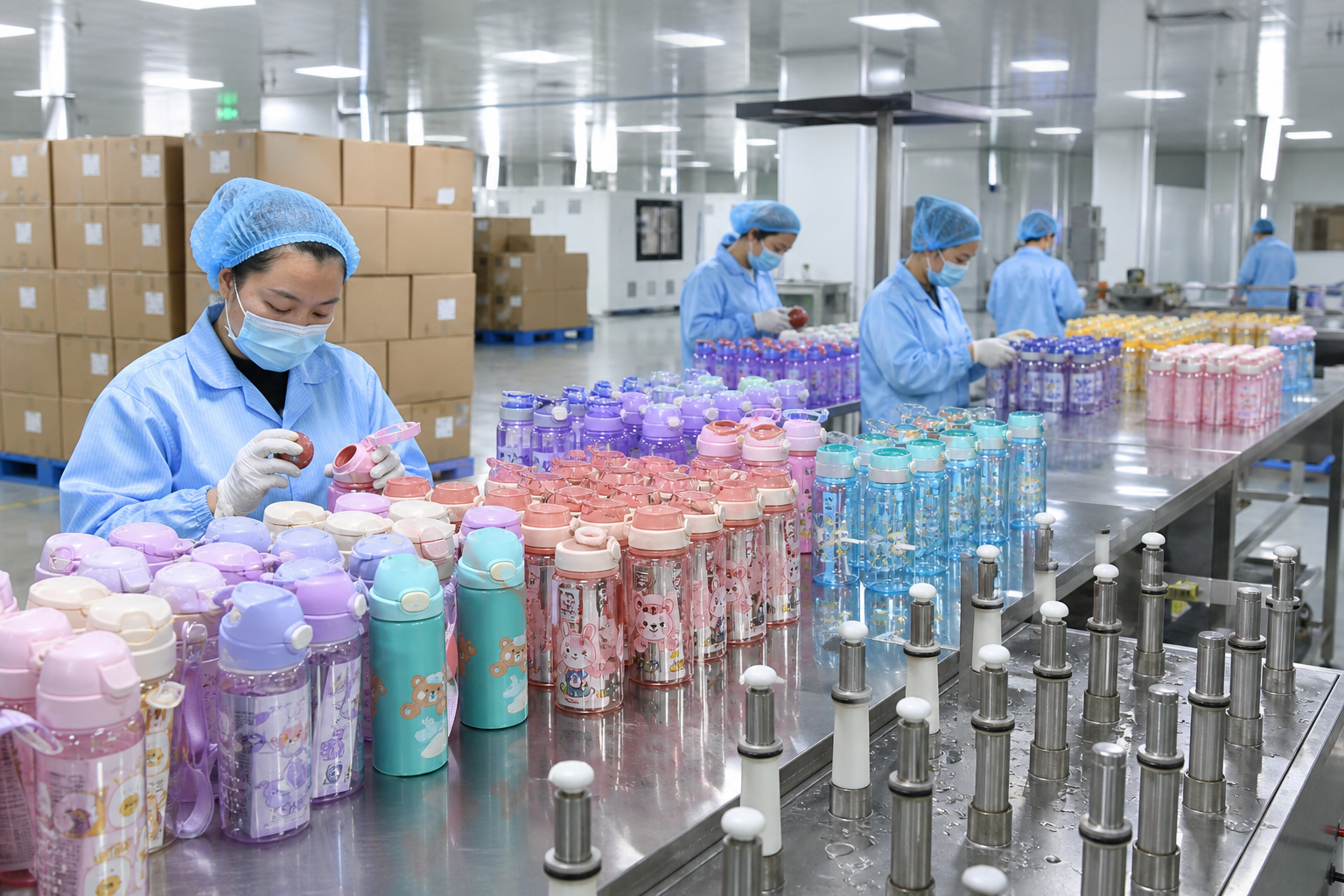
If you are sourcing a bulk kids drink bottle, the hard part is not the cute artwork. It is making sure the bottle clears safety tests, leaves the line on schedule, and still gives you margin after print, cartons, and freight. We see the same mistake in Zhejiang all the time: buyers start with colors, then end up fixing leakage, odor, or label problems after the order is already locked. One bad cap fit at 0.8 mm, and the buyer flags it fast.
For procurement managers and brand owners, this is a compliance job first. You need the right material, the right lid torque, the right MOQ, and a supplier who can hold tolerance across 10,000 to 50,000 units without making changes mid-run. At BottleForge in Hangzhou, we ship 600,000 units a month, with standard MOQ starting at 3,000 pcs and normal lead time of 25-35 days depending on decoration. QC pulled the sample on a 48-hour soak test last week, and the math still has to work before you place the PO.
What buyers really need to spec
When you buy a bulk kids drink bottle, start with the use case, not the print. School lunchbox, sports kit, retail peg, promo set: they do not call for the same build. A 450 ml bottle for 4-7-year-olds is a different brief from a 650 ml insulated model for older kids. Skip that and you pay for dead weight, like double-wall construction on a copolyester bottle that will never see hot liquid. We run this check before tooling; the wrong question is always color first.
The spec sheet needs capacity, weight, opening diameter, lid type, carry loop, and mouth shape. For school use, a 55-65 mm wide mouth makes ice loading and washing easier. Push-button and flip-top lids sell well for younger children, but they need leak testing and an accidental-open check. Ask for a sample with the wall thickness called out in writing. QC pulled the sample, checked it with a caliper, and 1.2-1.8 mm for plastic bodies plus 0.35-0.5 mm liner gauge for stainless is the range we ship against.
Do not treat the bottle body as the whole product. Cap, gasket, straw, and lock decide whether the buyer gets repeat orders or complaints. We have seen a PO rejected because the straw was soft silicone and collapsed after a few hundred cycles in a squeeze test. The line also caught a 2 mm gasket mismatch once, and the buyer flagged it on arrival. In wholesale drinkware, this is the wrong place to be loose.
Materials that hold up in use
For bulk drinkware, the core materials we run are PP, Tritan, PETG, 304 stainless steel, and silicone. For a best wholesale drink bottle for kids, Tritan is usually the cleanest pick: it stays clear, takes hits, and does not have the brittle feel you get from cheap acrylic. PP is cheaper and fine for light-duty canteen wholesale runs, but it picks up scratches fast and looks tired after one round through the line. We had a buyer flag a 500 pcs sample cart because the PP lid scuffed at the thread after a drop test. That is the wrong question to ask if you only look at unit price.
If your buyer wants metal, 304 stainless steel is the default for kids’ insulated bottles. Do not accept a vague “food-grade steel” line from a supplier. Ask for the material certificate, the steel grade confirmation, and the insulation structure. A proper vacuum bottle usually uses a 0.4 mm inner wall with a copper-plated or vacuum-sealed cavity depending on the build. On the line, QC pulled one sample that failed the 12-hour hot / 24-hour cold claim by 3 hours on the cold side, and we shipped the rest only after the structure was fixed. The math does not work if the test is not controlled.
For resin parts, request REACH and FDA compliance documents where applicable, and if the bottle goes into the EU, ask about LFGB for food-contact components. China has factories that can do this well, but the burden sits with the buyer to ask the right question before mass production starts. In Zhejiang, we have seen brands choose the wrong resin because a sample looked good under showroom lights and failed after 48 hours in a 60°C dishwasher test. We run into this every month. One PO even came in with “Tritan” typed as “Tritann”; that typo is small, the rework bill is not.
Lids, seals, and leakage control
Most lid failures start on the line, not in the bottle body. We have seen a 0.3 mm gasket cut-off and a bad thread pitch turn a clean-looking sample into a leak on the first school run. If you are buying canteen bulk or wholesale canteen models for schools, treat the lid as the part to audit, then the rest of the bottle.
Ask the factory for three items: gasket material, closure cycle life, and leak test method. Silicone gaskets are standard, but the durometer matters. Too soft and the seal collapses; too hard and the cap feels loose. On a recent run, QC pulled 12 samples and we ran 24-hour inverted leak tests, then a 1.0 m drop test on filled units. That is the right way to check it. A factory that cannot show that data is guessing.
If the design uses a straw, insist on food-grade silicone and a straight flow path with no burrs at the mold gate. If it uses a spout, check the drinking edge and the finger clearance around the button. For a bulk kids drink bottle, ease of use is not a nice-to-have. In Europe and North America, buyers will flag a lid that takes too much force or sticks after cold-chain transport. We have seen that turn a reorder into a claim in one week. One PO even came in with the cap color typo, and the buyer rejected the whole batch.
Pricing logic for bulk orders
Buyers ask for a price first. We always pull the spec sheet first. A 500 ml plastic kids bottle with one-color print usually sits around USD 1.20-1.80 EXW when the decoration is basic and the carton pack is standard. Move to a Tritan bottle with a custom lid, printed logo, and retail box, and you are more in the USD 2.20-3.60 range. Add vacuum insulation and the number shifts to USD 3.50-4.80, sometimes higher if the finish is special or the carton count is low.
That spread is normal. Mold complexity, tooling amortization, logo method, and packaging all hit the cost. On our line, silkscreen on a curved body is cheaper than laser engraving on stainless, but the buyer flagged the laser sample after 12 days because the mark held up better in rub tests. If you are comparing drinkware wholesale offers, use the full landed cost: EXW or FOB price, inner box, outer carton, testing fee, and freight cubic meter. A unit that looks cheap can turn into a bad buy if it ships in oversized cartons or fails AQL 2.5 at inspection.
For bulk canteen programs, some buyers try to bundle kids bottles with beer tumbler bulk, growler wholesale, or alcohol flask wholesale bulk orders to push volume across categories. This is the wrong question to ask. We run different tooling, caps, and compliance checks for each product, and the MOQ for a child-use bottle is not the same as a growler run. A supplier that handles beer growler wholesale bulk does not automatically have the right FDA or LFGB setup for kids drinkware, and we have seen that go sideways after a PO typo on lid color.
Compliance you should demand
If you are buying wholesale drinkware for the EU or North America, compliance is not a nice-to-have. It is the gate for customs and the retail PO. Ask for the material declaration, food-contact test reports, and a supplier quality pack tied to the exact item code you are buying. We had one buyer flag a PO typo on the lid code, and the lab report for the wrong SKU was useless. If the factory cannot map reports to the product code, the paper does not count.
For reusable kids bottles, ask for phthalates, BPA-related statements where relevant, and heavy metal limits on colored coatings and printed logos. A proper supplier in Zhejiang should know this without a lecture. On a 500 ml bottle line, we run AQL 2.5 for major defects and AQL 4.0 for minor defects when the order has three lid colors or printed variants. The math does not work any other way.
What to request before production:
- REACH or equivalent food-contact compliance documents
- Material certificates for PP, Tritan, silicone, or 304 stainless steel
- Production sample approval with photo sign-off
- Carton drop standard and label placement approval
- Inspection plan with AQL levels and sampling size
China can make strong kids drinkware, but only if the paperwork is tight. QC pulled the sample on a 2 mm print offset last month, and that small miss would have turned into a claim after shipment. Good factories in Zhejiang expect that discipline. We ship cleaner when the buyer does.
Customization that sells better
Your bottle has to earn shelf space or repeat orders, so customization has to support use, not just branding. The options that pull their weight are logo placement, lid color matching, handle shape, measurement scale, and packaging format. For a bulk kids drink bottle, an embossed logo often survives longer than a glossy print. On the line, we check laser depth at 0.15 mm on stainless steel, and laser engraving or 1-2 color silkscreen keeps the surface clean without peeling after washing.
Retail buyers often ask for multiple SKUs inside one platform design. One body, three lid colors, two graphics. Simple on paper. It works only if the factory keeps every variant straight. We have seen cartons mixed with 6 or 12 colors, and label confusion starts fast in drinkware bulk programs. Add a clear SKU matrix and barcode logic before mass production. If you are planning Amazon or cross-border retail, the packaging has to accept FNSKU labels without covering the required warnings. The buyer flagged a PO once because a single line item said “blue” in one place and “navy” in another.
Do not pile on features just because they sound useful. Straw, handle, flip top, time marker, and temperature display all look good until you check the reject rate. QC pulled the sample and found the lid tolerance drifting by 1.2 mm, and that is where the trouble starts. A cleaner design usually sells better and costs less to maintain. That is true for canteen wholesale, wholesale growler, and even alcohol flask in bulk programs. Simplicity cuts returns. The math does not work any other way.
How to manage factory risk
The best sourcing result comes from controlling the line, not from hoping the sample tells the whole story. We run this in Zhejiang every week: production sample, pre-shipment sample, then the packing list must match the carton count. If one carton says 48 pcs and the physical box holds 50, the order is already off. That is not a small gap.
Use a written checklist with approval points: design file, material approval, first article, mass production, final inspection, and loading photos. For orders above 10,000 pcs, ask for in-line inspection photos at 30-40% completion, not after the pallets are wrapped. We had one buyer flag a PO typo on "12,000 pcs" that was entered as "21,000 pcs" and the math did not work. If the project includes kids bottles plus adjacent categories like growler bulk or beer tumbler wholesale, keep the SKUs on separate production lines and separate packaging dates. Mixing glass, stainless, and plastic on one schedule is how you get label swaps and carton mix-ups.
Here is the honest part: a factory that answers fast is not always a good factory. You want the one that asks about cap torque, carton compression, and destination labeling before you even push for price. QC pulled the sample with a torque meter at 0.35 N·m, and that saved one order from loose lids. That is the right behavior from a wholesale drinkware partner. At BottleForge, we prefer buyers who want that level of detail, because it keeps both sides from burning time after the PO is signed.
Get a real quote for your kids bottle line
Send your capacity, target price, and artwork. We will quote the right spec, test route, and packing plan for China shipment.
Frequently asked questions
What is the usual MOQ for a bulk kids drink bottle?
For standard OEM orders, MOQ is usually 3,000 pcs per design or per color set. If you need custom tooling, the first production run may be 5,000 pcs to make the unit cost practical. For printed lids or multi-color packaging, plan on higher setup cost even if the MOQ stays the same. In Zhejiang, many factories quote lower MOQs but push higher pricing; check the total landed cost, not just the headline MOQ.
Which material is best for kids drink bottles?
Tritan is often the best balance of clarity, impact resistance, and premium appearance. PP is cheaper and fine for entry-level canteen wholesale programs. 304 stainless steel is better if you want insulation and a more durable retail product. For a 500-600 ml bulk kids drink bottle, Tritan and 304 stainless are the two most common choices for North American and European buyers.
How do I check if the bottle will leak?
Ask for an inverted leak test for 24 hours, plus a 1.0 m drop test on a filled sample. Also request the gasket material and lid cycle-life test, usually 20-30 open-close cycles on pilot samples. Most leaks come from the cap assembly, not the bottle body. If the supplier cannot explain the gasket hardness or thread fit, treat that as a warning sign.
What certifications should I request for Europe and the US?
For the EU, ask for REACH-related compliance and food-contact documentation, and if applicable LFGB for food-contact components. For North America, request FDA-related material declarations where relevant and keep your own internal compliance file. Also ask for carton and labeling approval, because customs and retail channels often care about packaging as much as material. Make sure the report references the exact SKU, not a generic sample.
What is a realistic lead time from China?
For a standard printed order from our Hangzhou factory in Zhejiang, lead time is usually 25-35 days after sample approval and deposit. If the order needs custom tooling, add 15-25 days for mold work and validation. Ocean freight to Europe or North America is separate, so build at least 7-35 days depending on destination and shipping mode. A supplier with 600,000 units monthly capacity should still confirm line allocation before you issue the PO.