Key Takeaways
- A 500 ml bulk military canteen usually lands around USD 1.20-2.80 FOB China, depending on material, lid, and finish
- For stable supply, ask for MOQ at 1,000-3,000 pcs and a sample lead time of 7-10 days
- Tritan, aluminum, and 18/8 stainless each solve a different buyer problem; choose by use case, not by appearance
- For EU and North America, request REACH, LFGB where relevant, and AQL 2.5 major / 4.0 minor inspection terms
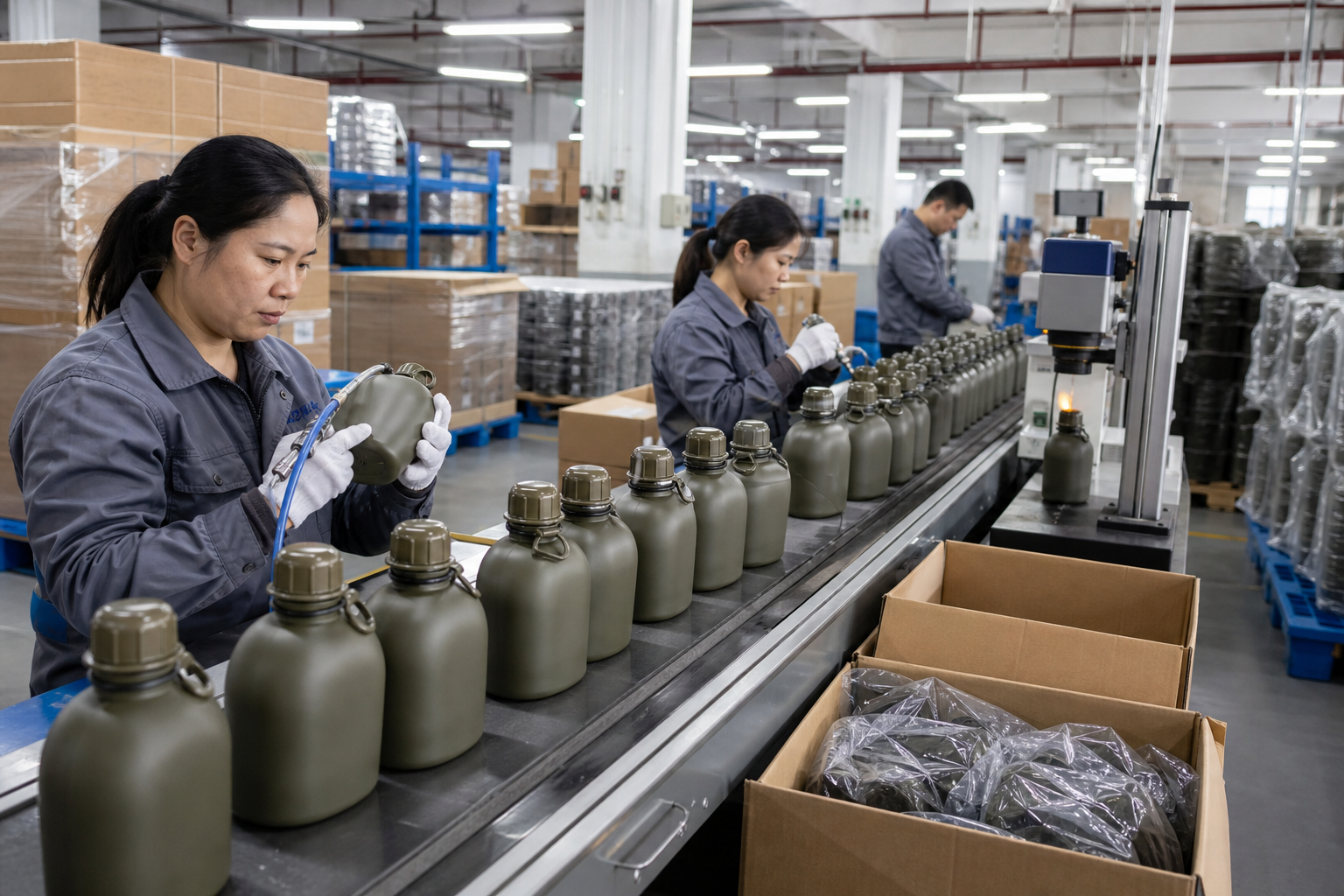
If you are buying bulk military canteen units for retail, promotions, outdoor programs, or institutional supply, the wrong spec will cost you twice: once in product claims and again in returns. We shipped a 50,000-piece lot last spring, and the buyer flagged seam dents on day one. A canteen that looks “military” on a catalog page may fail odor tests, dent too easily, or leak after 3 hot-filling cycles. Buyers in Europe and North America usually need more than a nice photo. You need repeatable quality, clear compliance, and packaging that survives the trip from Zhejiang to your warehouse.
At BottleForge in Hangzhou, Zhejiang, we see the same pattern every season: buyers start with a price target, then the line shows the real variables are capacity, wall thickness, coating system, lid torque, and carton strength. QC pulled the sample on a 600 ml body and found a 0.4 mm wall gap at the shoulder; that is where the math breaks. For a bulk canteen order, lock the use case first, then match material and tooling to it. That is how you keep your drinkware wholesale program under control instead of chasing defects one carton at a time.
Start with the actual use case
Before you price a bulk military canteen order, pin down the job first. Outdoor retail, training kits, tactical promo gifts, evacuation packs, private-label wholesale canteen sales — each one needs a different build. A hiking buyer usually wants a carabiner cap and a lighter body. A school or army contractor may ask for a wider mouth, tamper-evident packing, and a lid that still seals after a drop test from 1.2 m.
Buyers often say “military style” when they mean matte finish and a rugged shape. That is the wrong question to ask. Set the spec by capacity, temperature range, coating, and carton count. A 750 ml canteen with a screw cap and nylon sleeve ships on a different line than a 500 ml bare aluminum bottle. We had one PO with “500ml” typed as “50ml”; QC pulled the sample, and the buyer flagged it before we cut tooling. In Zhejiang, serious programs start with a drawing, not a photo. That saves time and stops people from comparing drinkware bulk prices across two products that do not belong in the same bucket.
Practical spec sheet fields:
- Capacity: 400 ml, 500 ml, 750 ml, or 1,000 ml
- Body material: aluminum, 304 stainless steel, 316 stainless steel, Tritan
- Wall thickness: 0.6 mm to 0.9 mm for metal bodies
- Lid type: screw cap, flip cap, loop cap, or wide-mouth closure
- Finish: powder coat, spray paint, brushed, or anodized
Choose the right material
Material choice is where a lot of canteen wholesale orders go off the rails. We’ve seen a buyer approve a sample, then flag the PO because the lid was fine but the body felt too soft in hand. Aluminum stays popular because it is light and cheap, and it still fits a lot of bulk canteen programs. Bare aluminum can pick up taste if the inner coating is weak, and thin walls dent fast on the packing line. If the brief calls for a rugged look without premium weight, 0.7 mm aluminum with a compliant inner coating is the middle ground we ship most often.
304 stainless steel is the safer all-round pick for premium wholesale drinkware. It handles odor better, gives the buyer less grief, and holds resale value when the account wants a cleaner spec sheet. For hot-fill or ice retention, double-wall 304 at 0.4-0.5 mm per wall is the starting point we run. 316 stainless costs more, so this is not the first line item for every tender. If the buyer wants stronger corrosion resistance or a marine-adjacent story, the math works.
Tritan and other copolyesters sit in a different lane. They work when the order needs a lightweight, clear bottle that can sell as the best wholesale drink bottle for daily carry. If the account wants a military look without a metal body, Tritan is worth a sample run. It is the wrong question to ask if you are trying to sell a steel feel. We had one PO with a typo on the finish code, and QC pulled the sample before the line moved forward. A smart exporter in China will tell you the wrong material spec kills margin faster than a bad carton.
Buyer rule: pay for the material that matches the use, not the material that looks expensive in a mockup.
Know your price drivers
I’m rewriting the section to sound like a factory-side sales engineer: tighter claims, more concrete cost drivers, and fewer generic transitions. I’m keeping the existing tags and list structure intact.For bulk military canteen sourcing, unit price usually comes down to four knobs: material, lid complexity, decoration, and packaging. A plain 500 ml aluminum body with a basic screw cap can start around USD 1.20-1.80 FOB China at MOQ 3,000 pcs. Move to double-wall stainless with laser logo and a color box, and the quote usually lands in the USD 4.20-7.80 range. QC pulled the sample at the sealing bench last week, and the pattern is the same every time: if a price sits far below that, the seller left something out.
Decoration changes the math fast. One-color silkscreen is cheap; multi-pass printing, laser engraving, or full-body hydro-dip is not. On the line, a single-color logo needs one jig and one pass; hydro-dip adds prep, curing, and another inspection step. If you need alcohol flask wholesale bulk style presentation for gift retail, packaging can cost as much as the bottle. Carton insert design, polybag choice, and label compliance all hit landed cost. The same logic applies to beer growler wholesale bulk orders, where closure type and a 72-hour leak test are part of the job, not an upgrade. We’ve seen buyers lose margin because a PO typo changed the insert size by 5 mm.
Factory capability matters too. At BottleForge, our normal export line runs about 180,000 units per month across stainless, aluminum, and Tritan drinkware, with sample development in 7-10 days and bulk lead time around 25-35 days after approval. On a busy week, the punch press and the laser marker are both booked, so schedule slips show up fast when the order doubles. That matters if you are buying drinkware wholesale for a launch window or seasonal program. Zhejiang has plenty of factories; the math does not work if the line cannot hold a date.
Ask for a split quote:
- Product ex-works or FOB price
- Decoration price per location
- Packaging upgrade cost
- Carton test and export document fee
- Sample freight, if you need pre-production approval
Test for leaks and compliance
You do not want to find a leak after 5,000 units are already on the water. We ran a 2,000-unit military canteen order last season, and QC pulled the sample at 8 a.m.; three caps weeped at the gasket line. For any wholesale canteen or wholesale drinkware order, push for leak testing, lid torque control, and drop testing before mass production approval. Our standard check is 100% water fill, inversion for 2-4 hours on sample units, then a 1.0 m drop test on packed cartons if the piece is headed to retail shelves.
Compliance is not a checkbox. For Europe, ask for REACH declaration and, where relevant, LFGB food-contact documentation. For North America, you may need FDA food-contact statements and carton labeling that fits your warehouse scan flow. We had a buyer flag a PO typo on the outer carton mark, and the shipment stalled two days while the reprint ran. If the order is a gift or promotional item, the paperwork still has to be clean.
Use AQL inspection terms in the PO. AQL 2.5 major and 4.0 minor is a common start for export drinkware. If the order is high-visibility retail, some buyers cut major defects to 1.0. This is the wrong question to ask if you think decoration makes the job easy. We’ve seen a plain canteen fail because the cap gasket was 0.3 mm off, and the coating chipped during transit.
Useful test points:
- Leak test on 10-30 sample units per color
- Thread fit and torque consistency, checked with a torque meter
- Coating adhesion and rub resistance
- Odor test after 24-hour water hold
- Carton compression and vibration test for export freight
Branding changes the order economics
Many buyers look at the bottle body and treat branding as a side note. That is the wrong question to ask. On a bulk drinkware program, logo method and placement change price, scrap risk, and carton damage. We had one order where a 28 mm laser mark on 304 stainless added a second setup step on the line, but the buyer wanted the premium retail look, so the math still worked. Silkscreen is cheaper for large-volume drinkware bulk orders, yet it can wear faster if the item gets scrubbed hard. If the client wants matte powder coat plus laser mark, we ship it that way, but nobody should pretend it is a low-cost decoration plan.
For bulk growler and growler bulk orders, the same rule applies: decoration has to survive real handling, not a mockup on a screen. A beer growler bulk buyer selling through breweries or taprooms usually asks for one of two setups: a heavy-duty branded surface or a clean body with strong carton branding. We once pulled a sample after QC found the ink scuffed at the rim after 12 rub cycles, and the buyer flagged it before mass production. The packaging often does more selling than the bottle itself. That is the truth.
If you are buying beer tumbler bulk or beer tumbler wholesale bulk SKUs alongside canteens, keep the decoration size standard where you can. That cuts setup cost and keeps the catalog looking like one family, not three random factories. Brand owners should ask for a digital mockup before tooling. In Zhejiang, a decent supplier will give you placement dimensions in millimeters, not vague “logo can be large” talk. We had a PO once with “logo on front somewhere” and the print ended up 8 mm off-center; fixing that after mold approval cost more than the logo itself.
Good branding questions:
- What is the printable area in mm?
- How many colors are included in the base quote?
- Is the logo centered or aligned to a seam?
- Will the finish affect logo adhesion?
Plan packaging and warehouse flow
Your product is not done when QC signs off. It is done when the carton lands, gets counted, and moves without a mess. For drinkware wholesale and wholesale growler programs, carton count, inner box layout, and barcode placement matter as much as wall thickness. We had a buyer flag a PO typo on carton count once, and the whole inbound team spent half a day fixing it. If you ship to a U.S. fulfillment center, you need FNSKU labels, carton marks, and case pack logic that matches your WMS. If you ship to a European distributor, pallet height and language compliance become the headache.
For a bulk military canteen order, we usually run 24 or 48 pcs per carton depending on size and sleeve. Keep carton weight under 15 kg if you want easier handling and fewer dents at handoff. We tested 16.8 kg on the line, and the drop result was ugly. Double-wall cartons make sense when the product has a coated surface or attached accessories. If your range also includes alcohol flask in bulk, beer growler in bulk, and canteen items, match master carton dimensions where you can. The math works better. Freight space drops, and warehouse stacking gets simpler.
Do not skip barcodes and retail labeling. Even a simple wholesale canteen needs a barcode zone that stays readable after shrink wrap or a sleeve goes on. Ask for pre-production artwork placement so you can check scannability before the factory prints 10,000 labels. QC pulled the sample on one run and the scanner missed it at 30 cm. That is standard discipline, not extra service.
Work the supplier like a pro
The best buyers stay specific. We see better quotes when the RFQ lands clean on one page, not twelve scattered emails. Give us capacity, material, finish, logo method, carton count, compliance needs, and target incoterm. If you want the cheapest bulk military canteen, say that. If you want the lowest complaint rate, say that instead. Those two targets change the build and the price. On one run, a buyer wrote “6000 pcs” in the PO and meant 6000 sets; the line caught it before molding started.
Ask for production photos, not stock shots from a catalog. Ask for a pre-shipment report with AQL results and sample retain photos. If the supplier in Zhejiang will not show tooling details, coating data, or inspection records, you are buying risk, not product. Good factories can show line capacity, QC checkpoints, and batch records with dates and lot codes. QC pulled a sample on a 2000 pcs run last month and found a 0.4 mm lip variation; that kind of finding saves a shipment.
For buyers comparing canteen wholesale, wholesale drinkware, and related items like alcohol flask wholesale, beer growler wholesale, or beer tumbler wholesale, supplier discipline wins. One factory that can keep the same spec across the full program is usually better than three cheap suppliers with different standards. We ship more repeat orders from the steady buyer than from the bargain hunter. The math does not work if the first invoice looks good and the second container brings mixed coating, crooked caps, and a PO typo on carton count.
RFQ checklist:
- Target quantity and annual forecast
- Material and wall thickness
- Logo method and artwork file
- Packing spec and destination market
- Testing and inspection requirement
Get a clean quote for your canteen order
Send your capacity, material, logo, and destination market. We will quote the right bulk military canteen spec, not a guess.
Frequently asked questions
What is the usual MOQ for a bulk military canteen?
Most factories in Zhejiang quote 1,000-3,000 pcs per color for a custom bulk military canteen. If you need a new mold, expect a higher threshold or a tooling fee. For stock shapes with simple branding, 500 pcs may be possible, but the unit price is usually 10-25% higher. Always confirm whether the MOQ applies per color, per logo, or per total order.
How much should I budget per unit?
For a 500 ml aluminum canteen, a realistic FOB China range is USD 1.20-2.80 depending on lid, coating, and packaging. For 18/8 stainless, budget USD 2.90-6.80 for single-wall or more for double-wall insulation. If you add laser engraving, custom color box, or sleeve, the landed cost rises quickly. Buyers who want beer growler wholesale bulk pricing should expect similar cost jumps when closures and leak tests are upgraded.
Which material is best for EU and North America?
304 stainless is the safest all-round choice for EU and North America because it handles odor, corrosion, and repeated use well. Aluminum can work if the inner coating is compliant and tested, but you need to be stricter on taste and abrasion. Tritan is good for lightweight, clear bottles, especially if you need the best wholesale drink bottle positioning for retail. For Europe, ask for REACH and relevant food-contact declarations before you place the order.
How long does production usually take?
For a custom bulk canteen order, sample time is usually 7-10 days if artwork is ready. Bulk production commonly takes 25-35 days after sample approval and deposit. If the order needs new tooling, coating matching, or a peak-season slot, add 10-15 days. Freight time from Zhejiang to Europe or North America is separate and depends on the shipping mode and port congestion.
Can I mix canteens, growlers, and flasks in one shipment?
Yes, but only if you control the carton and pallet plan carefully. Mixing bulk canteen, bulk growler, and alcohol flask wholesale bulk items in one container can save freight, but the packing specs must be compatible. Keep case packs sensible, separate SKUs clearly, and confirm barcode labeling for each item. If one line needs FNSKU for Amazon and another is for distributor pallet sale, set those rules before production starts.