Key Takeaways
- A practical bulk outdoor canteen spec usually starts at 18/8 stainless, 0.5 mm wall thickness, and an MOQ of 1,000 pcs
- For Europe, ask for REACH and LFGB; for North America, ask for FDA food-contact documents and Prop 65 screening when coatings are involved
- A Zhejiang factory running 800,000 units per month can usually quote 25 to 35 days for repeat bulk canteen orders after sample approval
- Use AQL 2.5 for critical and major defects, and specify carton drop tests before you confirm wholesale drinkware packaging
A bulk outdoor canteen looks simple on a spec sheet. It stops being simple when the line starts running. Wall thickness, lid seal, coating wear, carton drop strength, and whether the first sealed sample can survive 10,000 units from China decide the job. QC pulled the sample after a 1.2 m drop test, and that is where weak lids show up. If you buy for retail, promotion, or field use, a canteen wholesale order has to hit price, leak control, and compliance. Looks alone do not pay for a return cycle.
From Zhejiang and the wider China supply base, the cleanest programs start with a spec sheet the factory can actually run. We ship 304 stainless at 0.5 mm, a food-grade silicone gasket, and an AQL 2.5 inspection plan because chasing the lowest unit price usually breaks after the first carton audit. The cap line torque wrench was set to 1.8 N·m on the last run, and the buyer still flagged a 2 mm lid gap on one PO. For bulk drinkware, that math does not work.
Start With the Use Case
Do not start with color or logo. Start with the job the canteen has to do. A bulk outdoor canteen for hiking, camping, emergency kits, or military-style retail needs a different build than a canteen wholesale program for gift sets or travel bundles. If the buyer wants a bottle that can hang from a pack, survive abrasion, and stay shut in transit, we run the spec around shape, lid security, and surface finish before decoration ever enters the file.
Capacity is the first filter. The common range is 18 oz, 25 oz, 32 oz, and 40 oz. For outdoor retail, 32 oz is usually the safest middle ground. It carries enough water to feel useful, but a filled bottle that pushes past about 1.2 kg starts annoying people on a belt clip or in a daypack. We shipped a 40 oz sample once, and the buyer flagged it right away because the weight changed the whole use case. For bulk drinkware sold through distributors, that middle size also cuts inventory risk because it fits more shelves and more end users. If you are sourcing a bulk canteen for corporate programs, ask one direct question: will the user drink straight from it, pour into a cup, or just keep water in reserve?
There is a second decision buyers miss: whether the product is truly a canteen or closer to a growler. A bulk growler, beer growler bulk, or beer growler wholesale bulk order usually means a wider mouth, a different sealing method, and tighter control on beverage retention and pressure behavior. Same factory line, different spec. The logic sounds similar, but the use case is not. If you are also looking at alcohol flask bulk or alcohol flask wholesale bulk SKUs, keep them on a separate RFQ. Mixing categories in one quote turns the pricing messy and the samples weak. We saw a PO once that listed 32 oz canteen and growler in the same line item; QC pulled the sample, and the neck finish did not match either brief.
Pick the Right Material
Material choice is where bulk outdoor canteen programs get expensive later. We’ve seen buyers save $0.18 a piece on paper, then pay for rust claims and rework on the second shipment. Stainless steel is the safest default for wholesale canteen orders because corrosion resistance is predictable, dent resistance is better, and the compliance file is cleaner. For most buyers, 304 stainless is enough. If the canteen will sit in salty air, hard water, or acidic drinks, ask whether 316 earns its keep. 316 costs more, and that conversation needs to happen before tooling starts.
For a stamped stainless body, 0.4 to 0.6 mm wall thickness is the range we run. At 0.4 mm, the price looks good, but the dent rate climbs. At 0.5 mm, you usually get the better balance for drinkware wholesale programs. If a supplier sends a quote with no thickness called out, the math doesn’t work. Aluminum can fit a lighter canteen bulk order, but liner quality, coating adhesion, and impact resistance need tighter control. A thin aluminum shell can look fine on the sample bench and still fail after three drops. QC pulled one last month with a 1.2 mm ding near the base.
For branded retail, the finish matters as much as the base metal. Powder coating, brushed stainless, and matte paint wear in different ways, and the buyer flagged that fast when we compared shelf samples after a 48-hour dishwasher run. If you want a best wholesale drink bottle look for outdoor shelves, make the sample pass abrasion and dishwasher checks first. China has plenty of factories that can make the look; the better Zhejiang suppliers can show test data, tape-adhesion results, and 10 kg carton-drop findings to back it up.
Lids, Seals, and Leak Control
The lid is the product. Buyers spend time on the bottle body, then approve a weak cap and we end up dealing with returns. For a bulk outdoor canteen, we want the lid drawing to show thread profile, gasket material, venting if there is any, and the actual closure force in N·m. A good seal uses a food-grade silicone gasket, not a generic rubber ring that goes hard after 3 to 5 cycles. If the supplier cannot name the gasket hardness or the resin grade, the design is not ready for production.
Leak testing belongs on the purchase order, not in a sales email. We ask for inverted leak testing at room temperature, then again after hot and cold conditioning. For outdoor use, a 1.2 m drop test with water inside is a workable baseline. If the canteen uses a cup-style cap or a shoulder cup, check thread wear after 50 open-close cycles. QC pulled the sample last month and found a small burr on the first thread; that is the kind of issue the buyer flags only after field use.
The same logic applies if you are buying beer tumbler bulk, beer tumbler in bulk, or a wholesale growler for hospitality. The format changes, the failure stays the same: the seal breaks the promise, not the body. For alcohol flask wholesale or drinkware bulk orders that ship through Amazon or retail distributors, put the closure torque spec and a retention test in writing before mass production. We have seen this go sideways on a 24 mm cap that passed visual checks but failed after a 2 kg pull test.
MOQ, Price, and Lead Time
Price only makes sense after you lock down MOQ, line load, and decoration method. For a custom bulk outdoor canteen, 1,000 pcs per design and per finish is a normal China MOQ. If you want two colors, two lid types, or mixed sizes, the number moves fast because each variant adds setup time and extra packaging work. For canteen wholesale programs, ask the supplier to state whether the MOQ covers printed logo, laser engraving, or plain stock color. We had a buyer flag a PO typo once—“engrave” became “engraving”—and the quote changed by 9% overnight.
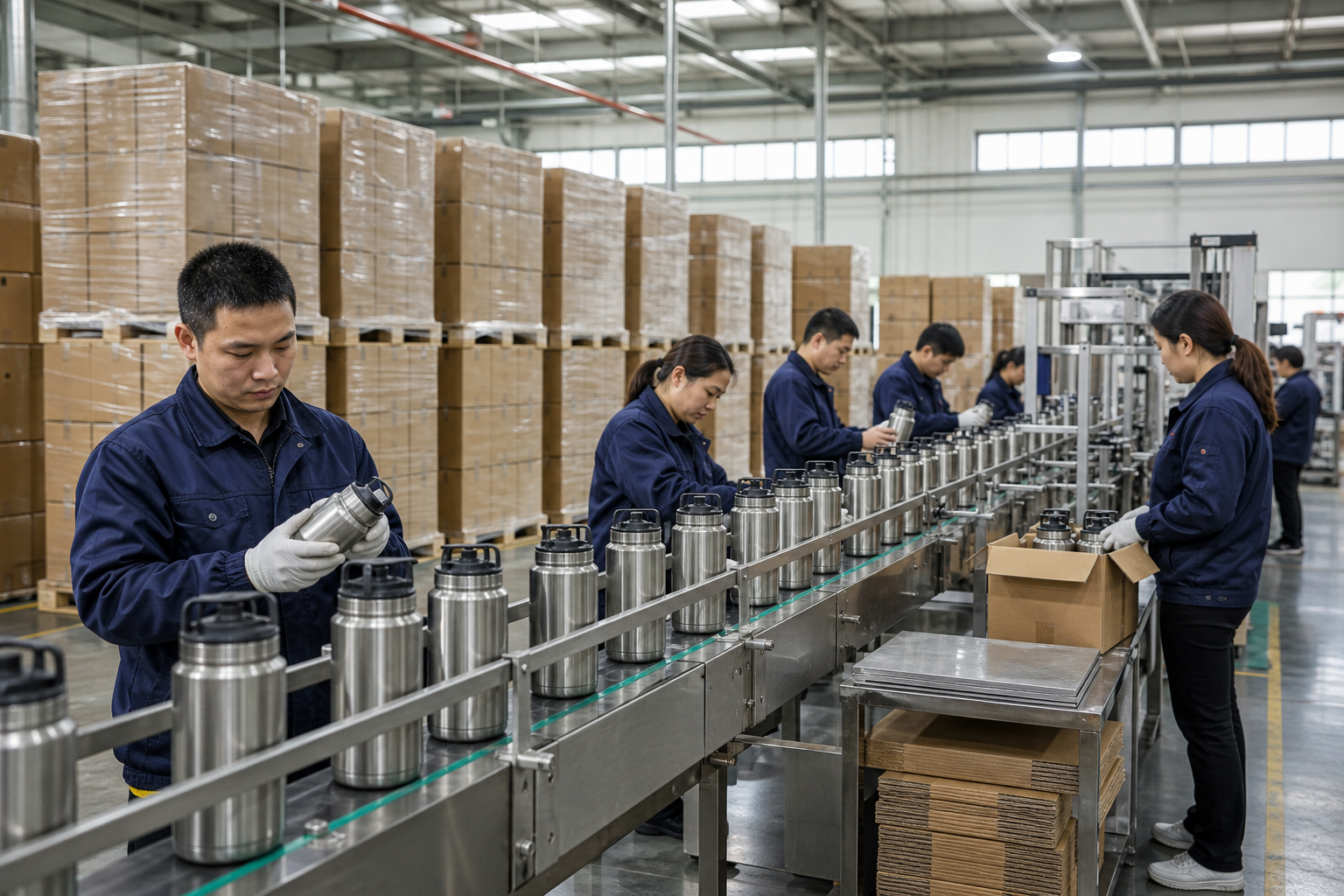
At a Zhejiang factory that runs steady, 25 to 35 days after sample approval is standard for repeat orders, as long as the line is not stacked with rush jobs. We run one drinkware line at about 800,000 units per month across multiple SKUs, and that scale keeps bulk canteen pricing stable instead of forcing every order into a custom setup. For first orders, add time for artwork sign-off, carton proofing, and compliance files. If a supplier offers 7-day delivery on a custom program, the math does not work; you are probably looking at stock goods, weak testing, or both. QC pulled the sample on one rush order because the lid torque missed spec by 0.3 N·m.
Price should be judged on landed cost, not unit cost alone. Count the inner box quantity, master carton size, pallet pattern, and any insert or accessory. A drinkware wholesale quote that is $0.18 lower at factory but adds 12 percent to freight can lose on the final sheet. Ask for FOB China, then compare carton efficiency and gross weight. That gives you a cleaner sourcing number. We once shipped a batch where the carton was 8 mm too tall for the pallet plan, and the buyer ate extra freight.
Compliance and Quality Control
If you sell into Europe or North America, compliance is not optional. For a bulk outdoor canteen, ask for REACH documentation, food-contact declarations, and migration test reports where relevant. Europe buyers often ask for LFGB because they want a tougher bar than a generic supplier claim. For North America, get FDA food-contact support, and check whether the coating, ink, or gasket has been screened for Prop 65 concerns if pigments or additives are involved. We once saw a 12 mm logo ring fail because the buyer accepted a “food safe” note with no file behind it. That is the wrong question to ask. Ask for the document.
On the factory floor, run the inspection plan to the risk, not to habit. AQL 2.5 is a standard starting point for major defects on wholesale drinkware; critical defects usually need tighter control. Define what counts as a leak, a print defect, a finish flaw, a dent, and a carton failure before production starts. ISO 9001 helps, but it does not replace a clear inspection sheet. If the product is made in Zhejiang or elsewhere in China, the factory should show incoming material checks, in-process checks, and final random inspection records. QC pulled the sample, found a 0.3 mm gap at the lid thread, and we held the line until the mold was corrected.
For branding programs, ask for test reports on abrasion, dishwasher cycles if applicable, and carton compression. That matters whether you are ordering bulk drinkware, wholesale growler units, or a steel canteen. We ship a lot of cartons, and a crushed case at 18 kg is a real cost, not a paperwork issue. The buyer who locks the failure criteria early gets fewer surprises later. We have seen it go sideways when the PO typo said 500 pcs per carton instead of 50.
Branding and Packaging
For retail or distributor programs, the logo method changes the economics. Screen printing is the cheap route and works fine for a simple logo on a flat or light curve. Laser engraving gives a cleaner look on stainless and the mark is harder to rub off, but it adds cost and can slow the line. We had a buyer flag a PO once because the logo was called out as “engraved” on line 7 and “print” on line 12. If you are comparing custom decoration across a bulk outdoor canteen, a bulk growler, or a beer growler wholesale SKU, ask the factory to quote each decoration method on the same base item so you are comparing the same 18 oz bottle, same 50 mm print area, same setup fee.
Packaging is where a lot of drinkware wholesale programs get sloppy. A carton spec should spell out inner protection, drop-test target, and barcode placement. If your customer is Amazon, include FNSKU labeling, suffocation warnings where required, and carton dimensions that keep dimensional weight down. If you sell through retail distributors, ask whether they want 6-pack, 12-pack, or shelf-ready tray packaging. We shipped one run at 2 mm over the target carton width, and the freight bill jumped. The math doesn't work if nobody checks the carton sample with a tape measure and caliper.
Think through the unboxing path before approval. The product should land clean, dry, and ready for the channel it serves. For alcohol flask in bulk or alcohol flask wholesale bulk programs, the packaging often needs a firmer insert and a better finish on the tray. For a wholesale canteen sold as outdoor gear, we usually push durability over luxury. QC pulled the sample with a scuffed lid, and that was enough to stop the job. Boring in the warehouse is good. Convincing on the shelf is better.
Send your spec and get a factory quote
Share your size, material, logo method, and target market. We will return a clear China FOB quote, MOQ, and lead time.
Frequently asked questions
What is a realistic MOQ for a custom bulk outdoor canteen?
For a custom bulk outdoor canteen, 1,000 pcs per design is a realistic starting point at many China factories. If you want multiple lid types, colors, or printed versions, the MOQ may rise to 2,000 to 3,000 pcs because each setup adds cost. For plain stock finishes, some Zhejiang suppliers can go lower, but you usually lose price efficiency and packaging control. Ask whether the MOQ is tied to color, logo method, or carton configuration. That detail matters more than the headline number.
Which material is better for wholesale canteen orders, stainless or aluminum?
For most wholesale canteen buyers, 304 stainless is the safer default because it gives better dent resistance, simpler compliance, and more consistent quality across batches. A wall thickness of 0.5 mm is a practical balance for bulk drinkware. Aluminum can be lighter and cheaper, but liner quality, coating adhesion, and impact resistance become more important. If the product is for harsh outdoor use or long retail shelf life, stainless usually gives fewer claims. If weight is the top priority, ask for drop-test data before you choose aluminum.
What compliance documents should I ask for when sourcing from China?
For China sourcing, ask for the documents that match your market and material. For Europe, REACH and often LFGB are relevant. For North America, ask for FDA food-contact support and, where needed, Prop 65 screening for coatings, inks, or gaskets. You should also request a material declaration, test report dates, and the exact model number on each report. If the order is for bulk outdoor canteen or drinkware bulk distribution, make sure the documents match the finished item, not just the raw stainless sheet. Old or generic reports are not enough.
How long does production usually take for bulk canteen orders?
For a repeat bulk canteen order at a capable Zhejiang factory, 25 to 35 days after sample approval is a normal lead time. First orders often take longer because artwork, packaging, and compliance documents need sign-off. If you are adding laser engraving, special colors, or retail-ready packaging, add several days for proofing and QC. A factory with around 800,000 units per month of drinkware capacity can usually hold that schedule, but only if you confirm the order early and lock the spec. Fast promises without a written spec are a warning sign.
Can I use the same factory for beer growler wholesale and outdoor canteen SKUs?
Yes, but only if the factory has real tooling and QC control for both. A beer growler wholesale program usually needs a wider mouth, a different seal, and packaging that supports heavier glass or stainless bodies. An outdoor canteen is often narrower and more pack-friendly. The production line may be the same, but the functional spec is not. If you are also building beer growler bulk, beer tumbler wholesale, or alcohol flask wholesale bulk items, keep each SKU separate in the RFQ so the supplier does not blend the requirements and quote the wrong package.