Key Takeaways
- A practical bulk protein shaker MOQ is often 3,000 to 5,000 units per color; custom molds push it higher.
- For North America and Europe, ask for REACH, LFGB, FDA-style declarations, and migration test reports before you pay.
- A 400–700 ml shaker with 2.5–3.0 mm wall thickness and a 100% leak test is a safer commercial spec.
- FOB Zhejiang pricing can start around USD 1.20–2.80 per unit depending on material, print, and packaging.
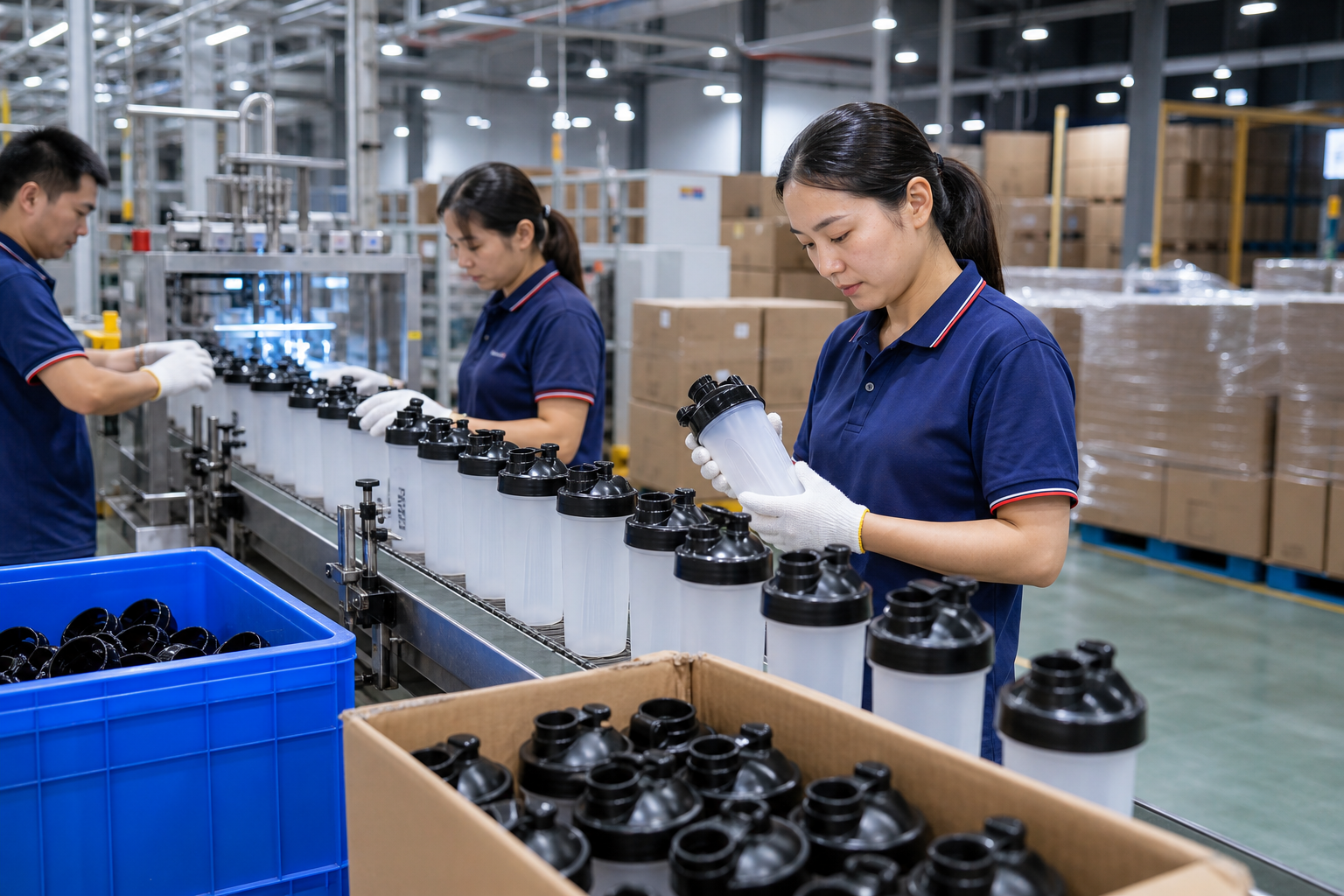
If you are buying a bulk protein shaker program for retail, gym chains, Amazon, or promo distribution, the real issue is not finding a bottle. It is finding a factory that can hold ±0.2 mm on the mold, pass compliance, and still hit your landed cost. In Zhejiang and across China, there are thousands of drinkware suppliers, but only a small share can keep molding stable, run leak tests, and pack custom cartons without the line drifting.
You also have to look past the shaker cup. MOQ, closure design, and print durability decide whether you get clean margins or a pile of returns. We run export drinkware orders every month at BottleForge Industrial in Hangzhou, Zhejiang, and we have seen this go sideways fast: one buyer flagged a typo on the PO, another wanted a 7-day sample turn but approved artwork late, and QC pulled the sample because the flip cap failed after 20 squeezes. The cheapest quote is often the wrong one if the lid leaks or the logo starts peeling after two washes.
What buyers should spec first
Start with the use case, not the decoration. A bulk protein shaker for gyms is a different job from a promo cup handed out at a race expo. Spec the capacity, lid type, mixing system, carry loop, measurement scale, and powder compartment before you talk price. For most B2B programs, 400 ml, 600 ml, and 700 ml are the working sizes. We ship the 600 ml a lot because it takes one serving plus liquid without feeling bulky in a gym bag.
Material choice drives the rest of the build. PP is the standard for drinkware wholesale shaker cups because it is light, cheap, and easy to mold on the line. Tritan costs more, usually 20% to 40%, but the clarity sells better at retail. If you are comparing a bulk protein shaker with a bulk canteen or wholesale canteen program, the targets are different. Shakers need a tighter cap seal, a stronger thread profile, and a mixing ball or insert that stays put in transit. We had one buyer flag a loose ball after a 12-day truck run; the math on a weak lid does not work.
Write the spec sheet before you ask for price. Include:
- Capacity tolerance: ±3%
- Wall thickness: 2.5 mm minimum for PP, 3.0 mm preferred for premium builds
- Cap leak standard: no leakage after 30 minutes inverted
- Print requirement: 1-color silkscreen or laser marking if the surface supports it
- Packaging: bulk pack, egg crate, or retail carton
In Zhejiang, a good factory will ask these questions right away. QC pulled the sample and checked the lid with a go/no-go gauge at 0.2 mm; that is the kind of detail you want. If they do not ask, expect sample trouble later. I have seen a PO with “600ml” typed as “600 mls” and the buyer still expected the carton art to match; we fixed it, but it slowed the line.
Materials that actually pass export
For Europe and North America, compliance comes first. We run PP, Tritan, and stainless steel on the line, but each one needs a paper trail before shipment. For plastic shaker cups, ask for REACH status, food-contact declarations, and migration test reports for your target market. For stainless parts, 304 is the normal call; 316 only makes sense when the buyer is paying for the corrosion gain. We have seen buyers ask for 316 on a low-margin shaker, and the math does not work. A stainless insert inside a plastic shaker can improve mixing, but it also adds 2 more assembly steps and more leak checks.
If your order also covers beer growler bulk, beer tumbler bulk, or an alcohol flask wholesale bulk program, the same export discipline still applies: material traceability, carton drop tests, and confirmed food-contact compliance. A factory that handles growler wholesale or wholesale growler orders usually knows how to build for heavier packaging and pressure, but that does not mean the same lid tooling will pass on a protein shaker. QC pulled the sample on one 500 ml shaker because the gasket groove was 0.4 mm off; the buyer flagged it before we shipped. Different product families need different molds, different tolerances, and different inspection points.
Here is the practical view:
- PP: lowest cost, good for drinkware bulk promotions, typical MOQ 3,000–10,000 units
- Tritan: clearer body, better shelf appeal, stronger retail margin, MOQ often 5,000 units
- Stainless steel: less common for shakers, more common in a beer growler wholesale or alcohol flask in bulk program
If you are comparing a best wholesale drink bottle for a sports line, check odor retention, dishwasher cycles, and impact resistance. We ran one PP bottle through 50 wash cycles and the surface haze was obvious; that is a return ticket waiting to happen. The buyer once sent a PO with the cap color wrong by one digit, and we caught it before production. Good material choice is the part that saves the shipment.
MOQ, price, and lead time
MOQ is where a lot of buyers get stuck. We’ve had inquiries come in at 1,000 units, then the buyer flagged sample fees, carton charges, and a 4-week wait that was never in the first quote. For a bulk protein shaker with a standard mold, 3,000 to 5,000 units per color is the normal factory number. If you want custom lid color, a custom insert, and printed retail cartons, plan on 5,000 to 10,000 units. New mold? The first order often starts at 10,000 units, depending on cavity count and whether the tool is 2-cavity or 4-cavity.
For FOB Zhejiang pricing, a basic PP shaker usually sits at USD 1.20 to 1.90 per unit. Add a better closure, a cleaner matte finish, or a custom mixing system, and the number moves to USD 2.20 to 2.80. Tritan units run higher. We’ve seen buyers compare shaker pricing to canteen bulk or canteen wholesale numbers and assume the math should match. It doesn’t. The shaker is easier to mold, but the line spends more time on assembly because a 0.3 mm seal gap turns into a complaint fast.
Lead time matters more than most sourcing teams allow for. A normal order runs 20 to 30 days after sample approval. If you want custom printing, carton design, and export inspection, build in 35 to 45 days. At BottleForge Industrial, we run 300,000 units per month across our drinkware lines, so mixed-container orders do not scare us. Still, a late AI artwork file or a typo on the PO can push shipment back 7 days. QC pulled the sample, found a lid color mismatch, and that whole batch had to be rechecked.
Do not compare unit price only. The wrong question to ask is, “What is the cheapest quote?” Compare total landed cost, including:
- Sample and mold cost
- Print setup
- Individual packing
- Carton test requirements
- Ocean freight from China
Testing and compliance you need
A supplier should not stop at “food grade.” We ask for the papers. For Europe, that means REACH and LFGB. For the U.S. file, you want a food-contact declaration that your importer can put on record without chasing the factory for a revised PDF later. If the shaker has a stainless insert, a silicone gasket, or a painted logo, each contact material needs to be named. Last month, QC pulled a sample with a missing silicone spec sheet, and the buyer flagged it before we even booked the carton label.
If your customer is a chain retailer, get the inspection terms into the PO before production starts. AQL 2.5 for major defects and 4.0 for minor defects is a common target, but write the numbers down. The math does not work if the PO says “inspect as usual.” We run into that typo all the time. One wrong digit turns a clean shipment into a dispute at receiving.
Leak testing belongs on the line, not in a sample photo. A proper commercial shaker should pass 100% inverted leak checks before carton packing. Drop testing matters too. For e-commerce and Amazon FBA, we use outer cartons that survive a 60 cm or 76 cm test, depending on the packaging spec. We’ve seen this go sideways with a 2 mm cap gap and a 12-day delay, while the buyer thought the issue was just “one bad sample.”
“A nice-looking sample means nothing if 2% of the caps arrive warped. In export drinkware, one bad seal becomes five support tickets.”
Printed decoration needs its own checks. Silkscreen is low cost, but on a curved body the edge wear can show up after 20 dishwasher cycles. Laser marking looks cleaner on metal, but it does not work on every plastic body. If you want a logo that holds, ask the factory how they tested ink adhesion and surface energy. That is the right question, not whether the pantone looks close under office light.
Packaging for retail and FBA
Packaging decides whether a shaker lands on shelf or shows up dented. A bulk protein shaker for gym wholesale programs can leave in plain master cartons, but retail and Amazon change the game fast. We check barcode placement, carton count, and box strength under pallet load. For FBA, each unit usually needs a scannable FNSKU, and the carton size has to fit the fulfillment plan or you eat oversize fees. We had a buyer flag a 2 mm carton height difference on one PO; that small typo turned into a fee dispute.
If your order includes a related SKU like a growler bulk line or a beer tumbler wholesale bulk promotion, keep the packaging language aligned where it makes sense. Do not force the same pack-out on a different shape. A growler bulk item needs thicker dividers and stronger corner pads than a shaker cup, and we’ve seen that go sideways on a 1.2 m drop test. Alcohol flask bulk orders need tighter finish protection because even light scuffs show on the line.
Practical packaging choices:
- Bulk pack: lowest cost, best for distributor warehouse intake
- Polybag plus insert card: good for promo and club retail
- Color box: better for shelf-ready programs
- Mailer carton: useful for Amazon or direct-to-consumer
Do not let the supplier pick packaging by habit. Ask for a carton spec sheet, drop-test assumption, and packed weight list. QC pulled the sample on a 16 kg carton and found the bottom seam opening after compression. If your freight forwarder sees unstable stacks, they quote the shipment with a safety margin. The math does not work any other way, and that is how a cheap drinkware bulk quote turns into an expensive freight bill.
How to audit the factory properly
Before you place a bulk protein shaker PO, audit the factory like a buyer, not like a tourist. You are checking whether they can hold quality on 5,000 units, not whether the showroom has glossy posters. Ask to see injection machines, mold maintenance logs, leak-test fixtures, and the packing line. We once saw a PO with “shkaer” on the carton draft, and the buyer flagged it before production. If the supplier also makes bulk canteen, wholesale canteen, or wholesale growler products, that is a good sign because they already know export packaging and traceability. Still, check the shaker line itself.
In Zhejiang, the better plants run separate QC checkpoints for molding, printing, assembly, and final packing. That setup matters. A lid thread problem caught after assembly is cheap to fix on 20 samples and expensive to fix on 8,000 finished pieces. Ask how they handle change control. If they cannot explain what happens when the gasket supplier changes, they are not ready for your retail program. QC pulled the sample at 0.3 mm off-center on the print, and that saved a lot of scrap.
Useful audit questions:
- What is your reject rate on shaker caps over the last 3 months?
- How many units can you finish per day on one line?
- What is your standard AQL level for export?
- Can you share photos of carton compression and leak testing?
A real supplier answers with numbers, not slogans. If they tell you “no problem” five times and never mention tolerances, move on. We ship for buyers who ask for 1.2 mm wall thickness, 500 ml fill line, and cap torque data; that is the level that keeps claims down. The math does not work if the factory talks big and writes nothing down. The best wholesale drink bottle supplier for one category is often strict on process, not the one that says yes to everything.
Request a shaker quote built for export
Send your spec sheet, target quantity, and market. We will reply with MOQ, FOB Zhejiang pricing, and a practical production plan.
Frequently asked questions
What is a normal MOQ for a bulk protein shaker order?
For a standard PP bulk protein shaker, 3,000 to 5,000 units per color is realistic. If you want custom lid color, printed measurements, and retail packaging, expect 5,000 to 10,000 units. New molds usually start at 10,000 units because the tooling cost has to be spread across more volume. In Zhejiang, many factories quote lower numbers to open the deal, then recover cost later, so always ask whether the MOQ includes one color, one print, and one carton spec.
What price should I expect FOB China?
A basic shaker often lands around USD 1.20 to 1.90 FOB China, depending on capacity, material, and packaging. A premium Tritan version can reach USD 2.20 to 2.80 or more. If you add a stainless insert, custom gasket, or retail box, the number rises fast. For procurement, compare the price against the total landed cost, not just unit cost. Ocean freight, cartons, and testing can add 15% to 35% depending on your route.
Which compliance documents should I ask for?
For Europe, ask for REACH and LFGB-related documentation, plus a food-contact declaration that lists all contact materials. For North America, ask for food-contact supporting documents and supplier traceability records. If there is printing, coating, or a silicone seal, those materials should be covered too. If you are building a retail file, request AQL terms, test reports, and batch traceability. A serious factory in China should provide these without hesitation.
How do I reduce leakage risk in shaker cups?
Specify the cap thread, gasket material, and leak test standard in writing. A proper commercial shaker should pass a 100% inverted leak test before packing. Ask for a sample that has been cycled through repeated open-close testing, not just a fresh hand-pulled sample. Also check the tolerance on the lid and body because a 0.3 mm mismatch can create visible sealing problems. For export orders, do not accept “looks fine” as a quality criterion.
Can I combine protein shakers with other drinkware in one order?
Yes, and that is often the smartest move if you are buying multiple SKUs from one Zhejiang supplier. Many factories can bundle bulk drinkware, canteen bulk, growler wholesale, or beer tumbler wholesale bulk programs into one shipment. The benefit is simpler sourcing and shared freight. The risk is treating different products as identical. A shaker needs a leak-tight cap, while a growler or alcohol flask wholesale bulk order needs heavier packaging and stricter finish protection. Keep each SKU’s QC sheet separate.