Key Takeaways
- A 500-piece MOQ is common for a custom bulk refillable water bottle, but decoration and cap type can push it higher.
- For Europe and North America, ask for REACH, LFGB, FDA, and ISO 9001 documentation before you approve tooling.
- A true production lead time is usually 25-35 days after sample approval, not counting freight and customs.
- If you also source bulk canteen or growler wholesale bulk, keep SKU specs separate so closures, coatings, and cartons do not get mixed.
Buying a bulk refillable water bottle looks simple until you start lining up wall thickness, lid systems, coating specs, and carton damage rates. The wrong bottle can look fine in a catalog and still leak in transit, fail a drop test, or show decoration wear after a few wash cycles. If you buy for retail, promotions, or Amazon, the spec has to protect margin. Low unit price alone does not do that.
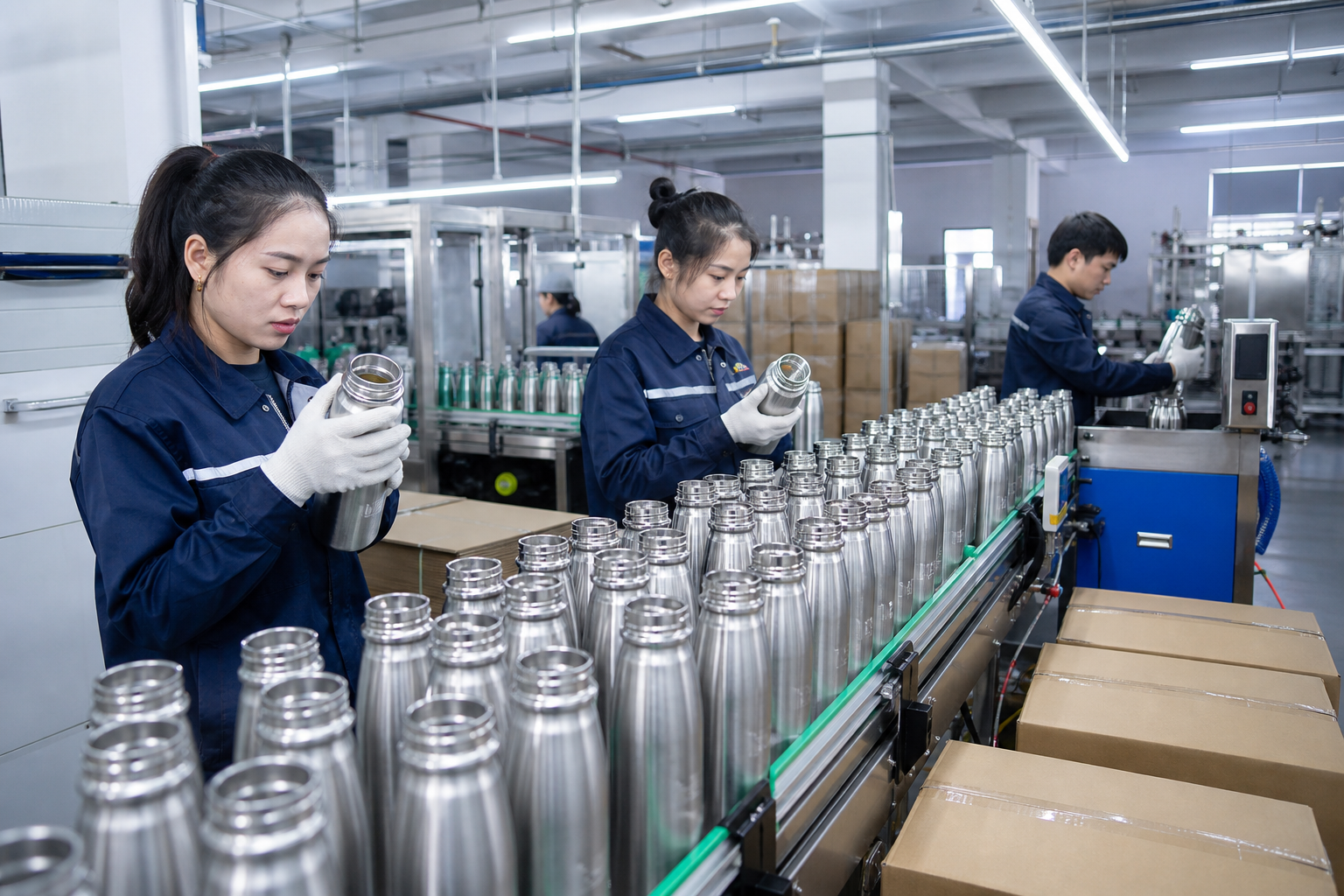
At our Zhejiang factory in China, the gap between a clean program and a headache usually shows up in small numbers: 0.4 mm versus 0.6 mm steel, silicone ring grade, whether the powder coat survives 50 dishwasher cycles, and whether we can hold a 25 to 35 day lead time at 500-piece MOQ or scale to 300,000 units per month. QC pulled the sample on the line last week and the buyer flagged a lid fit issue at 1.2 mm. That is the level to compare when buying wholesale drinkware.
Choose the right bottle structure
Buyers trip up when they treat every refillable bottle as the same part number. It is not. On the line, we start with body structure, then lid, then decoration. For cold-use retail, single-wall stainless steel with a 0.5-0.6 mm body is standard; it keeps the weight down and cuts freight. For insulated programs, double-wall vacuum construction costs more, and the math still works when the buyer wants fewer condensation complaints and a better shelf price point.
Tell us the use case before you ask for a quote. A gym bottle, a corporate giveaway, and a hiking bottle do not want the same closure. A flip lid is quick, while a screw cap with a carry loop holds up better in transit and on long-distance shipping. If the bottle is sold as wholesale drinkware in Europe or North America, ask for finished capacity, rim diameter, and neck finish in writing, not a marketing line. We’ve seen a sample pass, then mass production drift because the PO missed one digit.
- Body thickness: 0.4 mm is lighter and cheaper; 0.6 mm gives more dent resistance.
- Lid seal: silicone ring with a documented food-contact grade.
- Finish: powder coat, spray paint, brushed steel, or printed gloss.
- Capacity tolerance: ask for +/- 5 percent on the fill line.
When a SKU is sold as the best wholesale drink bottle in a retail line, it has to survive repeat use. First impression is easy. QC pulled the sample, checked the neck gauge, and the part that failed was the one that looked fine in photos. That is the wrong question to ask if you only chase looks.
Materials and compliance checks
Materials are where low-cost sourcing turns expensive if you skip the paperwork. For stainless steel, we ask for 304 grade on the inner wall for most premium refillable bottles; 201 can cut unit cost, but the math does not work once the buyer starts testing corrosion and odor. On the line, we check the mill certificate, not just the brochure. If the product is plastic, confirm the resin code and get a declaration of compliance for food contact. For Europe, REACH matters. For North America, ask for FDA food-contact documentation and, when relevant, California Proposition 65 screening. If the bottle is insulated, verify that the vacuum process leaves no oil residue or loose powder inside the chamber.
Do not assume a supplier in China can export because they have a catalog and good photos. A real factory in Zhejiang should be able to show traceable incoming inspection, material certificates, and a basic quality system such as ISO 9001. We ship plenty of private label runs, and the buyer flagged it when one factory could not match the heat number on the stainless coil to the finished bottle lot. If the factory works with chain retailers, BSCI is a useful signal for social compliance, but it does not replace product testing. For bulk drinkware, the carton and ink matter too. Ask whether the outer carton uses water-based ink and whether the product label uses FNSKU if the order is going to Amazon. I have seen a PO typo on the carton mark turn into 800 re-labeled units.
Practical rule: if a supplier cannot send you a test report and a material declaration within 48 hours, they are not ready for serious wholesale drinkware business.
For repeat orders, keep the approved sample, spec sheet, and signed artwork together. QC pulled the sample on a 1 mm cap gap once, and that saved us from a shipment with a weak seal and a different cap color. That file is your defense when a future lot arrives off spec.
MOQ, pricing, and lead times
MOQ is not just a number. It shows how the line runs. On a stable Zhejiang stainless-steel line, we can usually support a 500-piece MOQ for a standard bulk refillable water bottle with laser engraving or one-color print. Once the buyer asks for multicolor printing, a special carton, or a new cap, the MOQ often moves to 1,000 or 3,000 pieces. That is normal. On a recent PO, the buyer wrote “1k pcs” but missed the cap color code, and QC pulled the sample back the same morning. The factory should tell you which cost item is driving the jump.
For pricing, ask for three numbers: sample price, 500-piece price, and 3,000-piece price. If the quote barely changes, the math does not work. You want to see where the setup cost drops and where the print cost stays fixed. For standard wholesale drinkware, 25 to 35 days after sample approval and deposit is a fair lead time. We ship faster only when the item is stock-based. A claim like 10 days for a custom order usually needs proof, not applause.
- Sample lead time: 5-10 days for a standard spec.
- Mass production: 25-35 days after approval.
- Tooling: 10-20 days if a new cap or mold is required.
- Payment: 30 percent deposit, 70 percent before shipment is common.
If you are comparing bulk canteen, canteen wholesale, or drinkware wholesale quotes, compare landed cost, not factory price alone. Freight, inner cartons, master carton strength, and breakage rate can move the real cost by 8 to 15 percent. We saw one buyer save $0.12 per bottle on unit price, then lose it on a weak 5-ply carton that failed in transit. Ask for the carton spec, the gross weight, and the packed quantity per case before you sign off.
Branding without damaging function
Decoration lifts perceived value fast, but the wrong process ruins the bottle. For a bulk refillable water bottle, we usually start with laser engraving on stainless steel or a single-color silk-screen print with a tested ink system. That is the safe call. On powder-coated bottles, laser engraving gives a clean metal contrast only when the coating thickness stays steady. We check 60–80 μm on the gauge; if it runs thin, the mark looks weak, and if it runs thick, the edge turns ragged.
For promo runs, full-wrap print or a two-tone body can work, but the approval needs to be tight. Ask the supplier for exact Pantone references, print area, and curing temperature. We had a buyer flag a PO typo once—Pantone 186 C got written as 196 C—and the press line caught it before ink hit the bottle. Bad curing can leave odor or cut abrasion resistance, so this is the wrong place to guess. On lids, keep the branding small. A big logo on the cap wears out first because hands hit that spot all day.
Buyers sourcing drinkware bulk for retail should ask for the abrasion standard in writing. We set the bar at 50 cycles of normal hand washing, with no serious fading. If the bottle is for a premium line, ask for a 1 meter drop test with water inside, then check the lid for deformation, leakage, and print damage. QC pulled the sample on our bench last month and found a hairline crack around a printed cap after the third drop. The math does not work if the logo looks good on day one but fails in the first week.
One more practical point: if the same factory also sells growler wholesale, beer growler wholesale bulk, or alcohol flask wholesale bulk, do not assume the decoration settings transfer cleanly. Different curvature and coating chemistry need different settings on the line. We ship both 82 mm mouth bottles and curved flasks, and the pad print pressure changes from job to job. We have seen this go sideways when a buyer wanted the same artwork across all three SKUs.
Quality control that protects margin
Quality control starts before mass production, not at the port. We sign off a golden sample, tie the checklist to the PO, and write the defect callout in plain language. For a wholesale canteen or bulk refillable water bottle order, we ask the factory to inspect to AQL 2.5 for major defects and AQL 4.0 for minor defects unless the buyer pushes for tighter terms. That baseline works for most consumer drinkware, and the math holds.
We check leak testing, lid torque, coating adhesion, wall thickness, capacity, and carton compression. If the bottle is vacuum insulated, QC adds a vacuum retention check and a temperature hold test. For Europe, we ask for REACH-related declarations and we make the supplier separate a material certificate from a finished-product compliance file. QC pulled the sample on a 500 ml stainless bottle last month and found a 0.3 mm wall-thickness swing near the base; that kind of miss eats margin fast.
What to verify before shipment
- Leak test: 100 percent on assembled units for threaded lids.
- Drop test: 1 meter, 3 faces, with no functional failure.
- Carton test: at least 5-layer export master cartons for heavier SKUs.
- Sample retention: keep one approved unit per PO batch.
When a factory in China says the QC is strong, ask for defect photos from past shipments. A serious supplier in Zhejiang can show how they fixed a logo shift, a cap crack, or a sealing-ring issue without dancing around it. We had a buyer flag a PO typo on the print color code once, and the line caught it before ink hit the cups; that is the kind of proof you want, not a sales pitch.
When to expand your product line
Once your bulk refillable water bottle program is stable, the next move is line extension. We usually keep it on the same line and add one or two related SKUs with controlled risk. That might be a bulk canteen, wholesale canteen, stainless travel mug, or beer tumbler bulk if your customers want a broader drinkware wholesale offer. Keep the lids, coatings, and cartons aligned. If the QC sheet changes three times in one week, the operation gets messy fast.
Do not throw every category onto one PO just because the factory can make it. Beer growler in bulk, growler bulk, and alcohol flask in bulk all use different finishes and compliance paths. A growler wholesale order often needs a larger mouth and a different cap torque spec; we check that with the torque tester at 1.2 N·m, not by guesswork. An alcohol flask wholesale order usually wants thinner walls and tighter seam checks. A canteen bulk order is often price-led, and the math does not support premium engraving.
If you are building a private label range, start with two core bottle sizes and one add-on. For example: 500 ml for retail shelves, 750 ml for outdoor use, and one accessory such as a spare lid or carry strap. That keeps inventory under control and gives your distributor a clean story. We have seen this go sideways when a buyer tried to launch six SKUs at once; the carton labels drifted, then the PO had a typo on the FNSKU. If the program is moving into Amazon, match the listing and carton labels to the same SKU structure, then assign FNSKU at pack level so the warehouse does not mix cartons.
In Zhejiang and across China, the factories that perform best are the ones that hold a narrow spec on a high-volume line instead of promising every possible format. We run 304 stainless on the same line day after day because the yield stays predictable. That is the right question to ask.
Source your bottle line with fewer surprises
Send the spec, target MOQ, and market. We will match materials, decoration, and packaging to the retail or promo channel.
Frequently asked questions
What MOQ should I expect for a bulk refillable water bottle?
For a standard bulk refillable water bottle with one-color logo, 500 pieces is a realistic MOQ at many China factories. If you want special packaging, multiple print colors, or a custom lid, expect 1,000 to 3,000 pieces. For a vacuum insulated version, the MOQ often rises because the line is more complex. The right question is not only the MOQ but also what changes at each price break. Ask for 500, 1,000, and 3,000-piece quotes so you can see whether the supplier is pricing real production or just small-batch sampling.
How do I know if the bottle is compliant for Europe and North America?
Ask for the exact compliance pack before you pay the deposit. For Europe, that usually means REACH and food-contact declarations; for bottles with certain materials, LFGB is often requested by buyers even when it is not legally required for every case. For North America, request FDA food-contact documentation and any relevant Prop 65 screening. If the supplier says the product is fine but cannot send reports within 48 hours, treat that as a warning. A serious exporter in China should already have the paperwork ready for a bulk drinkware order.
What lead time is normal for custom wholesale drinkware?
For a standard custom wholesale drinkware order, 25 to 35 days after sample approval and deposit is normal. Add 5 to 10 days for sampling if you need artwork changes or a new finish. If tooling is required for a new cap or unique mold, add another 10 to 20 days. Freight and customs are separate from production, so do not confuse factory lead time with landed time. A factory in Zhejiang that says 7 to 10 days on a custom job may be quoting stock items, not a true production run.
Should I choose laser engraving or printed logos?
Choose based on the use case. Laser engraving is durable on stainless steel and works well for a premium bulk refillable water bottle, especially if you want a clean look with no ink wear. Silk-screen printing is better when you need a strong logo at a lower cost and can accept some abrasion risk over time. For powder-coated bodies, laser engraving can look excellent, but only if the coating thickness is consistent. If the bottle will be sold in high-volume retail, request abrasion testing and sample approval before mass production starts.
Can I combine water bottles with canteen or growler orders?
You can combine sourcing, but you should not blur the specification. A bulk canteen, canteen wholesale SKU, beer growler wholesale bulk order, and an alcohol flask wholesale bulk item may all come from the same factory, but they use different closures, coatings, and carton sizes. If you mix them on one PO without a clear spec sheet, you increase the risk of label errors and wrong-pack issues. For Amazon or retail programs, keep each SKU separate and confirm carton marks, barcodes, and FNSKU placement before shipment.