Key Takeaways
- A 500 ml or 750 ml bulk vacuum flask is the safest SKU for retail, with typical FOB pricing around USD 2.80 to 6.50 depending on finish and lid.
- For food-contact safety, ask for 18/8 stainless steel, REACH or LFGB paperwork, and an AQL 2.5 inspection standard.
- Standard custom thermos orders usually start at 1,000 pcs, while complex lids, gift boxes, or new molds can push MOQ to 3,000 pcs.
- A Zhejiang thermos factory with 400,000 units per month can usually ship in 25 to 35 days once samples and artwork are approved.
If you are buying a bulk vacuum flask for outdoor retail or a promo run, the wrong spec costs you twice: once on unit price, then again on returns. We shipped one job where the buyer picked a cheap lid gasket, and QC pulled the sample after a 12-hour hot test. The right question is not whether the thermos looks premium. It is whether the steel grade, wall structure, lid, and print method match how the customer will use it.
For most buyers, the decision comes down to a short list: 18/8 stainless steel, 500 ml or 750 ml capacity, a 1,000-piece MOQ, and a 25 to 35 day lead time from a China supplier. The better factories in Zhejiang run 400,000 units per month, but only if your artwork, packaging, and compliance file are clean on day one. We’ve seen this go sideways over a typo on the PO, and the math does not work when you have to redo cartons. That is where a custom thermos order stays smooth or turns messy.
Start With The Use Case
Before you compare catalog photos, lock the use case. A bulk vacuum flask for hikers does a different job than a promo thermos for a trade show. Outdoor buyers push for heat retention, a steady grip, and a body that survives a few drops on the floor. Brand owners and distributors watch logo space, carton count, and landed cost. If one design tries to do both, one side loses.
Start with the basics: 350 ml fits compact giveaway runs, 500 ml is the cleanest all-round retail size, and 750 ml or 1 liter makes more sense for camping, travel, or cold-weather promos. We see these three sizes on the line because the tooling stays manageable and the packing math works. On a recent 500 ml order, QC pulled the sample after the buyer flagged a 2 mm cap mismatch, and that saved a headache before mass production.
Use case filters that actually matter:
- Hot beverage retention target: 6 to 12 hours
- Cold beverage retention target: 12 to 24 hours
- Carton count: 24 or 30 pcs per master carton for lower freight cost
- Finish: powder coat for grip, mirror polish for premium gifting
If your buyers are outdoors-focused, ask for a scratch-resistant outer coating and a lid that opens with gloves on. If the flask is for promotion, keep the body simple and spend on branding and packaging. We’ve seen this go sideways when a buyer wanted a premium shape, a heavy print area, and a low MOQ in the same PO—the math doesn’t work.
Choose The Right Steel Build
The steel stack is what separates a solid bulk thermos from a cheap one. For most buyers, 18/8 stainless steel is the right baseline for both the inner and outer walls. We still see suppliers push 304 inside and 201 outside to shave cost, and the buyer flags it as soon as the first salt-spray test comes back ugly. If you want a custom thermos for export, keep both walls at 304 unless the target price forces a different call.
Wall thickness is where experienced buyers save money without hurting performance. A common spec is 0.35 mm to 0.45 mm on the inner wall and 0.35 mm to 0.50 mm on the outer wall. Thicker is not a free upgrade. It adds weight, pushes freight up, and slows the line when the deep-draw press starts creeping. The vacuum gap, weld quality, and seal integrity matter more than another 0.1 mm of steel.
Ask the manufacturer thermos team to confirm:
- 304 or 316 stainless for the food-contact surfaces
- Vacuum level and leak test method
- Silicone gasket grade and smell test
- Internal copper plating if they claim better heat retention
For Europe, request LFGB and REACH documents. For the US, ask for FDA food-contact declarations. A serious thermos supplier keeps those files ready before the PO lands. If they cannot state the steel grade clearly, treat it as a warning sign, especially on a low-cost promotional thermos run. We have seen that go sideways on a 5,000-piece order because the spec sheet called out 304, but the carton list showed 201 on the outer shell.
Pick Capacity And Lid Style
Capacity is not a marketing line. It changes bottle height, carton count, vacuum retention, and how the user actually carries it. A 500 ml bulk vacuum flask sells easiest for daily carry, office use, and short trips. We run 500 ml at 24 cm tall on one line, and it loads cleanly in export cartons. A 750 ml bottle gives more drink volume for longer outings and looks stronger on shelf. A 1 liter model fits gift sets and family use, but the math gets ugly fast on weight and freight.
Lid choice matters more than first-time buyers expect. A screw cap with a cup is simple, and QC pulled the sample apart without drama. A one-touch lid works better for commuters, but it adds parts, a spring, and more failure points if the seal is weak. Wide mouth helps with ice and cleaning. Narrow mouth holds temperature a bit longer. If you are sourcing a customizable thermos for a distributor thermos program, pick one lid family and build around it; mixing five lid formats in one PO just creates a mess at the packing table.
Good buyers ask for practical tests:
- Leak test at 45 degrees for at least 2 minutes
- Drop test from 1 meter onto concrete or steel plate
- Open-close cycle test for the lid, ideally 3,000 cycles or more
These checks look basic, but they cut down on complaints. We’ve seen a buyer flag a typo on the PO for 750 ml and still expect 500 ml cartons to fit; they didn’t. A promotional thermos with a clean print is still a bad product if it leaks in a backpack. For export, simple and tough wins.
Decoration That Holds Up
Logo work is where a custom thermos looks like a retail item, or like a rushed giveaway from a 3 p.m. packing table. The right method depends on artwork complexity, logo area, and abrasion. Silk screen is the low-cost option for one or two solid colors. We run it on the line when the customer wants a clean mark and the PO says 500 pcs MOQ. Laser engraving gives a tighter, permanent finish on brushed steel or matte powder coat. Heat transfer and wrap print fit full-color branding, but they need tighter process control; we’ve seen a 1 mm shift turn a sharp logo into scrap.
For a promotional thermos, keep the print simple. One logo, one short message, one readable URL. That’s enough. If the flask goes to outdoor retailers, the better question is not how much graphics you can cram on it. It is whether the buyer will accept a subtle logo and a finish that carries the value. A bold mark can work, but only if the line is consistent and the placement stays within 2 mm across the batch. QC pulled the sample on one order because the logo wandered on the curve, and the buyer flagged it fast.
Ask your thermos supplier for:
- Print tolerance on curved surfaces
- Color match reference using Pantone
- Scratch resistance test after packing and transit
- Artwork proof on a real sample, not only a flat mockup
For buyers comparing custom logo options, the rule is simple: if the product will be washed, rubbed, or stuffed into a bag every day, choose a decoration that survives handling instead of chasing the cheapest print. We ship a lot of bottle orders where the logo looks perfect on day one and tired after 12 days in transit and warehouse handling. The math does not work if you save $0.06 and lose the order after the first complaint. That is how a thermos custom order stays profitable after launch.
MOQ, Price, And Lead Time
The real question is MOQ and where the cost jumps. For a standard bulk vacuum flask order, we usually start at 1,000 pcs per color and per capacity. Add a new lid, custom carton, or a shaped body, and MOQ often climbs to 3,000 pcs or more because the cap mold, foam insert, and line setup all change. Asking for "best price" first is the wrong question to ask. We run this every week, and the buyers who ask what changed in the build get a cleaner quote.
A plain stainless model usually lands at USD 2.80 to 4.20 FOB at 1,000 pcs. Powder coat, gift box, and a better lid move it to USD 4.50 to 6.50 or more. At one Zhejiang plant running 400,000 units a month, the lead time is 25 to 35 days after sample approval. We have seen that slip when artwork sits 3 days on the buyer's side and the carton mark comes back with a typo. The math does not work if approval drags.
Useful questions to put to the supplier thermos team:
- What is the MOQ by color, lid, and carton style?
- Is the quoted price FOB Ningbo, FOB Shanghai, or ex-works?
- How many days for samples, and are sample charges refundable after approval?
- Can you hold stock for repeat distributor thermos orders?
Do not accept vague answers on capacity or packing count. A serious thermos vendor should quote it line by line, because that is how you protect margin when you buy from China. We once caught a PO typo on carton count, and QC pulled the sample again before the line packed 12,000 pcs.
Check Quality Before Shipment
If you want fewer claims, inspect the flask like a buyer, not like a designer. For a bulk vacuum flask, the QC sheet should cover visual checks, leak tests, thermal retention, carton checks, and document checks. AQL 2.5 is common for major defects on consumer drinkware; some premium buyers run AQL 1.5. Numbers matter, but matching the approved sample matters more.
Ask for a pre-shipment report with the exact SKU, lot count, and defect list. We check this against the PO line by line, and a missing carton code or one wrong lid color can turn into a dispute fast. For Europe, ask for REACH and LFGB files where they apply. For the US, ask for FDA declarations and test reports tied to the same material batch. If the thermos maker has BSCI or ISO 9001 audit records, good. That still does not replace product testing.
Minimum checks worth paying for:
- Hot-water retention test after 6 and 12 hours
- Vacuum seal test for random units from each lot
- Carton drop and compression test for export packaging
- Logo alignment and color consistency across all cartons
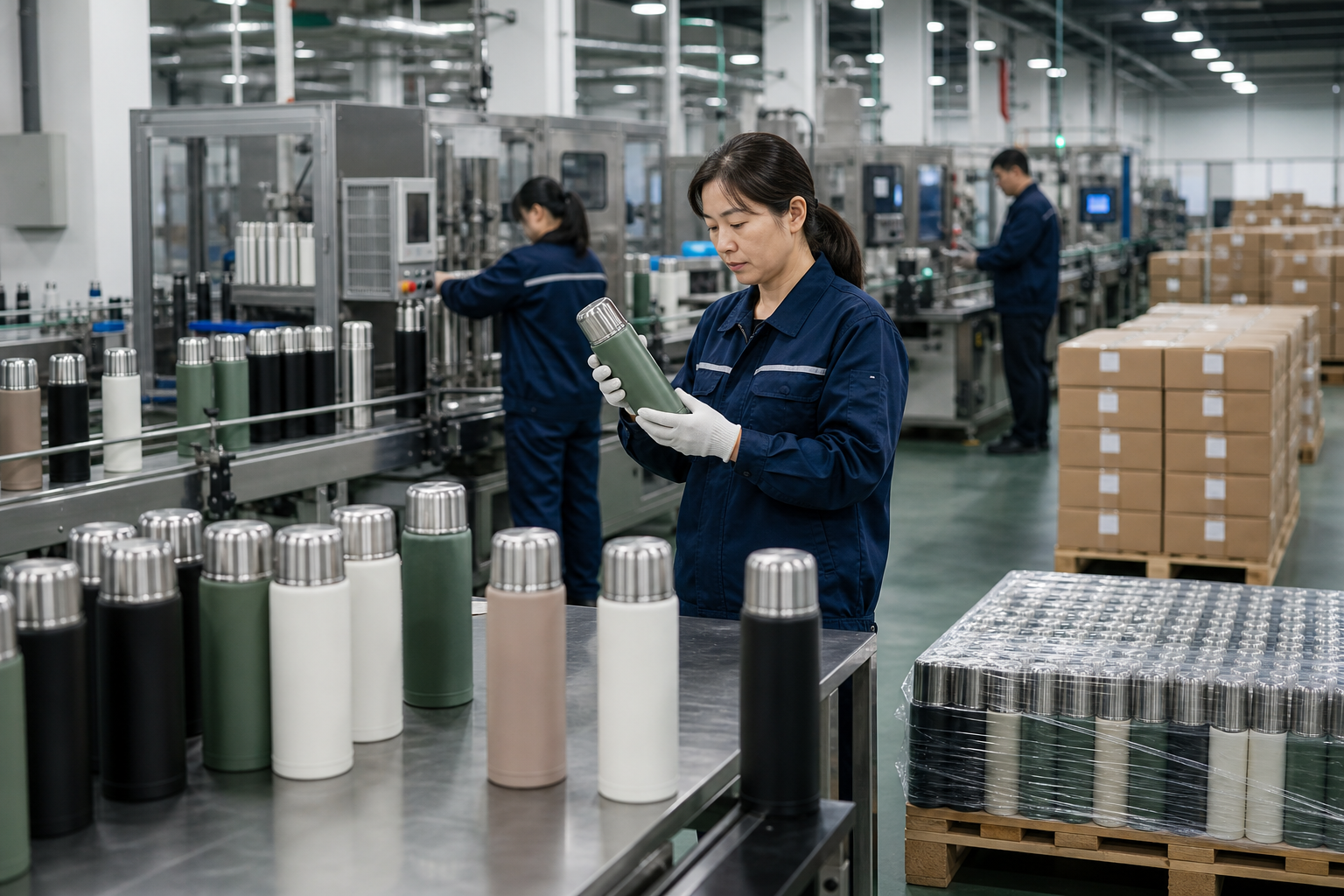
A Zhejiang thermos factory that really ships export orders will not push back on these checks. We run these on the line with a torque meter and a simple 1-meter drop test, then QC pulls samples before packing. If the supplier argues, the math does not work. You want a factory that treats inspection as part of production, not as an add-on.
Request a custom thermos quote today
Send your size, logo, target price, and market. We will match the right factory thermos spec, MOQ, and packaging for your order.
Frequently asked questions
What is a normal MOQ for a bulk vacuum flask order?
For a standard bulk vacuum flask with existing molds, 1,000 pcs per color is common. If you keep the body shape and lid from a factory stock model, some China suppliers will accept 500 pcs, but pricing usually rises 10% to 20%. Once you ask for a new lid, custom packaging, or a different finish, MOQ often moves to 3,000 pcs. If you are a distributor, ask whether MOQ is per SKU or per shipment. That detail changes your inventory risk more than the headline number.
Should I choose 304 or 316 stainless for a custom thermos?
For most retail and promotional thermos programs, 304 is the right choice. It gives good corrosion resistance, food-contact compatibility, and a sensible cost base. Use 316 only when the product will face harsher conditions, salty environments, or a premium spec that justifies the extra material cost. The price difference is usually small in percentage terms, but it still matters on large thermos bulk orders. What matters more is whether both inner and outer walls use the same grade and whether the supplier can prove it with test documents.
How long does sample and production take in China?
A normal custom thermos sample takes 5 to 10 days if the design uses existing molds and standard decoration. Production time is usually 25 to 35 days after sample approval and deposit, assuming the factory has materials in stock. If you need a new mold, special lid, or complex gift box, add 15 to 25 days. A Zhejiang thermos manufacturer with strong capacity can move faster, but only if your artwork, Pantone references, and carton details are final. Slow approvals are the main cause of missed ship dates.
Which logo method is best for a promotional thermos?
If you want low cost and simple artwork, silk screen is the usual choice for a promotional thermos. If you want a permanent mark that will not fade, laser engraving is stronger, especially on brushed steel or matte powder coat. For full-color branding, wrap print or heat transfer works better, but it needs tighter quality control and usually costs more. A good rule is to match the method to the use case: giveaways can use simpler print, while retail and outdoor products should use the most durable decoration you can afford.
What documents should a thermos supplier provide for Europe and North America?
For Europe, ask for LFGB and REACH-related documentation where applicable, plus material declarations for the stainless steel, silicone, and coatings. For North America, request FDA food-contact declarations and any test reports tied to the material batch. If the order is for Amazon or a large distributor, also ask for carton labels, country-of-origin marking, and traceability by lot number. A serious thermos supplier should be able to give you a pre-shipment inspection report, not just a packing list. If they cannot, your compliance risk goes up fast.