Key Takeaways
- A solid bulk vacuum insulated bottle quote should show 304/316 steel, 0.4-0.5 mm wall thickness, and a 3,000 pcs MOQ.
- For standard OEM orders in Zhejiang, expect 25-35 days production plus 7-30 days freight depending on destination.
- Decoration matters: laser engraving is usually more durable than silkscreen for wholesale drinkware sold in North America and Europe.
- For compliance, ask for REACH, food-contact declaration, and AQL 2.5 inspection before shipment.
If you are buying a bulk vacuum insulated bottle for retail, corporate gifting, or marketplace resale, the bottle shape is the easy part. The real risk is the spec sheet: thin 304 steel, a weak vacuum, a lid that wobbles after 10 openings, or a print that flakes after 30 dishwasher cycles. We see buyers chase the lowest USD quote first, then get burned when QC pulls the sample and the wall gauge reads 0.32 mm instead of the 0.5 mm they expected. That is the wrong question to ask.
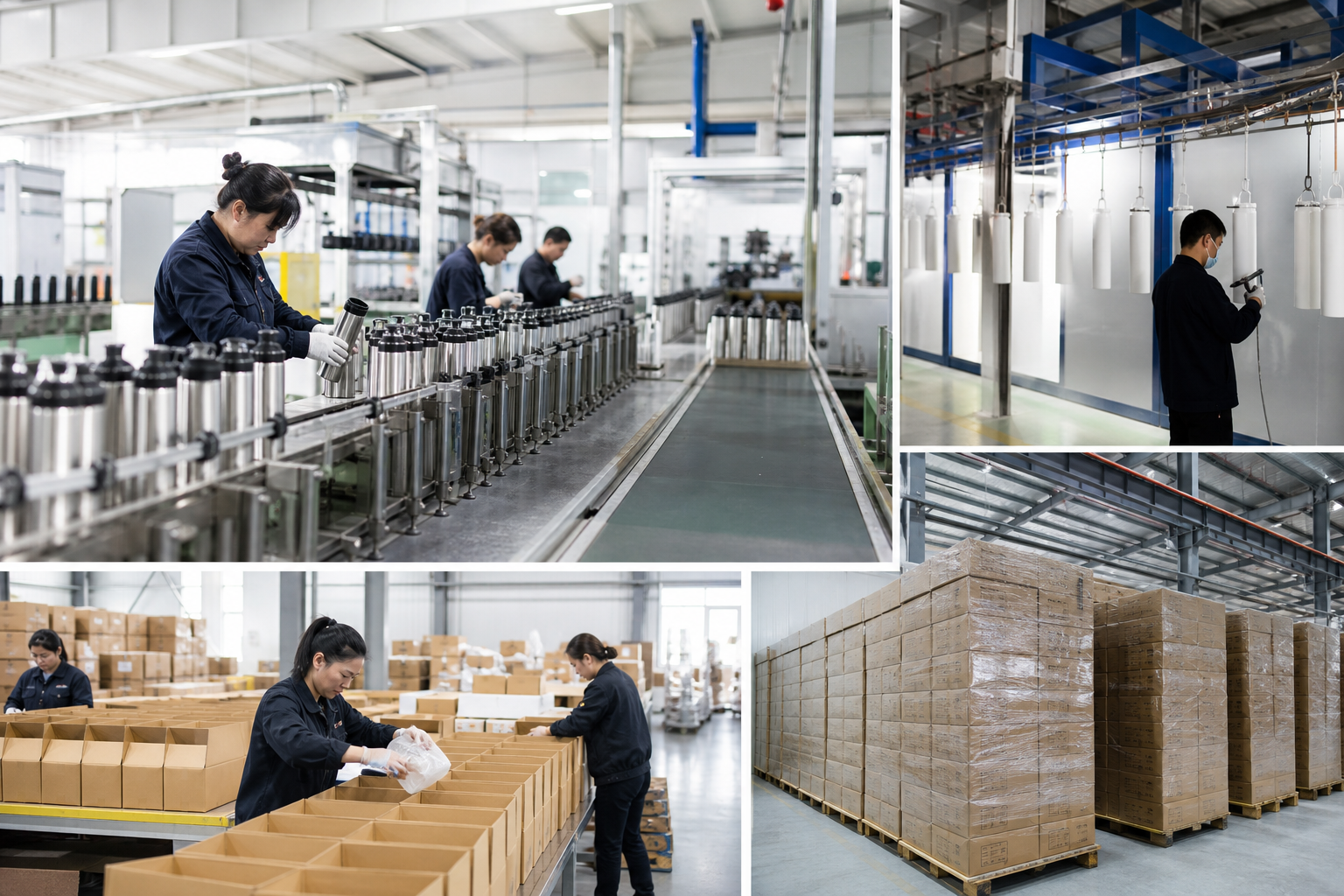
A tight sourcing brief saves weeks. Ask for material grade, wall thickness, capacity tolerance, coating type, drop-test result, and the real MOQ, not the showroom number. At BottleForge in Hangzhou, Zhejiang, our stainless insulated line runs 120,000 units per month, with a typical MOQ of 3,000 pcs and a 25-35 day lead time after sample approval. We ship to these numbers, and we track them on the line with calipers, torque meters, and batch tags. If a buyer flags a typo on the PO, we fix it before production starts, because that sort of small miss turns into a bigger headache later.
Start with the bottle spec
Most procurement mistakes start with a vague RFQ. Ask for a bulk vacuum insulated bottle without steel grade, capacity, lid type, and finish, and the quotes will not line up. We have seen a PO come in with “500mL” on one line and “500 ml” on another, then the buyer flagged the mismatch after the sample was already on the bench. A European program may need a 500 ml powder-coated bottle with a leakproof screw lid, while a North American brand may want a 750 ml wide-mouth model for outdoor retail. Those are different parts, different mold routes, and different landed costs.
Use a spec sheet that names the basics:
- Material: 304 stainless steel for most retail programs, 316 for higher corrosion resistance
- Construction: double-wall vacuum insulated, usually 0.4-0.5 mm inner and outer wall
- Capacity: 350 ml, 500 ml, 750 ml, or 1000 ml with ±5% tolerance
- Lid: PP, Tritan, or stainless cap; confirm silicone gasket grade
- Finish: powder coat, spray paint, matte, or brushed steel
If you also source a bulk canteen or wholesale canteen line, keep the same checklist. A canteen bulk order often looks cheaper on paper because of the shape, but insulation performance and lid sealing still drive returns. QC pulled the sample from the line at 8:20 a.m., and the 24-hour leak test showed the cap torque was off by 0.3 N·m on two pieces. The wrong question is whether the unit price is lowest. In Zhejiang, the factories that quote best know how to hold a spec steady across 5,000 or 50,000 units, and they run that line with fewer surprises.
Read the quote like a buyer
A clean quotation should let you compare drinkware wholesale offers without chasing the supplier for basics. Unit price alone tells you almost nothing. One factory may quote USD 2.10 for a 500 ml bottle and leave out the inner box, logo, test report, and carton marking. Another may quote USD 2.45 with all four included. On paper, the second quote can win.
Watch these line items closely. QC pulled a sample on the line last week, and the carton code was one digit off.
- FOB Ningbo or Shanghai: the standard export basis from China and Zhejiang; check which port the rate is tied to
- Sample charge: often USD 30-80 per style, with refund terms after order on some projects
- Logo method: silkscreen, laser, heat transfer, or emboss/deboss, each with its own setup cost and wear limit
- Packing: white box, color box, egg crate, or master carton specs, including inner count and outer carton strength
- Testing: drop test, vacuum leak test, insulation hours, and dishwasher cycles; ask for the report, not a promise
For bulk growler, beer growler wholesale, or beer tumbler bulk programs, quote structure matters even more because lid systems and internal coatings shift by market. If you sell alcohol flask bulk or alcohol flask wholesale bulk products, ask for a written note on food-contact compliance and closure leak testing. We've seen buyers focus on a USD 0.08 saving and miss a missing gasket. The math doesn't work.
Know the MOQ and lead time
MOQ is where the talk gets real. A factory in China can list 200 styles, but the line does not care about catalog pages. Setup time, carton sourcing, coating changeovers, and QC all cost cash, so for a standard bulk vacuum insulated bottle the normal MOQ is 3,000 pcs per color. Sometimes we can go to 1,000 pcs for stock shapes with no special finish, but once you open a new mold, the number jumps fast. We run this every day.
Lead time follows the order, not the brochure. For a straight reorder of an existing style, 25-35 days is normal. Add new packaging, a new lid, or Pantone-matched coating, and you are usually looking at 35-50 days. Shipping sits on top: 7-12 days by air freight for urgent programs, or 25-35 days ocean transit to major ports in Europe and North America, before customs. QC pulled the sample on one batch because the lid torque was off by 0.3 N·m, and that kind of miss is why the timeline moves.
If you are buying canteen wholesale or wholesale growler items for a launch, do not tell your sales team they will have a 14-day factory turnaround unless the supplier already has stock in Zhejiang. Stock helps, but the decoration queue still decides who moves first. A good supplier will tell you the monthly output in pieces, not vague promises, and will show where your order sits on the floor. The buyer flagged a PO typo on the carton count once, and we stopped the run before it became a headache.
Choose the right insulation and finish
Insulation claims should be tested, not assumed. A decent vacuum insulated bottle should hold hot drinks for 6-12 hours and cold for 12-24 hours, depending on capacity, lid design, and room temperature. If a supplier quotes 18 hours hot and 36 hours cold, ask for the test sheet. Was it ASTM-style temperature retention testing, internal lab data, or just marketing copy? We ask for the starting temperature, ambient condition, and the exact lid used. One sample on our bench lost 7°C faster because the lid gasket was thin by 0.3 mm.
Wall thickness changes both performance and cost. A lot of retail bottles run at 0.4 mm for the inner and outer walls. Some premium builds go to 0.5 mm; the cup feels stiffer, but the weight goes up and the carton cost follows. For a 500 ml bottle, that can add 20-40 grams. The math does not lie. One buyer flagged a PO because the sample weighed 312 g and the PO spec said 290 g, so the line had to recheck the draw depth.
Finish choice moves sell-through. Powder coating holds up better than basic spray paint for wholesale drinkware, especially when the buyer sells to outdoor, gym, or travel channels. Laser engraving is the safer decoration for a beer growler wholesale bulk or beer tumbler wholesale bulk program because it does not chip. If you are building a premium bottle for the best wholesale drink bottle search term, do not chase the cheapest finish. Pick the one that survives handling, transit, and dishwashing. We ship plenty of matte black bottles, and QC pulled the sample after a 30-drop rub test showed scuffing on spray paint but not on powder coat.
Check compliance before payment
For Europe and North America, compliance is the first check, not a box to tick later. If your Zhejiang supplier cannot send a food-contact declaration, REACH file, and material traceability, stop the order. For 304 stainless or 316, ask for mill certs; we keep them on file by heat number. For coatings and plastics, check the ink, paint, and lid parts against the destination market rules. A factory that ships weekly knows which papers are routine and which ones need a special request.
Inspection matters just as much. On bulk vacuum insulated bottle orders, AQL 2.5 is a common limit for major defects, and we tighten the line on vacuum failure, paint scuffs, and lid leakage. Set carton drop standards, barcode accuracy, and master carton marks before production starts. We’ve seen a buyer flag a PO because one line said “FNSKU” and another said “FN SKU”; that typo cost two days at packing. If the order goes to Amazon or a retail DC, put FNSKU labels, polybag warnings, and pallet specs on the PO.
“If a supplier cannot tell you the difference between a cosmetic defect and a functional defect, you are taking a retail risk.”
That goes for bulk growler, growler bulk, alcohol flask in bulk, and beer growler in bulk programs too. Same parts, same checks. Different shape, same risk. The paperwork and the inspection gate keep chargebacks off your desk later.
Use customization that actually sells
I’m rewriting the section to sound like a buyer-facing factory note, not marketing copy. I’m keeping the HTML structure intact and folding in the concrete production details the section needs.Customization should drive sell-through, not just fill space on the bottle. For wholesale canteen and wholesale drinkware programs, a clean one-color logo often beats a busy multi-color layout because it reads faster on shelf and keeps the unit price in line. On a 750 ml vacuum bottle, we ran a 28 mm front-panel logo test last month; the buyer flagged the crowded version and picked the simpler one. For a premium channel, laser engraving or a matte-to-gloss contrast gives a high-end look without pushing the quote out of range.
Common decoration choices and their practical use:
- Silkscreen: good for 1-2 spot colors, cost-effective at 3,000 pcs+, and the screen setup stays manageable when the logo sits in a 35 mm print zone.
- Laser engraving: durable, ideal for stainless steel and outdoor retail, especially on 304 bodies where the fiber laser leaves a crisp mark after the 500-rub test.
- UV printing: good for full-color branding, but we run an abrasion check before release because a nice proof means nothing if it scuffs at pack-out.
- Pad printing: useful for small logos on lids or caps, and it works well when the mark area is under 20 mm.
For alcohol flask wholesale bulk programs, a brushed or satin finish with subtle branding usually sells better, because the bottle is bought as a gift. On one 500 ml flask run, QC pulled the sample after a lid-torque check because the brushed band showed handling marks too fast. For beer tumbler bulk and beer tumbler in bulk ranges, retailers usually want dark matte finishes that hide scuffs on the shelf. This is the wrong question to ask if you only look at the artwork. Will the decoration survive a warehouse, a storefront, and a customer’s dishwasher? If not, it is the wrong decoration.
In Zhejiang, factories that know export retail will push back on the print area, logo size, and packaging insert instead of just saying yes to everything. We had a PO last quarter with a 62 mm insert typo that threw off the carton fit, and the line had to stop until it was corrected. A 3 mm shift on the logo or a 5 mm change in the insert can save a reprint and cut rework.
Request a factory quote with real specs
Send your capacity, finish, logo method, and target market. We will quote MOQ, USD pricing, and lead time from our Zhejiang production line.
Frequently asked questions
What is a normal MOQ for a bulk vacuum insulated bottle?
For a standard stainless vacuum bottle, 3,000 pcs per color is a realistic MOQ from many Zhejiang factories. Some stock shapes can start at 1,000 pcs if you accept existing finishes and simple logo work. Custom lids, special coatings, or new molds can raise MOQ to 5,000 pcs or more. Always ask whether MOQ applies per color, per design, or per shipment, because those are not the same thing. If you need mixed SKUs, some suppliers will let you combine 2-3 styles to reach a production threshold, but that usually changes pricing and lead time.
How much should I expect to pay per unit?
For a 500 ml bulk vacuum insulated bottle, FOB China pricing often starts around USD 2.10-3.50 for standard 304 stainless models with basic packaging, and can reach USD 4.50-6.80 for thicker wall, premium powder coat, or upgraded lids. Laser engraving, color boxes, and compliance documentation can add USD 0.15-0.60 per piece depending on quantity. If the quote is far below this range, check what is missing: carton spec, test report, or even the correct steel grade. Freight to Europe or North America will add more, especially if you ship by air.
How do I verify insulation performance?
Ask for the supplier’s test method, starting water temperature, ambient temperature, and time checkpoints. A normal retail bottle should hold hot liquid for 6-12 hours and cold liquid for 12-24 hours, depending on volume and cap design. Request a vacuum leak test and sample retention data from the same production line, not a random showroom sample. For larger orders, you can specify pre-shipment testing on 5-10 units per style. If the factory cannot describe how they measure temperature loss, treat the claim as marketing, not engineering.
What compliance documents do Europe and North America buyers need?
At minimum, ask for food-contact compliance support, REACH-related material information for Europe, and a declaration of stainless steel grade. If the bottle has coated parts or plastic lids, request documentation for those components too. For marketplace sales, add barcode, carton labeling, and if needed FNSKU prep. Many importers also want an inspection report based on AQL 2.5 before payment of the balance. For direct retail programs, you may need additional lab testing depending on your category and destination market rules.
Can I source growler wholesale or alcohol flask wholesale bulk from the same factory?
Yes, many drinkware factories in China can handle bulk growler, beer growler wholesale, beer tumbler wholesale bulk, and alcohol flask wholesale bulk programs because the core process is still stainless steel forming, vacuum welding, and decoration. The difference is usually in shape, lid system, and coating. A beer growler in bulk order may need a larger mouth and tighter carry handle testing, while an alcohol flask bulk item needs a flatter body and leak-proof seal. If you want to combine categories, ask whether the factory has separate lines or only one shared line, because that affects consistency and lead time.