Key Takeaways
- Standard growler MOQ is often 1,000 pcs, with 25-35 day lead time from a Zhejiang factory.
- 304 stainless at 0.7-0.8 mm wall thickness is the safest default for beer growler bulk.
- Ask for AQL 2.5 major and 4.0 minor defects, plus 24-hour leak testing and REACH or LFGB documents.
- Decoration can change unit cost by 8-20%, so lock logo method and packaging before sampling.
If you want to buy in bulk growler, capacity is only the first check. You are buying a container that has to hold beer foam, survive repeated wash cycles, pass export transit, and still look clean when the buyer opens the carton and inspects the lid. We saw one sample fail after 12 wash runs because the cap liner shifted 1.5 mm. That kind of miss kills a program fast.
For importers in Europe and North America, bulk growler sourcing works better when you treat it like a small production job, not a catalog click. A Zhejiang factory can send a price in one day, but the quote that matters lists body gauge, coating type, carton size, test standard, and lead time in writing. We run this on the line all the time: a low FOB number can turn into a bad deal once freight, AQL 2.5 inspection, and rework get added. The math does not work if those items are missing.
Pick the right growler spec
Start with the use case. A 64 oz stainless beer growler is not the same as a 32 oz commuter bottle, and we do not let a supplier blur those two. For retail and taproom programs, 32 oz, 64 oz, and 1 liter are the stock sizes we run. For buy in bulk growler orders, 304 stainless with 0.7-0.8 mm wall thickness is the usual call because it keeps cost, weight, and dent resistance in line. Glass looks clean on shelf, but one cracked case can turn into a claims pile fast, so we only use it when the channel can take the breakage rate.
Think about filling and cleaning next. If the customer fills from a tap, a wide mouth and a gasket that seals on the first test matter more than a shiny logo. QC pulled the sample with a 38 mm opening, and the buyer flagged a lid that needed two hands to close. If you are selling a wholesale growler as a gift item, a matte powder coat or brushed exterior can support a higher ticket. For a mixed drinkware wholesale catalog, we often pair growler bulk with a bulk canteen or canteen wholesale line, but only when the lid spec and carton count stay clean. The wrong question to ask is whether the bottle looks premium first; the math works from fit, closure, and pack-out.
- Choose capacity first.
- Choose lid and gasket second.
- Choose decoration last.
Materials decide price and risk
Material choice sets the margin and the complaint rate. For beer growler bulk, 304 stainless is the line we run most often because it keeps cost and corrosion risk in balance. 316 adds about 15% to 20% to the unit price, so we reserve it for harsher storage or a premium shelf story. Glass can work for growler wholesale, but it needs a heavier master carton, 12 mm separators, and a claim budget that the buyer can live with. Coated carbon steel is not a serious option for beverage contact.
Gasket and closure quality matter just as much as the body. A bad silicone ring makes a solid bottle feel cheap, and QC pulled the sample on a 3,000-cycle cap test when the seal started to lift. Ask for food-grade silicone, a leak test, and a clear closure-cycle target. For alcohol flask in bulk or alcohol flask wholesale bulk programs, the same rule applies: the metal may pass, but the lid decides whether the buyer reorders.
Do not skip compliance. For Europe, ask for REACH and, where relevant, LFGB. For North America, check FDA food-contact declarations and keep traceability on file. If a factory in China cannot name the resin or steel grade, they are not ready for a serious wholesale drinkware order. We had a PO last month with the wrong steel code typed in, and that small error cost two days on the line. In Zhejiang, stronger exporters already tie material certificates to batch numbers, which saves time when customs or a buyer asks for paperwork.
MOQ, lead time, and FOB
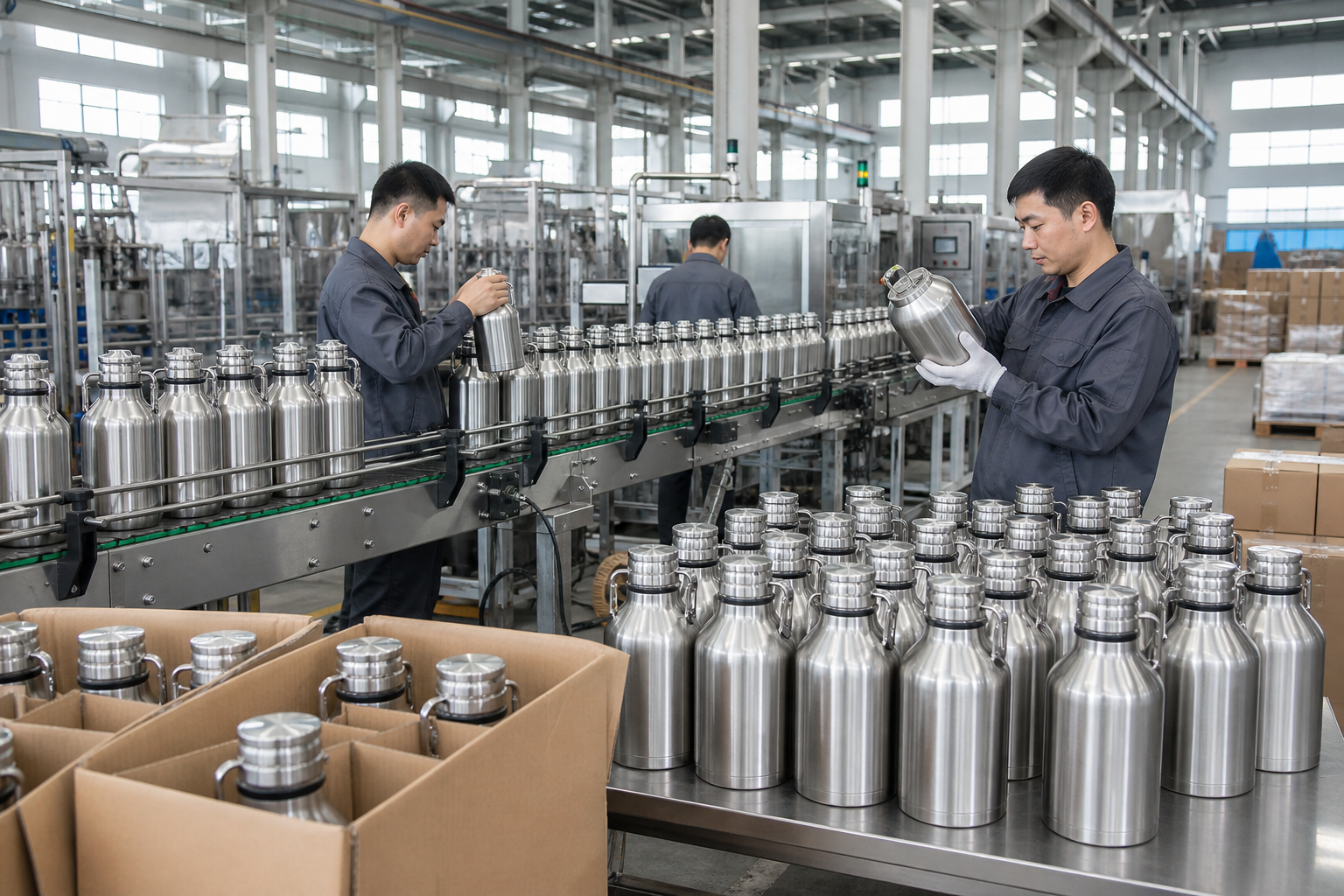
Unit price is the easy trap. A proper wholesale growler quote should show the Incoterm, decoration method, carton count, and sample policy. In our Zhejiang plant, we run 120,000 units a month across metal drinkware. MOQ starts at 1,000 pcs for a standard stainless growler and 3,000 pcs for fully custom packaging. Lead time is 25-35 days after sample approval; custom colors or a tool change push it to 40-50 days. QC pulled a sample last week and caught a lid thread issue before it hit packing.
EXW can look cheap on paper and still lose money at destination. Ask for FOB Ningbo or Shanghai so you can compare freight on the same basis. A plain 64 oz beer growler in bulk usually lands in the USD 4.20-6.80 range before ocean freight, depending on wall thickness, finish, and lid. Laser engraving adds less than a full-color print on a coated surface. Retail-style packaging cuts carton density, and the buyer flagged that in a PO because the outer carton size was written wrong by 10 mm.
Stable reorder pricing matters more than a one-time low quote. If your forecast is 5,000 units, do not take a price that only works at 20,000. The math does not work. We have seen this go sideways on the second PO, when the factory has to reprice the line and the margin disappears.
Quality checks that matter
Quality control belongs in the PO, not in a polite email. For bulk drinkware and wholesale growler orders, we write AQL 2.5 for major defects and 4.0 for minor defects unless the buyer asks for tighter limits. We run incoming material checks, in-line inspections, and final random inspection before packing. On this line, the first thing QC pulls is the lid torque sample, then they check the body for scratches and print shift. For a beverage container, the basic tests are leak, seal fit, drop, and surface adhesion.
Ask for an inverted leak test for 24 hours, a closure open-close cycle target, and a cross-hatch adhesion check if the product is coated. If you sell into retail, a 1.2 m drop test on the packed carton is a sensible baseline. One buyer once sent a PO with “LFGB” typed as “LFBG”; we caught it before sampling, and that saved a week of back-and-forth. For EU import programs, keep REACH documents on file; for food-contact claims, LFGB is often requested by buyers even when local law does not require the same document set. ISO 9001 and BSCI do not replace product testing, but they tell you the factory has process discipline.
Do not approve pre-production samples until the lid seals on the actual filling line, not just on a bench test. We’ve seen this go sideways with a 0.3 mm gasket gap.
That step stops the most common growler complaint: the bottle looks fine, then seeps after the first wash cycle.
Branding without killing margin
I’m rewriting the section in-place, keeping the HTML tags and structure unchanged while tightening the sales tone and adding concrete factory details.Branding should support the channel, not fight the product. On stainless, laser engraving is the cleanest route; it survives daily washing and keeps the surface clean. Silkscreen gives a sharper color hit, but on a curved body a 0.3 mm registration miss or weak pre-treatment will crack the ink. Powder coat opens up retail colors, but Pantone has to be locked before the line runs, or QC pulls the sample and the batch splits.
If you are selling beer growler wholesale bulk into taprooms, a one-color logo and a size mark usually beat a crowded graphic. This is the wrong question to ask if the buyer wants shelf speed. For Amazon or DTC, the buyer will flag the carton if the FNSKU sits over the brand mark, so the polybag rule and barcode placement need to be set before packing starts. We run logo, carton, and master case as one check, not three separate guesses. The same packaging discipline applies to beer tumbler bulk, beer tumbler wholesale, and canteen bulk programs. MOQ 3,000 pcs keeps the print setup honest.
Review decoration cost in percentage terms, not just dollars. A simple laser mark might add 0.15 USD, while a wrap print plus custom box can push the landed unit up 8% to 12%. If the retail margin can carry it, fine. If the SKU is a replenishment item, that spend just burns cash. We have seen this go sideways on a PO that said "black logo" and left the Pantone code blank.
Order like an export buyer
The safest order flow is plain: sample, sign off, deposit, production, inspection, ship. We start with one pre-production sample in the exact finish and lid combo you plan to buy. Then lock carton count, pallet pattern, and master case marks. If the order is going to a distributor, ask for photo proof at 20%, 50%, and 80% output. We run that on the line all the time, and it saves you from ugly surprises at loading.
For paperwork, you will usually need the commercial invoice, packing list, and bill of lading. If the shipment is going into a retail program, align the barcode and carton label early so the warehouse does not kick it back later. A 30/70 payment split is common, but bigger programs may use 20/80 or letter of credit. We had one PO with the wrong carton mark code by one digit, and QC pulled the sample before it became a claim. If your program spans wholesale canteen, wholesale growler, and alcohol flask wholesale bulk SKUs, group the calendar so the factory can run one batch instead of three small ones.
When the numbers are right, buy in bulk growler is not a risky phrase. It is a disciplined sourcing order from China, with export details closed before the goods leave Zhejiang. The math works. If it does not, the buyer flagged it already.
Quote your next growler run with real factory data
Send the spec, target price, and market. We will map MOQ, lead time, testing, and packaging before you place the PO.
Frequently asked questions
What MOQ should I expect for a wholesale growler order?
For a standard stainless wholesale growler, 1,000 pcs is a realistic MOQ in China if you are buying an existing body and lid structure. If you want custom coating, special packaging, or a new closure, expect 3,000 pcs or more. A Zhejiang factory with stable production can usually sample in 7-10 days and run mass production in 25-35 days after approval. If the supplier offers 300 pcs with a fully custom spec, check where they are cutting corners. Low MOQ is fine for sampling, but it is not a good signal for repeatable bulk drinkware supply.
Is 304 stainless enough for beer growler bulk programs?
Yes, 304 stainless is the normal default for beer growler bulk and most wholesale drinkware programs. It gives you a good balance of corrosion resistance, cost, and availability. In practice, 0.7-0.8 mm wall thickness is a sensible target for a retail growler that will be washed and reused. Move to 316 only if the buyer has a specific corrosion or premium-positioning reason, because it usually adds cost without changing the customer experience much. The lid, gasket, and coating quality matter more than the jump from 304 to 316 in most B2B orders.
What quality documents should I ask for from China?
At minimum, ask for REACH if you are shipping to Europe, plus LFGB if your buyer wants food-contact support for the German market or a stricter retail file. For process control, request ISO 9001 and BSCI if you care about auditability, but do not treat them as product tests. Your PO should also specify AQL 2.5 for major defects and 4.0 for minor defects, a 24-hour inverted leak test, and a 1.2 m drop test on packed cartons. A serious China supplier should also keep batch traceability for steel, silicone, and coating lot numbers.
Can I mix growler, canteen, and other drinkware SKUs in one shipment?
Yes, and that is often the best way to reduce freight cost for wholesale drinkware. The key is to group SKUs that share a similar body size, lid platform, or carton style. A bulk canteen and a wholesale growler can share a container well if the cartons load cleanly and the labeling is consistent. If you also add a smaller alcohol flask wholesale bulk program, the packaging plan becomes more complex, so build a clear carton map before production starts. Mixed-SKU shipping works when the factory treats it as one export plan, not three separate small orders.
How do I keep landed cost under control?
Standardize the body first. A 64 oz stainless growler with one-color laser engraving is usually cheaper to land than a custom-shaped bottle with full-color print and a retail box. Ask for FOB Ningbo or Shanghai so you can compare freight fairly, then check the carton count and master case size. If your quote changes by more than 10% between sample and mass production, ask why. A stable growler wholesale program should let you reorder at nearly the same price for at least two seasons, not force a redesign every time you buy again.