Key Takeaways
- A realistic MOQ for custom sport bottles is usually 500 to 3,000 pcs, depending on mold, print, and lid type.
- A stable China factory should show a lead time of 20 to 35 days and a monthly capacity above 300,000 units.
- For EU and US sales, ask for REACH, LFGB where relevant, and packaging that supports FNSKU or carton labeling.
- The cheapest quote is often wrong if the lid, gasket, or coating fails after 30 to 50 wash cycles.
If you want to buy sport bottle wholesale, the hard part is not finding a bottle. It is buying the right bottle at the right cost without turning the order into a leak, compliance, or freight headache. For Europe and North America, we check material grades, lid sealing, print rub resistance, and whether the supplier can hold the same spec on a 5,000-unit repeat without drifting 0.3 mm on the cap thread.
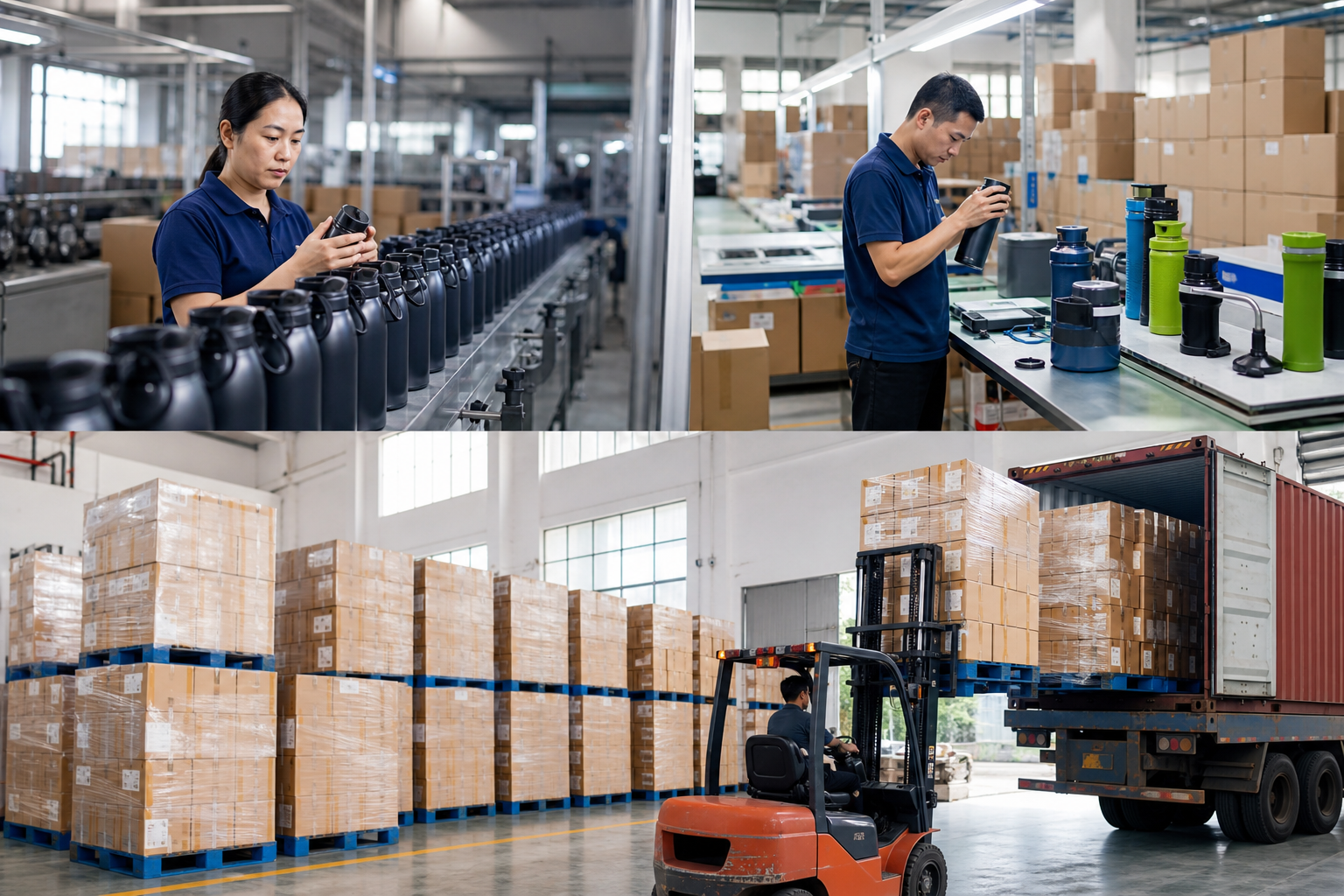
At BottleForge in Zhejiang, we see this every week. A buyer pushes for the lowest unit price, then QC pulls the sample and finds the flip lid leaks after a 1.2 m drop test, the matte coat scuffs in 20 cycles, or the carton plan breaks FNSKU labeling at the warehouse. That is the wrong question to ask. Good wholesale drinkware runs on repeatability, and if you are sourcing from China, the scale only helps when the factory can show MOQ, lead time, and QC records with numbers, not talk.
Start With the Bottle Use Case
Before you buy sport bottle wholesale, pin down where the bottle will be used. A 750 ml squeeze bottle for a gym floor is a different item from a 1 L screw-cap bottle for trail retail, and both are a long way from a double-wall stainless model for premium hydration. Get the spec wrong and the landed cost goes up fast. We’ve seen a buyer push for “one universal bottle” on a 48 mm neck, then complain when the hand feel missed the channel.
For procurement, ask direct questions. Is the order for retail shelves, sports events, subscription boxes, or B2B promo programs? Will it ship as wholesale drinkware, go out with a carabiner and brush, or be packed as a gift set? If you need a best wholesale drink bottle for a high-turn channel, we run for low failure risk, fast decoration, and a cap that survives 200 open-close cycles. If you are sourcing a bulk canteen or canteen wholesale program, focus on impact resistance, seal reliability, and spare-part supply. On our Zhejiang line, the same molding machine can run both canteen bulk and sport bottle jobs, but the mold, torque spec, and drop test are not the same.
Practical rule: choose the simplest structure that still hits your market price. Every extra spring, lock, or coating adds defect risk and pushes lead time; QC pulled the sample, checked the cap torque at 0.8 N·m, and the math did not work on a low-margin PO.
MOQs, Price Tiers, and Lead Times
The economics of buy sport bottle wholesale are easy to read once you split stock models from custom builds. A plain stock bottle often starts at 500 pcs per color. Add a custom color, logo, or lid combo, and MOQ usually moves to 1,000 to 3,000 pcs. If the buyer wants a new mold, tooling cost goes up and the first order has to be bigger. We see this every week on the line. That is normal in China if you want repeatable quality, not a one-off sample that dies on the shelf.
Ask for tiered pricing at 1,000, 3,000, and 5,000 pcs. The drop should be real. If the quote only shaves off a few cents, the tier is fake. On a typical wholesale drinkware program, a basic plastic sport bottle can move from USD 1.05 to USD 0.78 as volume rises, while a stainless model may go from USD 4.20 to USD 3.60 depending on finish and packaging. We had a buyer flag a PO because the logo line item was missing, and the math did not work. If the factory cannot say what changes at each tier, walk away.
Lead time matters as much as unit price. A capable factory in Zhejiang should quote 20 to 35 days for repeat production after sample approval, with rush orders only if the line is already set up. QC pulled the sample with a 0.3 mm lid gap last month, and that kind of miss adds days fast. One factory metric we track is 300,000 units per month across multiple drinkware lines. That number only means something if the scheduling board is real and the QC team can hold AQL targets on every shipment.
Materials and Compliance Checks
Material choice decides whether your order lands as a stable SKU or a claim file. For bulk drinkware, the usual picks are Tritan, PETG, PP, AS, aluminum, and 304 or 316 stainless steel. On the line, a 2 mm wall can survive a drop test that a thinner shell will fail, no matter how good the render looks. Tritan gives a clear premium look, PP is usually the lowest-cost option, and stainless is the better fit when you want a tougher feel or real temperature retention. If you are comparing bulk canteen programs, wall thickness, drop resistance, and cap geometry matter more than the language on the spec sheet.
For Europe, ask for REACH documentation and confirm whether the product touches the food-contact rules for your market. For the US, the supplier should know the gap between general food-contact expectations and customer-specific test requests. We had a buyer flag a PO typo on a cap code, and the first lab sample came with the wrong gasket. For coated stainless models, ask whether the finish passes abrasion testing and whether the powder coat survives repeated washing. An ASTM or ISO reference is useful only when the factory can show the actual test report, not just the standard number.
Do not approve a sample until you know which resin grade, gasket material, and printing method will be used in mass production. We have seen a soft TPE gasket pass sample stage, then fail when the line switches to a harder one. Sample swapping is a common failure point in China sourcing.
If you are sourcing wholesale canteen or wholesale growler items alongside sport bottles, keep the compliance file separate by SKU. A beer growler wholesale bulk order and a kids bottle order should not share assumptions about lid security, staining, or odor retention. On a 5,000-piece run, QC pulled the sample because the lid torque spec was off by 0.3 N·m, and that saved a headache. The wrong question is whether one file can cover everything; the math does not work.
Branding Without Weakening Performance
Decoration is where a lot of drinkware programs lose margin. We see the same thing on the line: buyers ask for full-wrap print, laser logo, gradient coating, and gift packaging on one SKU, then the PO price jumps 18% and they push back. The right move is to pick one main branding method that matches the body. Silkscreen suits a simple 1-color logo. Laser engraving fits metal best. UV print gives more color, but it adds passes and the reject rate climbs if surface prep slips by 0.2 mm.
If you are buying bulk drinkware for retail, think about shelf distance and abrasion. A logo that looks sharp in a sample box can look tired after 20 dishwasher cycles or three weeks riding in a warehouse carton. We ask buyers to approve one production-like sample with real packaging, not a showroom piece. For canteen wholesale and beer tumbler wholesale runs, the mark has to survive handling, stacking, and barcode placement. If the SKU needs Amazon prep, tell the factory up front about FNSKU placement, suffocation warnings, and carton master labels before we run the first batch.
Some buyers also ask for alcohol flask bulk or beer growler in bulk items for seasonal campaigns. Those jobs can work. Do not force one decoration spec across shapes that behave differently. A flat flask, a curved growler, and a straight sport bottle each have their own print tolerance, and we have seen that go sideways. The best wholesale drink bottle is the one that balances decoration area, hand feel, and defect control. QC pulled the sample, and the logo sat 1.5 mm off center; that is the sort of miss that turns a good order into a complaint.
QC, Packaging, and Shipping
QC is where a wholesale drinkware order gets saved or sunk. We run checkpoints on raw material, in-process assembly, and final packing. Ask for AQL 2.5 on major defects and AQL 4.0 on minor defects, or your own standard if you already use one. If the supplier cannot explain leak testing, torque checks, drop testing, and color tolerance, the order is too risky. QC pulled the sample at 9:20 a.m., found one lid thread mismatch, and that saved a 5,000-piece headache.
Packaging is not a side issue. A sport bottle can leave the line perfect and still cost you money if the carton crushes, the insert shifts, or the lid scuffs the surface in transit. For export orders from China, the carton spec has to fit the shipping route. Europe usually accepts a different pallet stack than North America, and a good factory will ask for pallet height, carton weight, and whether you want retail-ready or bulk shipper packing. We had a buyer flag a PO typo once—“48 pcs” typed as “84 pcs”—and the packing plan had to be corrected before booking.
Ask for these controls:
- Leak test on 100% of closure samples during setup
- Drop test at 1.0 m or your buyer standard
- Carton compression check for ocean freight
- Barcode and FNSKU verification before seal
For beer tumbler wholesale bulk or growler wholesale orders, add odor checks and lid pressure tests. Those categories fail in different ways, and a supplier in Zhejiang should know that before the first mass run leaves the line. This is the wrong question to ask if someone says, “It should be fine.” The math does not work when a 20 kg carton splits on the last leg.
Request a quote with your exact spec
Send target price, MOQ, material, and artwork. We will match the right factory setup in Zhejiang and keep the numbers honest.
Frequently asked questions
What is a realistic MOQ when I buy sport bottle wholesale?
For stock models, 500 pcs is common if you accept existing molds and standard colors. For custom logo, color, or lid combinations, 1,000 to 3,000 pcs is more realistic. If you need a new mold or a special cap, expect the MOQ to rise and the tooling fee to be separate. A serious China factory should explain exactly which part drives the MOQ, because the bottle body, lid, and packaging may each have different minimums. For planning, get tiered pricing at 1,000, 3,000, and 5,000 pcs so you can see the actual unit-cost curve.
How do I compare prices from different suppliers?
Compare the same spec, not the same photo. You need resin grade, wall thickness, lid type, print method, packaging, and test standard in writing. A USD 0.20 price gap can disappear once you add better gaskets, thicker walls, or retail cartons. Ask each supplier for FOB China pricing, sample lead time, mass lead time, and what happens at 3,000 or 5,000 pcs. A useful quote also shows whether the factory can support repeat orders in China without changing the tooling or decoration method. If the quote is vague, it is not really comparable.
Which material is best for wholesale drinkware?
There is no universal best material. Tritan works well for clear, premium-looking bottles with good impact resistance. PP is the cost leader for promo and event use. 304 stainless is better when you want a premium feel or temperature retention, while 316 stainless is used in more demanding corrosion scenarios. For Europe, you should still confirm REACH-related documentation and food-contact suitability. For any drinkware wholesale program, ask for the exact material grade, not just the category name, because the grade controls odor, clarity, and durability.
How do I reduce leak risk in bulk orders?
Leak risk usually comes from three places: the gasket material, the thread tolerance, and inconsistent assembly torque. Ask the supplier to run closure tests on pilot samples before full production, then specify the test method in the PO. For a new lid, do a 100% leak check during setup and a sampled test during final inspection. If you are sourcing a bulk canteen or wholesale canteen order, also ask for drop and pressure tests. A factory in Zhejiang that handles high volumes should be able to document all of this without improvising on the line.
Can I sell these bottles on Amazon FBA?
Yes, but packaging must be planned from the start. The factory should know FNSKU placement, carton markings, polybag warnings if needed, and the box count per master carton. Retail-ready packaging is not the same as FBA-ready packaging, so tell the supplier which version you need before production starts. If you are mixing sport bottles with other items like beer growler wholesale bulk or alcohol flask wholesale bulk SKUs, keep the labels and carton plans separate. That prevents receiving errors and reduces prep labor at the warehouse.