Key Takeaways
- A realistic MOQ for a custom thermos is often 1,000 pcs, with 25-35 day production after sample approval.
- For most buyers, 304 stainless is the default; 316 makes sense for premium or acidic-use applications.
- Ask for AQL 2.5 major and 4.0 minor inspections, plus real insulation data, not marketing claims.
- A good vacuum flask supplier in Zhejiang should quote FOB, sample lead time, and decoration limits clearly.
If you want to buy vacuum flask wholesale, do not treat every stainless thermos like a commodity. We see the gap after the first 30 days on the line: a lid starts weeping, heat retention slips, the coating picks up scratches, or the logo print comes out off-center by 1-2 mm. For outdoor retailers and promo brands, that means returns, slow sell-through, and a price line you cannot defend once the distributor starts comparing samples.
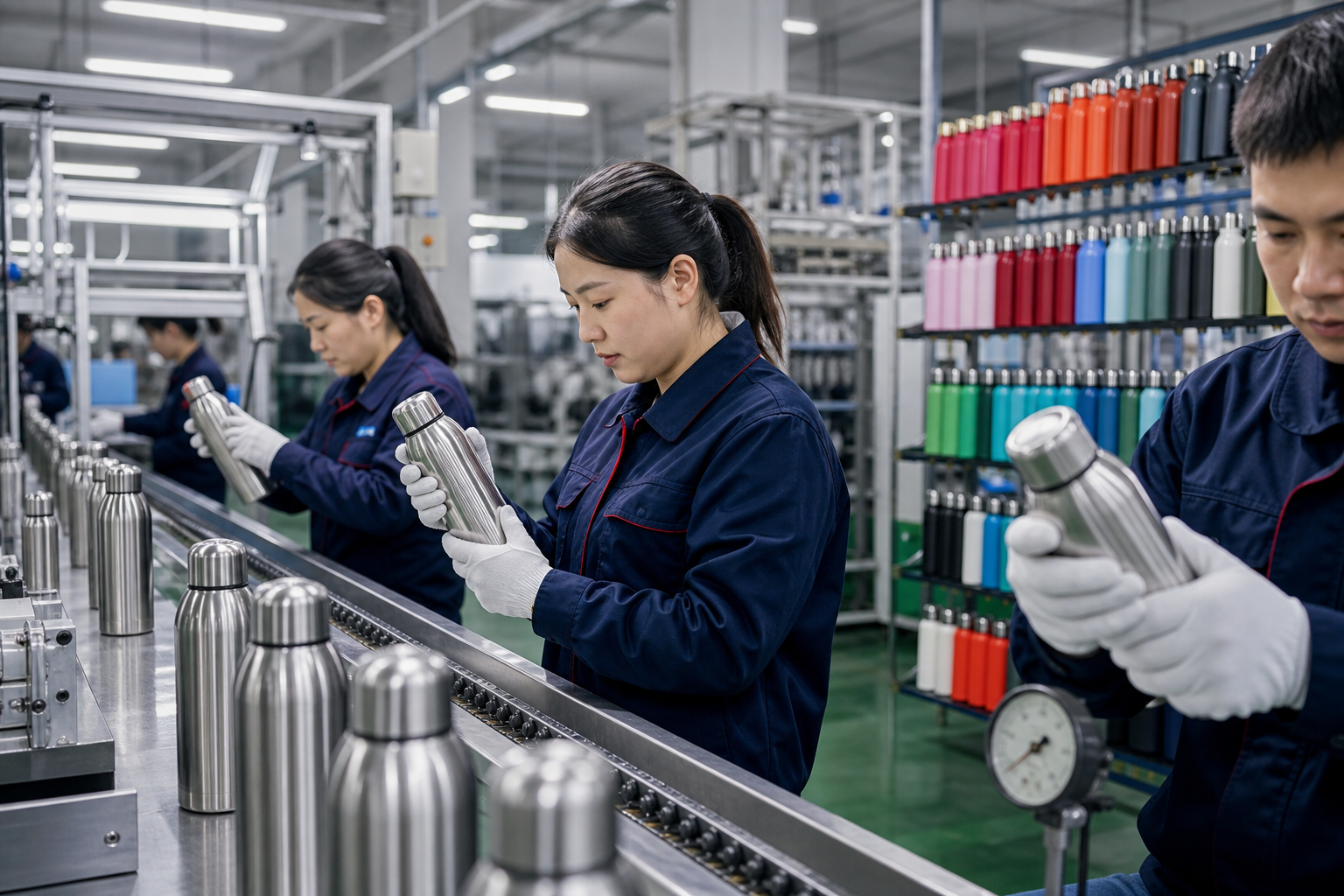
The better move is to buy from a thermos manufacturer that gives you hard numbers: 18/8 stainless steel, 0.4-0.5 mm inner wall thickness, 6-12 hour hot retention targets, MOQ from 1,000 pcs, and a stable lead time of 25-35 days. We run welding, vacuum sealing, and coating in-house in Zhejiang, and QC pulled the sample when the vacuum test missed spec by a narrow margin. That is the wrong question to ask if you are still shopping on unit price alone, because the math does not work once a buyer flags a leaking lid or a typo on the PO and the shipment gets held up.
Start With the Use Case
Before you place a bulk thermos order, pin down where the bottle will be used and who will carry it. A trail shop wants something different from a trade-show giveaway. We ship both, and the gap is obvious on the line: hikers ask about 12-24 hour insulation, a lid that survives a 1.2 m drop, and a body that still grips with wet gloves on. Corporate gifting is a different game. Buyers care more about logo sharpness, the gift box, and a price that stays inside the promo budget. Skip this step and you pay for a feature set nobody asked for.
Ask three direct questions. First, what size actually sells in that channel? 350 ml, 500 ml, 750 ml, and 1,000 ml are the usual picks, but the wrong size can sit in cartons for months. Second, what lid is expected? A screw cap, push-button lid, or tea infuser changes the cost and the leak rate. QC pulled a batch with a loose spring last month, and that one detail would have turned into a complaint. Third, where is it going? A thermos distributor into outdoor retail needs a different margin than a thermos vendor filling company giveaways. Be specific. A vague brief makes the quote useless.
When you work with a thermos factory in Zhejiang, the better suppliers will ask the same questions back. That is the right signal. It means they are building around your use case and your landed-cost target, not just sending out a stock number. We had one buyer flag a PO that listed 500 ml on the spec sheet and 450 ml in the note field; the math did not work, and the quote had to be rebuilt. If a supplier gives you one price for every application, that is not convenience, it is a warning.
Pick the Right Steel Grade
For most buyers who want to buy vacuum flask wholesale, 304 stainless steel is the baseline. It is the 18/8 material we run on most durable drinkware lines because it holds corrosion resistance, cost, and forming stability in one spec. If the order is for acidic drinks, salty use, or a higher retail price point, 316 stainless is worth a quote. It costs more, but the buyer gets a cleaner case for that use.
Do not stop at the words stainless steel. Ask about the wall structure, not just the grade. A solid factory thermos spec should show inner and outer wall thickness, usually around 0.35-0.5 mm depending on the design. We have seen 0.30 mm walls save a few cents and then dent on a simple drop test from 1 m. The math does not work. Thin walls also make vacuum yield harder to keep steady, and that is where the factory process matters more than brochure copy.
Check the surface finish too: powder-coated, painted, or brushed. Powder coating is a common choice for promotional thermos orders because it gives better scratch resistance and a cleaner matte look; one 500 pcs sample run came back with a logo rub issue after tape test, and the buyer flagged it fast. Brushed metal fits a distributor program, but it is less forgiving when the bottles get tossed in cartons and handled rough. In Zhejiang, the better suppliers keep a controlled material chain and can show material certificates, RoHS-related declarations if needed, and incoming inspection records. That is standard now, not a favor.
- 304 stainless for mainstream bulk thermos programs
- 316 stainless for premium or demanding use cases
- 0.35-0.5 mm wall thickness as a practical production range
- Powder coat for better wear and logo visibility
Vacuum Performance Matters
Insulation claims are where a lot of buyers get burned. A thermos bulk quote that says “keeps hot for 24 hours” tells you almost nothing. Ask for the test condition behind the number: starting water temperature, ambient temperature, fill level, and whether the lid was opened during the test. We run these checks on the line with a vacuum gauge and a simple temperature probe. If the supplier can only give you a sales line, the math does not work.
For sourcing, ask for 6-hour, 12-hour, and 24-hour retention data from the same starting point, usually 95 C hot water in a room around 20-25 C. The exact result shifts with size and lid design, but the curve should stay consistent across samples. A 500 ml stainless thermos should still be above 60 C after 12 hours if the vacuum seal is solid and the cap is doing its job. We once had a buyer flag a 3 C gap between two samples, and QC pulled the sample again because the PO had a lid code typo. If the temperature drops fast, the problem is usually the vacuum process, not the print.
Check condensation and outside temperature too. A good vacuum flask stays dry on the shell during hot-fill tests, and the outer wall should not feel warm after 10 to 15 minutes. If it does, vacuum integrity is off. Good suppliers in Zhejiang test this daily with a leak tank and sample retention log, not only before shipment. When you compare thermos manufacturers, ask for photo proof of the vacuum line, the leak test, and the retention report. That beats a glossy catalog. If the supplier cannot explain the setup, do not treat the insulation claim as a spec.
For wholesale buying, insulation data must repeat. If sample A and sample B miss by more than a narrow range, your order risk is already too high.
Price, MOQ, and Lead Time
The commercial side of a custom thermos order stays simple if you pin the quote to real numbers. For a standard build, a capable thermos supplier in Zhejiang usually sets MOQ at 1,000 pcs per design. If the buyer wants special packaging or a new mold, 3,000 pcs is more common. Sample lead time runs 7-10 days. Mass production from approval to shipment is usually 25-35 days, if the artwork is locked and the lid structure has already passed a line test. QC pulled the sample on a torque gauge and the numbers were fine. A serious factory should say all of this upfront.
Price moves with size, steel grade, lid complexity, coating, and decoration. A plain 500 ml stainless model with a basic cap is a different FOB number from a customized thermos with laser engraving, a silicone ring, and a color box. We see buyers push back on a $0.18 print upgrade, then lose $0.60 on a bad carton later. That is the wrong question to ask. The landed cost is what matters after freight, duties, packing, and scrap rate. A lower unit price can still burn margin if the coating chips or the logo shifts 2 mm off center.
Ask for a tiered quote: 1,000 pcs, 3,000 pcs, and 5,000 pcs. That shows the real breakpoints. If you buy for wholesale, use those breakpoints to plan the next PO instead of chasing one-off deals. A mature manufacturer will also spell out whether the price includes one-color print, one position, and standard carton packing. We have seen a PO typo turn "one color" into "full wrap" on paper, and the buyer caught it only after the sample photo came back. If those details are buried, the final invoice will not match the offer.
For sourcing in China, FOB Ningbo or FOB Shanghai is standard enough to compare apples to apples. A quote that hides gate pickup, inner box cost, or pallet charge is not a clean quote. That matters more than a headline unit price.
Customization That Sells
Good customization starts with the channel, not with decoration for its own sake. A promo thermos for a corporate campaign needs a clean 45 mm logo area, a gift box that ships flat, and a finish that still looks sharp after 200 cartons sit under warehouse lights. A retail custom thermos for outdoor use needs a steadier grip, a lid that survives bag abuse, and a surface that does not show scuffs on the first run. If you sell through distributors, batch-to-batch color has to stay tight. We have seen one 0.8 shade shift on a reorder wipe out buyer confidence fast.
The main decoration methods are silk screen printing, laser engraving, and heat transfer. Laser engraving holds up on brushed stainless, and the line likes it because the marking depth stays around 0.15 mm instead of wandering. Silk screen is the right call when the brand wants a solid Pantone hit on a coated bottle. Heat transfer works, but the buyer usually pushes back on abrasion after a drop test. If you need to choose, use the end use as the filter, not the sample table. A thermos customizable program also has to cover cap color, strap material, and box insert. That is where unboxing and shelf impact are won or lost.
There is a limit to customization. Change the lid, the body shape, the finish, and the packaging at the same time, and tooling risk climbs fast. QC pulled the sample twice on one job because the lid code on the PO was typed as `A12` instead of `A21`, and that kind of mistake burns days. Lock the bottle structure first, then customize one or two visible parts. That keeps the order sane for a thermos supplier and easier to repeat at scale. We have seen this go sideways when a buyer tried to tweak everything at once. The math does not work.
For a distributor thermos line, keep the SKU matrix tight. One body, two lid colors, two logo positions, and one packaging spec is enough to cover most seasonal demand. On the floor, that means fewer carton labels to verify and fewer changeovers at the pad printer. Clean, simple, repeatable.
Quality Checks Before Shipment
Wholesale drinkware is won or lost in inspection. Before shipment, ask for a written QC plan with incoming material checks, in-process inspection, and final random inspection. AQL 2.5 for major defects and 4.0 for minor defects is a fair baseline, but only if the factory actually runs it on the line. Your thermos manufacturers should log leak testing, insulation sampling, coating adhesion, and cosmetic checks under bright light, not just tick boxes on paper.
Look at the failure points that hit resale first. A lid that leaks after 20 turns, a powder coat that chips in transit, or a logo that sits 1.5 mm off-center costs more than a small ex-works gap. We have seen buyers argue over a $0.18 price jump, then lose a whole carton because QC pulled the sample and found seepage. If you are ordering from a thermos factory in Zhejiang, ask straight: do they run 100% leak testing or sample-based testing? For higher-value custom thermos programs, 100% testing is worth it. For simpler bulk thermos runs, a tight sample plan works only if process control is stable.
Compliance matters too. For Europe, REACH-related material awareness is not optional if your buyer asks for it. For the United States, you may need food-contact declarations and testing tied to your channel. If the bottle is sold on thermal performance claims, the test report has to match the wording on the listing. We once caught a PO typo that changed the claim from 12 hours to 18 hours, and the buyer flagged it before print. A supplier thermos partner who knows export paperwork can keep you from re-testing after order approval. China has plenty of factories that can quote fast; only a few can quote and document correctly at the same time. That is the part that matters.
If you want to see how capabilities are structured across a real factory, compare the production flow, QC points, and packaging setup before you commit. Ask where the weak spot is. A good China partner will show you the risk, not hide it behind a neat brochure.
Request a factory quote for your next thermos order
Send your size, finish, logo, and target price. We will turn it into a wholesale specification with MOQ, lead time, and export-ready QC.
Frequently asked questions
What MOQ should I expect when I buy vacuum flask wholesale?
For a standard custom thermos, 1,000 pcs per design is a normal starting point. Some factories in Zhejiang can do 500 pcs for stock models, but once you change coating, print, or packaging, 1,000 pcs is more realistic. If you want a new lid mold or special box, MOQ can rise to 3,000 pcs. Ask for the MOQ by color and by logo version, because those are often different. A serious supplier should also tell you the sample lead time, usually 7-10 days, and the mass production lead time, often 25-35 days after sample approval.
Is 304 stainless good enough for a stainless thermos order?
Yes, for most wholesale programs 304 stainless is the right default. It gives you strong corrosion resistance, good forming performance, and a price point that works for bulk thermos, distributor thermos, and promotional thermos projects. If your market is premium retail, uses acidic beverages often, or asks for a higher-grade story, 316 stainless is a valid upgrade. Ask the factory to confirm the material grade in writing and, if needed, provide a material declaration. Also check wall thickness: 0.35-0.5 mm is a practical production range for many stainless vacuum bottles.
How do I judge insulation claims from a thermos manufacturer?
Do not accept a single “24-hour hot” claim without the test method. Ask for the starting water temperature, ambient temperature, fill level, and whether the lid stayed closed the whole time. A credible thermos manufacturer should provide data for 6, 12, and 24 hours. For a 500 ml bottle, a strong sample may stay above 60 C after 12 hours under standard conditions, but the exact number depends on lid design and capacity. If sample A and sample B vary too much, that is a process-control problem, not a marketing problem.
What decoration method should I choose for a custom thermos?
Choose based on use and surface finish. Laser engraving is durable and clean on brushed stainless. Silk screen printing gives stronger branding on coated surfaces and is usually better for promotional thermos orders. If your bottle will be handled roughly, powder coating with laser or one-color print is often safer than a complex multi-color design. Ask the factory for decoration limits on curved surfaces, minimum line thickness, and color matching tolerance. In practice, one body style with one or two decoration methods is easier to control than a fully customized thermos program with too many variables.
What should be in the quality inspection for a bulk thermos shipment?
At minimum, you want leak testing, insulation sampling, cosmetic inspection, carton drop checks, and AQL-based final inspection. A common target is AQL 2.5 for major defects and 4.0 for minor defects. For export orders, also confirm packaging strength, barcode readability if needed, and whether the outer carton matches your distributor requirements. If the order is going to Amazon or another retail platform, the packing structure may need FNSKU labels and stronger master cartons. A good supplier thermos partner will tell you what is included before production, not after the goods are packed.