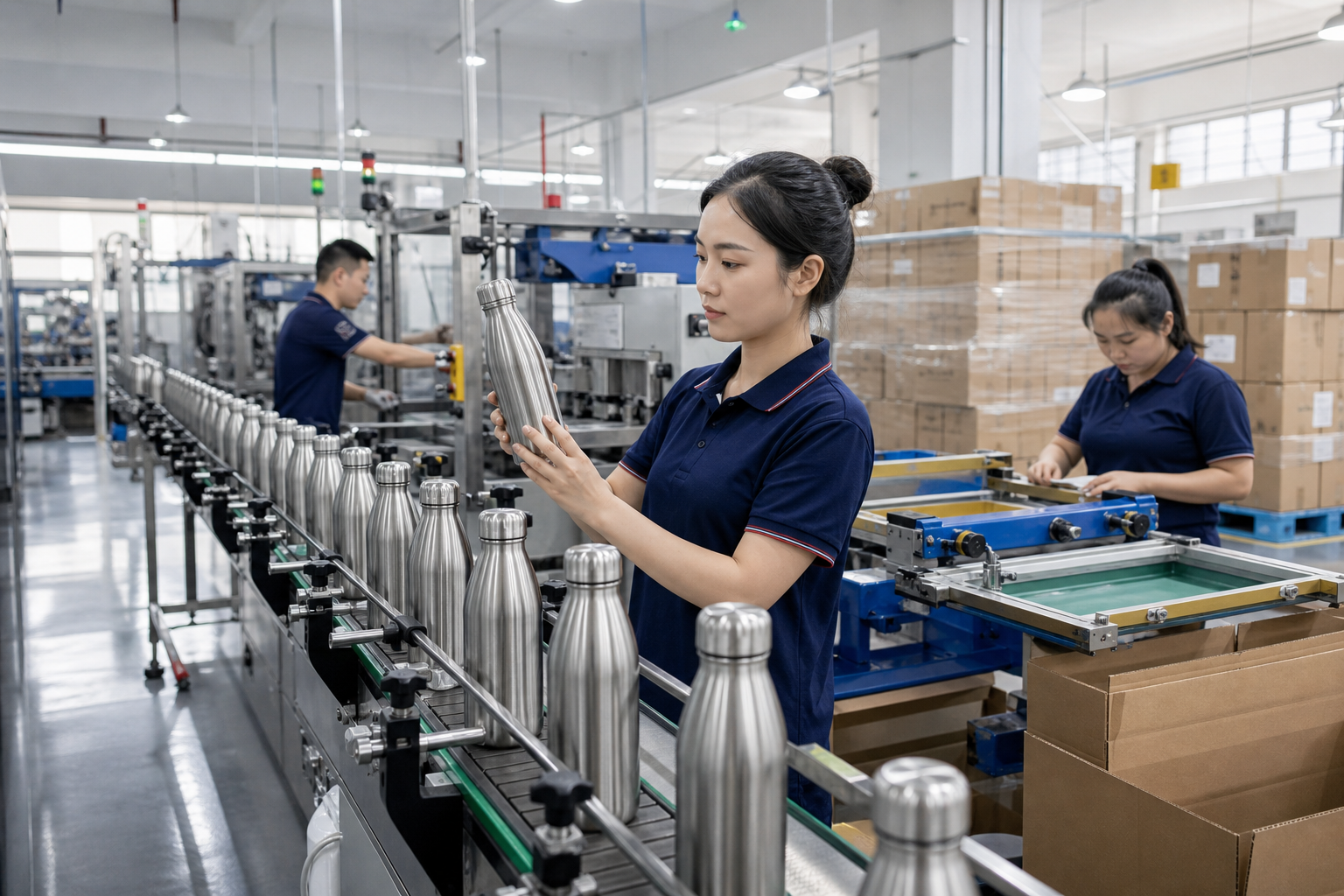
Key Takeaways
- Most canteen private labeling projects start at 1,000 pcs per size or color, with 25-35 days lead time after sample approval.
- A Zhejiang factory running 300,000 units per month can usually support both canteen promotional runs and long-term distributor canteen supply.
- For Europe and North America, ask for REACH, LFGB, FDA, and AQL 2.5 / 4.0 inspection targets before production starts.
- The cheapest logo method is not always the best; silkscreen, laser, and wrap print each have different durability and cost profiles.
Canteen private labeling looks simple until you line up materials, closures, decoration methods, and carton specs on the same sheet. We have seen a 18 mm lid pass sample checks and still fail on the line because the gasket sat 0.5 mm off. If you are buying for a canteen distributor, a retail brand, or a promo run, the logo is rarely the problem. The wrong spec is. It looks fine on one sample, then breaks in mass production, shipping, or daily use.
The clean way is to set the market first, then match the canteen custom build to the channel. A Zhejiang canteen factory can run low-volume customized drinkware and larger distributor drinkware orders, but only when MOQ, lead time, and compliance are fixed before tooling starts. We ship a lot of orders after a buyer pushes a late artwork change, and that is where the trouble starts. This is the wrong question to ask: not "can you make it," but "can you make it at 500, 5,000, or 50,000 pieces without changing the spec."
What Private Labeling Really Changes
Canteen private labeling is not just putting a logo on an off-the-shelf bottle. Once you move into canteen customizable or canteen customized work, you are deciding tooling, carton size, unit cost, and how the canteen survives a 1-meter drop in transit. We have seen a buyer ask only for artwork, then complain when the landed price missed the shelf target by 18 percent. QC pulled the sample after the cap torque drifted at 14 N·cm. That is the wrong question to ask.
For a practical custom canteen order, lock down size, material, lid type, finish, logo method, packaging, and target market before you ask for a quote. That is the gap between a 3-day mockup and a production-ready run. On the line, a 0.3 mm wall change or a matte finish instead of gloss shifts both packing and appearance, and the buyer flags it fast. If you sell through a canteen vendor or canteen distributor network, repeatability beats novelty. One bad gloss batch can kill the reorder.
- Logo-only jobs work when the base product already fits your channel.
- Custom drinkware projects need a spec sheet, not just artwork.
- Canteen promotional orders usually chase unit price and 7-day delivery.
- Distributor drinkware programs need stable packing, clean barcodes, and cartons that survive 12 days at sea.
If you treat canteen private labeling like a sourcing exercise instead of a design exercise, you will usually get fewer surprises from the canteen factory. We ship these programs every week, and the math does not work if you skip the spec.
Choose Material Before Artwork
Material choice sets the user experience before the first logo hits the cup. For a metal canteen, we usually work with 304 stainless steel, 316 stainless steel, and aluminum. On most custom drinkware runs in China, 304 is the practical default because it keeps cost, corrosion resistance, and stock supply in balance. If the buyer is asking for a premium retail SKU or a coastal use case, 316 makes sense, but the price jump is real. A normal 304 wall sits at 0.5-0.6 mm; go thinner and the sample dents in transit, go thicker and freight cost climbs. We saw that on a 12,000-piece order last month, and the buyer flagged it after carton drop test.
Closures matter just as much as the body. A silicone gasket, a food-grade PP cap, and a clean thread pitch are what keep a customized canteen from leaking when it lands in a distribution center or gets tossed into a backpack. On the line, QC pulled the sample and found a 0.3 mm mismatch at the neck ring, which was enough to create seepage after repeated opening and closing. If your line includes a custom growler or customizable growler, pressure and seal design become the first things to check, not the last. The same rule applies when one lid has to fit three SKUs. If the thread spec is off, the math does not work.
From a buyer perspective, material should map to channel:
- Promotional gift: lighter body, faster decoration, lower FOB target.
- Retail brand: better finish control, tighter tolerance, stronger carton test.
- Distributor line: shared components, repeat orders, stable color batches.
A good canteen supplier will tell you when a design is too thin, too heavy, or too expensive for the market you are targeting. We run that check before artwork, because changing the material after printing is where jobs go sideways. One PO typo can turn 304 into 201 on paper, and that is the kind of mistake that burns a week.
Decoration Methods That Hold Up
Most canteen factories we work with can run silkscreen, laser engraving, heat transfer, pad print, and full wrap decoration. We usually match the method to the art and the budget first, then check whether the mark has to survive 200 dishwasher cycles, carton rub, and mixed pallet handling. For a premium canteen custom order, laser engraving is the cleanest route because there is no ink to scuff off. If the buyer wants a tight Pantone match on a canteen promotional program, silkscreen still wins for 1 or 2 solid colors. On our line, the usual setup time is 12 days for engraving versus 18 days when a multicolor print needs extra screens.
The practical rule is simple: once the graphic gets busy, you have to control the base finish and print registration with more care. Small text, thin strokes, and gradients are where cheap art turns into scrap at QC. We have seen a 0.3 mm line close up after the first test print, and the buyer flagged it before shipment. REACH-compliant inks and a signed artwork proof should be standard, not an upgrade. For Europe, ask whether the ink system is tested for food-contact use and whether the finish meets the right migration limits. For North America, the question is the same, just with a different paper trail.
Do not approve a logo by eye on a PDF alone. Ask for a pre-production sample or a physical color chip if the order volume justifies it. We have had a PO that said "navy" on one line and "blue" on the next, and that typo cost us a full reprint.
If you need a deeper comparison of marking methods, see silkscreen vs laser engraving for drinkware. That call often decides whether your custom canteen reads as giveaway stock or something a retail buyer would put on the shelf.
MOQ, Lead Time, and Price
MOQ is where a lot of canteen distributors get the math wrong. A factory may quote 1,000 pcs per color and size, but the real floor is often set by tooling, lid inventory, and print setup. On the packing table, QC pulled the sample and checked the lid fit with a 0.2 mm gauge. If you ask for two body colors, a custom box, and a special insert, you may be looking at 2,000-3,000 pcs before the numbers work. In a Zhejiang factory with 300,000 units per month of capacity, the question is not whether we can run it. The question is whether your target price fits the line.
For standard 304 stainless models, FOB China pricing commonly lands around USD 1.20-1.80 for plain bodies and USD 1.60-2.60 with simple branding, depending on size and packaging. Premium double-wall or upgraded finishes can move into the USD 3.40-5.80 range. The line runs a first-piece logo check before mass production, and that saves you from a PO typo turning into 10,000 bad prints. Samples usually take 7-12 days. Bulk production after approval is often 25-35 days, and that can stretch if you revise artwork after the first proof. The buyer flagged a 3-day art change once, and the schedule slipped. For a seasonal launch, that is the wrong thing to gamble on.
Freight should stay in the quote, or the landed cost will surprise you. A low ex-factory price can disappear once cartons, pallets, and destination labeling are added. We weigh the master carton on the floor scale at 8.6 kg, then check the carton count and gross weight against the shipper plan. Ask for the master carton drop test result before you compare offers. If the seller cannot explain their MOQ logic, they are not ready for a serious distributor drinkware program. We have seen that go sideways too many times.
Compliance and QC You Cannot Skip
For Europe and North America, private label success depends on documents as much as on the cup itself. A canteen factory in China should be able to show REACH and LFGB support for the EU market, FDA-relevant food-contact information for the US market, and a declaration of conformity when asked. On our side, we keep the file set tied to the batch, with the lot number on the carton and the test report in the same folder. If a buyer wants a brand audit, ask for ISO 9001 and BSCI or an equivalent social compliance file. EU buyers ask for it. US buyers do too.
On inspection, use AQL logic instead of guessing. A normal start is AQL 2.5 for major defects and 4.0 for minor defects, with 100 percent leak testing on assembled lids. We also check coating adhesion, thread fit, odor, drop resistance, and carton compression on the line. The math does not work if you skip this step and hope the warehouse will catch it. If you are shipping a customized drinkware line into retail or e-commerce, confirm that barcodes, warning labels, and FNSKU placement are correct before the cartons leave China.
Practical QC checklist
- Leak test on every assembly line batch.
- Logo alignment and Pantone tolerance on first article.
- Odor check after washing and drying.
- Packaging drop test for export cartons.
When QC is handled at the factory, you cut rework in your warehouse and protect distributor margin. We have seen this go sideways on a 3,000-piece order because one PO typo put the FNSKU on the wrong side of the carton. QC pulled the sample, caught it, and the buyer still made the ship date.
How to Choose the Right Supplier
Not every canteen vendor is set up for private label work. Some can knock out a sample in 5 days, then miss the next 3,000 units because the Pantone drifts by 2 Delta E. Others can run volume, but artwork control falls apart when the PO has a typo or the buyer changes the lid color after approval. The supplier you want can speak to spec, compliance, and shipment terms in one call. If they cannot show where the cost sits, they will not protect your margin later.
Ask the canteen manufacturer for a full quotation breakdown: product body, lid, logo method, inner packaging, master carton, export label, and any custom insert or hangtag. Then ask for a sample timeline and a production timeline. A serious factory will lay out the sequence: artwork confirmation, sample approval, deposit, mass production, final inspection, balance payment, booking. We run this every week, and the line slows down fast when one step is fuzzy. That is where weak suppliers lose control.
If your line includes multiple SKUs, ask whether the same lid family can be shared across sizes. One shared cap mold cuts tooling chaos and keeps lead time from slipping by 7 to 10 days. For larger programs, the supplier should also state spare parts policy, reorder color matching rules, and storage terms for repeat batches. We have seen this go sideways when a buyer assumes last season's lid still fits, then QC pulled the sample and found a 1.2 mm mismatch. That is the wrong question to ignore.
For a deeper view of manufacturing scope, review our private label capabilities, our quality controls, and how MOQ works for custom drinkware. If you are comparing product formats, stainless steel drinkware options are a useful reference point for spec planning. Keep one thing straight: if a supplier cannot explain how they ship a 20 HQ with mixed SKUs and 304 stainless parts, they are not ready for a real program.
Start Your Canteen Private Label Quote
Send your logo, target price, carton spec, and destination market. We will confirm material, MOQ, and lead time before sampling.
Frequently asked questions
What is a realistic MOQ for canteen private labeling?
For most canteen private labeling projects, a realistic MOQ is 1,000 pcs per size or color if you use standard tooling and a common lid. If you want multiple Pantone colors, custom packaging, or a special insert, the real minimum can move to 2,000-3,000 pcs because setup cost gets spread across fewer units. A Zhejiang canteen factory with steady export volume can often support smaller trial runs, but the unit price will rise. For a launch order, ask for both the sample MOQ and the repeat-order MOQ so you do not lock yourself into a bad first run.
Which logo method lasts longest on a custom canteen?
Laser engraving is usually the most durable because the mark is part of the metal surface rather than sitting on top of it. It is a strong choice for a premium custom canteen or a long-life distributor drinkware program. Silkscreen is still the best value when you need one or two solid colors and controlled unit cost, but it can wear faster if the bottle sees heavy abrasion or aggressive washing. If your art has multiple colors, a wrap or heat-transfer system may be better, but you should ask for wash testing. For most buyers, the right answer depends on price, logo complexity, and expected use.
Can I order a canteen customized line with several sizes?
Yes, but only if the product family is planned correctly. The easiest way is to keep the lid or closure system shared across sizes, then vary only the body capacity and packaging. That is how many canteen manufacturers build a scalable range without multiplying MOQ too much. For example, one 17 oz and one 25 oz model can often share artwork, carton style, and even some spare parts. If you add a custom growler or larger-format bottle, treat it as a separate spec because pressure, seal design, and freight profile change. A good canteen supplier will tell you where the shared platform ends.
What compliance documents should I ask for in China?
For Europe, ask for REACH and LFGB support, plus a declaration of conformity that matches the exact material and finish. For the US, ask for FDA-relevant food-contact information and any available test report tied to your final spec. If you are selling to a retailer or distributor, also ask for ISO 9001 and BSCI evidence if social audits matter to your account. A practical canteen factory in China should also provide batch traceability, carton labeling details, and leak-test records. If your customer base is strict, confirm whether the inks, coatings, and silicone parts are all tied to the same approved documentation set.
How do I compare canteen suppliers without wasting time?
Compare them on the things that change your landed cost and reorder risk: material spec, decoration method, MOQ, lead time, packaging, and QC process. A good canteen supplier will quote all of those clearly, not just the base bottle price. Ask for a sample timeline, a mass-production timeline, and the inspection standard, ideally AQL 2.5 for major defects and 4.0 for minor defects. Also check how they handle Pantone matching, logo placement, and spare lid policy. If the supplier cannot explain these points in writing, they are not ready for a long-term canteen distributor account.