Key Takeaways
- A serious canteen supplier directory should expose MOQ, sample lead time, and export readiness, not just product photos.
- A Zhejiang canteen factory with 600000 units/month can usually support 500 to 1000 pcs MOQ and 25 to 35 day bulk lead times.
- For Europe and North America, ask for REACH, LFGB, FDA food-contact support, and ISO 2859-1 AQL 2.5 / 4.0 inspection terms.
- Laser engraving, silk screen, and UV print each fit different canteen customizable and custom growler programs, so decoration choice affects margin.
You do not need a long supplier list; you need a canteen supplier directory that shows who can ship the same spec twice, with a real QC record, not a polished PDF. For Europe and North America, the gap between a solid canteen manufacturer and a weak canteen vendor shows up fast: test reports, decoration limits, and whether the second order matches the first on the line. QC pulled the sample at 9:20 a.m. and the cap thread was off by 0.3 mm. That is the kind of miss that kills a program.
A good shortlist should point you to a canteen factory in China or Zhejiang that can quote MOQ, lead time, and compliance without hand-waving. If the numbers do not survive sampling, carton marks, and freight, the math does not work, and we have seen that go sideways on 12,000-unit runs. For canteen custom and canteen promotional orders, the real test is margin after print setup, inner tray cost, and a buyer who flags a PO typo before we ship.
What a directory should reveal
A canteen supplier directory is only useful if it gives you operating data. At minimum, you should see factory location, product range, audit status, and the decoration methods the line actually supports. If the listing does not say whether the canteen manufacturer handles laser engraving, silk screen, or powder coating in-house, expect 7 to 10 extra days and a higher reject rate. We’ve seen that on a 3,000-piece order; QC pulled the sample, and the print sat off-center by 1.5 mm.
For a buyer, the best directory entries read like a procurement brief, not a brochure. Look for the exact substrate, lid style, finish, and whether the supplier is a true canteen factory or just a trading company. This is the wrong question to ask only at the RFQ stage; the answer changes your landed cost. A canteen distributor needs that split because a middle layer adds a fee to every sample, every carton, and every correction. One PO typo on our side—“304 stianless” instead of 304 stainless—cost a buyer two rounds of email and a week of delay.
- Factory address: Zhejiang, Guangdong, or another export base with visible production depth.
- Product scope: custom canteen, customizable canteen, or broader custom drinkware lines.
- Compliance: REACH, LFGB, FDA, and traceable test reports.
- Commercial terms: MOQ, sample fee, bulk lead time, and FOB port.
If a directory entry cannot answer those four points, it is not a sourcing tool. It is a lead list. We run this check before we send a quote: if the entry does not show MOQ 500, FOB Ningbo, and a real workshop photo with the laser machine in frame, we move on.
Capacity beats polished claims
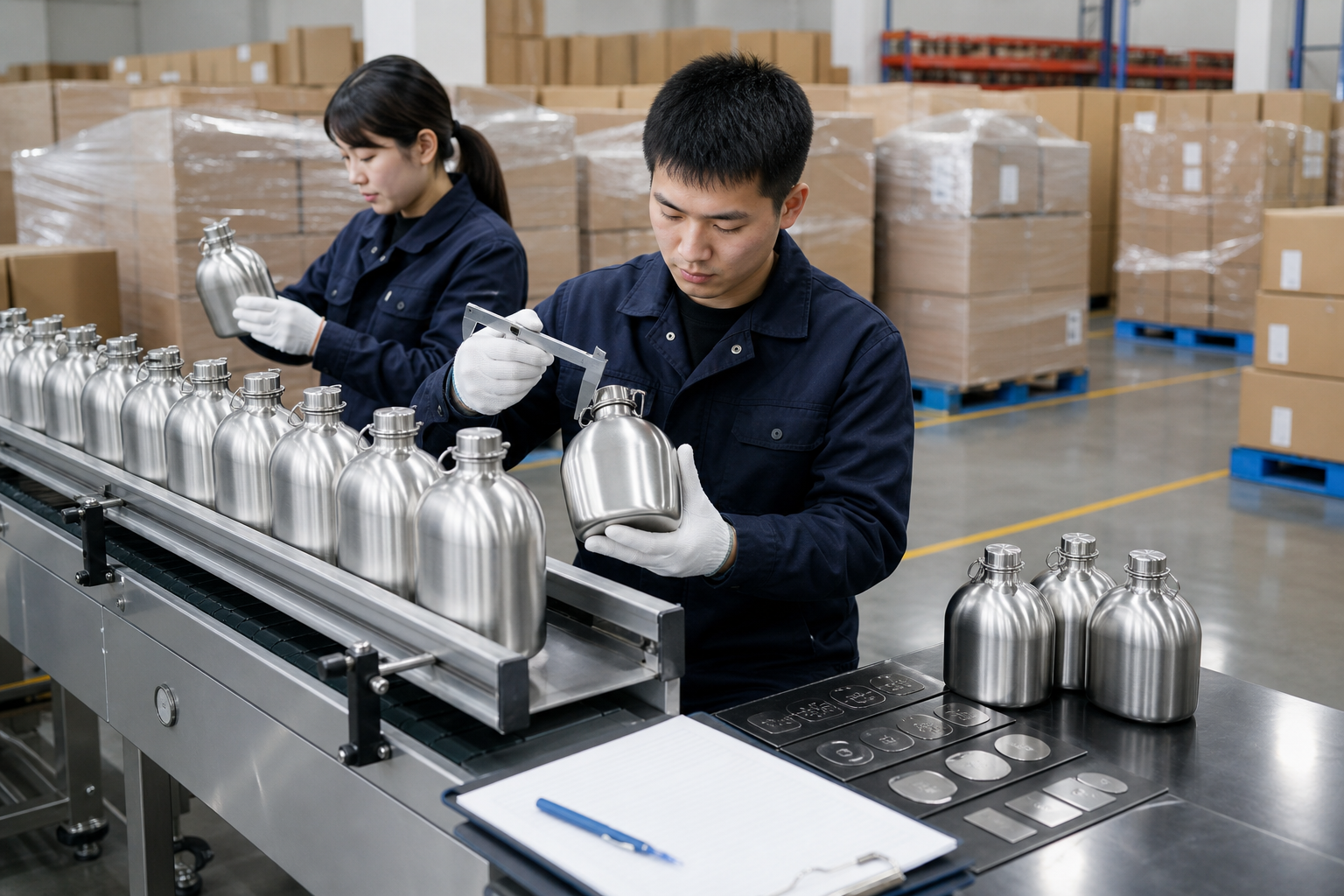
Capacity is where a canteen supplier directory earns its keep. A nice page means nothing if the line cannot hold peak-season output. In Zhejiang, we run 600000 to 800000 units a month across stainless and plastic programs, with one line for standard molds and another for custom canteen jobs. That scale matters when a retailer asks for a second colorway or a distributor order jumps after a promo lands. One busy week can break a weak factory.
Ask for numbers, not adjectives. A real canteen manufacturer should give MOQ by model, color, and logo method. For stock molds, 500 pcs is common; for customized canteen builds with new lids or body colors, 1000 to 3000 pcs is more realistic. Sample time should be 7 to 10 days, and bulk production 25 to 35 days after approval. If the factory says everything is possible in 12 days, the math does not work. QC pulled the sample on one PO because the cap thread was 0.8 mm off, and the buyer flagged it before we shipped.
Practical rule: if the supplier cannot show weekly output by line, they are not ready for a repeat order.
For canteen distributors, a stable lead time is worth more than a 3 percent unit-price discount. Unstable supply kills retailer confidence faster than a slightly higher landed cost. We had a buyer push back on a PO typo once — the carton mark said 24 pcs, the packing list said 20 pcs, and customs held the lot for two days. That is the wrong question to ask if you are only chasing unit price.
Materials and compliance that matter
Most canteen buyers ask about appearance first and compliance second. That is backwards. A custom drinkware program lives or dies on material control. For stainless steel canteen products, state the grade plainly: 304 is the common baseline, 316 gives better corrosion resistance, and wall thickness should be specified in millimeters, not described as "thick". On the line, we see 0.4 to 0.6 mm body shells most often, while the lid, gasket, and coating stack decide how the product feels after a 12-day run or an 18-day run.
For Europe, ask for REACH and LFGB documentation. For North America, ask for FDA food-contact support, and if your channel demands it, Prop 65 screening. Production inspection should reference ISO 2859-1 with AQL terms such as 2.5 major and 4.0 minor. That gives you an actual acceptance standard instead of vague quality talk. We have seen buyers flag a PO typo on carton marks and then blame the factory, so check carton labels, barcode accuracy, and cosmetic limits before the truck leaves.
- Metals: 304, 316, and sometimes 18/8 stainless.
- Plastics: PP, Tritan, and food-grade silicone for seals.
- Testing: migration, odor, dishwasher durability, and drop tests when required.
- Documentation: BSCI or factory audit reports when your buyer requests them.
If the factory also handles a custom growler or customizable growler line, ask whether the same lab data covers those builds or if the test package changes. We run into this when a buyer assumes one report covers everything. It does not. Ask for the exact SKU list tied to the report, or QC pulled the sample and the numbers no longer match the build.
Branding that survives real use
Branding method changes the order math. For canteen promo runs, silk screen is the cheapest choice on flat or lightly curved panels, especially with a 1-color or 2-color logo. On our line, an 80-mesh screen and a clean squeegee pass keep setup fast. Laser engraving costs more up front, but a 0.3 mm mark is harder to scratch off and keeps its face after repeated washing. UV printing gives you full-color graphics, yet it needs tighter carton inserts and a cleaner transit path because abrasion shows up fast.
If you are selling canteen customizable products into retail, ask how decoration changes the MOQ. Some factories keep the body MOQ at 3000 pcs but push the logo MOQ to 5000 pcs if the ink needs a fresh Pantone match or the rotary jig takes 20 minutes to reset. That is normal. The wrong question is which method looks good in the render. What matters is the sheet in front of you. A canteen vendor that gives you a decoration matrix by method, color count, and print area is much easier to run than one that sends a single price and revises it after the artwork PDF is approved.
The same logic applies to a custom growler program. A powder-coated body with a laser logo usually outlasts full-color print for outdoor, gym, or travel accounts. For customized drinkware, the best decoration is the one that stays acceptable after 50 washes, one dent, and a week in a warehouse at 38 C. QC pulled the sample after a 24-hour tape test, and the buyer flagged the edge lift. The fancy option looked fine on screen. The math does not work if the logo starts peeling on day three.
We split appearance samples from production samples for a reason. A brushed finish can pass a photo check and still fail a 2 mm logo-position check on the bench. One PO we saw called the finish "matt" in one line and "matte" in another, and that small typo sent the approval back to the buyer. Experienced canteen manufacturers know that a 0.2 mm shift, a different curing time, or one extra hour in the oven changes the result.
How distributors protect margin
If you are a canteen distributor, margin usually disappears in packaging, not in the base unit price. We see it on the line all the time. A solid canteen supplier directory entry should state whether the factory handles retail hang tags, barcode stickers, FNSKU labels, and custom cartons in-house, with no third-party labor. That matters when you ship to Amazon, club stores, or regional retail chains that want exact carton counts and the same case-pack every time.
Ask for master carton dimensions, gross weight, and pallet configuration before you approve artwork. A 2 mm change in wall thickness or a thicker lid can push the carton past the freight break point. We had a buyer flag a PO because the carton size typo was 58 cm, not 56 cm, and the math did not work. For distributor drinkware programs, this is where a canteen factory either earns its keep or loads hidden cost into the order. FOB pricing looks clean, but if you need DDP, inner box inserts, or multilingual packaging, the landed number can jump fast.
- Packaging detail: inner box, master carton, and drop-test requirement.
- Barcode control: EAN, UPC, or FNSKU applied at source.
- Channel fit: retail, promotional, or e-commerce.
- Lead-time discipline: no carton changes after production starts.
For China sourcing, this is standard work for export factories in Zhejiang. QC pulled the sample, checked the 0.8 mm liner fit, and the carton still held 24 pcs without crush. Weak suppliers treat it like a favor. Strong ones run it as part of the order.
Questions to ask before sampling
Before you pay for samples, ask the questions that expose weak suppliers fast. Start with the exact MOQ by color, logo, and lid type; on our line, that can be 300 pcs for one color and 500 pcs if the lid changes. Ask whether the sample is a working prototype or a trimmed-down appearance sample. Those are not the same thing, and the buyer should not guess. A real canteen manufacturer should state the sample fee, the courier method, and whether the fee gets credited back against the bulk order.
Next, ask for proof that the production line can repeat the same finish after the first lot. If a canteen custom order uses matte paint or laser engraving, ask for a batch photo from a previous run, not a render from sales. We have seen a 2 mm logo shift turn into a rejected carton. If the supplier is offering customized canteen, customized drinkware, or customized growler work, they should explain how they control color tolerance, logo placement, and packaging sequence. That is where expensive mistakes happen. The wrong question is, "Can you do it?" The right one is, "How do you keep it stable on the line?"
Finally, ask about after-sales terms. A good factory will tell you how many days you have to report shipping damage, what evidence they need, and whether replacement parts such as lids or gaskets are available separately. We usually see a buyer flag it only after the first carton is opened, which is too late if the PO typo went to the wrong lid code. That matters when you are managing distributor canteen sales or a promotional campaign with a 12-day window instead of 18. If the line can ship lids and gaskets separately, you have a cleaner backup plan.
If the answers are slow, vague, or contradictory, move on. The best canteen suppliers answer commercial questions the same way they handle production: directly and in writing. QC pulled the sample, checked the mark, and sent the photo the same day. That is the standard you want.
Shortlist a qualified canteen factory today
Send us your target MOQ, artwork, and destination market. We will map the right canteen supplier path, sample plan, and export terms.
Frequently asked questions
What MOQ should I expect from a canteen supplier directory listing?
For standard stock molds, expect 500 to 1000 pcs MOQ from a serious canteen supplier. If you want a new color, a special lid, or a customized canteen with complex branding, 1000 to 3000 pcs is more realistic. Some China factories will quote lower, but check whether that price includes carton printing, logo setup, and sample approval. For Europe and North America, I would also ask for production lead time in writing. A good Zhejiang canteen factory should usually quote 25 to 35 days for bulk after sample approval, not "as soon as possible."
Can I mix canteen custom colors and logos in one order?
Yes, but the factory will usually charge for each setup change. A canteen custom order with 2 colors and 2 logo positions is much easier than 4 colors and 3 logo methods. Expect the MOQ to rise by 20 percent to 50 percent if you split production across too many variants. That is normal for customizable drinkware. A practical approach is to keep one body color, one lid color, and one logo method, then use packaging to separate SKUs. That keeps the line stable and the margin easier to forecast.
Which logo method is best for canteen promotional products?
For canteen promotional jobs, silk screen is usually the most cost-effective if your logo is simple and the order size is at least 1000 pcs. Laser engraving costs more, but it holds up better after repeated washing and handling. UV print is useful when you need full-color artwork, but it can require tighter packing and more damage control. If the customer wants a premium look, I would push laser engraving on stainless and a powder-coated body. If the customer wants the lowest landed cost, silk screen is still the usual answer.
How do I know if a canteen manufacturer is export-ready?
Look for three things: compliance documents, packing discipline, and communication speed. An export-ready canteen manufacturer should be able to show REACH, LFGB, or FDA food-contact support depending on destination, plus an AQL inspection standard such as 2.5 major and 4.0 minor. They should also confirm carton dimensions, barcode handling, and label placement before production starts. If you need retail or Amazon packaging, ask for FNSKU support. A factory in Zhejiang or another Chinese export base that answers these points clearly is usually much safer than one that only sends product photos.
Can one supplier handle both canteen distributors and custom growler orders?
Yes, if the factory has separate tooling and finishing lines. A canteen distributor often needs stable repeat orders, while a custom growler program may need heavier bodies, different neck finishes, or more decorative coating. The factory should tell you whether the same line handles both or whether one product is subcontracted. Ask for monthly capacity, because a shop that makes 600000 units per month can usually absorb both categories if scheduling is disciplined. If they cannot explain the difference between stock replenishment and one-off customized growler work, they are not ready for mixed distributor demand.