Key Takeaways
- A serious canteen supplier list should track MOQ, lead time, material grade, and compliance, not just unit price.
- For a custom canteen program, expect 500-1,000 pcs MOQ, 25-35 day lead time, and 1,000-3,000 pcs for complex decoration.
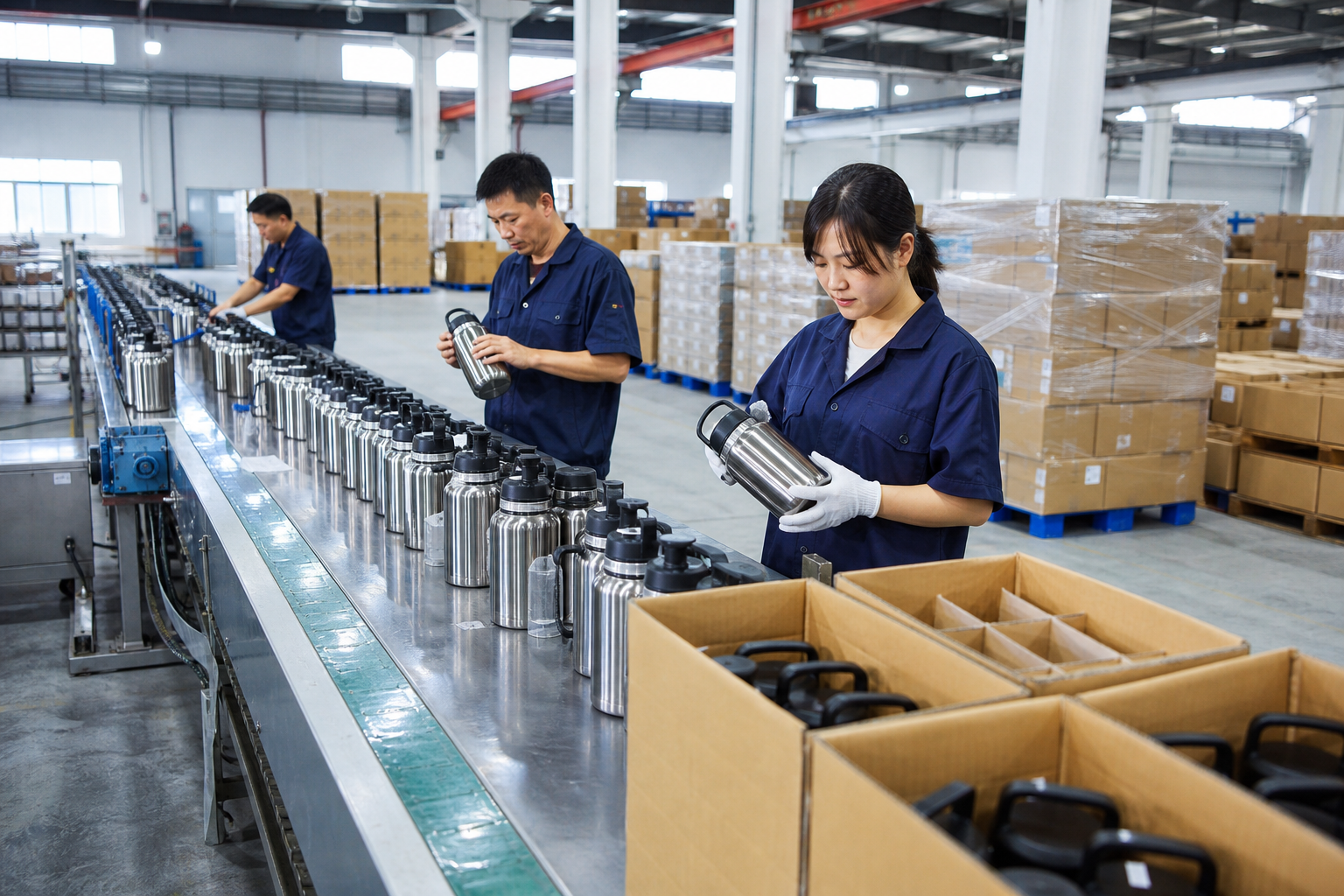
- A Zhejiang canteen factory with 300,000 units/month capacity is more useful than a broker with no QC control.
- For Europe and North America, ask for REACH, LFGB or FDA declarations, ISO 9001, and AQL inspection records before you approve a canteen supplier.
If you are building a canteen supplier list, do not start with glossy photos and a low sample price. We see that trap all the time. A canteen supplier can look fine online and still fail on weld quality, lid sealing, coating adhesion, or export paperwork. Last month, QC pulled a sample with a 0.3 mm gap at the lid ring, and the buyer flagged it the same day. For Europe and North America, you need more than a canteen vendor who can print a logo. You need a canteen manufacturer that can show material grade, REACH status, AQL 2.5, and lead times that stay within 12 days, not 18.
That matters even more when you source from Zhejiang or wider China, where the good factories run real volume and the weak ones hide behind trade listings. We ship from Hangzhou, so we know the line can turn fast if the spec is clean. The right list filters for MOQ, tooling control, custom canteen options, and whether the supplier can support distributor drinkware or canteen promotional orders without drifting in color, capacity, or delivery. A PO typo on “500 ml” once turned into “50 ml” on one of our quotes, and that is the kind of mistake that kills a program. The math does not work if the factory cannot keep the numbers straight.
What Belongs On the List
A useful canteen supplier list is not a phonebook. It is a working tool. We rank each canteen supplier on the things that decide repeat orders: material consistency, compliance files, decoration methods, packing quality, and export experience. A canteen factory that ships 20,000 pieces once is not the same as a canteen manufacturer that can repeat 20,000 pieces every quarter with the same cap torque, the same color, and the same leakage rate. QC pulled the sample, checked the cap at 0.8 N.m, and that is the number that tells you whether the line can hold up.
Start with a simple scorecard. Give each canteen supplier a score out of 5 for the following:
- Factory role: direct canteen factory, trading company, or canteen distributor
- Product fit: stainless steel canteen, insulated bottle, or custom growler
- Compliance: REACH, LFGB, FDA, ISO 9001, BSCI
- Customization: logo, coating, lid, box, and barcode support
- Delivery: sample lead time, production lead time, and on-time history
That structure matters because a canteen vendor that is good at promotional printing can still miss on export cartons, and a distributor canteen partner may have local stock but fall apart on a custom canteen program. We have seen this go sideways when the buyer flagged a typo on the PO, then the carton mark on the line did not match the barcode. If you sell custom drinkware into retail, Amazon, or corporate gifting, keep the list narrow and practical. The math does not work if the supplier can only do it once.
Material And Compliance Details
Most canteen buyers stare at the outside finish and ignore what sits inside the shell. That is the wrong question to ask. For a custom canteen, we usually start with 18/8 stainless steel, also called 304. On one line, QC pulled the sample at 0.45 mm and the cup passed dent checks; a 0.30 mm wall looks cheap and ships back in cartons with flat spots. 316 stainless has a place in salt-heavy or chemical exposure jobs, but for most drinkware the math does not work. Ask for wall thickness on paper, not just a sales promise.
For the cap, check the gasket and the resin. We run food-grade silicone gaskets, and the cap body needs a clear BPA-free declaration. If the canteen gets powder-coated, ask for coating test data, adhesion test results, and migration reports where they apply. A buyer once flagged a PO typo that said "matte black" in one line and "gloss black" in another; that kind of mess starts at approval, not packing. For Europe, REACH and LFGB matter. For the US, ask for FDA food-contact declarations. If you buy from China, insist on batch traceability so each customized canteen lot ties back to its steel coil and gasket batch.
Do not let a canteen supplier hide behind vague words like "eco-friendly" or "safe material". Ask for documents, not adjectives. A serious canteen manufacturer in Zhejiang will know which test reports they have, which lab handled them, and which model needs extra validation for custom drinkware or canteen promotional programs. We ship to customers who ask for AQL 2.5, and they are right to push hard, because a missing report costs more than a 20 g weight change ever will.
MOQ, Lead Time, And Capacity
MOQ is where a lot of canteen buyers burn days. The better question is not “What is your minimum?” It is “What is your real minimum at my decoration level?” For a plain custom canteen with a one-color logo, 500-1,000 pcs per SKU is common. Once you move to a full-color wrap, a special lid, or an odd shape, 3,000 pcs is a more honest starting point. We’ve had buyers push back on that all the time, then the math lands on the same number. A supplier quoting 300 pcs may work for a test run, but the unit cost climbs fast and the options shrink.
Lead time should be counted from final artwork approval, not from first email. On our line, a standard canteen with a simple logo usually ships in 25-35 days after deposit and sample sign-off. If the buyer adds custom packaging, plan another 5-7 days. We once found a PO typo on a carton spec, 24 pcs changed to 24 sets, and QC pulled the sample back before packing; that saved a headache. For factories in Zhejiang and other parts of China, ask for monthly capacity in hard numbers. A plant running 300,000 units per month is a different animal from a shop that only pushes out a few thousand. Capacity decides whether your seasonal distributor program, retail reset, or fixed-date canteen order lands on time.
A low MOQ only helps if the factory can repeat the same order next quarter with the same color, coating, and leak rate.
If you are building a canteen supplier list, write down max monthly output, sample turnaround, and on-time shipment rate. A factory saying “we are flexible” is not data. Ask for 12 days vs 18 days on samples, ask for the last three shipment records, and ask what happens when the buyer flags a color shift. That gives you a cleaner answer than a low first quotation from China.
Custom Logo And Packaging
Customization is a sales tool, not decoration. For canteen promotional runs, we usually put four options on the table: screen print, laser engraving, UV transfer, and full-wrap print. Screen print is the low-cost choice for one or two colors and works well when the order is 3,000 pcs or more. Laser engraving stays cleaner on stainless steel and usually lands around USD 0.20-0.50 per unit, depending on size and placement. UV transfer and full-wrap graphics cost more, but they sell better when the buyer wants shelf impact. QC pulled a sample with a 0.3 mm logo shift last week, and the buyer flagged it right away.
If you sell through Amazon or retail, ask the canteen supplier for carton dimensions, pallet pattern, barcode placement, and FNSKU labeling. This is the wrong question to skip. Bad packaging turns a solid custom drinkware item into a margin leak because the shipping cube gets bloated or the finish scuffs in transit. A workable pack-out for a mid-size canteen is 24 pcs per carton, with inner trays, desiccant if the line needs it, and a master carton drop test. We run into PO typos on carton marks all the time, usually one missing digit that throws off the warehouse scan.
For broader lines, the same rule applies to a custom growler or customizable growler program. Keep the decoration method aligned across SKUs if you want clean reorders and fewer artwork mistakes. A good canteen manufacturer will tell you which process fits the margin, not just the mockup. We have seen this go sideways when one buyer mixed laser on one SKU and UV on the next, then asked why the second reorder took 12 days longer. The line does not forgive that kind of inconsistency.
How To Audit The Factory
When you check a canteen factory, do not stop at the product photo set. Ask for the factory audit, the inspection flow, and the test list. BSCI covers social compliance, and ISO 9001 shows there is a documented quality system, but the paper alone does not tell you how the line runs. Ask how they handle incoming inspection, in-line checks, and final inspection. If they cannot explain the flow in plain terms, your order will be managed by guesswork. We have seen a buyer accept a slick sample room, then QC pulled the sample and found no records for the welding station.
For quality control, use AQL terms clearly. A practical export standard is AQL 2.5 for major defects and AQL 4.0 for minor defects, with critical defects at zero tolerance. For canteens, major defects usually include leakage, cap failure, sharp edges, or severe finish mismatch. Minor defects might be small cosmetic marks or print drift. Ask for the leak test, torque test, thermal retention if insulated, and drop testing at 1.2 m for shipping packs. If a factory says it checks everything, push back. We want the actual log sheet, not a promise. On the line, a torque wrench and a 1.2 m drop box tell you more than the sales deck.
A reputable canteen manufacturer in China should also keep batch records for raw steel, silicone, and coating lots. That matters if you later need a claim investigation or a reorder matched to a previous shipment. We have watched a buyer flag a PO typo on the silicone color code, and the batch card saved the shipment. For custom canteen and customizable drinkware programs, traceability is not a bonus; it is part of the supplier's job. If the supplier cannot trace a 304 stainless coil back to the heat number, the math does not work.
Pricing For Distributors
The cheapest quote is rarely the lowest landed cost. We check the full export stack: unit price, print charge, inner box, master carton, pallet fee, freight, duty, and inspection. A canteen supplier quoting USD 2.10 FOB can end up dearer than one at USD 2.45 if the first one needs repacking, runs a 6% reject rate, or ships in 5-ply cartons that crush on the dock. QC pulled the sample last month and found a 1.2 mm cap mismatch. That kind of issue eats margin fast.
Ask for tier pricing at 1,000, 3,000, and 5,000 pcs. If a factory won’t quote those breaks, they are not set up for repeat orders. Then ask how they handle mixed SKUs, replacement caps, and spare gasket supply. We had a buyer flag a PO typo on cap color once, and the line caught it before packing; that saved a full carton of rework. For distributor drinkware, this is the wrong question to ask: “What is your cheapest price?” Ask what happens after the first shipment. If you also carry a custom growler line, keep the same logic—split decoration cost from the base bottle, and lock the packaging spec before approval.
For China sourcing, write Incoterms clearly. FOB China is the clean starting point for most importers because it keeps factory pricing separate from freight. If you need DDP, the supplier should show every step, from export docs to last-mile handoff. In Zhejiang, the better factories quote this cleanly; the weak ones miss details like carton count or HS code, and then the math does not work. We ship from Hangzhou every week, and a 20 kg sample case can tell you a lot before a 20-foot container leaves the yard.
Build a stronger canteen supplier list now
Use hard filters on MOQ, compliance, and factory capacity before you place a trial order. The right China partner saves you time on every reorder.
Frequently asked questions
How many suppliers should be on a canteen supplier list?
For a serious buying program, keep 6-10 names on the first pass, then narrow it to 2-3 that can actually quote, sample, and document compliance. I would usually want at least one direct canteen factory in Zhejiang or broader China, one backup canteen manufacturer, and one regional canteen distributor if you need faster replenishment. Do not keep a supplier just because they are cheap on one sample. If they cannot meet your MOQ, lead time, and audit requirements twice in a row, they are not a real option. The best list is small enough to manage and strict enough to protect your margin.
What MOQ should I expect for custom canteen orders?
For a standard custom canteen with one-color logo printing, 500-1,000 pcs per SKU is a normal starting point. If you want special coating, multi-color art, custom lid tooling, or a premium pack, 3,000 pcs is more realistic. Some canteen suppliers will offer 300 pcs, but the price usually rises 12-25% and the decoration choices get narrow. Ask whether the MOQ is tied to the bottle body, the cap, or the print method, because those are not the same thing. If you are testing a market, a small MOQ is useful. If you are building a repeat canteen promotional or distributor drinkware program, a stable 1,000-3,000 pcs order is easier to scale.
Which compliance documents are non-negotiable for Europe and North America?
At minimum, ask for a food-contact declaration, REACH-related testing for coatings and rubber parts, and ISO 9001 if you want a baseline quality system. For Germany or other strict EU buyers, LFGB is often expected. For the US, request an FDA food-contact statement, not just a generic 'safe' claim. If the supplier uses printed cartons or retail packs, ask for packing test evidence as well, especially if the product will be dropped, palletized, or stored in humid conditions. BSCI is not a product test, but it helps you judge the factory's management discipline. A serious canteen manufacturer should be able to show lot traceability, not just certificates without batch references.
How do I compare canteen suppliers on price without getting fooled?
Compare landed cost, not sample price. Put the same assumptions on every canteen supplier list entry: 1,000 pcs, same logo method, same carton count, same Incoterms, and same inspection level. Then include freight, duty, labeling, and any rework risk. A cheaper quote can hide thinner steel, weaker lids, or loose print registration, which raises your defect rate later. I also look at how the supplier quotes extras: replacement caps, spare gaskets, gift boxes, and barcode labels. If those are vague, the base price is usually misleading too. A good comparison sheet will tell you which canteen factory is actually cheaper at the dock, not just on paper.
Can one factory handle both distributor and promotional canteen orders?
Yes, if the plant has enough line separation and QC discipline. A Zhejiang canteen factory with 300,000 units per month can usually support distributor canteen orders, canteen promotional programs, and even adjacent custom growler SKUs, but only if it controls changeovers, color matching, and packing clearly. Ask how many production lines they run, how long a setup change takes, and whether they keep separate inspection records by order. Distributor drinkware needs repeatability, while promotional work often needs faster turnaround and more packaging flexibility. One factory can do both, but only if it can explain the process in numbers: capacity, lead time, AQL level, and on-time shipment rate.