Key Takeaways
- A standard 500-750 ml PP bottle often lands around USD 0.35-0.70 FOB at 3,000 pcs, depending on cap and print.
- Simple molds, 1.0-1.2 mm walls, and one-color silkscreen are the fastest way to keep a canteen custom project cheap.
- Ask for REACH, LFGB or FDA food-contact evidence, plus AQL 2.5 appearance checks and AQL 1.0 for sealing parts.
- A Zhejiang canteen factory with 300,000 units/month can usually offer 25-35 day lead times on standard custom drinkware.
If you need a light, low-cost item for promotions, the cheapest custom polypropylene bottle is the right place to start. PP keeps the mold simple, the line runs fast, and a 24-cavity injection tool in a canteen factory can turn out a practical custom drinkware option without paying for material you do not need.
The catch is simple: cheap only works when the spec stays tight. A plain body, 1.0-1.2 mm wall, one-color logo, and a realistic MOQ keep the quote on target; ask for a custom shape, a special lid, or full-wrap print, and the number moves fast. We have seen a buyer flag a PO typo on capacity and the whole sample order slip a week. For Europe and North America, the real target is low FOB pricing, REACH-ready paperwork, and steady lead times from China. That is where Zhejiang factories split real offers from noise.
Why Polypropylene Is Cheapest
PP is cheap because the resin costs less, the injection cycle is short, and a straight bottle mold is far simpler than Tritan, glass, or stainless. For a custom canteen project, you pay for shape, cap, and print first, not material prestige. A basic customized canteen in PP can start around USD 0.35-0.70 FOB at 3,000 pcs, while a complex body or a fancy cap can push the price up fast.
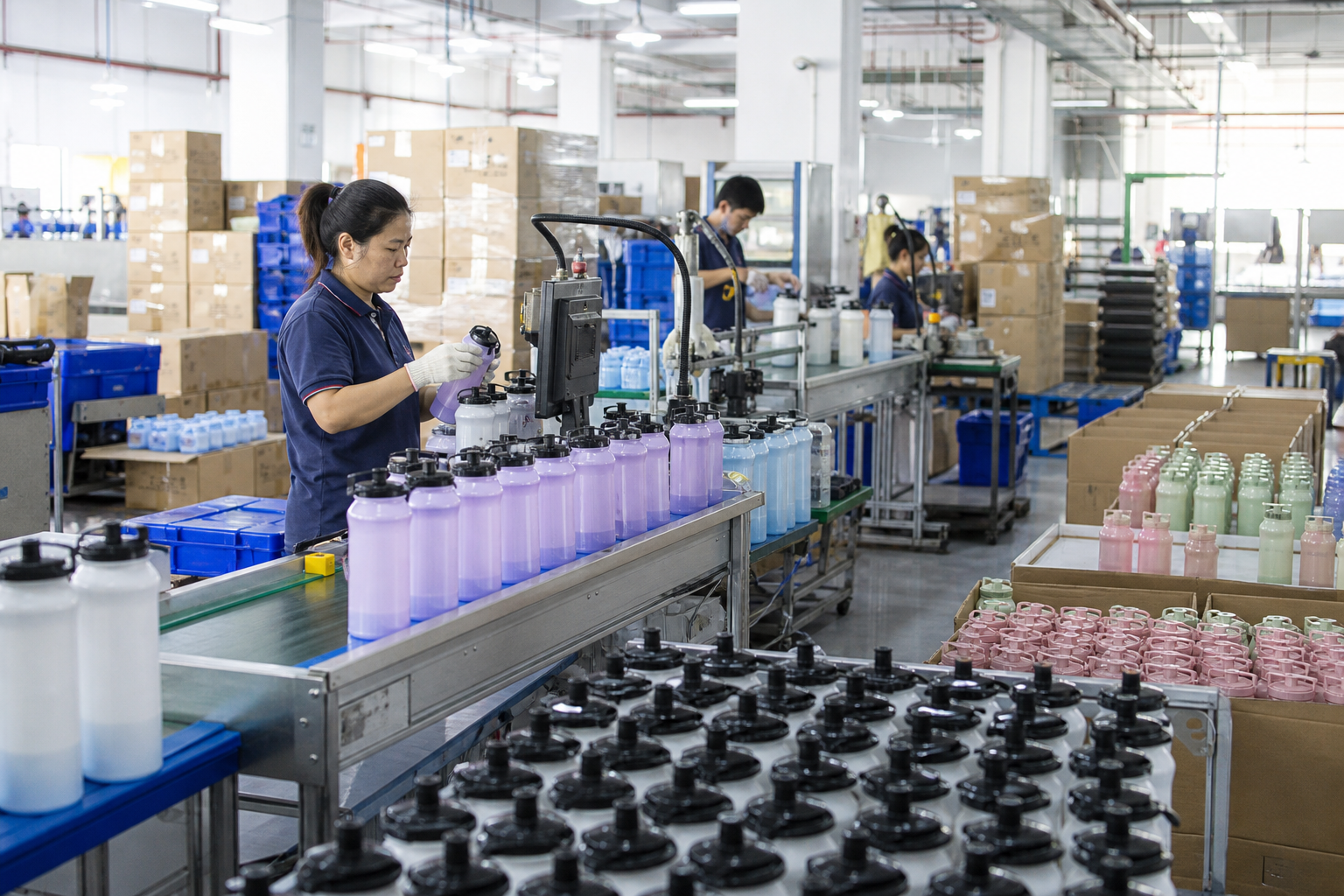
In Zhejiang, a canteen factory running modern injection lines keeps scrap low and cycle time steady. We run 1.0-1.2 mm wall bottles all the time, and that thin, simple geometry lets the line stay stable without extra polishing or hand work. QC pulled the sample once with a 0.3 mm flash at the neck, and the buyer flagged it; the fix was just mold tuning, not a new process. If you are buying for a distributor program or a promotion, the cheapest custom polypropylene bottle is usually the one with fewer steps, not the one with the lowest sample quote.
PP also fits school, sports, and event orders because the bottle is light, easy to pack, and cheap to ship. We ship cartons at lower gross weight, so freight stays easier to control. A buyer once asked for a “premium” PP bottle with too many curves, and the math did not work. That is why PP is the default entry material for custom drinkware. It is not fancy. It just makes commercial sense.
Specs That Move The Quote
Tooling and shape set the first jump in price. A flat-sided 500 ml bottle with a single-cavity mold is easier for us to run than a curved 750 ml distributor drinkware model with molded grips or a carry loop. On our line, a plain PP cap mold usually lands at USD 2,000-8,000 for simple shapes, and the number climbs if you want a proprietary cap, logo relief, or a sealing structure the buyer flagged late in the PO. If a supplier quotes sample cost and leaves out mold ownership, you are not comparing the same job.
Wall thickness changes the math fast. At 0.8 mm, some bottles look light but they warp faster and fail more often in packing; QC pulled the sample and we saw it. At 1.2-1.5 mm, the bottle feels better, but resin use goes up by 10-18 percent. Add a silicone seal, spring lid, or metal spring hinge and the unit price moves immediately. A plain PP body with a PP cap is the cheapest combo. Mixed materials and soft-touch overmolding are a different spec.
- Capacity: 500 ml is usually cheaper than 750 ml because resin weight stays lower.
- Color: natural or one color is cheaper than two-tone body molding.
- Cap: screw cap costs less than flip lid or push-pull top.
- Packaging: bulk pack cuts carton cost, but retail box adds labor.
If you need a customizable canteen for a school or club promotion, keep the spec lean and spend on artwork, not on extra plastic. We ship a lot of these at MOQ 3,000 pcs, and the buyer usually cares more about the print file than a fancy cap. That is the wrong question to ask if cost is the goal.
Decoration Without Wasting Money
Decoration is where a cheap PP bottle gets expensive fast. On the line, one-color silkscreen on a flat panel is still the lowest-cost route, and it stays clean on a 5,000-piece promotional run. Pad printing fits a small or curved logo area, but every extra color means another stencil, another setup, and more registration risk. Full-wrap graphics push the unit price up and raise scrap, because PP starts to move when heat sits on it too long.
Keep the artwork plain. A 40 x 40 mm logo, one PMS color, and no special texture will usually beat a full-body print by a wide margin. If a canteen supplier suggests laser engraving as a cheap upgrade, check the substrate first. We tried that on a sample tray once, and the mark looked weak on PP but solid on metal. For distributor programs, this is the wrong question to ask: not what looks premium, but what holds up across 5,000 pieces without turning into rejects.
On export orders, one-color print also makes QC faster. The team can check placement, ink adhesion, and edge clarity without debating the artwork. If you are comparing canteen vendors, ask for a pre-production sample with the exact print method, not a mockup on another plastic. We ship fewer disputes that way. One PO came in with the logo size typed as 4 x 4 mm instead of 40 x 40 mm, and the buyer flagged it before the line ran.
Compliance And Quality Checks
Cheap does not mean untested. For Europe, ask for REACH and LFGB where needed; for the US, ask for FDA food-contact evidence and the exact resin grade. A solid bottle factory in China should also show ISO 9001, and if you want third-party social compliance, BSCI is common. We had a buyer flag a “BPA-free” claim on a PO once. Good catch. PP is usually BPA-free by chemistry, but pigments, cap gaskets, and recycled additives can change the result.
Use AQL 2.5 for appearance and AQL 1.0 for functional checks if the bottle has a locking lid or sealing ring. Ask for drop tests from 1.0 m, leak checks, and a migration report for the color you actually ordered, not a random white sample. QC pulled the sample on our line with a 1.0 m drop rig and a torque wrench set to 0.35 N·m. A good supplier in Zhejiang will know these terms without turning them into sales talk. If they cannot explain the test standard, you are not dealing with a strong canteen maker.
For repeat orders, keep the QC sheet simple and specific: bottle weight tolerance, cap torque range, seal fit, print rub resistance, and carton drop test. We usually write 215 g ± 5 g, 0.30 to 0.40 N·m, and AQL 2.5 right on the checklist. That gives you a practical way to compare canteen suppliers, not just sales promises. In China, the better factories talk in numbers, not adjectives.
How To Compare China Quotes
When you compare China quotes, put the same spec sheet next to each one. FOB Ningbo and EXW Zhejiang are different numbers. A quote that skips export carton thickness, inner bag, or master carton count is not a real quote. The cheap one often leaves out mold amortization, printing, or spare caps. Ask each canteen vendor for a written breakdown: resin weight per bottle, cap material, logo method, packaging, mold fee, and lead time after sample approval.
A clean benchmark for a standard PP bottle is 25-35 days production after deposit and artwork confirmation, and a factory with repeat business should hold about 300,000 units/month if the line stays loaded. For a plain customized drinkware line, MOQ 3,000 pcs is a sane floor; below that, unit cost jumps or the schedule gets shaky. We run the math by carton, not by piece, because a 58 x 42 x 35 cm carton can move freight more than 8 g of resin. The buyer flagged it on one PO because the carton count was typed wrong.
Check who owns the mold. If the canteen manufacturer keeps it, your reorder can move faster, but you lose some control. If you own the mold, you control the program, and you need a storage and maintenance note in writing. QC pulled the sample last week and found a 0.3 mm flash on the cap thread; that kind of detail is what bites later. This is the wrong question to ask if you only chase the lowest quote. For seasonal runs in Europe or North America, that ownership line decides whether the next order ships in 12 days or drifts to 18.
When PP Is The Wrong Choice
PP works when the brief is simple: low price, low weight, fast line output. It fails when the buyer wants glass-like clarity, hot-fill performance, or a premium reusable growler feel. A customizable growler for beer, or a branded bottle for 90 C drinks, needs a different resin and a different cap system. If the PO says cheapest custom polypropylene bottle but the market wants luxury retail, the math does not work. We have seen this go sideways on a 480 ml order when the buyer pushed for PP and then asked why the bottle looked “too light” on shelf.
For seasonal promos, sports events, school campaigns, and distributor canteen programs, PP is the clean answer because we can hit a low FOB and keep print simple with one-color silk screen. For a repeat retail program, you usually need a thicker wall, a better seal, or a different substrate. One line detail matters here: QC pulled the sample at 100 mm height and found the cap torque was fine, but the feel was still cheap for chain-store retail. Choose the material after you lock temperature, branding, and service life. Start from use case. Price follows.
If you are sourcing from Zhejiang or another export hub in China, ask the factory for two quotes side by side: the lowest-cost PP build and the upgraded version with better sealing or decoration. That gives you a real comparison, not a loose back-and-forth. We ship these every week, and the buyers who get the best result are the ones who compare a 12-day sample plan against an 18-day upgraded plan before they place the order.
Request a PP bottle quote with your target price
Send your capacity, logo method, and MOQ target. We will return a spec sheet, sample cost, and FOB quote from China within 24 hours.
Frequently asked questions
What MOQ should I expect for a cheapest custom polypropylene bottle?
<p>For a standard PP bottle with a simple cap and one-color logo, 3,000 pcs is a realistic MOQ from a serious factory. Some stock molds can start at 1,000-2,000 pcs, but the unit price often rises by 20-40% because the setup cost is spread over fewer pieces. If you want a new shape, new cap, or multiple print colors, MOQ usually moves to 5,000 pcs or more. For canteen custom programs, the cleanest pricing usually comes when you accept a standard mold, one decoration method, and a simple carton pack.</p>
Is polypropylene safe for drinking bottles?
<p>Food-grade PP is widely used for drinking bottles because it is lightweight, stable, and typically BPA-free by material chemistry. That said, you still need the right resin grade, compliant pigments, and a cap seal that passes food-contact rules. If you sell into Europe, ask for REACH and LFGB support where required. For the US, ask for FDA food-contact evidence. Do not assume a cheap customized canteen is safe just because the plastic is PP; the additives, colorant, and gasket matter too. For hot liquids above about 80 C, ask for explicit heat and migration data before you approve production.</p>
Which printing method is cheapest on PP bottles?
<p>One-color silkscreen is usually the cheapest and most common option for PP bottles. It works best on a flat or lightly curved area and keeps setup simple. Pad printing is useful for smaller or more curved logo zones, but the price usually rises with every extra color. Full-wrap decoration or heat transfer can look stronger visually, but it adds labor and rejects. If you are buying for a canteen distributor program, the lowest-risk option is usually a single PMS color, a 40 x 40 mm logo, and a clear print placement spec. That gives you consistent output across a 5,000-piece run.</p>
How much are samples, molds, and lead time from China?
<p>For a standard custom drinkware project, sample cost is often USD 50-150 depending on print and cap complexity. A simple new mold can run USD 2,000-8,000, while more custom parts cost more. Production lead time for a repeat or standard-order PP bottle is usually 25-35 days after deposit and artwork approval. If the factory has the mold in place and the color is standard, faster delivery is possible. A Zhejiang canteen factory with around 300,000 units/month can usually keep those timelines stable, but only if you lock the spec early and avoid late artwork changes.</p>
How do I know if a China quote is actually cheap?
<p>Compare quotes only after the specs match line by line. Check bottle weight, resin type, cap style, print method, carton count, inner bag, and whether the FOB price includes mold amortization or not. A low quote that hides packaging or uses a thinner wall is not a real saving. Ask for AQL 2.5 appearance standards, AQL 1.0 for seals, and a clear lead time. If two canteen suppliers quote USD 0.42 and USD 0.58 FOB, the lower one may still be more expensive once you add freight, rejects, and rework. The real number is landed cost per sellable unit, not the headline price.</p>