Key Takeaways
- A simple 500 ml 304 stainless thermos with one-color print can start around USD 2.20-3.40 FOB China at 1,000 pcs.
- MOQ for a basic custom thermos is often 500 pcs per style, but a special lid, color, or box can push it to 1,000 pcs.
- Silk screen is usually the cheapest decoration, while laser engraving adds durability for about USD 0.12-0.25 per piece.
- Ask for AQL 2.5 major inspection, REACH or LFGB test reports where needed, and a 1.2 m drop test before you pay balance.
The cheapest custom thermos bottle is rarely the one with the lowest unit quote. Price moves with steel grade, wall thickness, lid tooling, print method, and carton spec. On the line, a 0.4 mm body and a basic PP lid price out very differently from a 0.5 mm shell with a two-piece cap. If you only chase the lowest FOB, you usually give up insulation stability or end up with a lid that feels loose in hand.
For outdoor retailers and promotional brands, the better question is which thermos custom spec gives you the lowest landed cost without bringing returns back through the door. We have seen buyers push for a $0.18 cut, then the sample fails a 1.2 m drop test and the math stops working. A Zhejiang thermos factory in China can keep pricing sharp when the structure stays simple, decoration stays to one color, and the order size stays disciplined. QC pulled the sample, the buyer flagged a PO typo on the cap color, and that kind of mess costs more than the quote difference.
What cheap really means
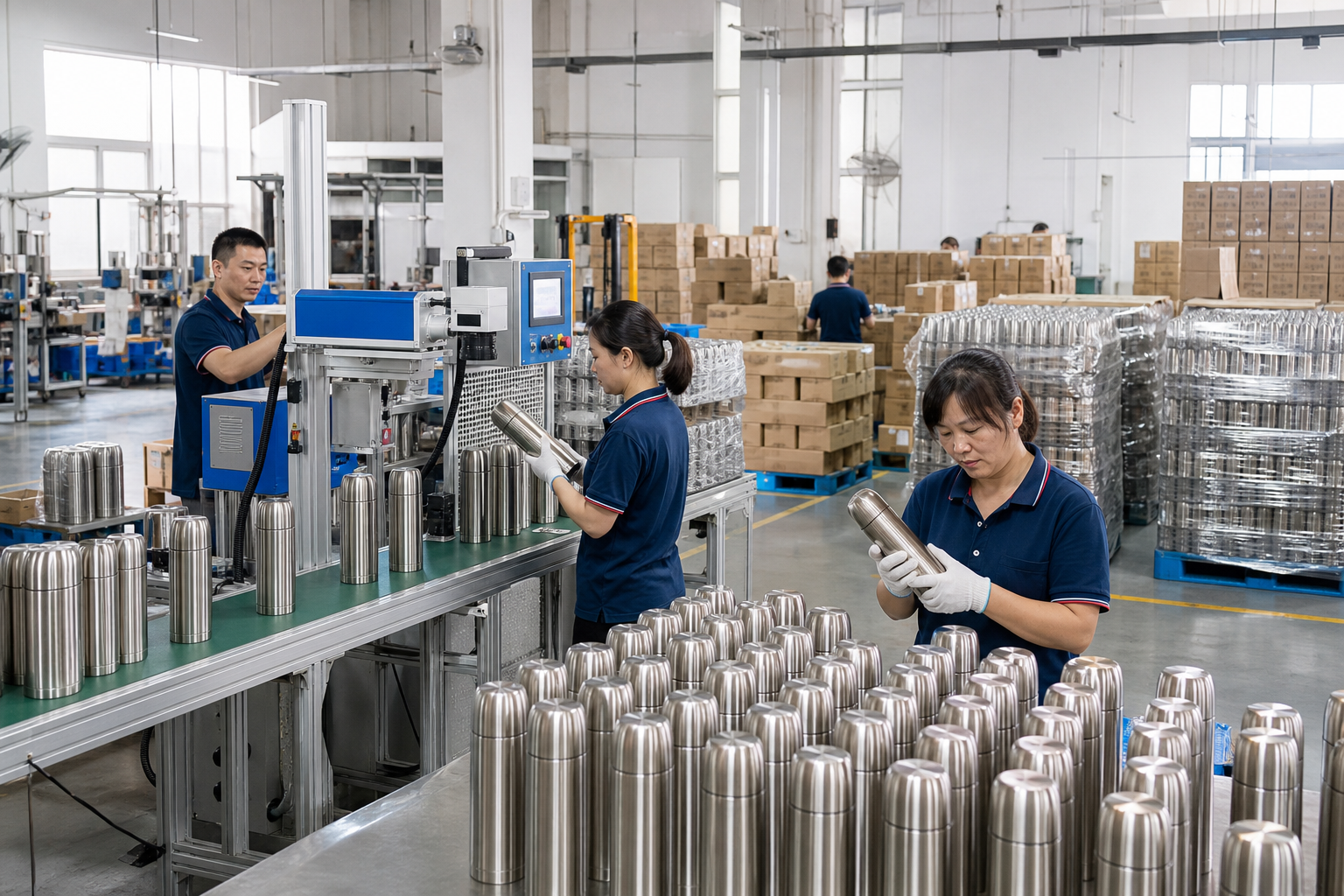
Buyers asking for the cheapest custom thermos bottle usually mean the lowest price that still moves through retail. That is not the same as the bottom quote on paper. We run this every week in China sourcing: the unit price comes from three parts, the metal structure, the lid, and the decoration. The bottle body is only one piece.
For a plain 350 ml to 500 ml vacuum thermos, the clean spec is 304 stainless, PP lid, and one-color print. That is the sweet spot. At 1,000 pcs, a Zhejiang factory quote usually sits around USD 2.20-3.40 FOB, depending on finish and packaging. A custom gift box adds USD 0.20-0.45. A soft-touch coating or a complex lid pushes it up fast. QC pulled the sample with a 0.2 mm wall check on the caliper, and that number tells the story.
The wrong move is to cut cost by asking for ultra-thin steel or a weak lid. It looks fine on the first PO, then the buyer flags leakage, dents, or a cap that cracks in transit. This is the wrong question to ask. A good thermos supplier should break the quote into cup body, lid, seal ring, print, carton, and test cost. If they cannot show that breakdown, they are not helping you buy smart. They are just selling cheap.
Pick the spec that saves money
I’m rewriting the section in place, keeping the HTML structure intact and tightening the language so it reads like a factory-side sales engineer, not generic web copy.If you want the cheapest custom thermos bottle that still looks credible, keep the build plain. The real savings come from cutting parts, not shaving steel by 0.05 mm. For bulk thermos programs, 304 stainless is the normal cost target. 316 stainless makes sense for salty air or harsher chemicals, but it is not the cheapest choice for a promo bottle or a basic retail line. QC pulled the sample in Hangzhou last week, and the first thing they checked was the part count, not the steel grade.
A low-cost spec we run often is 304 inner and outer shell, 0.35-0.40 mm wall thickness, straight cylinder body, powder coat or a simple spray finish, and a screw lid with one sealing ring. If you add a tea filter, a cup-style lid, or a push-button closure, the line needs more parts and more checks. That is fine for a premium SKU. It is the wrong setup if the buyer wants a sharp opening price. We have seen POs where "cup lid" was typed as "cap lid," and the buyer flagged it before production.
- Use one body shape across the range. One mold, one changeover.
- Choose one cap color for all SKUs. One Pantone, one paint run.
- Keep vacuum insulation standard, not overengineered. The math does not work on a 3,000 pcs order when you add extra features.
- Avoid custom molds unless you will reorder at least 3,000 to 5,000 pcs. That is the point where setup cost starts to make sense.
A Zhejiang factory runs this cleanly when the MOQ is 3,000 pcs or more, because setup changes stop killing the schedule. That is how China stays competitive on thermos bulk orders: fewer variables, fewer rejects, faster packing on the line.
Decoration costs that matter
Decoration is where buyers blow the budget. A plain promo thermos does not need fancy art. If you only need one logo, one-color silk screen is usually the cheapest route. At 1,000 pcs, the print add-on is often USD 0.08-0.18 per piece. Laser engraving runs a bit higher, usually USD 0.12-0.25, but the mark stays put because it is cut into the surface. QC pulled the sample and the logo still read clean after the abrasion test.
For outdoor retailers, the choice comes down to shelf appeal or scratch resistance. Powder-coated bodies take silk screen well if the surface is prepped right on the line. Bare stainless works well for laser and looks clean, but it reads more like a tool than a promo item. Full-wrap printing, gradient art, and multi-color registration are all possible, yet this is the wrong question to ask if you want the cheapest custom thermos bottle. They also slow sampling. We have seen a buyer flag a PO because the artwork called for three methods on one bottle, and the math did not work.
If you want to keep cost under control, use these rules:
- One logo, one position, one color.
- Do not mix print methods on the first order.
- Choose standard carton printing instead of a printed insert card.
- Ask the thermos supplier for a decoration proof before mass production.
For most distributors, a laser logo on a matte body is the cleanest compromise. It looks sharp, holds up in transit, and avoids the setup cost of full-color printing. We ship a lot of those at 500-1,000 pcs, and the buyer usually stops arguing once they see the sample next to a scratched silk-screen cup.
MOQ and lead time in China
MOQ is where the buying decision starts. A serious thermos factory will often take 500 pcs per style for a plain custom thermos order, but 1,000 pcs is more common once you ask for a special color, custom carton, or a different lid. If the buyer wants a new mold, MOQ can jump to 3,000 pcs or more. That is normal. We quote it that way because the tooling bill has to be spread somewhere, and the math does not work at 200 pcs.
For a standard bulk thermos program from China, sample lead time is usually 5-10 days after artwork confirmation. Mass production often takes 25-35 days after deposit and sample approval. On our Zhejiang line, the ultrasonic welder and vacuum leak tester run across multiple SKUs, and monthly output can hit 300,000 to 500,000 units. In practice, the bottleneck is usually the buyer’s spec sheet, not the machine capacity. We have seen a PO typo on lid color cost two days.
Cheap and fast is possible, but only when you remove custom parts early. Every extra variable adds time, rejects, and packaging cost.
Most suppliers want 30 percent deposit and the balance against the bill of lading copy. That is standard in China. If you are buying thermos distributors’ stock for a launch date, ask for an internal production calendar before you sign the purchase order. A clear schedule beats a lower quote that misses the ship window. We once had a buyer push for a 12-day delivery promise on a 20,000 pcs order; the line could not do it, and QC pulled the sample after the packing spec changed.
Quality checks that protect margin
I’m rewriting the section to sound like a shop-floor sales engineer: tighter wording, concrete checks, and no AI-style filler. Next step is to keep the HTML structure intact and replace the prose inside each paragraph only.Low price means nothing if the first cartons show leaks, weak vacuum retention, or crushed boxes. Before production starts, lock the inspection standard in writing. AQL 2.5 for major defects and AQL 4.0 for minor defects gives the supplier a hard target, not a hand-wavy promise. On our line, QC pulls the first-off samples before the sealing machine runs past 50 pieces, and that catches bad gaskets early. If you are buying for Europe, ask for REACH or LFGB-related food contact testing as needed. For North America, ask for the right food-contact compliance papers and make sure the claim matches the market.
The key tests are plain and practical: leak test, vacuum insulation test, lid torque check, drop test, and carton compression. A normal promo spec might ask for 6-12 hours of hot retention, while a better retail bottle should reach 12-24 hours, depending on fill volume and lid design. We run a torque meter on the lid and check the gasket seat before the sample leaves QC. Do not accept a glossy claim with no test method behind it; we have seen the math fall apart when the cap changes by 0.5 mm.
Check the small parts too. Seal rings should sit flat, threads should start clean, and the logo should survive a basic rub test without chipping. If your thermos vendor cannot send inspection photos, packing photos, and carton counts, the savings are fake. One PO typo on carton count, 2,400 instead of 2,040, can turn into a warehouse fight fast. QC pulled the sample, found a loose ring, and that order went back to the line. The wrong question is the cheapest unit price; the real question is what gets checked before the cartons leave.
Spec the right bottle for your channel
Outdoor retail and promotional sales do not buy the same product. For a giveaway or corporate gift, the cheapest custom thermos bottle is usually a 350 ml or 500 ml model, 304 stainless, PP lid, one-color logo, and a plain kraft or white box. We run that spec on the line when the buyer only cares about landed cost; it ships clean, and QC pulled the sample after the 1.2 m drop test with no extra fix. For a distributor thermos program, the better move is often a mid-tier 500 ml bottle with a tougher coating, because distributors need something that survives shelf rubbing and repeat orders. Treat the two channels the same, and the math breaks fast.
If you sell into outdoor retail, spend a little more on grip, surface finish, and closure feel. Buyers notice the lid before they talk about the steel grade. A screw lid with a clean seal, a matte body, and a simple laser mark can read as higher value without pushing the unit price much. We saw a buyer flag a glossy lid after 20 handlings on the packing table, and that complaint came back in the next PO. That is where a smart thermos manufacturer earns repeat business.
Use these target specs as a starting point:
- Promotional thermos: 350 ml, 304 stainless, one-color print, FOB China around USD 2.20-2.80 at 1,000 pcs.
- Retail entry line: 500 ml, powder coat, laser logo, FOB China around USD 2.80-4.20.
- Higher-value bulk thermos: tea filter, custom box, tighter insulation spec, usually USD 4.20 and up.
If your buyer wants the lowest price, keep the product honest. If they want stronger sell-through, spend on the parts shoppers can see and feel. We have seen this go sideways when the PO says one thing and the carton spec says another.
Send your thermos spec for a real quote
We will price the structure, decoration, and packaging separately so you can see where the cheapest custom thermos bottle actually saves money.
Frequently asked questions
What is the cheapest custom thermos bottle price I should expect?
For a basic 350 ml to 500 ml 304 stainless thermos with one-color logo and standard packaging, a China factory can often quote USD 2.20-3.40 FOB at 1,000 pcs. If you add a custom gift box, expect another USD 0.20-0.45. If you add special coating, a complex lid, or two-color decoration, the price rises quickly. Shipping, duty, and last-mile costs are separate, so compare landed cost, not only unit price.
What MOQ do thermos suppliers usually ask for?
For a simple custom thermos, 500 pcs per style or color is common, especially if the factory already has the body and lid tooling. If you need a new lid, a custom Pantone color, or a special carton, 1,000 pcs is more realistic. New molds can push MOQ to 3,000 pcs or higher. A good supplier will explain which parts are stock and which parts are custom so you know why the MOQ changes.
Is 304 stainless enough for Europe and North America?
Yes, 304 stainless is the standard cost-effective choice for most stainless thermos programs. For Europe, ask the thermos manufacturer for the relevant food-contact test reports, often including REACH-related evidence and, where applicable, LFGB. For North America, ask for food-contact compliance documentation that matches your channel. If the bottle will see unusually harsh conditions, 316 stainless may be worth it, but it is usually not the cheapest route for bulk thermos buying.
Which decoration method is cheapest for promotional thermos orders?
One-color silk screen is usually the cheapest. At 1,000 pcs, it can add around USD 0.08-0.18 per piece. Laser engraving is often USD 0.12-0.25, but it holds up better against abrasion and shipping wear. Full-wrap printing, multi-color art, and complex finishes raise setup time and cost. For most promotional thermos programs, a single logo in one position gives the best cost-to-impact ratio.
How do I avoid hidden costs from a China factory?
Lock down the spec before you ask for a final quote. Confirm material grade, wall thickness, lid type, print method, carton format, and drop test standard. Ask for AQL 2.5 major inspection, packing photos, and a sample approval record. If you are buying from Zhejiang or another China manufacturing hub, also ask whether the quote is FOB Ningbo or another port so you do not compare mismatched numbers. Most surprises come from incomplete specifications, not from the factory itself.