Key Takeaways
- A cheapest custom thermos flask usually starts around USD 2.30-3.20 FOB China at 500 ml, depending on finish and lid
- A safe MOQ for simple print jobs is often 1,000-3,000 pcs, while fully custom lids can push MOQ to 5,000 pcs
- 304 stainless inner and outer walls with 0.4-0.5 mm thickness are the practical baseline for bulk thermos buying
- A good factory thermos should survive a 24-hour hot retention test above 60°C and pass REACH or LFGB requirements for your market
If you are buying the cheapest custom thermos flask for an outdoor retail line or a promotional campaign, the real cost is never the unit price alone. A 500 ml stainless thermos at USD 2.80 can turn into a bad buy if the lid leaks, the coating chips, or the vacuum fails after 3 months. We have seen 24-hour leak tests expose a bad silicone ring before shipment, and then the buyer flags the whole lot. Chasing the lowest quote is the wrong question.
The right way to buy a custom thermos is to control the spec, not just the price. Wall thickness, steel grade, lid structure, print method, and carton packing all move your landed cost. A serious thermos factory in China should give you a clear FOB China price, show the MOQ, and tell you where the savings are real. On our line, a 0.4 mm body versus 0.5 mm changes the math fast, so ask the same questions every time if you source from a manufacturer in Zhejiang.
What drives thermos price
The cheapest custom thermos flask is usually cheap because the factory stripped the build down. That is fine if you know what got cut. We run these on the line every week, and the cost usually comes from five places: steel grade, wall thickness, lid tooling, decoration method, and packing. For a standard 500 ml stainless thermos, 304 inner and outer steel with a 0.4 mm wall is a common cost base. Move to 0.5 mm and your material cost rises by roughly 8-12%. Switch to 316 inside, and you pay more again, often USD 0.25-0.60 per piece depending on volume. QC pulled the sample on one batch because the wall gauge drifted by 0.03 mm. That is the kind of detail that changes the quote.
Lid design matters more than most buyers expect. A basic PP screw lid is far cheaper than a push-button or tea infuser lid. The buyer flagged it on a 3,000 pcs order last month because the “cheap” lid leaked in the cap torque test. Decoration is the same story. One-color silkscreen on a flat body might add only USD 0.08-0.15, while laser engraving or a 360-degree wrap print costs more and needs tighter process control. If you want a custom thermos for a distributor program, ask the thermos supplier to quote each option separately. That is the right question. Otherwise you are comparing suppliers thermos offers on a headline price that hides the real build.
Typical FOB China pricing at 5,000 pcs, 500 ml:
- Plain powder coat, one-color print: USD 2.30-2.90
- Matte color finish, one-color logo: USD 2.60-3.20
- Tea lid or upgraded stopper: add USD 0.20-0.70
- Gift box packaging: add USD 0.15-0.40
Those numbers are normal for a Zhejiang manufacturer. If a quote lands far below that, we ask what steel thickness, vacuum retention, and lid test they skipped. We have seen this go sideways on a 10,000 pcs PO where the carton spec was typed wrong and the buyer had to rework the whole shipment. Cheap is not free.
Choose the right stainless build
For outdoor retailers, the cheapest custom thermos flask still needs to look and feel like a retail product. We run 304 stainless inside and outside on most orders for a reason: stable vacuum, decent corrosion resistance, and a lid that does not carry that recycled-plastic smell. If a buyer pushes for 316, we ask where it will be sold and what liquid it will hold. That extra spec makes sense for harsh use, but it is not the cheapest route.
Check the wall structure next. A double-wall vacuum thermos with 0.4-0.5 mm steel is enough for daily retail use, and on the line we see fewer dent claims at that range. Last month QC pulled the sample and measured a 0.32 mm wall on a bargain quote; the buyer flagged it after one carton failed the drop test. Thin steel saves grams, not headaches.
What to specify on the drawing
- Inner and outer steel grade: 304 or 316
- Body thickness: 0.4 mm minimum for budget retail
- Capacity tolerance: ±3% is normal
- Vacuum target: 24-hour heat retention above 60°C for a tested sample
- Coating: powder coat, spray paint, or bare steel
If you buy from a thermos manufacturer in China, these specs keep the talk clean. They also let you compare factory thermos quotes on the same sheet, instead of arguing over what “high quality” means. We saw one PO with a typo on the capacity line, and the math did not work until the buyer corrected it. Use the drawing to lock the deal.
MOQ and price breaks matter
I’m rewriting the section to keep the HTML structure intact while making the copy sound like it came from a factory-side sales engineer. I’m checking for the exact places where the price logic, MOQ logic, and packaging detail need more concrete, on-the-ground language.MOQ is where a lot of buyers burn time. A thermos distributor asking for 800 pcs gets a different number from a brand owner at 5,000 pcs, and the gap shows up fast on the line. In Zhejiang, a stock body with a custom logo usually lands at 1,000-3,000 pcs per color. If you want a new lid, new handle, or a fresh mold detail, 5,000 pcs or more is the normal starting point. Tooling is not free, and the mold shop does not care about the buyer's target margin.
The cheapest custom thermos flask is often not the lowest unit price at 1,000 pcs. We have seen this go sideways when the buyer fixes on one quote and ignores the curve. Move from 1,000 pcs to 3,000 pcs and the FOB can drop by USD 0.20-0.35 per unit. If your market can take the stock, that beats chasing tiny repeat orders. QC pulled the sample at the packing table, and the buyer flagged the carton count before we loaded the pallet.
Ask your supplier thermos partner for pricing at 1,000 / 3,000 / 5,000 pcs. If they only give one number, they are hiding the real buying curve.
Check carton efficiency too. A bottle that ships 24 pcs per carton instead of 30 pcs can wipe out the factory saving once freight lands. We had one PO where the buyer typed the carton size wrong by 2 cm, and the pallet count changed overnight. That is why a thermos supplier should quote unit price, carton size, gross weight, and pallet count together. The math does not work any other way.
Logo methods change the margin
For promotional thermos work, decoration is the margin line. A cup can pass inspection and still lose the order if the logo looks cheap. We run silkscreen, pad print, laser engraving, heat transfer, and full-body wrap on the line every week. If the buyer wants the cheapest custom thermos flask, one-color silkscreen on a powder-coated body is usually the lowest-cost logo choice. It moves fast, stays readable, and fits bulk thermos orders without slowing the packing table.
Laser engraving costs more in setup, but the mark stays clean after 200 or 300 hand washes. That is the right call when a buyer pushes for a premium custom thermos or sells through outdoor channels where abrasion is normal. Heat transfer and wrap printing can look sharp, yet they need tighter process control, and we have seen the reject rate jump when the rotating jig is not set right. A good thermos manufacturer will give you the logo area limits, the Pantone match tolerance, and the per-color price gap before you send the PO. If they cannot, the math does not work.
Practical logo guidance:
- One-color silkscreen: lowest price, clean on powder coat
- Two-color print: higher cost, more alignment risk
- Laser engraving: durable, premium, slower on the line
- Wrap print: strong branding, needs tighter setup control
If you are running a promotional thermos program, keep the artwork simple. A logo at 40 mm wide usually prints cleaner than a design that tries to span half the body. We had one buyer flag a PO because the artwork file called for a 52 mm logo, and QC pulled the sample after the edge started blurring at the curve. Simple art cuts spoilage, and spoilage is one of the hidden costs every thermos supplier watches.
Test quality before ordering
The cheapest custom thermos flask is not cheap if the vacuum cracks in transit or the lid leaks into a retail carton. This is the wrong question to ask: what matters is whether the sample survives the line. For China sourcing, ask for a pre-production sample and a production sample from the same run, then check hot retention, leak resistance, coating adhesion, and odor. For Europe and North America, your supplier should understand REACH, LFGB where applicable, and the retailer rules that usually show up after the PO is signed.
At BottleForge in Hangzhou, Zhejiang, we usually hand buyers a plain approval sheet: 24-hour thermal retention, 1-meter drop test, screw-thread alignment, and dishwasher warning text if the coating is not rated for repeated cycles. QC pulled the sample with a torque wrench, and the cap still missed by 0.4 mm on one unit. A serious thermos manufacturer should also speak in AQL terms. For a bulk thermos shipment, AQL 2.5 for major defects and 4.0 for minor defects is a common commercial standard, though some brand programs ask for tighter control. The math does not work if the factory says "all good" without a number.
Ask for batch photos, not just one clean sample. A factory thermos sample can look right while the production line is drifting, and we have seen that go sideways on a 3,000-piece order. If the thermos custom run is for Amazon or retail, request inner carton drop testing and barcode placement confirmation before mass production. One PO typo on the carton code can delay a week of shipping, so check the detail sheet before we ship.
Source from Zhejiang with control
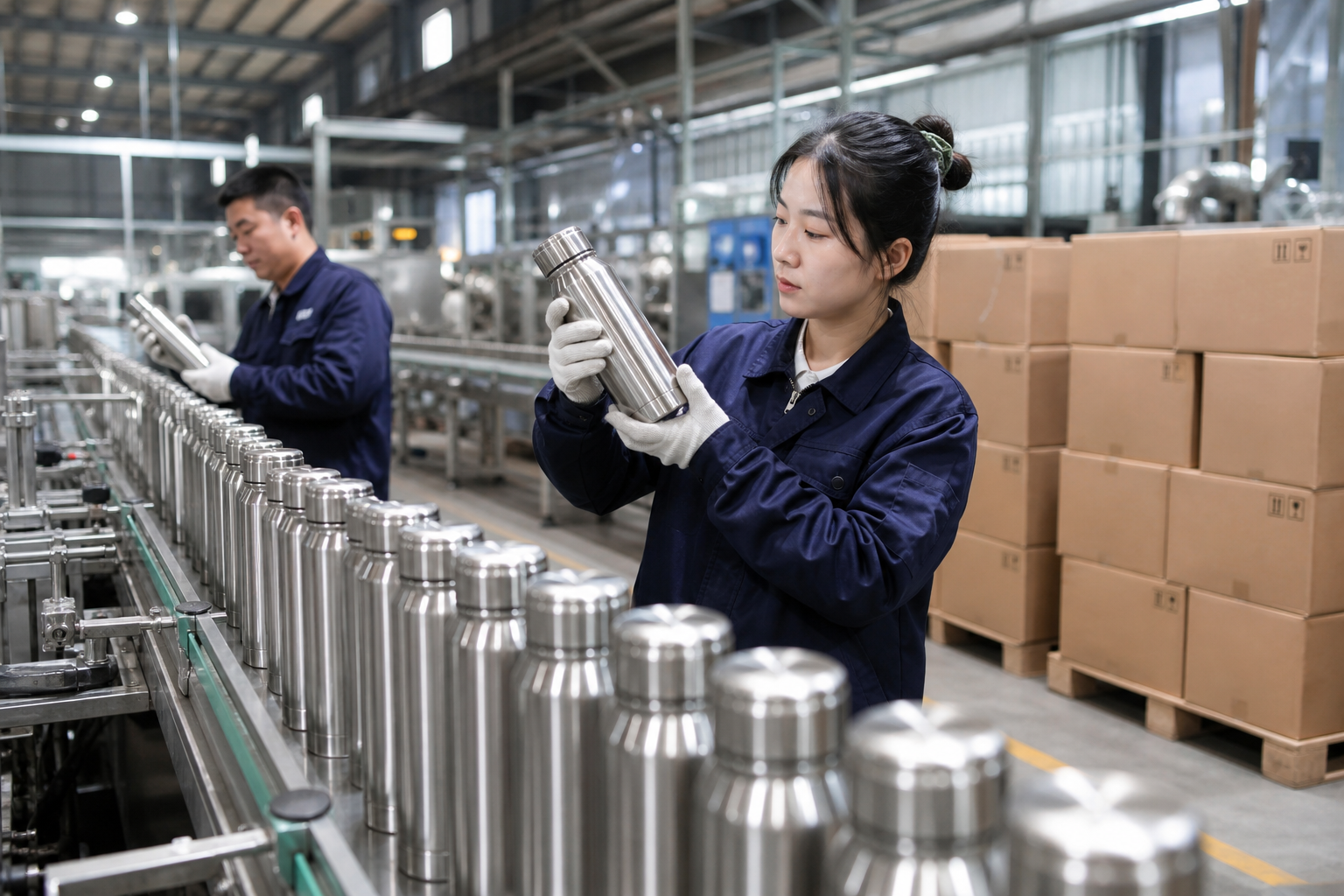
China has a lot of thermos factories, but Zhejiang still makes sense if you want export habits, fast sampling, and mixed-order runs. In Hangzhou, our line runs about 120,000 units a month across stainless drinkware, with samples in 5-7 days and mass production in 20-30 days after order confirmation. QC pulled the first sample at the 0.8 mm lid gap, fixed it, and shipped the recheck the next morning. That is the kind of schedule you can build a launch plan around.
Do not pick a thermos vendor because the replies are fast. Ask for BSCI or a similar audit, written QC checkpoints, and a clean claim process. On the floor, we check body thickness, vacuum seal, and drop marks before packing; that is the real test, not a polished sales reply. A supplier thermos team should tell you what is in stock, what needs tooling, and what can be customized without changing the mold. For a distributor thermos program, this is the right question to ask, because saving USD 0.10 means nothing if the buyer flags a lid code typo on the PO and the rework bill eats it.
When the lowest price is acceptable:
- You need simple logo-only promotion
- You can accept standard 304 steel and a basic lid
- You have enough volume to cover shipping efficiently
- You are buying from a proven thermos factory with export documentation
If your buyer base wants a retail-grade bottle, pay for the body first and the decoration second. We have seen the math go sideways on a 500-box run when a cheap cap cracked in carton drop tests. That is how you buy cheap without buying trouble.
Request a thermos quote with real landed cost
Send your capacity, logo method, and target MOQ. We will quote the cheapest workable thermos custom option, not a fake low number.
Frequently asked questions
What is the cheapest custom thermos flask price I can expect?
For a 500 ml stainless model with 304 steel, basic powder coating, and one-color logo, a realistic FOB China range is USD 2.30-3.20 at 3,000-5,000 pcs. At 1,000 pcs, many factories quote USD 2.90-4.10 because setup and labor are spread over fewer units. If you add a tea lid, gift box, or laser logo, budget another USD 0.15-0.80. The exact price depends on wall thickness, lid complexity, and how much customization you want.
What MOQ should I expect from a thermos manufacturer?
For a stock body with custom print, MOQ is often 1,000-3,000 pcs per color. For a fully customized thermos with a new lid or molded detail, 5,000 pcs is common. Some suppliers can accept 500 pcs for sample-style orders, but the unit price will usually be much higher. If you are a distributor thermos buyer, ask for tiered pricing at 1,000, 3,000, and 5,000 pcs so you can judge the real break point.
Is 304 stainless enough for outdoor retail use?
Yes, in most cases 304 stainless is the right balance of cost and performance for a bulk thermos program. It resists corrosion well, is widely accepted for export, and keeps your price competitive. For harsher use or premium positioning, some manufacturers offer 316 inner steel, but that usually adds USD 0.25-0.60 per unit. If your goal is the cheapest custom thermos flask, 304 is the standard choice unless your buyer spec says otherwise.
How do I check thermos quality before mass production?
Request a pre-production sample from the actual production line, not just a showroom sample. Check leak resistance, lid fit, print alignment, coating durability, and thermal retention after 24 hours. For export, ask the thermos supplier about REACH, LFGB if needed, and AQL inspection levels. A common commercial target is AQL 2.5 major and 4.0 minor defects. If the factory will not explain its QC steps, move on.
What is a normal lead time for custom thermos orders from China?
For a standard custom thermos with existing tooling, sample time is usually 5-7 days and mass production 20-30 days after approval and deposit. If you need a new mold or a special lid, add 15-30 days for tooling and debugging. Zhejiang factories with export experience can sometimes move faster, but only if your artwork, carton spec, and payment are confirmed early. Fast production is useless if your artwork keeps changing.