Key Takeaways
- A plain PET or single-wall stainless bottle can start around USD 0.85-1.40 FOB at 1,000 pcs; decoration changes the math fast.
- MOQ often drives price more than material: 500 pcs usually costs 15-30% more per unit than 3,000 pcs.
- Laser engraving adds durability but not always the lowest price; one-color silk screen is often cheaper for canteen promotional orders.
- Landed cost from Zhejiang can rise 20-35% after freight, duty, packaging, and compliance if you do not specify cartons and test standards early.
If you are chasing the cheapest custom water bottles, the first mistake is asking only for the lowest unit price. That is the wrong question to ask. We have seen bottles crack at the shoulder, print with pinholes, or add $0.12 to freight because the carton spec was loose by 2 mm and the pack-out ran heavy. On the line, QC pulled the sample and dropped it three times from 1.2 meters before we cleared the batch. Cheap only works when the spec is locked down: material, mold, decoration method, carton packing, and shipping weight all have to match.
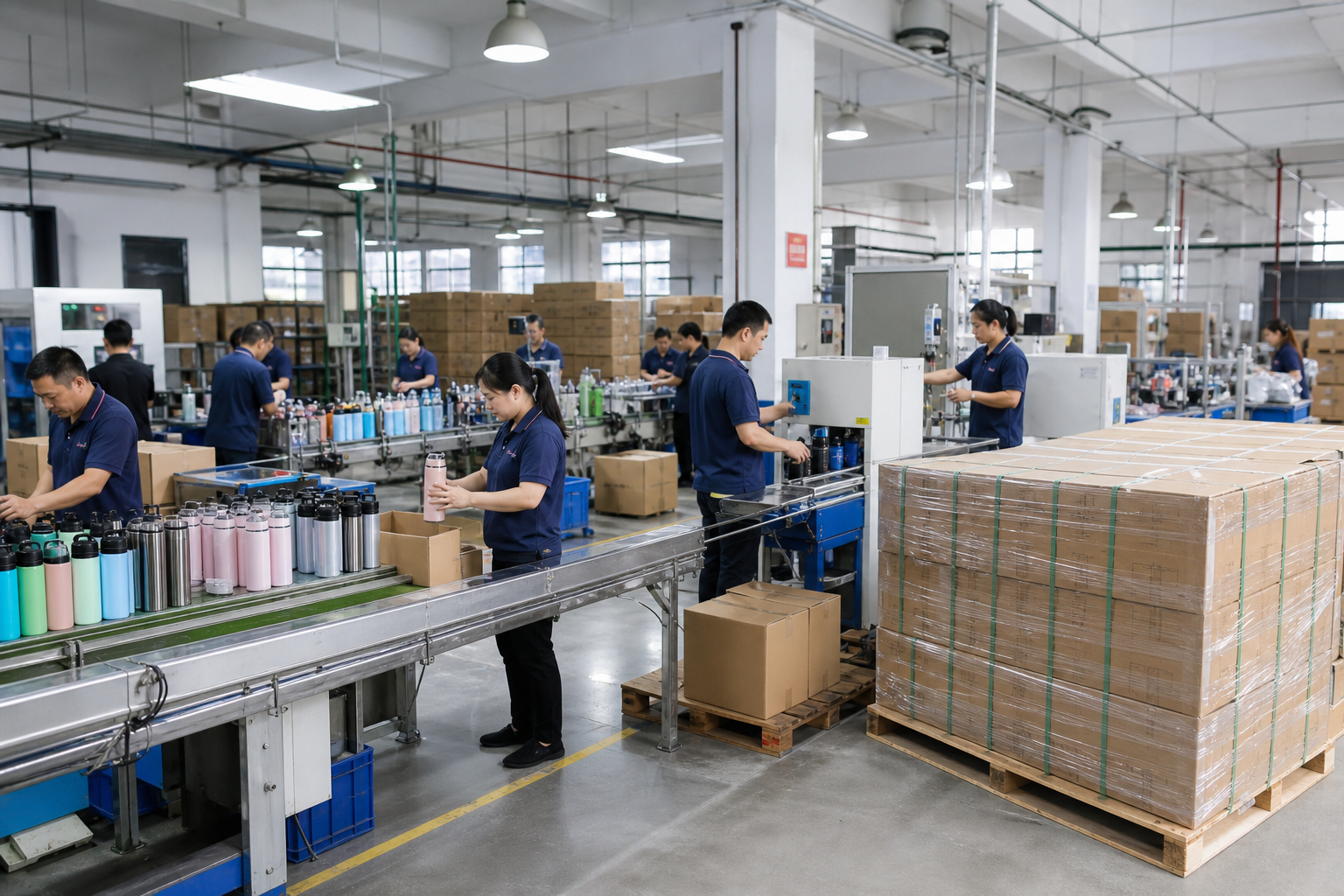
At our Hangzhou factory in Zhejiang, we build custom drinkware for distributors and brand owners who want a clean price structure, not a surprise invoice. Our MOQ starts at 500 pieces for many stock-body projects, standard lead time is 15-25 days, and monthly output reaches 300,000 units across bottle lines. We run the numbers before we quote. If the buyer flags a PO typo on the carton count or asks for 18-day delivery on a 2-color print job, the math does not work, and we say so early. If you know how China pricing is built, you can buy a canteen custom project at a realistic FOB price and still keep margin in Europe or North America.
What cheap really means
When buyers ask for the cheapest custom water bottles, they usually mean landed cost, not the factory quote. Those are different numbers. A bottle quoted at USD 1.05 FOB Ningbo can land at USD 1.65-2.10 after export cartons, inland trucking from Zhejiang, ocean freight, duty, and last-mile handling. We run that math on the packing table with a calculator and the booking sheet. If you buy for a canteen distributor, that spread sets your margin. Any quote that ignores it is the wrong question to ask.
The lowest real build is a stock shape, one decoration method, and plain packaging. A new mold, two-color print, or gift box pushes the cost up fast. QC pulled the sample with a caliper and the wall came back at 0.8 mm; once the buyer asked for a 1.2 mm wall, the price moved. We have seen that go sideways on a 5,000-piece order. You want to control three things:
- Body material: PET, PP, Tritan, 304 stainless, or 18/8 stainless.
- Decoration: one-color silk screen, laser engraving, UV print, or heat transfer.
- Packing: bulk pack, egg-crate tray, or retail box.
If a canteen supplier cannot give you a split between body cost, print cost, and packing cost, you do not have a clean B2B quote. You have a guess. We check this on the line with a sample sheet and a PO for 3,000 units; a single typo on the carton mark can add a day of rework. Good factories in Zhejiang quote by component because that is how export orders stay under control. This is not an abstract pricing exercise.
Pick the material first
Material choice is the quickest place to cut cost without wrecking the bottle. For cheapest custom water bottles, PET and PP sit at the bottom of the price ladder. PET comes out clear and light, but it does not like heat. PP takes daily abuse better, and the tool change on the line is simple. If you are building a custom drinkware run for gym promos or campus giveaways, a 500 ml PP sport bottle at USD 0.78-1.20 FOB can land far below a stainless spec.
For stainless jobs, 201 stainless costs less than 304, and we run that comparison on almost every quote. The buyer flagged one sample last month because the 201 body showed surface marks after a 48-hour salt spray check, so the math did not work for a U.S. chain. For food-contact drinkware sold in North America and Europe, 304/18-8 is the safer default because compliance review is tighter and buyers expect it. A customized growler or custom growler in double-wall stainless will not be your cheapest option, but it can stay competitive if you keep the finish plain and leave out molded sleeves.
Practical rule: if the bottle will be given away, choose the lightest compliant body that survives your shipping and use cycle.
For a canteen customized for outdoor promotions, a 500-750 ml PP or PET body usually wins on cost per impression. We once caught a PO typo that changed 500 ml to 5,000 ml, and QC pulled the sample before the line started cutting. For a customized canteen sold through retail, use the better resin and take the higher cost. Cheap failures cost more than a clean quote from a China canteen factory.
Decoration drives the price
Decoration is where cheap custom water bottle orders stop being cheap. One-color silk screen is still the lowest-cost branding option on flat or lightly curved surfaces. At 1,000 pcs, it usually adds USD 0.08-0.20 per unit, depending on ink count and setup. On our line, the screen frame is the first thing QC checks, because a 0.5 mm misalignment turns into a reject stack fast.
Laser engraving on stainless looks clean and lasts, but the machine time is longer, so it is not always the cheapest route. UV print can look sharp, yet a full-wrap graphic on a canteen promotional order means more setup and slower throughput. We run a flatbed UV, and if the buyer pushes a wrap on a 500 pcs trial, the math does not work.
If you are a canteen distributor or canteen vendor, keep the design simple:
- 1 logo color instead of 3 or 4
- 1 print position instead of full wrap
- No metallic foils unless the order is above 3,000 pcs
- No individual name personalization unless needed
For canteen customizable projects, ask for the cost difference between silk screen, pad print, and laser engraving before you approve artwork. A competent canteen manufacturer in Zhejiang will show you the delta in 24 hours. If they cannot, they are probably outsourcing the decoration step and giving up control of lead time and reject rate. We have seen that go sideways after a PO typo on the artwork file, then the buyer flagged color drift and the ship date slipped.
MOQ and tooling change everything
MOQ is not a sales trick. It is the math the line runs on. If you want the cheapest custom water bottles, your order size has to fit the factory’s setup cost and machine time. On stock molds, 500 pcs can work, but the unit price often sits 15-30% above a 3,000 pcs run. On a new custom canteen mold, tooling can run USD 1,500-8,000 depending on structure, cap system, and cavity count. QC pulled one sample with a caliper last week, and the mold fee still had to be spread across every piece.
For distributor canteen projects, the smart move is usually a stock body with a new cap, collar, print, or color. That keeps you in the cheapest custom water bottles zone without making the product look generic. A buyer who asks for a unique shape, dual-wall insulation, and a printed retail box at 1,000 pcs is not shopping cheap. The math does not work that way. We’ve seen this go sideways when the buyer flagged a PO typo on the carton size and the whole packing plan had to be rechecked on the floor.
Here is the honest math:
- 500 pcs stock bottle: lower commitment, higher unit cost
- 1,000 pcs: better print setup efficiency, still moderate risk
- 3,000 pcs+: usually the best price break for canteen distributors
If your demand is not locked in, skip the custom mold. Use a customizable canteen platform with color and logo changes, then test the sell-through before you commit to tooling. That is how a canteen supplier in China keeps your price down without cutting basic product integrity. We run this way for a reason, and the line stays cleaner when the spec is simple.
Check compliance before you chase price
Low price without compliance gets expensive fast. If you sell into the EU, you need the food-contact declaration and, for some materials and coatings, REACH-related testing. For North America, buyers usually ask for FDA food contact compliance, and some retailers still want third-party reports that line up with ASTM-style performance checks. We have seen a $1.12 bottle turn into a $4.80 headache because the paper trail was missing. If you are importing as a distributor drinkware or distributor growler buyer, get the test reports before you release the order.
A credible canteen factory in Zhejiang should talk through BPA-free claims, phthalate checks, migration limits, and carton drop requirements without stalling. QC pulled the sample on one run because the painted surface failed a 48-hour salt spray test, and the buyer flagged it before shipment. For stainless items, ask for corrosion data when the body has paint or powder coat. Cheapest is not the one that skips testing. It is the one that passes on the first round and ships on schedule.
Use this as your filter:
- Material declaration: food-grade resin or stainless grade confirmation
- Test reports: REACH, FDA, LFGB if required by your market
- Packaging spec: master carton count, 1.2 m drop test target, barcode label placement
China sourcing gets cheaper when you lock these requirements early. We run this every week in Zhejiang, and the factories that export well know the drill. If they hesitate, the math does not work. A typo on a PO, like “304 stianless,” is small on paper and painful on the line.
How to get the right FOB quote
Good FOB pricing starts with a complete brief. If you send only a logo and the words cheapest custom water bottles, you get a useless range. Send the factory the exact body material, capacity, closure type, print method, packing style, and target market. That is how a canteen manufacturer quotes without guessing. On our line, a clear spec usually gets a price back in 1 business day, and QC can spot a missing lid note before the sample even hits the caliper.
Ask for the quote to split these items:
- Body price
- Decoration cost
- Accessory cost such as lid, straw, carry strap, or filter
- Packing cost
- Tooling, if any
Compare suppliers on the same Incoterm. A low EXW quote from a China factory can look good on paper, then the math falls apart once you add export carton, port handling, and inland freight from Zhejiang to the port. For a lot of buyers, FOB Ningbo or FOB Shanghai is the cleaner benchmark. We have seen buyers chase a cheap EXW number, then flag the freight bill after the 20-foot container is already booked. If a canteen vendor only says “best price,” that is the wrong question to ask. Real export pricing is itemized.
Ask for the reject tolerance and AQL level too. AQL 2.5 for major defects and 4.0 for minor defects is common on promotional drinkware. If a supplier promises zero defects, they are not being serious. They are selling you a story, not custom drinkware. We once found a PO typo on the carton mark that would have sent 3,000 units to the wrong warehouse, and the buyer caught it only because the sample label did not match the packing list.
Order structure that keeps margin
If you want cheap and profitable, build the order around repeatability. The cleanest buyers are canteen distributors, canteen suppliers, and brand owners who come back for the same base item and only change logo or color. That keeps the cost curve flat and cuts setup losses. On our line, a 1-color screen print on a 65 mm cap is a different job from a full new spec, and the math does not work if you keep restarting from zero.
For a custom growler or customizable growler, repeat orders matter even more because stainless sourcing and polishing labor move with nickel and steel pricing. For a custom canteen, a lid color change is usually cheaper than opening a new mold or adding a sleeve. If you need a canteen promotional campaign for 50,000 units, lock one base model and pre-approve the artwork for 3 SKUs. We ship faster that way, and we have seen buyers argue for a new body shape, then get hit with a 12-day delay and a higher MOQ.
Good distributors also plan fulfillment from the start. If your retailer needs FNSKU labels, polybags, or master carton marks, put them in the quote. One extra label may cost only USD 0.01-0.03, but rework after production costs more. QC pulled the sample once because a buyer typoed the PO carton mark as `CTN-01` instead of `CTN-001`; that tiny miss turned into 800 cartons of manual relabeling. The cheapest custom water bottles are the ones built for the line, not the sales deck. Zhejiang factories know this because export drinkware runs on repeatable process, not guesswork.
Send your spec for a real FOB quote
Get an itemized price from Zhejiang with MOQ, decoration, packing, and compliance clearly split so you can compare suppliers on the same basis.
Frequently asked questions
What is the cheapest material for custom water bottles?
For most B2B orders, PET and PP are the cheapest materials for custom water bottles. A simple 500-750 ml PP sport bottle can land around USD 0.78-1.20 FOB at 1,000 pcs, depending on lid style and print. PET is often slightly cheaper for clear bodies, but heat resistance is weaker, so it is not the right pick for every market. If you need stainless, 201 is usually cheaper than 304, but for Europe and North America, 304/18-8 is safer for food-contact expectations. The cheapest option is the one that fits your use case and passes compliance the first time.
How low can MOQ go for a custom canteen?
For stock-body custom canteen projects, many canteen manufacturers in China can start at 500 pcs. At that level, expect the unit price to be 15-30% higher than a 3,000 pcs run because setup, printing, and labor are spread across fewer units. If you need a new mold, MOQ may jump to 1,000-3,000 pcs or more depending on structure. In Zhejiang, a practical factory will tell you whether the order should stay on a stock mold or move to a custom mold. If you want the cheapest custom water bottles, stay on stock tooling as long as possible.
Is laser engraving cheaper than printing?
Usually no. Laser engraving is durable and premium-looking, but on stainless drinkware it often costs more than a one-color silk screen print. For a 1,000 pc order, silk screen may add only USD 0.08-0.20 per unit, while laser can be higher depending on artwork size and machine time. If your goal is the cheapest custom water bottles, use one-color print on a simple area. If the customer wants a premium retail look or a canteen customized for long-term use, laser engraving can still be the better choice because it does not wear off like ink.
What compliance documents should I ask for?
Ask for material declarations and market-specific test reports before you confirm the order. For Europe, REACH-related checks and, where relevant, LFGB or food-contact migration data matter. For North America, FDA food-contact compliance is the common baseline. If you are buying from a China canteen factory, also request carton drop test targets, ink safety confirmation, and stainless grade documentation. For promotional or distributor drinkware, AQL levels such as AQL 2.5 for major defects are standard. A low price without paperwork is not a real saving; it just postpones the problem.
How long does production take in Zhejiang?
For standard stock-body drinkware with logo printing, lead time is usually 15-25 days after sample approval and deposit. If you need new tooling or special packaging, add 7-15 days for mold work and packaging proofing. A busy Zhejiang factory producing around 300,000 units per month can still hit a tight schedule, but only if your artwork, carton spec, and compliance requirements are finalized early. If you delay approval, the cheapest custom water bottles order can quickly become a rush job with higher freight and rework costs.