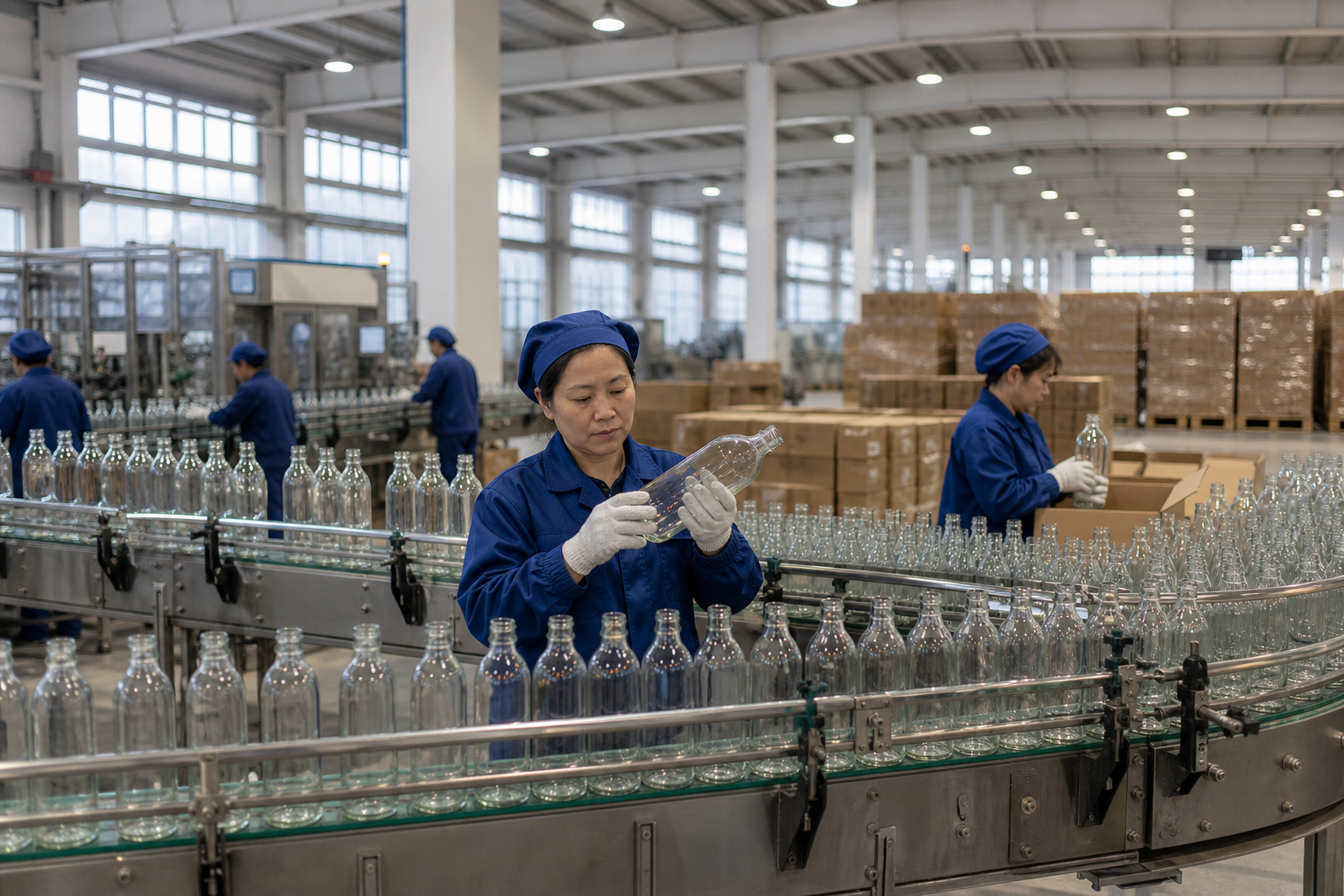
Key Takeaways
- A 500 ml promotional glass bottle can start around USD 0.38-0.62 FOB China at 3,000-5,000 pcs, before decoration and cartons.
- Standard MOQ at a Zhejiang canteen manufacturer is often 3,000 pcs, with 25-35 days lead time for simple printing.
- Breakage drops sharply when you move from loose packing to 1pc/egg-crate or kraft box packing, usually saving 2-4% in claims.
- Laser engraving, silk-screen, and decal pricing can differ by USD 0.05-0.22 per piece depending on color count and coverage.
If you are sourcing the cheapest promotional glass bottle, the real question is not “what is the lowest unit price?” It is “what lands in your warehouse at the lowest total cost with acceptable breakage, branding, and lead time?” A $0.42 bottle that needs a $0.18 carton and loses 6% in transit is not cheap. We see this mistake every week in Zhejiang. One buyer sent a PO with the carton spec missing; QC pulled the sample, and the math failed on day one.
You are usually balancing three things at once: factory MOQ, decoration cost, and freight density. Glass is unforgiving. Choose the wrong neck finish, wall thickness, or insert pack, and a 10,000-piece promo run gets ugly fast. A proper bottle line talks in cents, grams, and cartons per pallet, not slogans. We ship on those numbers. That is the level you need if you want real savings on custom drinkware.
What makes glass bottle pricing cheap
The cheapest promotional glass bottle is a stock shape with one decoration method and a packing setup we already run every week. A plain cylindrical 500 ml bottle, no special mold, no strange handle, no odd neck thread. That is where the math works. In Zhejiang, mold cost kills the “cheap” claim fast, and we see buyers get surprised when a 1.5 mm neck change turns into tooling. If you ask for a fully customized shape, you are paying for tooling, not cheap promotional glass bottle pricing.
For a real benchmark, a stock 350-500 ml clear glass bottle from a canteen supplier can come in around USD 0.38-0.65 FOB at 3,000 pcs, while a new mold can add USD 2,000-8,000 upfront. We had one buyer flag a PO typo on the neck finish, and QC pulled the sample back because the thread spec did not match the carton print. Spread that tooling across a small order and the unit cost climbs fast. That is why canteen distributors usually start with an existing bottle shape and put the money into branding, not glass geometry.
- Best value format: straight-wall clear glass, 5-6 mm base, standard cap
- Cheapest branding: one-color silk screen, one position
- Most expensive mistake: new mold for a low-volume promo order
If you need a custom canteen or customizable canteen for retail later, test the market first with a stock promotional bottle. Then move to a customized canteen only when the repeat order pays for tooling. We’ve seen this go sideways with 2,000 pcs and a rushed logo change, so start simple.
Choose stock shapes, not new molds
If your goal is the cheapest promotional glass bottle, start with stock molds. A canteen manufacturer in China usually has 20-60 standard bottle shapes already in rotation. That keeps the forming line steady. The factory knows the mold wear, the wall thickness, and the QC check points, so you are not paying to debug a new shape. A new mold looks small on a quotation, then it adds lead time, trial scrap, and an extra deposit.
In our Hangzhou, Zhejiang facility, stock items ship in 25-35 days. A new mold project usually needs 45-60 days before first mass production. We ran one job where the buyer wanted a 280 ml custom neck, then pushed back on the tooling fee; the math did not work, and we told them to pick a stock body instead. For a promo campaign, that 20-day gap is the difference between selling on time and missing the season. A line running 3 million units/month can still say no to a small rush order, because changeover eats the schedule. That's not attitude. It's factory math.
What to ask the supplier
- Is this a stock mold or a new mold?
- What is the exact MOQ for clear glass, amber glass, and frosted glass?
- Can you supply the same bottle with different caps to create a customizable canteen range?
For distributor canteen programs, stock molds let you test three price points without locking cash into tooling. We ship that way a lot. QC pulled the sample on one 500 ml bottle and found the mouth finish was already stable, so the buyer could focus on cap color instead of mold risk. That is how distributors keep inventory risk low and still move fast.
Decoration changes your landed cost
Buyers often fixate on bottle glass cost and miss the decoration line, where a cheap item turns into a normal one fast. On a promo bottle, decoration can cost more than the glass body itself. One-color silk screen usually adds USD 0.06-0.12 per piece. Laser engraving belongs on stainless steel, not glass. For glass, we run silk screen, decal, or acid etch. Decal looks premium, but it is not the lowest-cost choice.
If you want the cheapest custom drinkware, keep the artwork plain. One logo. One color. One side. A full-wrap print with gradient colors adds setup time and raises the reject rate. On the line, printers charge by screens, color separations, and curing passes. A two-color logo can add 20-40% to print cost versus one color on the same canteen custom bottle. The buyer flagged a PO once because the logo file had three Pantone calls, and the math did not work.
Simple art is cheap art. If your logo works in one solid PMS color, you save real money.
For canteen promotional orders, ask for print tolerance, usually ±1.5 mm to ±2.0 mm depending on bottle curvature. We check that with a caliper at QC. If the supplier cannot give a tolerance, they are guessing. That is the wrong question to avoid in a B2B custom drinkware order.
Packaging and breakage decide real savings
Glass is cheap only when it lands whole. The cheapest promotional glass bottle on paper can turn expensive after breakage, repacking, and claims. We saw a 4.8% loss rate on one 40HQ to Germany when the buyer pushed for loose pack and skipped a carton compression test. If your container ships to North America or Europe, carton strength, dividers, and drop-test assumptions decide the real cost.
The usual options are bulk pack, 1pc/egg-crate, or gift box. Bulk pack has the lowest factory price, but that is the wrong question to ask. A 1pc kraft box may add USD 0.10-0.18 per unit, and we have watched it save more than that when QC pulled broken necks from the bottom layer after a 1.2 m drop test. For distributor drinkware and distributor growler programs, that trade-off usually makes sense. Retail is harsher. One crushed case can wipe out the margin on the whole PO.
- Bulk pack: lowest factory cost, highest risk
- Egg-crate pack: best balance for promotions
- Gift box: higher cost, better shelf appeal
A serious canteen supplier should show carton test data, pallet pattern, and whether the package passes 1.2 m drop testing. We check the carton wall at 5-layer, 7 mm flute, and we mark the outer carton with the right pallet count before the line starts. If they cannot show that data, you are buying hope, not logistics.
FOB China versus landed cost
Buyers hunting for the cheapest promotional glass bottle often stare at FOB only. That is the wrong number if you care about margin. FOB Zhejiang can look low on paper, then inland trucking, export docs, ocean freight, duty, and destination handling show up on the invoice. We had one buyer in Germany push back on a USD 0.08 gap; once we checked the carton count and pallet pattern, the “cheap” option landed higher. A weak carton can erase the savings fast.
For a 20,000-piece run, freight density is the first thing we run through the spreadsheet. Glass is heavy, and every extra gram changes container fill. A 320 g bottle is not a 410 g bottle. The heavier one may look better in hand, but the math gets ugly at scale. Our QC pulled the sample last month and weighed two cartons: the 410 g version cut container efficiency by 8-12% after we set the 5-layer master carton and 1,200 mm pallet height. This is the wrong question to ask if you only want a prettier bottle.
Ask your canteen vendor for a landed-cost worksheet. We ship these with the quote when the buyer asks the right way. The sheet should include:
- FOB unit price
- Carton cost
- Inner pack cost
- Estimated breakage reserve
- Ocean freight per carton
If a supplier cannot produce this, they are not ready for serious B2B custom drinkware work. We have seen PO typos on carton count turn a small saving into a real headache, and the line does not forgive that kind of mistake.
How to evaluate a China supplier
Do not buy from a canteen vendor just because the unit price is low. We run the line on repeat orders, and the real test is whether the factory can hold the same quality in month 1 and month 6. A dependable canteen factory in Zhejiang should show BSCI or equivalent social compliance, REACH material declarations for the target market, and a QC system tied to AQL 2.5 for critical appearance defects. On one order, QC pulled a rim chip at 0.8 mm and stopped packing. For food-contact items sold into Europe, you want documents in hand, not promises.
Ask the supplier for: production photos, in-line QC points, sample lead time, and mass production lead time. A stock-shape custom canteen or customized drinkware sample should land in 5-10 days. If they need 3 weeks to make a sample from a known mold, they are slow. If they say they can do everything but cannot quote MOQ, the buyer flagged the right issue. That is a broker answer, not a factory answer.
There is nothing wrong with using a canteen distributor for a small test order. Once volume matters, go direct to canteen manufacturers. On a 50,000-piece run, layered trading margins can add 8-15% before you even touch freight, and the math does not work. We have seen this go sideways after a PO typo turned 3,000 cartons into 300 on paper, then everyone lost a week fixing it.
Before you approve, check whether the supplier can support:
- FOB Ningbo or Shanghai terms
- REACH and food-contact declarations
- Carton mark compliance for Amazon FNSKU or retail barcodes
That is the gap between a cheap quote and a supply chain that ships on time.
When glass is cheaper than other formats
Glass is not always the cheapest material on the shelf, but for a promotional run it can be the cheapest path to a clean, premium look. If the buyer wants a clear, recyclable bottle and does not want to pay for double-wall vacuum steel, a plain glass bottle usually beats a more complex customizable growler or insulated custom growler. The math only works when the design stays tight. QC pulled the sample and checked the 2.1 mm wall with a caliper, and that is where the real cost story shows up.
For a giveaway campaign, a 500 ml clear bottle with a bamboo lid or standard PP cap can run lean. On a 3,000-piece order, the line moves fast, and sleeve labels, simple embossing, or a two-color silk screen can still give the body a canteen customized look. We had a buyer push back on that closure spec because they wanted a retail feel at giveaway money, and that is the wrong question to ask. If you are a distributor canteen buyer, one base bottle can cover promotion, events, and entry-level retail without forcing three separate molds.
The practical rule is simple: if branding matters more than heat retention, the cheapest promotional glass bottle is often the right answer. If the job calls for temperature control or rough transport, switch formats and stop trying to make glass behave like steel. We have seen that go sideways on the line when a PO typo listed the cap as PP on one page and PE on another, and the buyer caught it before packing. Do not make glass carry a load it was never built for.
Request a factory quote on stock glass bottles
Send your target price, quantity, and logo file. We will quote FOB Zhejiang with packaging, decoration, and lead time in one clean sheet.
Frequently asked questions
What is a realistic MOQ for the cheapest promotional glass bottle?
For stock shapes, a realistic MOQ is usually 3,000 pcs per design and color, sometimes 5,000 pcs if you want custom packaging. In Zhejiang, some factories will quote 1,000 pcs for sample-run business, but pricing rises quickly. For a clean FOB China quote, expect better numbers at 3,000-10,000 pcs. If you want multiple print colors, each extra color can increase setup cost and may push the MOQ higher. A serious canteen manufacturer should tell you the exact minimum for bottle body, cap, and carton separately.
How low can the unit price go on a 500 ml glass bottle?
For a basic clear 500 ml stock bottle, you may see FOB China pricing around USD 0.38-0.62 at 3,000-5,000 pcs before decoration. Add one-color silk screen and packaging, and the finished factory price may move to USD 0.52-0.85. Heavier glass, frosted finish, or decal decoration will push it higher. The cheap quote is only useful if the bottle weight, carton spec, and defect rate are all acceptable. Otherwise, you are just buying the cheapest headline number, not the cheapest landed cost.
Is silk screen cheaper than decal or laser marking?
On glass, one-color silk screen is usually the cheapest decoration option for promotional orders. A simple print often adds USD 0.06-0.12 per piece, depending on artwork size and curing. Decal is typically more expensive because it needs extra processing and can look more premium. Laser marking is generally for metal or coated surfaces, not standard glass bottle branding. If your goal is custom drinkware at the lowest cost, keep the logo one color and avoid full-wrap designs unless the brand margin supports it.
How do I reduce breakage in export shipping?
Use better packaging before you chase a lower bottle price. Moving from loose bulk pack to egg-crate or individual kraft boxes can reduce breakage by 2-4% on long-haul shipments. That matters more than a few cents saved at the factory. Ask for carton compression strength, pallet pattern, and drop-test performance. A good canteen supplier should show you how many units fit per 20GP or 40HQ and what the safe stack height is. For Europe and North America, breakage reserve should be included in your landed-cost calculation.
Can I customize a glass bottle and still keep it cheap?
Yes, but keep customization limited. A stock mold with one logo print, one cap style, and standard packaging is the cheapest path to a customized canteen look. If you add embossing, color spray, frosted treatment, or a new closure, the price climbs fast. For a custom canteen or customized drinkware program, the best approach is to start with stock shape, validate sell-through, then upgrade later. That is how canteen distributors and distributor drinkware buyers manage cash flow without tying up money in tooling.