Key Takeaways
- The cheapest promotional polypropylene bottle often lands at USD 0.42-0.78 FOB China, depending on size, print, and cap.
- A 5,000-unit MOQ usually gives better tooling efficiency than smaller runs, and China-based supply from Zhejiang keeps mold and labor costs low.
- One-color silkscreen is usually cheaper than full-wrap printing; expect 8-15% savings versus complex decoration.
- Ask for AQL 2.5 inspection, REACH paperwork, and carton pack details before you approve any canteen customized order.
If you are chasing the cheapest promotional polypropylene bottle, the unit price is the wrong place to stop. Landed cost is what matters: bottle price, printing, carton pack, freight, duty, and the scrap rate. We run this math on the line with a caliper and a wall-thickness gauge before we release a job. A bottle that looks cheap at USD 0.42 ex-works can end up costing more than a USD 0.58 option once you add 1-color silkscreen, individual polybagging, and air shipment. Buyers push back on that all the time, then the freight invoice lands and the math does not work. Smart buyers in Europe and North America ask for a full quote, not a sticker price.
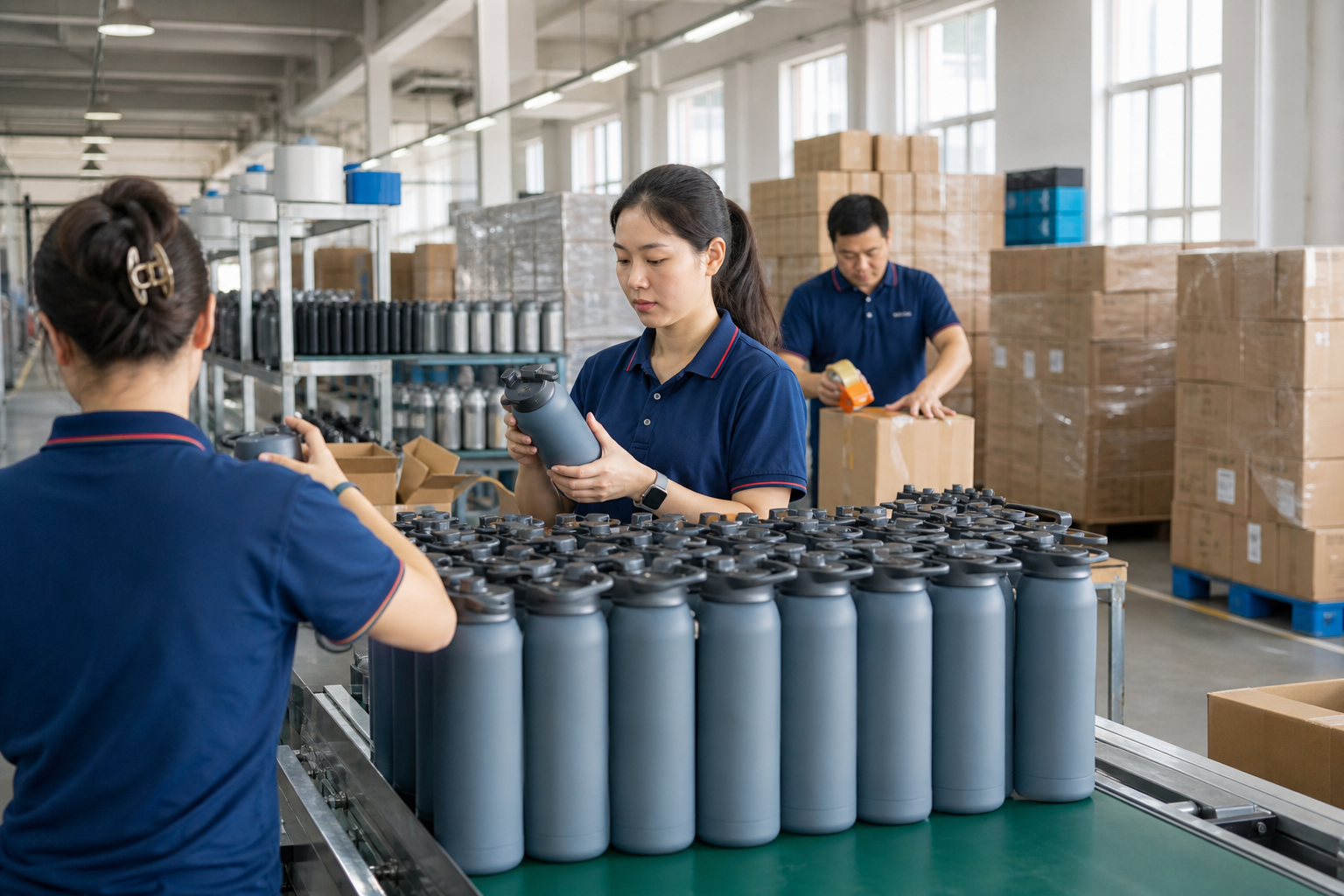
At our Zhejiang factory in China, we see this mistake every week from first-time procurement teams and distributors. The low-cost polypropylene bottle works for sports events, schools, and brand giveaways, but only if you control wall thickness, cap style, and decoration. QC pulled the sample last week with a 1.2 mm wall on one side and 0.9 mm on the other; that kind of spread is where complaints start. A practical MOQ is often 5,000 units, and a standard lead time is 20-25 days after sample approval. If the PO says 5000 and the buyer later asks for 5,200 without revising the artwork, we have to stop the line. For custom drinkware pricing that stays competitive, this is the right question to ask: where does the money go?
What makes polypropylene the low-cost choice
Polypropylene, or PP, is usually the cheapest practical plastic for a promotional bottle. Resin price stays low, the molding temperature is manageable, and the cycle time is fast on the line. For a simple 500 ml bottle, the raw material may be only a slice of the ex-works price, but that slice matters when the PO is 20,000 or 50,000 units. We ran this comparison last month on a 24-cavity mold: PP beat Tritan and stainless steel by a wide margin. For giveaway work, PP wins on cost and weight. That is why canteen suppliers in Zhejiang keep PP in the standard promotion line.
The catch is plain. PP does not feel premium. It scratches more easily than copolyester, and it is the wrong material if the buyer wants an upscale retail look. We had one customer ask for a “gift-grade” finish on a 1.2 mm wall bottle, then the buyer flagged the first sample because the matte texture showed scuffs after a simple rub test. For canteen promotions, school programs, and distributor bundles, PP is still a solid tradeoff. A wall thickness of 1.2-1.8 mm is enough for daily handling without making the mold too expensive. Push thicker and you add grams and cost. Go too thin and warpage starts, then scrap climbs. We’ve seen that go sideways fast. For a canteen factory trying to stay competitive, that balance is where the savings come from.
Where the price really comes from
When a buyer asks for the cheapest promotional polypropylene bottle, we split the quote into five lines: resin, molding, cap and accessory, decoration, and packing. Resin moves with petrochemical pricing, so a 7-day valid quote is standard, not a trick. On our line, the gram weight matters; a 500 ml body at 42 g and one at 48 g are not the same cost. If the bottle shape is already in our library, the mold is there and the math gets simple.
Mold cost is fixed only when you already own the tool. For a standard 500 ml shape, a new mold in China is usually spread over 20,000-50,000 pcs, and that is where unit price starts dropping fast. If you want special grip lines or a carry loop, the tool price goes up, sometimes by USD 800-2,500 depending on the cavity work. We have seen buyers push for a custom silhouette, then complain the quote looks high; that is the wrong question to ask.
Decoration is where buyers lose money. A 1-color silkscreen print is the cheapest path. At 2 colors, registration gets tighter, and QC pulled the sample more than once because the second pass drifted by 1.5 mm. Laser engraving does not work on PP, so if a supplier offers it, they are mixing up materials. Packing changes the number too. Individual polybag plus master carton is common, but for a distributor canteen program, bulk pack with carton dividers can cut labor on the packing table. Cheap unit price is only cheap if the structure stays simple and the shipping plan is clean; the line breaks down fast when someone adds a typo on the PO and asks us to fix it after print approval.
- Standard mold: lowest setup cost
- 1-color print: best price-to-brand ratio
- 5,000 pcs MOQ: usually the best entry point
- FOB Ningbo or Shanghai: common export terms from China
MOQ and lead time that keep cost down
MOQ is not just a factory rule. It sets the unit price. If you want the cheapest promotional polypropylene bottle, 5,000 units is often the sweet spot because the line can run with one mold change, one pad print setup, and one packing spec instead of spreading that work across a small batch. Below that, the per-unit cost climbs fast because setup time, print plates, and carton labor get split across fewer pieces. For branded campaigns, 10,000 units is often where FOB starts to move down, sometimes 6-12% versus a 3,000-piece test order. QC pulled a sample at 2,400 units last month, and the carton label typo alone would have forced a rework. That is the wrong order size if the goal is cheap.
Lead time hits cost too. A normal production window of 20-25 days is the economical range. Rush work can add 10-20% because it breaks line planning, especially in peak season before Q3 promotions and back-to-school orders. We run enough bottle jobs to know this: a 48-hour schedule squeeze usually means overtime on the cap assembly table and more packing mistakes at the end of the shift. A serious canteen supplier in Zhejiang should show monthly capacity in black and white; a mid-size factory might produce 200,000-400,000 pieces per month across multiple bottle lines. If a vendor cannot state that clearly, they are probably leaning on spot subcontracting, and the math does not work for stable cost or delivery. For distributor drinkware buyers, that is margin risk you do not want.
Cheap bottles are usually expensive when the supplier cannot hold lead time, print quality, or packing consistency.
Choose the right print and cap
Decoration and closure choices can move a quote fast. On a recent 50,000 pcs PP run, QC pulled the first samples after 500 pieces and the fine text had already started to blur on the pad printer. For a promotional PP bottle, silkscreen is usually the lowest-cost branding method for one logo and one location. If the art has small text or two or three colors, setup cost goes up and the reject pile gets bigger. On a simple order, silkscreen can be around USD 0.03-0.08 per piece depending on size and number of colors. Wrap-around printing, color-matched caps, or a molded insert will push the price up fast. If you're sourcing canteen customizable products for events, this is the wrong place to get clever. Keep the art bold and clean.
The cap drives more cost than buyers expect. A standard screw cap is the cheapest option. A flip-top or sports spout adds parts, assembly time, and leak risk. On the line, a 28 mm cap with a strap means one extra station and one more chance for the packing team to miss a step. If you need a carry strap, the extra plastic looks small on paper, but it changes packing and assembly. For a canteen custom project, it is usually smarter to use an existing cap platform from the canteen factory than to open a new closure system. That is how canteen distributors keep pricing workable for retail bundles and promotional packs. If your buyer asks for a customized canteen with a special lid, spell out the cost: often USD 0.05-0.15 extra per unit, plus tighter QC. We've seen that go sideways when the PO typo called for a "sports lid" but the buyer meant a leak-proof cap.
What to simplify first
- Use one logo color instead of two or three; the second pass on the screen frame slows the press
- Use a stock cap instead of custom tooling; a new mold for a 28 mm closure changes the math
- Keep the bottle body round, not contoured; a simple shape runs cleaner in the mold and stacks better in cartons
- Avoid metallic coatings on low-cost PP; they mark up fast in carton rub tests
Compliance for Europe and North America
Even the cheapest promotional polypropylene bottle still has to pass compliance. For Europe, we run REACH declarations and food contact checks. For the United States, buyers usually ask for FDA food-contact confirmation and migration data from the canteen manufacturer. Some chains still want LFGB too, even when the channel does not require it, because the retailer QA team wants a cleaner paper trail. We have seen that request save a shipment from a customs hold. Good suppliers in China should hand over lab reports from recognized labs, not a self-made PDF with no test number or sample code.
Inspection terms matter just as much. AQL 2.5 for major defects and 4.0 for minor defects is common on mass drinkware, though some distributors push tighter limits on print misalignment or leaking caps. One buyer once flagged a PO typo on the carton count, and the line had to stop for rework. If your order goes to Amazon, retail, or a distributor canteen program, ask for carton drop-test data, barcode placement, and case pack dimensions before production starts. A bottle that saves USD 0.04 but fails at receiving is not cheap. We ship from Zhejiang, and the good canteen factories treat compliance as part of the spec, not an extra. If they cannot explain material traceability from pellet to finished bottle, keep looking.
How to compare quotes from China
Do not compare only bottle price when you check quotes from a canteen vendor in China. Put the same spec sheet in front of every supplier: capacity, net weight, wall thickness, cap style, print area, packaging, and Incoterm. A 500 ml bottle at 38 g is not the same part as a 500 ml bottle at 28 g. We run into this all the time on the line. The lighter one looks cheaper on paper, but if it twists in the carton or feels soft in hand, the buyer will flag it after the first shipment. Ask for FOB Ningbo, FOB Shanghai, or EXW Zhejiang in writing, because freight handling can move the landed number more than a resin change.
For distributor growler programs or large plastic bottles, the same rule holds: spec first, price second. If a canteen distributor sends vague drawings or a mood board instead of a technical sheet, the quote is a guess. We saw one PO with "bottle collor" typed in the remarks; QC pulled the sample and still had to ask which Pantone the buyer wanted. A usable buyer sheet lists bottle height, diameter, neck finish, mold ownership, carton count, and print file format. The better canteen manufacturer answers with numbers: unit weight, 7-day sampling, 18-day production, and carton size. That is how you separate a real factory from a trading desk. In Zhejiang, the factories that reply fastest usually own molding, printing, and packing on site.
If one supplier comes in 20% lower, check what they cut. We have seen this go sideways with no carton drop test, thin print ink, or a skipped compliance document. Cheap is fine. The math does not work when the hidden cost shows up after delivery.
Get a real quote, not a guessed price
Send your size, logo, and target quantity. We will quote the cheapest workable PP bottle from Zhejiang with clear FOB, MOQ, and lead time.
Frequently asked questions
What is a realistic FOB price for the cheapest promotional polypropylene bottle?
For a simple 500 ml PP bottle with one-color print, a realistic FOB China price is often USD 0.42-0.78 per piece at 5,000-10,000 units. If you add a better cap, extra colors, or individual packing, the price can move by USD 0.05-0.18 each. In Zhejiang, standard export quotes usually assume FOB Ningbo or Shanghai, not air shipment. Always ask whether the number includes print setup and carton packing, because those hidden items change the true landed cost fast.
What MOQ should I expect for a custom canteen order?
For a standard custom canteen in PP, 5,000 pieces is a practical MOQ from a real factory. Some canteen suppliers will accept 3,000 pieces, but the price usually rises 8-15% because setup cost is spread over fewer units. If you want a fully customized canteen shape, the MOQ may still stay at 5,000, but tooling cost becomes separate. For distributor drinkware buyers, 10,000 units is often the point where pricing becomes much more efficient.
Is polypropylene safe for promotional drinkware?
Yes, PP is widely used for food-contact drinkware when it is made with approved resin and tested properly. For Europe, ask for REACH-related documentation and migration testing; for the United States, request food-contact compliance support. A good canteen manufacturer should provide material traceability, batch records, and test reports from a third-party lab. Safety depends on the resin grade and process control, not just the material name. Cheap does not mean unsafe, but you should never skip documentation.
What print method is cheapest for branded bottles?
One-color silkscreen is usually the lowest-cost branding method for a PP bottle. On a standard promotional run, it can add only a few cents per piece, depending on logo size and quantity. Multi-color print increases setup time and reject risk. If your artwork is simple, one solid color will give you the best price. For canteen promotional work, keep the logo bold and avoid tiny text, because fine detail increases rework and slows production.
How do I avoid bad quality from a low-price supplier?
Ask for a pre-production sample, production photos, and a QC plan before you confirm. Specify AQL 2.5 for major defects and define what counts as a leak, print smear, or cap failure. You should also confirm wall thickness, net weight, carton size, and drop-test expectations. A serious canteen factory in China will answer with numbers, not vague promises. If the supplier avoids test reports or changes the spec after deposit, treat that as a warning sign.