Key Takeaways
- Premium tumbler gift programs usually land at USD 4.20-7.80 FOB per set for 500 ml double-wall stainless steel bottles with boxes.
- A realistic MOQ in Zhejiang is often 500-1,000 pcs for stock shapes, but 3,000 pcs or more for full custom packaging.
- For corporate gifting, use REACH-compliant materials, food-grade 304 stainless steel, and AQL 2.5/4.0 inspection.
- A well-built gift box can raise perceived value by 30% or more without changing the bottle spec.
A corporate gift water bottle sounds simple until you need 3,000 units on one launch date and the box has to look premium without blowing the budget. HR wants something people keep on their desk. Marketing wants the logo centered, the color matched, and the carton not crushed on arrival. We see the same problem over and over: the bottle is fine, but the unboxing feels cheap.
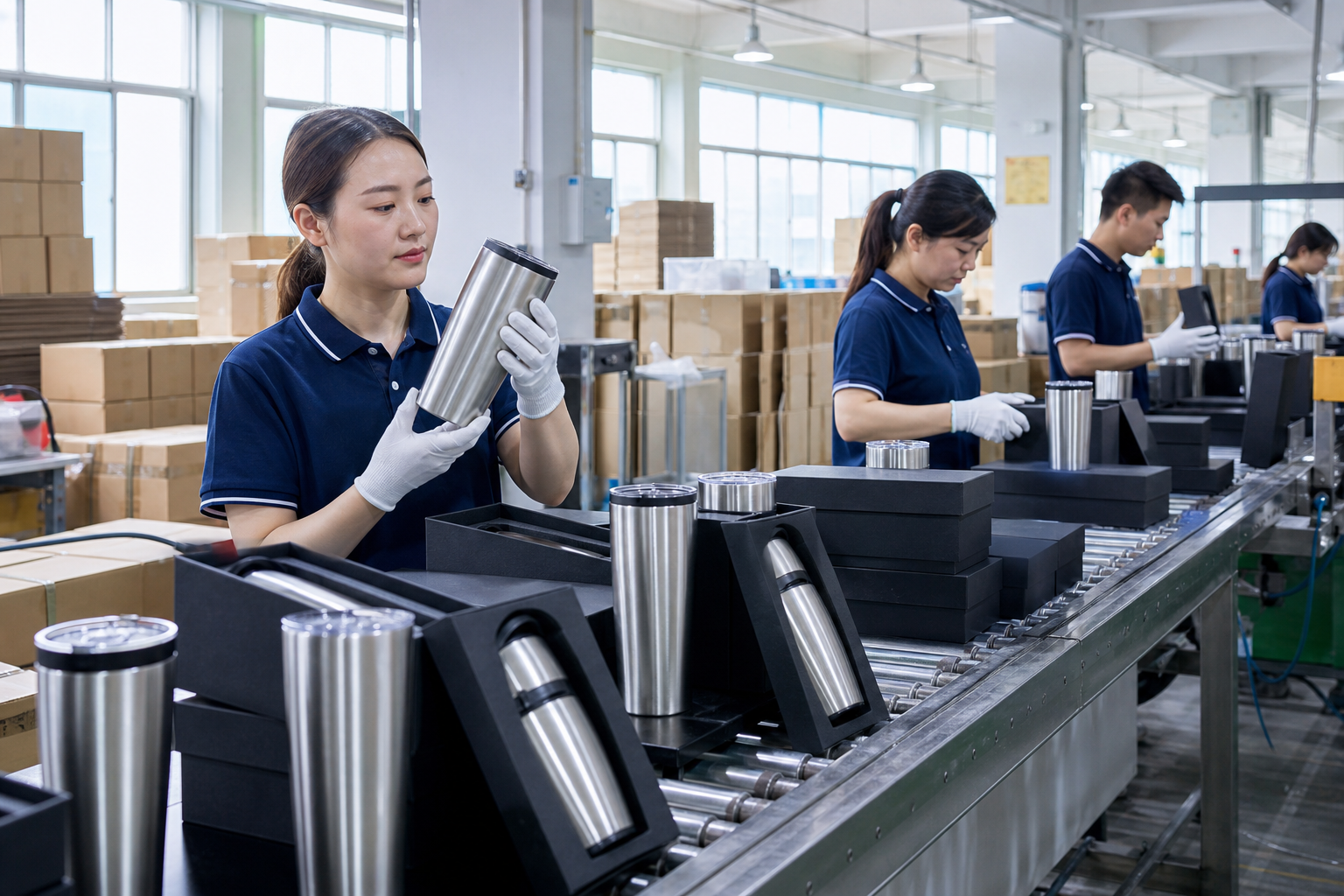
If you source in China, especially from Zhejiang, treat the bottle, lid, print, and gift box as one job. That is how we run it on the line. A solid factory should quote a 500 ml double-wall tumbler at USD 4.20-7.80 FOB, pair it with a rigid box, and ship 20,000 units a month with a 25-35 day lead time after sample approval. The math works when the whole program is set up together; if you split the box from the bottle, QC will pull the sample and the buyer will flag a color mismatch or a bad fit.
Why gift programs fail
Most corporate gifting projects fail for one reason: they get treated like a logo print job, not a product launch. A corporate gift water bottle has to satisfy three groups at once. Procurement wants cost stability. HR wants employees to use it. Marketing wants brand recall. Miss one, and you end up with a nice-looking PDF sample that feels cheap in hand.
The usual mistakes are easy to spot. Teams approve a 500 ml tumbler and never check lid torque, vacuum performance, or carton fit. We run that test on the line with a torque meter, and a loose lid shows up fast. They buy the bottle first, then chase a separate gift box later and find the insert is 3 mm too wide. Or they pick a coating that chips in transit because the export carton was under-spec’d. One buyer once sent a PO with the box size typed as 250 x 180 x 90, then changed it after sample approval; the carton plant had already cut the inserts. The math doesn't work. For Zhejiang orders, a good supplier asks for the final gift-box dimensions before the outer carton is locked. That is not overthinking. It keeps damage rates under 2%.
For employee gift campaigns, practicality beats hype every time. A bottle with a 304 stainless steel liner, 0.5 mm wall thickness on the inner cup, and a leak-resistant PP or Tritan lid will outlast a decorative item that sits in a drawer. QC pulled the sample on one run because the lid seal failed after a 1.2 m drop test. We ship daily-use pieces, not desk ornaments. A gift should reflect company standards, and it should still work after 200 washes.
Choose the right tumbler spec
The right premium tumbler depends on how it will be used, not on how it looks on a sample shelf. For office gifting, 500 ml or 600 ml is the safe call. It fits daily coffee, slides into a desk drawer, and still works in a commuter bag. For executive gifts, 750 ml can work, but only if the lid, handle, and wall proportions stay clean. We’ve seen a 750 ml unit get rejected because the handle looked thick on a 15 mm lip. It read cheap.
Do not skip the technical side. Ask for:
- 304 stainless steel for the inner wall; 201 stainless steel is a cost-down option, but it is not where you want to save on a premium program.
- Inner wall thickness around 0.4-0.5 mm; outer wall can be slightly lighter depending on finish.
- Vacuum hold test of at least 12 hours hot and 24 hours cold for a standard corporate gift water bottle.
- REACH and LFGB or FDA food-contact documentation, depending on your market.
Decoration decides whether the piece feels premium or like a giveaway. Laser engraving gives a clean mark that does not rub off, and the QC table will catch any burn halo before packing. If you need color branding, screen print is fine, but keep it to one or two spot colors. We had a buyer flag a PO that called for a full-wrap logo on a matte body; the line ran a sample, and it looked like promo stock. For most HR gifting projects in Europe and North America, matte powder coat with a small logo is the better move.
Gift box design that feels premium
The box is part of the product. A rigid gift box with 1200-1500 gsm grayboard, wrapped in coated art paper or textured paper, can push a USD 5 tumbler into the right bracket for a USD 20 corporate gift. We see this every week on the line. It is not magic, just board thickness, wrap choice, and tight corner wrap. Add a molded paper pulp insert or EVA insert, and the set feels planned, not thrown together.
Keep the print calm. One logo on the lid, one short message inside, and a clean insert are usually enough. For employee gifts, we often print a simple thank-you line under the lid; any long paragraph turns into filler. The buyer flagged it on a 300-set sample last month, and QC pulled the sample back because the inside copy looked like a brochure. The unboxing should reach the bottle in under 20 seconds.
Final dimensions have to be locked before production starts. A 500 ml tumbler in a 95 x 95 x 245 mm box looks fine until you add a handle, lid, or straw, then you need clearance on all sides. We had a PO last quarter with a 2 mm typo on the height, and the whole insert had to be re-cut. In export packing, 1 mm changes carton loading and freight cost. If your factory in Zhejiang can ship 24 sets per master carton instead of 18, the math works better and breakage drops too.
When a buyer says “make it premium,” they usually mean the box should feel expensive, the logo should be subtle, and nothing should rattle.
Budgeting the full set
Procurement teams need the full set, not just the bottle. Budget the tumbler, logo work, gift box, insert, carton label, and the paperwork. We usually see four cost buckets on the line: product, decoration, packaging, and freight. If you only compare bottle prices, landed cost is off by 18-35%.
For a 500 ml corporate gift water bottle set from China, a normal FOB range looks like this:
- Stock tumbler with one-color logo: USD 3.20-5.50
- Laser logo plus matte finish upgrade: add USD 0.30-0.80
- Rigid gift box with insert: add USD 1.00-2.20
- Custom mailer or sleeve: add USD 0.35-0.90
If the program needs kitting, barcode labels, or individual polybags, add those too. QC pulled the sample on a 3,000-unit order last month and found the carton was 12 mm too tall for the freight quote. That kind of miss burns margin fast. The buyer flagged it after seeing the pallet count jump.
For North American buyers, ask for a clean FOB China quote, then separate sea freight, duty, and domestic delivery. For European buyers, ask for REACH-compliant documents and carton marks for the destination. A Zhejiang factory that ships every week should answer both at once. If the PO says “gift box size TBD,” stop there and get the die-line fixed before we run the cartons.
MOQ, lead time, and sample control
Corporate gifting has a fixed date. The event is booked, the onboarding kit ships on Monday, or the holiday cut-off is already printed on the PO. Sample control is not optional in that setup. We run three checkpoints: product sample, decorated sample, and pre-production sample with the final box artwork. If a supplier tries to skip one, the buyer flagged it for a reason.
In Zhejiang, a solid factory will usually take stock-shaped tumblers at a MOQ of 500 pcs, with 10-15 days for samples and 25-35 days for bulk after approval. We see 1,000-3,000 pcs once you ask for custom lids, box structures, or molded inserts. That is the normal range. If someone promises deep customization at 100 pcs, ask whether they are a trading layer or just doing print on a stock item. The math doesn't work. Last month QC pulled the sample because the PO said “matte balck” on the carton spec, and that kind of typo turns into rework fast.
Ask for the sample to be tested the same way the bulk run will be tested. A buyer who knows the line will ask for:
- Leak test at 45 degrees for 24 hours
- Drop test from 80-100 cm for packed units
- Print adhesion check after 50 wash cycles for hand-washable items
- AQL 2.5 for critical defects and 4.0 for minor defects
This level of control saves you from cartons sitting at the warehouse door while your launch date keeps moving. We’ve seen that go sideways when the outer box passed, but the foam insert was 2 mm too loose and the tumbler rattled in transit.
Branding that employees keep
Employee gift programs work when the bottle feels personal enough to keep, but neutral enough for desk, gym, and travel. That balance is hard. Too much branding and the tumbler turns into a walking ad. Too little and the company name gets lost. For a corporate gift water bottle, we usually keep it to a small logo, one color family, and one premium detail such as brushed steel, powder coat, or a matching lid accent. On the line, a 12 mm logo often looks cleaner than a big wrap print.
HR wants positive sentiment that sticks. Marketing wants repeat brand exposure without looking pushy. A matte black or off-white premium tumbler with a debossed or laser-etched logo usually gets carried more than loud graphics. We ship a lot of these, and the same pattern keeps showing up in sample feedback: the buyer flagged the bright artwork, then approved the muted version on the second round. If you want stronger brand presence, print on the box instead of on the bottle. The box makes the first impression; the bottle gets the daily use.
There is a practical reason to keep branding restrained: resale value and perceived quality. Employees keep a bottle that looks chosen, not issued. I’ve seen this go sideways when a buyer pushed for full-surface printing, then QC pulled the sample after the finish started to look cheap under inspection light. In Zhejiang, we can hold powder coating color matching within a Delta E of 2.0-3.0 for most corporate runs. If your brand palette is strict, ask for a physical color chip approval before bulk production. Do that before the PO goes in.
Sourcing from China without surprises
If you are sourcing from China, the first mistake is assuming one factory can do product and packaging well at the same time. A plant may run deep on 304 stainless cup bodies and still miss the mark on rigid gift boxes. We have seen carton suppliers nail print color and then lose the lid fit by 2 mm. The cleaner setup is a supplier that controls the full program in-house or keeps partner lines in Zhejiang on a short leash.
Ask straight questions. How many units do you ship per month? What is your MOQ for a premium tumbler? Can you support BSCI or a similar audit? Where are the QC checkpoints for logo print, lid assembly, and box fit? If the answer drifts, the line will drift too. A real Hangzhou factory should speak in numbers: 20,000-50,000 units per month, 25-35 days lead time, and sample turnaround in under two weeks for stock molds. QC pulled the sample on our side with a caliper at 0.1 mm, and that is the level you want before a PO goes out.
Check compliance early. For Europe, REACH and food-contact rules are the first gate. For the U.S., ask for FDA food-contact material declarations and any ASTM test reports your buyer team wants on file. We once saw a PO where the buyer typed "gift boox" instead of "gift box"; small typo, big delay when customs asked for matching documents. The math does not work if you save a cent on sourcing and lose a week at clearance. China is cost-competitive, but the real value is a factory that knows export paperwork, not just domestic output.
Request a premium tumbler quote today
Send your logo, target price, and delivery date. We will match the bottle, box, and packaging to your corporate gifting plan in China.
Frequently asked questions
What is a realistic MOQ for a corporate gift water bottle with a custom box?
For stock tumbler shapes in China, 500-1,000 pcs is realistic for the bottle and logo print. Once you add a fully custom rigid gift box, insert, or custom lid color, many Zhejiang factories move to 1,000-3,000 pcs. If you need separate packing for multiple office locations, ask early because kitting may push the MOQ higher. The lowest-cost setup is usually a stock 500 ml double-wall tumbler with one-color logo and a standard gift box.
How much should I budget per set for premium corporate gifting?
A practical FOB budget for a premium tumbler gift set is USD 4.20-7.80 per unit for a 500 ml stainless steel tumbler with custom branding and a rigid box. If you add laser engraving, molded inserts, or upgraded matte coating, the cost can rise by USD 0.30-2.00 per set. Freight, duty, and last-mile delivery are extra. For North America and Europe, landed cost often ends up 18-35% above FOB once packaging volume and logistics are included.
What materials should I specify for a premium tumbler?
For a corporate gift water bottle, specify 304 stainless steel for the inner wall, food-grade PP or Tritan for the lid, and a vacuum structure with around 0.4-0.5 mm inner wall thickness. That gives you a good balance of durability and weight. If you are selling into Europe, ask for REACH and, if needed, LFGB documentation. For the U.S., request FDA food-contact declarations. Do not rely on generic “food-safe” claims without paperwork.
How long does production usually take in Zhejiang?
For stock molds and standard print, lead time is usually 25-35 days after sample approval. Sample turnaround is often 7-15 days, depending on decoration and packaging complexity. If you need custom tooling, a new lid, or a completely new rigid gift box structure, add 15-30 days before bulk production starts. A capable Zhejiang factory should be able to quote monthly output, commonly 20,000 units or more, so you can judge whether your deadline is realistic.
Should I use laser engraving or screen printing for employee gifts?
For most employee gift programs, laser engraving feels more premium because it is permanent and subtle. It works especially well on brushed steel and matte powder-coated bottles. Screen printing is fine if you need a brand color or a larger logo, but keep it to one or two colors. If the goal is long-term use, a small laser logo on the bottle and a branded gift box often looks better than a large printed graphic. For premium tumbler sets, restraint usually wins.