Key Takeaways
- UV printing is usually better for sharp artwork on hard, smooth surfaces, with setup starting around 1 pc samples and production MOQs often 100-300 pcs.
- Heat transfer is stronger for full-wrap decoration on curved bottles, especially when you need seamless CMYK printing bottles and photo-grade print across the body.
- Typical decoration adds about USD 0.35-1.20 per bottle for UV and USD 0.25-0.90 for heat transfer, depending on size, coverage, and color count.
- A well-run factory in Zhejiang can keep lead time to 12-20 days after approval, but complex full-wrap art and custom boxes can push it to 25-30 days.
If you are buying bottles for a DTC brand, decoration is not cosmetic. It changes MOQ, unit cost, lead time, and how the artwork survives 30 dishwasher cycles plus a few courier drops. The usual fight is UV print vs heat transfer bottle, and the wrong call shows up fast: banding, seam lines, or a design that looks sharp in photos and flat in hand.
For full-wrap decoration, the real job is balancing photo-grade print quality with production stability. We run both lines in Zhejiang because no single method fits every bottle shape, wall finish, or budget. On one 500 ml order, QC pulled the sample after the buyer flagged a 1.2 mm registration shift at the seam, which is why we always ask for the bottle neck and body drawing before quoting. If you want CMYK printing bottles for seasonal drops, retail kits, or influencer merch, you need to know where each process holds up, where it cracks, and what it costs on the line.
What each process really does
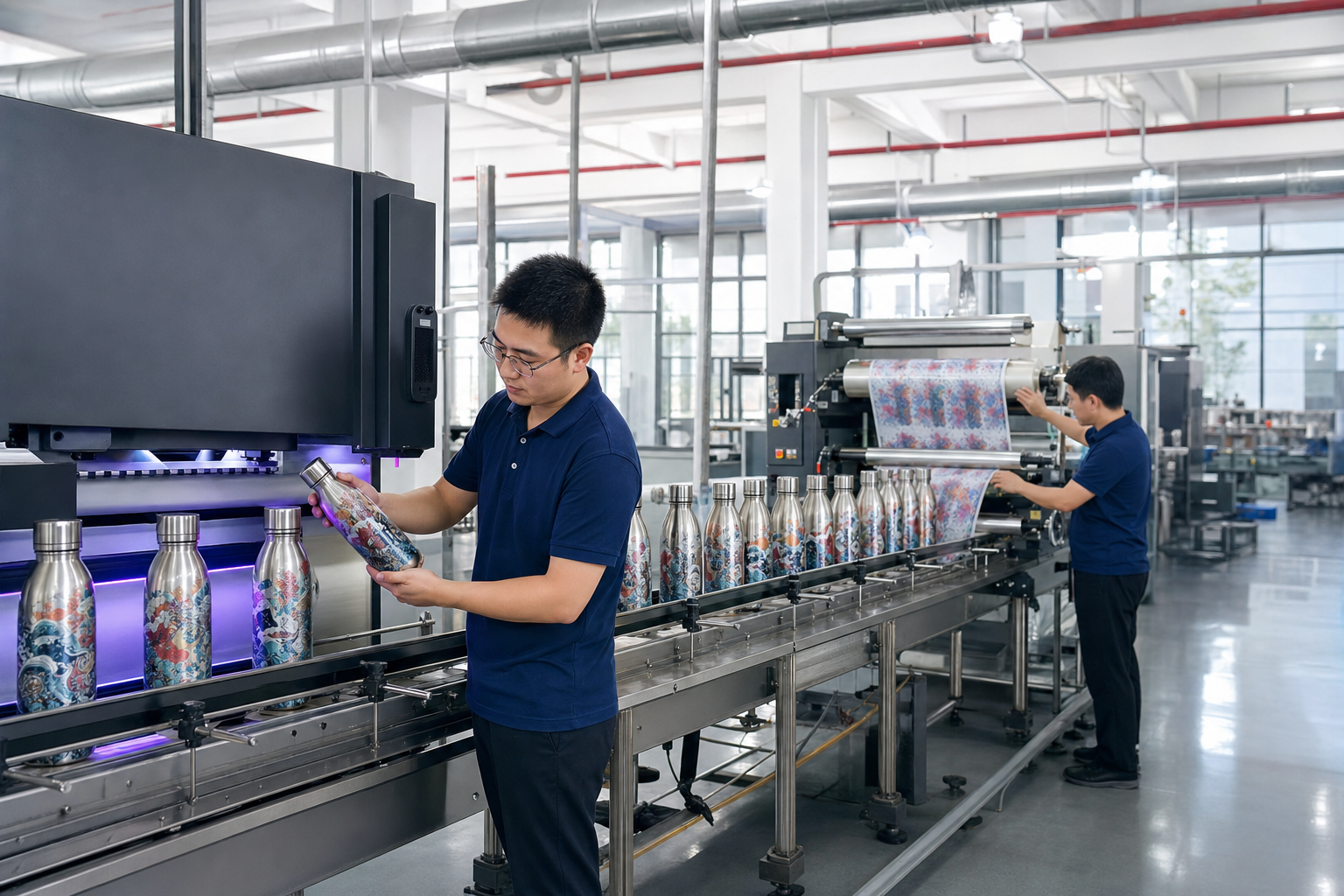
UV printing shoots ink straight onto the bottle and cures it under ultraviolet lamps. We run it on flat panels, 1.5 mm ribs, and small text where the buyer wants tight edges. Heat transfer is a different line: the artwork goes onto transfer film first, then we wrap the bottle and press it with heat. It suits curved bodies better, especially when the order calls for a full wrap decoration with no clear start or stop.
For a DTC brand, this is not theory. UV gives cleaner registration on flat or lightly curved panels, and we can hold spot placement within 0.3 mm when the jig is set right. Heat transfer is stronger for 360-degree coverage on cylinders, because the film follows the shape instead of fighting it. If the bottle has ribs, a taper, or a powder-coated finish, the wrong process will show up fast at the line.
In our Hangzhou factory in Zhejiang, buyers often push for UV because they think it looks more premium. That is the wrong question to ask. We had a PO last month with “full wrap” typed as “full whap”; QC pulled the sample anyway, and the real issue was the coating texture. A rough surface makes UV look dry or patchy. Heat transfer can also miss the mark if the film tension is off or the pressure is uneven, and then the seam shows. Both can deliver photo-grade print. Neither is magic.
Where UV print wins
UV printing wins when you need fast setup, 100-500 pcs per SKU, and exact color placement. We run it on stainless steel, coated aluminum, and hard plastic bottles with smooth surfaces and a fixed print panel. If the bottle has a white or light base, UV gives clean CMYK printing bottles with sharp edges and good contrast. QC pulled a 300mm sample last week and the black stayed tight; on a dark body, the buyer flagged the same artwork because the contrast dropped off.
For DTC launches, UV is often the faster path. Sample turnaround is usually 3-5 days, then production starts after the PDF proof, color target, and print position are signed off. On our line, a standard UV job runs about 3000-8000 pcs per day, depending on bottle shape and color count, and photo-heavy art slows the heads down. One buyer once sent a PO with the location code off by 2 mm; we caught it before plates were made, and that saved a rework. This is the wrong question to ask if you want full-wrap coverage—UV is about controlled panels, not chasing every curve.
- Good for: logo-heavy designs, graphic panels, short runs, variable art
- Less ideal for: deep cylinders, highly curved bottles, 360° wrap artwork with no safe gap
- Typical decoration cost: USD 0.35-1.20 per piece
UV also works well when you want to test demand before a bigger run. If you are building a storefront or a subscription box SKU, it is easier to change a UV layout than to reset a transfer film across 2 sizes and 3 cap variants. We’ve seen this go sideways with one MOQ of 500 pcs: the art sold, but the buyer wanted a second SKU with a different logo lockup, and UV handled the switch without holding the line.
Where heat transfer wins
Heat transfer is the better call when the brand wants a full-body image with clean wraparound coverage. We run a 38 mm sample bottle through the line, and this method keeps the artwork moving from shoulder to base without the hard break you get from a plain direct print. It fits seasonal art, illustration-heavy drops, and full-color scenes. A seam in the middle kills the graphic.
On a round bottle, heat transfer gives a cleaner 360-degree look because the film pulls tight under heat and pressure. If you sell on Amazon or DTC and the buyer wants the product photo to match the hand sample, that matters. We had one buyer flag a 2 mm gap at the back seam on a mockup, and they were right to push back. That kind of mismatch costs orders.
In Zhejiang, we usually point buyers to heat transfer when artwork coverage goes above 70% of the bottle body or when the bottle is strongly cylindrical. It handles dense gradients and photo elements across a wide area without choking the image. The math works better on large runs too, though setup takes longer because the film has to be printed, aligned, and checked. QC pulled the sample twice on one 5,000 pcs PO after a typo on the placement drawing, so yes, the prep step matters.
For full-wrap graphics, print quality is only half the job. The real test is whether the design holds up on the curve, at the seam, and after curing.
Durability and wash resistance
Durability is where buyers often get it wrong. UV printing can cure hard, but adhesion still lives or dies on surface prep and line control. If the bottle is not cleaned before printing, we see edge lift or scuff marks after 10-15 wash cycles. Heat transfer bonds well when the press temp, dwell time, and pressure are set right, yet the film grade matters just as much.
For consumer use, 20-30 hand-wash cycles is a fair target. We had one buyer push back on that number, then the sample failed at cycle 14 because the pre-wipe was skipped on the line. If you need stronger wash resistance, ask for a coating test, alcohol rub test, and dishwasher data. Set the standard before we quote. Otherwise the math doesn't work.
From a procurement angle, ask for a small validation batch and check it against AQL 2.5 for visual defects. QC pulled the sample and flagged pinholes, ghosting, seam misalignment, and color shift on a 500 ml tumbler run. If the bottle goes to Europe or North America, keep REACH compliance, ink SDS, and substrate declaration on file. A decent China supplier should send those within 24 hours, not after three reminders.
Cost, MOQ, and lead time
Price only makes sense when setup is on the table. UV usually has less tooling friction because the file moves from proof to print with fewer prepress steps. Heat transfer needs film prep, more registration checks, and a sample round that can drag from 2 days to 5 if the buyer keeps changing the wrap seam. On bigger full-wrap runs, transfer can win on unit cost once that setup is paid back. That is the wrong question to ask if you ignore the first sample cost.
A realistic buying range for DTC programs is below:
- UV print MOQ: 100-300 pcs per design
- Heat transfer MOQ: 300-500 pcs per design
- UV lead time: 10-18 days after sample approval
- Heat transfer lead time: 12-22 days after sample approval
In our Zhejiang facility, the decoration department runs 200,000+ units per month across print, coating, and assembly lines, so lead time is usually about artwork readiness, not machine bottlenecks. If you send final AI/PDF files, Pantone targets, and bottle dielines on day one, we save 3-5 days. If the PO says “make it pop” and the buyer flags the seam after sampling, we lose time fast. QC pulled the sample on a 28 mm lid bottle last week because the artwork sat 1.5 mm off center, and that kind of miss kills schedule.
On pricing, UV often lands around USD 0.35-1.20 per bottle for standard coverage. Heat transfer may land around USD 0.25-0.90, but a 360-degree wrap with dense graphics pushes that up. FOB terms from China make the comparison cleaner because you see the factory cost before freight and destination handling. We ship a lot of these orders, and the math does not work if you compare print price alone.
Artwork rules that decide the method
The artwork decides the method. Small serif type, tight logo placement, and a limited print zone usually go to UV. A full-body illustration, repeat pattern, or 360-degree scene is a heat transfer job. Once the art depends on smooth color blocks and clean wraparound edges, we push the buyer toward transfer first. The line knows why.
Geometry changes the answer fast. A straight cylinder is easy; a tapered tumbler, contoured sports bottle, or soft-touch finish changes how the image lands. On stainless thermoses, the coating color shifts the final tone too. If you need a white ink underbase, raise it early, because not every shop runs the same stack. We had a buyer flag a dark green bottle and ask for photo-grade print on the spot—the math did not work without a second pass or a different film spec.
Practical file checklist
- AI or editable PDF with 1:1 dieline
- Bleed of 2-3 mm minimum
- Minimum stroke width of 0.25 mm for fine lines
- Preferred color system: Pantone plus CMYK reference
- Logo clear space and seam placement marked
If you source from China and your brand lives on design, this checklist cuts most of the back-and-forth. Zhejiang factories see the same miss every season: good artwork, no seam plan. QC pulled the sample, found the overlap sitting on the front logo, and the PO had no seam note at all. The printer cannot guess where you want the break hidden.
How to choose for your brand
If your brand sells clean, premium minimalism, UV is usually the smarter commercial choice. If your brand sells bold art, collectibles, or a limited 1,000-piece drop, heat transfer usually gives you the deeper wrap look. Neither process wins by default. The bottle shape, artwork width, and whether the buyer will catch a seam in hand decide the job.
Use this rule of thumb:
- Choose UV when you need fast turnaround, crisp logos, and small batches under 500 pcs
- Choose heat transfer when you need full-wrap coverage and artwork that runs edge to edge
- Choose neither until the substrate, coating, and wash test are confirmed
For DTC, the safest move is to sample both on the same blank. Ask for one UV sample and one transfer sample, then check them under daylight and store lighting; we run this test under a 5000K lamp on the line, and the weak one shows up fast. QC pulled the sample last week because the buyer flagged a 1.5 mm seam at the back, and that kind of miss kills a reorder. Five minutes is often enough. In our shop, the buyers who compare samples instead of arguing over spec sheets make cleaner decisions and come back faster.
If you are taking a bottle line from 500 to 5000 units, ask the supplier in Zhejiang for the real bottleneck: print speed, drying time, or carton packing. The math does not work if one station is stuck at 12 days while the rest of the order needs 18 days to clear. We see this on the floor all the time with a typo on the PO or a wrong coating note. The print method is only one piece, and it is usually the first problem that surfaces.
Send your bottle artwork for a real comparison
We can quote UV and heat transfer side by side, show sample photos, and flag the seam risks before you place a PO.
Frequently asked questions
Is UV print or heat transfer better for full-wrap bottle graphics?
For true full-wrap decoration, heat transfer is usually better because it handles 360-degree coverage more cleanly on round bottles. UV print is better for smaller print zones, logos, and sharp artwork on smooth panels. If your design covers more than 70% of the body or needs seamless artwork, start with heat transfer. If you need fast sampling and flexible MOQs around 100-300 pcs, UV is often the easier route. The right choice depends on bottle shape, seam placement, and wash resistance target.
Which method gives better photo-grade print quality?
Both can reach photo-grade print, but they do it differently. UV can produce very sharp detail and strong contrast on smooth surfaces, especially with white underbase. Heat transfer is usually stronger for large image areas, gradients, and artwork that wraps around the bottle without visible breaks. If your image has lots of tiny text, UV usually wins. If your image is a large illustration or pattern repeat, heat transfer often looks better in hand and on shelf.
What MOQ should I expect for custom decoration?
A normal MOQ for UV print is 100-300 pcs per design. For heat transfer, expect 300-500 pcs because film setup and alignment take more prep. If you want multiple SKUs, the MOQ can be split by artwork but still depends on bottle shape and color count. For a new DTC launch, many buyers start with 300-1000 pcs total across two designs. That keeps risk manageable while still covering production setup.
How durable are UV and heat transfer finishes?
A good decoration job should survive 20-30 hand-wash cycles with minimal visible wear. UV can be very durable if surface prep and curing are controlled. Heat transfer also performs well, but film quality and press temperature matter. If you need stronger validation, request alcohol rub testing, adhesion checks, and sample wash testing. For EU and North America, also keep REACH documents and ink SDS on file. AQL 2.5 visual inspection is a reasonable buyer-side standard.
How much extra does full-wrap decoration add per bottle?
Typical decoration cost is about USD 0.35-1.20 for UV print and USD 0.25-0.90 for heat transfer, depending on size, coverage, and artwork complexity. Large full-wrap graphics, white underbase, or multi-pass photo work can move costs higher. Lead time is usually 10-18 days for UV and 12-22 days for heat transfer after sample approval. If your supplier in China already has the artwork and dieline, you can save 3-5 days immediately.