Key Takeaways
- For most custom thermos orders, 304 stainless steel is the baseline; 316 is worth it for salty or harsh outdoor use.
- A realistic MOQ is 500 to 1,000 units, with sample lead time at 5 to 7 days and mass production at 30 to 45 days.
- Ask for measured insulation data at a fixed test setup, not a marketing claim like 24 hours hot.
- A real thermos factory in China should show AQL records, leak tests, and export compliance for REACH, LFGB, and FDA.
A custom thermos looks simple until you are buying 5,000 units and checking heat retention, logo placement, and carton damage at the same time. On the line, we have seen a buyer flag a 1.2 mm lid gap after the first trial run, and that small miss turns into a pile of returns fast. Outdoor retailers focus on grip, lid lock, and insulation. Promo brands look at print sharpness, price, and whether the bottle still looks clean after 12 months of handling. Pick the wrong spec, and the unit cost looks fine while the refund file gets ugly.
The better way to source a custom thermos is to treat it like an engineered product, not a handout. A supplier in Zhejiang or anywhere else in China should give you steel grades, vacuum test data, and a lead time that matches the factory calendar, not just a polished sample from the showroom. QC pulled the sample, checked the weld seam, and measured the wall thickness before we even talked about artwork, because that is the order that keeps a bulk thermos program on track. MOQ, retention performance, and packaging are the numbers that matter. Anything else is noise.
Start With the Steel Grade
The first sourcing decision is the body material. For most custom thermos jobs, 304 stainless steel is the default because it keeps cost, corrosion resistance, and weldability in balance. If you ship to coastal markets, outdoor retailers, or buyers who want a tougher bottle, 316 stainless is the better call. It costs more, and that is the point. The extra headroom matters when salt spray, sports drinks, and long storage start chewing on the finish. On our line, we have seen a 304 sample pass the first visual check, then come back with staining after a 48-hour salt test. Put the steel grade on the spec sheet. Do not leave it to a sample and a verbal promise.
Do not stop at the grade. Ask for wall thickness, usually 0.4 mm to 0.5 mm on the inner and outer shells, and confirm the vacuum layer is consistent. A 0.05 mm swing sounds small. It is not. Thin shell saves a few cents, but it cuts dent resistance and heat retention, and the buyer will flag it after the first drop test. A good thermos factory should also spell out what is inside the lid: PP, Tritan, stainless inserts, or a mixed structure. If the cap is weak, your customized thermos fails there first, usually before the bottle body shows any wear.
For outdoor use, ask for a food-grade silicone seal, a smooth neck finish, and a powder coat that can take abrasion. We ship bottles where the coating passes a tape test but scratches at the rim after one week in a pack, so this is the wrong question to ask if you only look at color. A proper supplier thermos spec should include steel certificates, visual inspection criteria, and the exact contact material list. I would rather see that on day one than argue over a typo on the PO after the sample has already left the line. That is the difference between a decent promotional thermos and one distributors reorder after the first season.
Insulation Claims Need Testing
Insulation numbers mislead buyers all the time. A label that says 12 hours hot or 24 hours cold means little until you know the setup behind it. Ask how the bottle was filled, what ambient temperature was used, whether it was filled to 80% or 100%, and if the cap stayed closed the whole time. On our line, QC pulled a sample after a lid-open check and the reading dropped fast. A custom thermos for retail should be tested with real liquid, not an empty chamber or a shortcut that makes the chart look good. The same bottle can behave differently with a wide mouth, a narrow mouth, or a heavier lid.
For a serious thermos manufacturer, the useful number is retention at a fixed starting temperature, after a fixed time, in a fixed room condition. 95 C water at 20 C ambient, measured at 6, 12, and 24 hours, gives you something you can compare. If the factory only hands over one headline claim, push back. The math does not work. We run vacuum leak tests, thermal shock tests, and lid seal checks on the bench, and a buyer once caught a typo on the PO because the sample report listed 90 C instead of 95 C. For bulk thermos orders, ask for results by lot, not one cherry-picked sample.
Outdoor retailers care about use, not lab copy. They want a cap that does not drip, a body that does not sweat, and a bottle that still holds up after repeated washing. One inspection found a 0.2 mm gap at the lid gasket, and that is the kind of thing that turns into a return later. If you sell a thermos custom line into travel, hiking, or workwear channels, make the supplier show the test report before you approve packaging or logo placement. This is the wrong question to ask? No. The right one is whether the bottle survives real handling on the line and in the field.
Choose the Right Logo Method
Decoration decides whether your custom thermos looks like a product or a giveaway. For one-color branding, screen printing is usually the lowest-cost route and runs clean on coated steel when the body is flat enough. Laser engraving gives you a permanent mark; we see fewer complaints because it does not peel or fade after a week in transit. UV printing can carry full-color graphics on some shells, but a bottle that gets washed, dropped, and tossed in a bag every day is the wrong place to gamble on a fragile print. Pick the method by artwork, channel, and how hard the product will be used.
For a promotional thermos, simple usually wins. One logo, one strong PMS match, and a matte body color sell better than a crowded layout. On a 500 pcs run, QC pulled the sample straight off the line and the buyer still flagged the busy version first. For a distributor thermos or retail line, laser is easier to defend because the durability is obvious in hand. If you want to compare methods before you commit, review silkscreen vs laser engraving for drinkware and ask for physical samples, not mockups.
Placement matters too. A curved bottle body can distort a large logo, and a narrow shoulder may not leave enough print area. A practical thermos supplier should show you decoration templates with the actual printable width, the registration tolerance, and the color deviation limit. We measure that in mm on the jig, not on a render. On a thermos customizable project, the right answer is usually the one that stays sharp after 200 wash cycles, not the one that looks loud on a screen.
MOQ, Price, and Lead Time
Bulk thermos pricing comes down to steel grade, capacity, finish, lid parts, and decoration. On our line, a plain 500 ml stainless bottle with a one-color logo usually lands at USD 3.20 to 4.50 FOB China at 500 to 1,000 units. Step up to 316 steel, a tighter lid structure, or a gift box, and the quote moves to USD 5.80 to 8.50 or more. That is normal. The buyer flagged a “too high” quote once, but the real issue was a two-piece lid and a thicker powder coat, so the math did not work any other way.
MOQ should follow the amount of customization. A simple promotional thermos can start at 500 pieces, while a fully customized thermos with molded lid parts, special powder coat, or extra tooling may need 3,000 pieces or more. A thermos factory in Zhejiang with 300,000 units of monthly output can usually run repeat orders faster than a small trading setup, but only if the molds are ready and the steel coil is in stock. QC pulled the sample on day 5 in our workshop, and sample lead time is usually 5 to 7 days. Mass production is usually 30 to 45 days after sample approval and deposit, with 50 to 60 days in peak season.
If you need a thermos distributor program, ask for pricing at 500, 1,000, 3,000, and 5,000 units. That shows where setup cost is still sitting in the quote and where the unit price starts to flatten. One PO typo on a carton mark can cost a day, so we watch the BOM, the print file, and the packing spec together. If you compare a thermos vendor with a direct thermos manufacturer, the gap usually shows up in tooling control, response speed, and how clearly the vendor breaks down the BOM.
Quality Checks You Should Demand
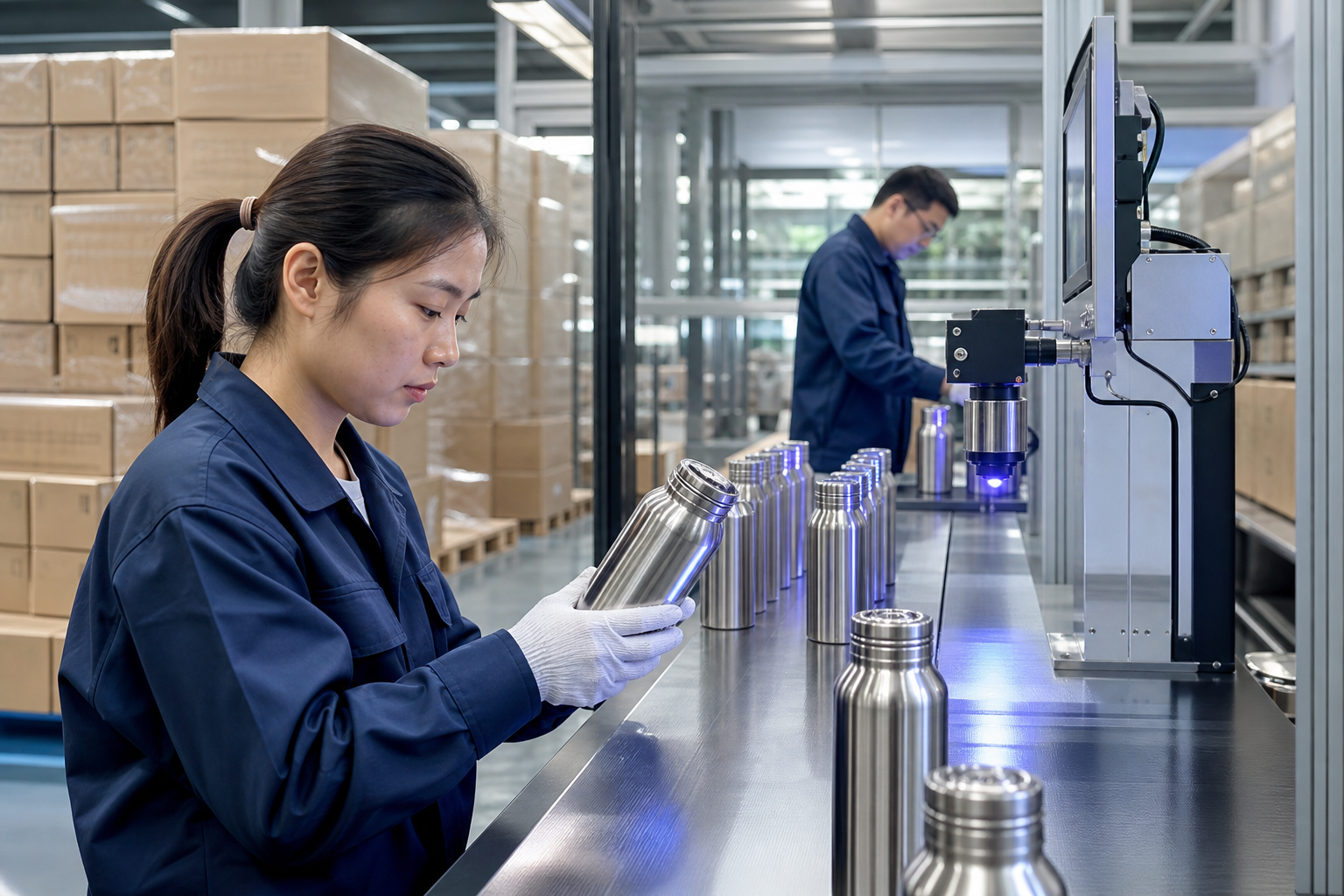
Quality control for a custom thermos has to be specific, measurable, and repeated on every lot. We run visual checks, leak testing, insulation sampling, and carton drop testing on the line. For export orders, ask the factory to work to AQL 2.5 for major defects and AQL 4.0 for minor defects unless your program is stricter. That gives you a real inspection line instead of a vague promise that everything is fine. On one 5,000-piece run, QC pulled the sample and found a 1.5 mm cap gap on two lids; that is the kind of thing a good report catches. A reliable supplier should also keep records of weld integrity, cap torque, and vacuum loss.
What a real report should include
A proper QC pack should show the sample size, the lot size, defect categories, and the exact pass or fail result. For a stainless thermos, I want to see leak tests on inverted bottles, a 1.2 meter drop test on filled units, and thermal retention checks on at least several samples per batch. If the bottle is marketed to Europe, ask for REACH and LFGB documentation. If it will enter the US retail channel, ask for FDA food contact support and check whether the artwork or package raises any Prop 65 concerns. We once had a buyer flag a PO typo on the carton count, and the shipment held because the paperwork no longer matched the labels. For a branded bulk thermos order, ISO 9001 and BSCI are useful signals, but they are not a substitute for product testing.
The cleanest thermos custom programs come from factories that treat inspection as part of production, not as a final sorting step. That matters when you ship to distributors who expect low claims and consistent shelf appearance. I have seen this go sideways when a 304 stainless order passed the finished goods check but failed after 72 hours in a salt spray room. If the factory cannot show you test data, it is not a quality issue yet. It is a sourcing risk.
Packaging for Retail and Promo
Packaging is where good bottles get damaged on the last meter. For a retail-ready custom thermos, we run a carton with a 5-layer outer box, an inner tray or bag to stop rub marks, and a master carton that holds stack strength in transit. For promo runs, we keep the structure lean to protect cost, but we still guard the logo face and lid edge. QC pulled a sample last week and found a 1.5 mm scuff on the cap ring after drop test; that is the kind of miss that turns into a buyer complaint fast.
For Amazon or mixed retail channels, unit labels, FNSKU placement, and carton size need to be set early. If the carton is 2 mm over the warehouse limit, the inbound team flags it and the shipment sits. Even outside Amazon, that same discipline helps distributors process inventory without back-and-forth. A thermos customizable project should decide up front whether the pack is a paper sleeve, a gift box, or a plain white box. We have seen a buyer push back on a “simple” white box because the shelf looked cheap, and the freight math did not work once the box size grew by 18%. If you want more background on commercial packaging and compliance, review drinkware quality control standards and factory capabilities for stainless thermos production.
For Europe or North America, lock the packaging spec before tooling starts. That avoids the usual mess where the bottle is fine, but the carton count, barcode, or pallet pattern is wrong for the distributor. We once caught a PO typo on carton marks, one missing digit, and the whole line had to stop while reprint files were checked. This is the wrong question to ask after goods are packed.
Build your custom thermos spec the right way
Send us your target price, capacity, and logo method. We will quote the right stainless build, MOQ, and lead time for China production.
Frequently asked questions
Which stainless grade should I choose for outdoor retail?
For most outdoor retail custom thermos programs, 304 stainless steel is the default because it gives solid corrosion resistance and a competitive price. If the bottle will see salt air, sports drinks, or harsher use, 316 is the safer upgrade. Ask the manufacturer thermos team for the steel certificate, wall thickness, and whether the inner liner is 18/8. A good spec will also state the seal material and lid construction. In practical terms, 304 is fine for most promo and retail lines, while 316 is better when the brand promise is durability and the price point supports it. The real difference is not the grade alone, but how well the supplier controls welding, vacuum sealing, and finish consistency.
How long does sample and mass production take?
A standard sample for a custom thermos usually takes 5 to 7 days if the factory is using existing molds and stock finishes. If you need new tooling, a custom lid, or a unique coating, sampling can stretch to 10 to 15 days. Mass production is often 30 to 45 days after sample approval and deposit, but peak season in China can add another 10 to 15 days. A Zhejiang thermos factory with high monthly capacity can move faster than a small workshop, but only if your artwork, packaging, and testing are approved early. Build in time for pre-production checks, because a fast launch is not helpful if the first shipment misses your sales window.
What certifications matter for Europe and the US?
For Europe, you should ask for REACH-related material support and, when relevant, LFGB testing for food contact surfaces. For the US, FDA food contact suitability is the usual baseline, and you should also check for any packaging or ink issues that could create Prop 65 exposure. If you are building a distributor thermos program, ask the supplier for ISO 9001 quality management evidence and, if social compliance matters to your channel, BSCI or a similar audit. Certifications do not replace product testing, but they do reduce risk. A serious thermos manufacturer should be able to show both compliance paperwork and batch-level QC records, not one or the other.
How do I compare thermos suppliers before placing a bulk order?
Compare them on four things: product spec, production capacity, QC discipline, and export experience. A good thermos supplier should tell you the steel grade, wall thickness, insulation test method, and decoration limits without hesitation. Ask for monthly output, lead time, and whether key parts are made in-house or sourced out. For a bulk thermos order, request leak test data, AQL standard, and photos of packaging before you approve samples. If the quote is very low but the answers are vague, the savings are usually fake. A real supplier thermos partner should act like an engineer and a coordinator, not just a sales inbox.