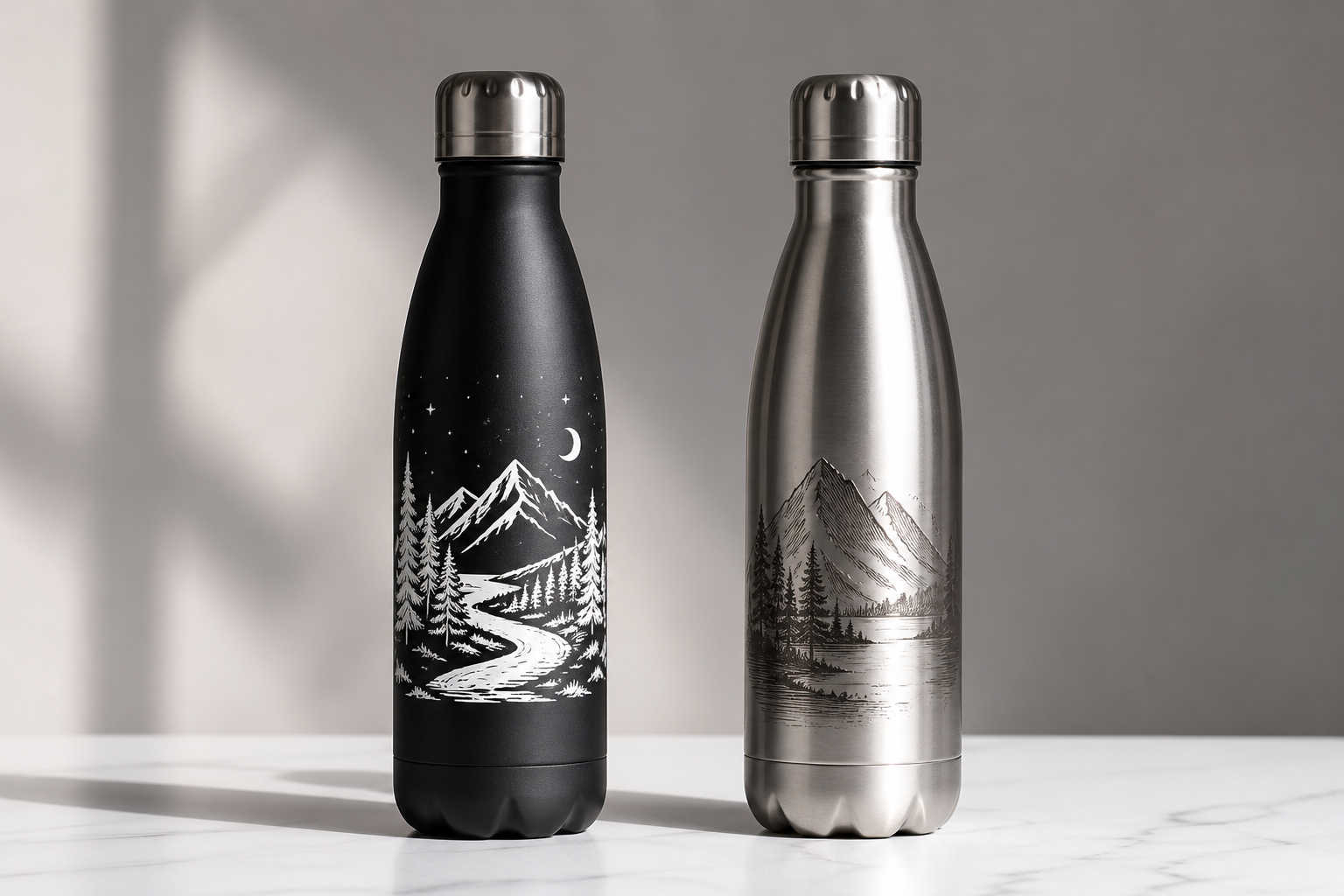
Key Takeaways
- Silkscreen wins on color fidelity, brand color matching, and unit cost at high volumes.
- Laser engraving wins on permanence, premium feel, and freedom from setup fees per color.
- For runs over 5,000 units with a 1–3 color logo, silkscreen is almost always the right call.
- For premium retail bottles where the logo is part of the product story, laser engraving justifies its cost.
Buyers who only commission one custom bottle in their career sometimes think the decoration method is a small detail. It's not. The wrong method on the wrong substrate can make a beautiful brand mark look cheap. The right method on the right product can make a $4 unit cost feel like a $15 retail product.
Below is the comparison we walk every new client through.
How each method actually works
Silkscreen printing
Silkscreen — also called silk-screen, screen printing, or sometimes "pad printing" depending on the specific tool — works by forcing industrial ink through a fine mesh stencil onto the bottle surface. The ink is then heat-cured at 180–220°C to bond it to the substrate. Each color in your logo requires its own mesh, its own ink mix, and its own setup pass. So a 4-color logo means 4 sequential print passes per bottle.
Strengths:
- Solid spot colors. Pantone-matched. Crisp edges. Looks like a print should look.
- Cheap at volume. Once the screens are made, the marginal cost per bottle is pennies.
- Dishwasher-tolerant. A properly cured silkscreen ink survives commercial dishwashers for years.
- Works on most substrates. Stainless, Tritan, PP, glass — all fine.
Weaknesses:
- Setup fees per color. $30–$60 per screen, paid once. Each new color is a separate setup.
- Not great for gradients. Solid colors only. If your brand uses gradient logos or photographic art, silkscreen isn't your tool.
- Limited to 5–6 colors in practice. Beyond that, registration becomes finicky and unit cost spikes.
Laser engraving
Laser engraving uses a high-precision fiber laser to physically etch the bottle surface. On stainless steel, this means burning away the powder coat or top layer to reveal the contrasting metal underneath. On uncoated steel, it creates a subtle tonal mark (slightly darker than the surrounding finish).
Strengths:
- Permanent. Cannot fade, peel, scratch off, or wash away. The bottle would have to be physically destroyed to remove the mark.
- No setup fee per design change. The laser just receives a new vector file. Great for limited editions or seasonal variations.
- Premium look. The Stanley / Hydro Flask / Yeti aesthetic. Customers know it when they see it.
- Detail. Fine line work, small type, and intricate marks are all easy.
Weaknesses:
- No color. Only the tonal contrast of the substrate. You cannot laser-engrave a red logo. You can engrave a logo that reveals red metal underneath, but that's the substrate showing through, not added color.
- Stainless only, really. Lasers can mark plastics, but the result usually looks burned and amateurish. Stick to stainless and aluminum.
- Higher unit cost on small runs. Each bottle takes 8–15 seconds of laser time. Silkscreen is faster per unit at volume.
The cost picture, honestly
Here's what unit costs typically look like for a 500 ml stainless thermos at 5,000 units:
- Silkscreen, 1 color: + $0.15 per unit, + $40 setup once. ~$3.50 total decorated cost.
- Silkscreen, 4 color: + $0.50 per unit, + $160 setup once. ~$4.10 total decorated cost.
- Laser engraving, single logo: + $0.40 per unit, $0 setup. ~$4.00 total decorated cost.
So at this volume, single-logo laser and a 1-color silkscreen are within pennies of each other — the choice becomes about aesthetic, not budget. At 50,000 units, silkscreen pulls ahead by $0.25/unit or more.
"Premium drinkware brands use laser. Promotional drinkware brands use silkscreen. The line between them is mostly about retail price."
When we recommend silkscreen
- Promotional product runs over 3,000 units
- Brand logos that are 1–3 solid Pantone colors
- Plastic, glass, or coated metal substrates
- Tight budget constraints — every dollar of unit cost matters
- Brand identity that's print-native (logos that look like ink should look)
When we recommend laser engraving
- Retail bottles priced over $25
- Stainless-only product lines
- Premium gift / corporate gifting programs
- Limited-edition or short-run drops (under 500 units) where setup fees would dominate
- Outdoor / lifestyle brands where the worn-in look of an engraved mark is part of the appeal
The hybrid: laser + silkscreen on the same bottle
The best decoration choice is sometimes both. We've shipped runs where the primary brand mark is laser-engraved on the front, and a secondary tagline or QR code is silkscreened on the bottom. The visual contrast is striking — and the cost is lower than two laser passes.
It's also a way to handle multilingual SKUs efficiently. Laser the main logo (same for every market), silkscreen the back text in the local language. One mold, one decoration setup, many SKUs.
Want a sample of both methods on your logo?
Send us your artwork — we'll produce one silkscreen and one laser sample for direct comparison.
Frequently asked questions
Which is cheaper, silkscreen printing or laser engraving on water bottles?
At low volumes (under 500 units), laser engraving is usually cheaper because silkscreen has $30–60 setup fees per colour. At high volumes (5,000+ units with a 1–2 colour logo), silkscreen wins by $0.20–$0.40 per unit.
Can you laser-engrave colour onto a stainless steel bottle?
No. Laser engraving produces a tonal mark by physically etching the bottle surface — it cannot add colour. If you need a colour logo on stainless, choose silkscreen, UV digital print, or heat transfer instead.
Is silkscreen on a water bottle dishwasher-safe?
Yes, when properly cured. Industrial silkscreen ink heat-cured at 180–220 °C bonds to the bottle and survives years of commercial dishwasher cycles. Hand-pad-printed or air-dried decorations do not — verify the curing process in your spec.
Which method gives the most premium look on a custom water bottle?
Laser engraving on brushed or matte stainless. It is the visual language of Stanley, Yeti, Hydro Flask, and Hidrate Spark — a permanent etched mark that signals 'retail-grade' to consumers.
Can I combine silkscreen and laser engraving on the same bottle?
Yes — a hybrid is increasingly popular. Many of our clients laser-engrave the primary brand mark on the front and silkscreen secondary text, QR codes, or care instructions on the back or bottom.