Key Takeaways
- For distributors drinkware, expect MOQs around 3,000 to 10,000 units and 25 to 35 day lead times for standard custom canteen runs.
- Europe-bound drinkware usually needs REACH and often LFGB-style food contact proof; North American buyers still ask for FDA-style documentation and traceability.
- AQL 2.5 major and AQL 4.0 minor is a normal final inspection target for export drinkware.
- The best canteen distributor program balances size mix, logo method, and carton count so you can move inventory without discounting too hard.
If you buy distributors drinkware for a catalog, retail chain, or promo program, your job is not to find a nice bottle. You need a product that can survive a 1.2 m drop test, pass FDA and LFGB checks, hold a logo cleanly, and still leave margin after packaging, duty, and local warehousing. That is why a canteen custom order should be judged like a sourcing project, not a sample chase. We have seen the math break when the buyer forgot the foam insert and the carton cost jumped by 0.8 RMB a set.
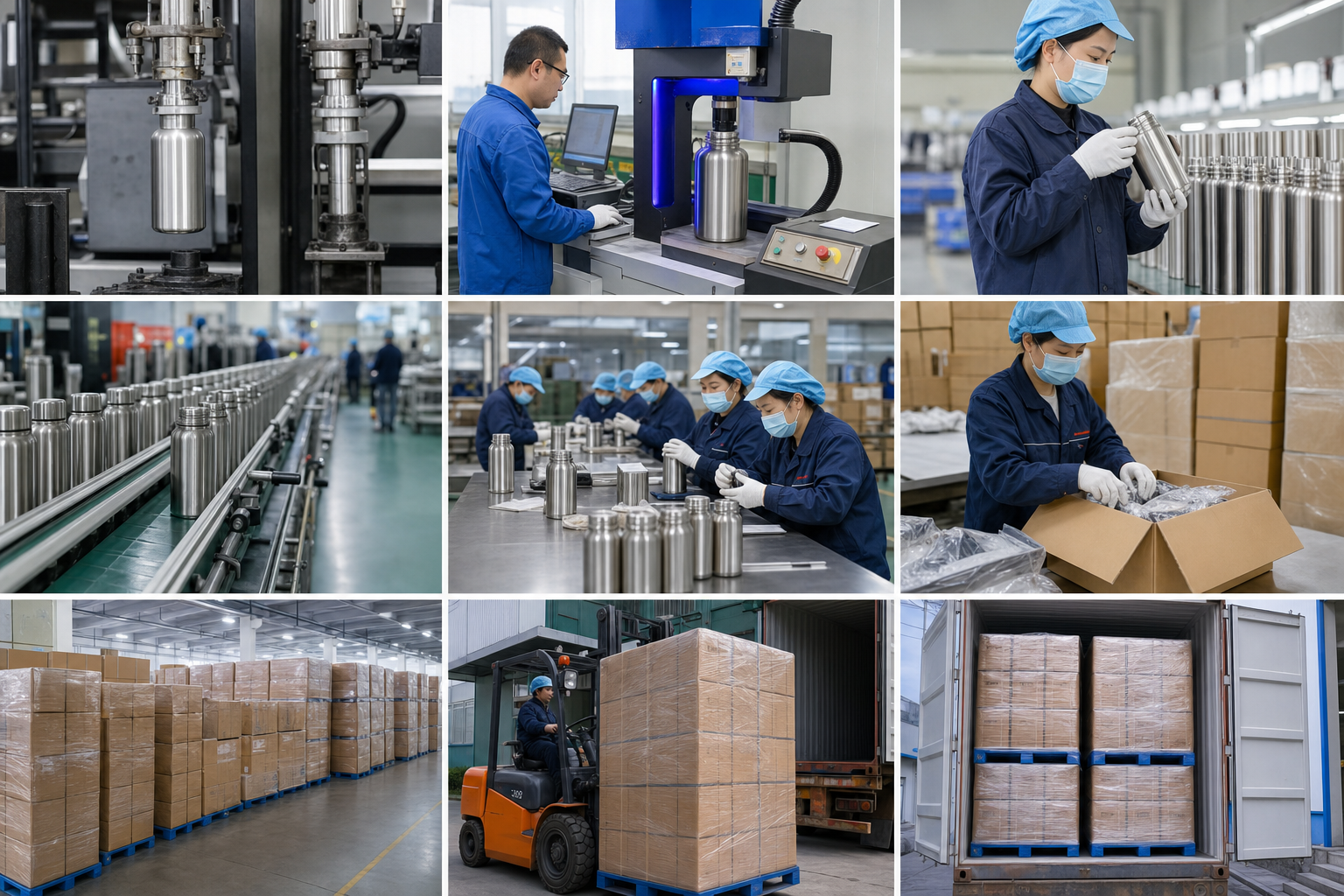
In Zhejiang, China, a serious canteen factory or canteen manufacturer will talk in terms of MOQ, lead time, decoration capacity, and test reports, not just color options. On the line, we run a laser engraver and a pad print bench; if the artwork needs two colors, the schedule moves fast. For a standard stainless steel run, 3,000 to 10,000 units is common, with 25 to 35 days after sample approval if the print is simple. The right canteen supplier gives you options that fit your channel, not a pretty catalog page. QC pulled the sample at 18.5 oz against an 18 oz spec once, and the buyer flagged it before shipment. That is the question that matters.
What distributor buyers actually need
If you are a canteen distributor or a distributor drinkware buyer, the real problem is not sourcing one bottle. It is building a SKU your sales team can reorder without re-teaching the market every quarter. We run this every day on the line: same body, same 1.5 mm wall spec, same logo panel, same carton count. QC pulled the sample, the print drift was 2 mm, and that is enough to cause a buyer flag. This is the wrong question to ask if you start with price alone.
The best distributor canteen programs usually start with three questions: who is buying, where it gets used, and how fast it must turn. A canteen promotional item for trade shows can live with a simpler lid and a lower MOQ. A customized drinkware program for outdoor retail needs better insulation, 5-layer cartons, and fewer color choices because the math does not work when every color sits on inventory. A distributor growler line for beverage accounts needs a wider mouth, stronger handle geometry, and a closure that stays tight in a drop test from 80 cm.
Do not let a canteen vendor push stock that only fits their warehouse. If you need a canteen customizable enough for private label, ask for wall thickness, lid gasket material, packing count, and whether the same body can support a custom canteen and a custom growler without new tooling. We have seen a PO come in with a typo on the carton count, and that one line sent the whole shipment back for rework. That is how you protect margin.
Pick the right product platform
The cheapest mistake in distributors drinkware is picking the wrong body platform. You can put a logo on almost anything, but a 500 ml double-wall stainless bottle, a 750 ml Tritan bottle, and a soda-lime glass bottle behave differently on shelf and in transit. Stainless steel is still the safest default for a canteen manufacturer selling into Europe and North America because it takes heat, survives a 1.2 m drop test, and handles laser engraving or screen print on the same line. We run a 50 W laser head here, and it stays clean. Plastic fits entry pricing, but we watch odor, scratch marks, and color shift after 48 hours in the sun. Glass can work for premium gifting. It fails fast when cartons get stacked 8 high or the pallet stays in transit for 12 days.
For a canteen customized for mass distribution, compare three layers: function, decoration, and compliance. Function means capacity, thermal retention, and cap style; decoration means silk screen, wrap print, pad print, or laser marking; compliance means food-contact declarations, migration testing, and the country-of-origin file the buyer will ask for after the PO lands. On the shop floor, QC pulled the sample when the lid gap drifted by 0.3 mm, because that is how warranty claims start. If you are selling a customizable canteen into outdoor, fitness, or school channels, choose a platform with standard spare parts. This is the wrong question to ask if you ignore replacement lids. A missing lid insert kills a reorder faster than a $0.18 price gap.
Simple platform rule
- Use stainless steel for broadest distributor drinkware acceptance.
- Use plastic only when price point matters more than lifespan.
- Use glass only when the channel supports premium handling.
For a 1,000-piece trial, a custom canteen and a custom growler can share the same decoration workflow if the factory keeps the screen press at 120 rpm and the art file is set up right. We ship both from the same Zhejiang line, but the buyer flagged a 2 mm logo shift once, so the print jig matters. The claim that one setup fits every body is off.
MOQ, pricing, and lead times
MOQ is where distributor deals turn from talk into a PO. The wrong question is “What is your lowest MOQ?” because a sample-friendly number is not a production number. For a straight stainless steel canteen or tumbler, 3,000 units is a workable start. For insulated shapes with a harder mold and more parts on the line, 5,000 to 10,000 units is the number we usually run. If you want mixed colors or mixed lids, the effective MOQ climbs fast because the factory has to split resin, print setup, and packing by SKU.
Pricing should be judged as landed cost, not ex-works alone. A distributor shipping into Europe or the United States has to count inner boxes, master cartons, freight mode, duty, and destination labels, or the margin math does not work. We have seen a USD 0.18 unit gap disappear after the carton changed from 52 x 38 x 28 cm to 54 x 40 x 30 cm. That is why a canteen vendor in Zhejiang should quote FOB and carton dimensions on the same sheet, not send you two separate answers and hope you do the rest.
Lead time matters just as much. A clean custom logo order usually lands in 25 to 35 days after sample confirmation. Add 7 to 15 days if you need new tooling, special coatings, or third-party testing. If the supplier cannot tell you whether the spray line is booked for 12 days or 18 days, you are guessing on your reorder. A real canteen factory in China should be able to tell you whether it ships 200,000 or 500,000 units per month, because capacity decides if your peak-season refill is safe.
Ask for a quote that separates unit price, print charge, sample charge, carton spec, and lead time. If the supplier cannot do that cleanly, your margin model will be weak.
Branding that still sells
Decoration is where a lot of custom drinkware programs get overdesigned. A retail buyer does not need every surface covered. A clean logo, one useful color story, and packaging that looks planned usually beat busy artwork. On our sample table, a logo that still reads at 12 mm is the real test. For a distributor growler or canteen promotional SKU, the logo method should match the sales channel. Laser engraving gives a premium feel and holds up well. Silk screen is still the lowest-cost route for a simple one- or two-color logo. Full-wrap print can work, but only when the artwork earns the extra setup, and we have seen a buyer flag a wrap file that needed three screens and blew past the target MOQ.
If you are managing custom canteen or customizable canteen programs, think in terms of repeatability. Can the same artwork work on 500 ml, 750 ml, and 1 L? Can the logo stay legible after dishwasher cycles? Can the carton survive a 1-meter drop test? This is not a theory question. QC pulled the sample after 40 dishwasher runs, and the logo had to stay clean. If it flakes or blurs, the reorder stops there. The math does not work any other way.
Branding also affects minimum order economics. One logo position is cheaper than two. One PMS color is safer than four. On a 3,000-piece order, that second print hit can add a full day on the line. If your customer wants a customized canteen for a seasonal campaign, keep the base body fixed and change only the print or sleeve. That keeps pricing steady and still gives the buyer a fresh look. We run that way because the line stays simpler and the defect rate stays lower.
For buyers who want a broader view of decoration options, see silkscreen vs laser engraving for custom drinkware and custom logo drinkware services.
Compliance and quality control
For Europe and North America, compliance is part of the buying decision, not a form you file after the cartons are ready. For stainless drinkware, we ask for food-contact declarations, REACH material confirmation, and test reports for inks, coatings, and silicone seals. If a factory is serious, it can show batch traceability from the 18 mm neck ring to the carton lot number, and it can match the production lot to the inspection report without a long search through the office file cabinet.
QC needs to be specific. On a normal export run, we inspect raw tube stock, neck forming, welding, vacuum sealing, print adhesion, and final packing. AQL 2.5 major and 4.0 minor is the baseline we run. For customized drinkware, ask for pre-production samples, one production sample pulled from the line, and carton photos before freight is booked. That costs far less than a container full of logo defects, and we have seen the buyer flag the wrong Pantone on the first shipment for a reason.
Do not mistake a clean sample for a stable line. A factory can make one perfect cup on the bench. The real question is whether it can hold 20,000 units with the same lid torque, the same 0.3 mm print edge, and the same vacuum result. If you sell through distributors, consistency beats the one-off sample miracle every time. Ask for the test workflow and the internal inspection checklist before artwork approval; the math does not work if the line only behaves on the sample table.
If you need a broader benchmark, review drinkware quality control standards and compare them with your own import requirements.
Choose a factory partner
The difference between a canteen supplier and a real factory partner is how they handle uncertainty. A vendor quotes a price. A factory in Zhejiang explains the process, flags the weak points, and tells you where the schedule can break. We have seen the line slip when coating cure time jumps from 12 minutes to 18 minutes, and the buyer only finds out if nobody speaks up. That matters when you are buying distributors drinkware at scale, because missed ship windows and crushed cartons kill reorder trust.
Look for a canteen factory that can show you a full chain: raw material sourcing, forming, polishing, coating, printing, inspection, and export packing. Ask whether it is BSCI audited, whether it has ISO-based internal controls, and whether it can support repeated reorders with the same tooling file. A plant shipping 200,000 to 500,000 units per month usually has tighter discipline than a trading desk that outsources everything. Check the weld seam, the vacuum test, and the carton drop test. You need that discipline if you plan to offer a distributor canteen line across multiple territories.
Shortlist the suppliers that answer operational questions directly. How many production lines are dedicated to insulated bottles? How many QC staff are on shift? What is the response time for sample revisions? Do they support mixed-SKU packing, FNSKU labeling, or custom master carton marks when needed? We once had a PO typo on carton count turn into a three-day hold, so this is the wrong question to ask after you place the order. Those details decide whether the relationship is useful after the first order.
If you want to compare capability levels, review factory capabilities for custom drinkware and the sourcing checklist in MOQ explained for drinkware buyers.
Request a distributor drinkware quote
Send your target MOQ, logo file, and destination market. We will match you with the right canteen, growler, or tumbler spec.
Frequently asked questions
What MOQ should I expect for custom canteen orders?
For standard stainless steel distributor drinkware, 3,000 units is a realistic starting MOQ. If you need special lids, mixed colors, or a custom growler shape, 5,000 to 10,000 units is more typical. Complex decoration or a new mold can push the MOQ higher. A good canteen factory in China should quote MOQ by body style, print method, and packaging, not as one vague number. Ask whether the MOQ can be split by color or size, because some canteen suppliers allow one tooling base with multiple finishes while others treat each variant as a separate run.
How long does a custom drinkware production run take?
For a straightforward custom canteen or customized drinkware order, expect 25 to 35 days after sample approval. If you need a new mold, special coating, or third-party testing, add 7 to 15 days. Shipping is separate: air freight can move fast but is expensive, while sea freight is cheaper and usually adds 20 to 35 days depending on destination. A canteen manufacturer in Zhejiang should give you a schedule broken into sample, production, inspection, and loading dates so you can plan reorder windows instead of guessing.
Which certifications matter for Europe and North America?
For Europe, ask for REACH-related material confirmation and food-contact documentation. For certain markets, you may also need LFGB-style testing on contact materials, inks, or silicone parts. For North America, buyers often ask for FDA-related material statements and traceability tied to production lots. For both regions, ISO-based quality systems, batch coding, and BSCI audit status help reduce risk, but they do not replace product testing. A serious canteen supplier should be able to link each lot to its raw material batch and inspection record.
Can I mix sizes or colors in one distributor order?
Usually yes, but the cost changes. If you mix sizes, you may be creating separate production runs with separate cartons and inventory handling. If you mix colors on the same body, the factory may allow that only after the base MOQ is met, often 3,000 to 5,000 units per color family. For a canteen distributor program, the smart move is to keep one body style and vary only print or lid color. That gives you more flexibility without breaking factory efficiency or raising your landed cost too much.
What files do you need for logo printing?
A clean vector file is best: AI, EPS, or PDF with outlines. If you only have PNG, the factory can sometimes recreate it, but that adds time and the result may be less precise. For custom logo drinkware, tell the supplier the print size, Pantone reference, and placement on the body or lid. For laser engraving, ask for a black-and-white vector because shading usually does not translate well. A good canteen vendor will send you a digital mockup plus one physical pre-production sample before mass production.