Key Takeaways
- MOQ usually starts at 500-1,000 pcs; printed samples take 5-7 days and mass production 18-30 days
- Budget drink bottle for promo orders can start around USD 1.20-2.80 FOB, while stainless insulated models usually land at USD 4.80-9.50 FOB
- For Europe and North America, ask for REACH, LFGB, FDA food-contact declarations, and carton drop testing before you approve mass production
- A reliable print area is usually 40-70 mm wide for logo placement; laser engraving on stainless lasts longer than 1-color silk screen
If you are buying a drink bottle for promotional gifts, the hard part is not finding a supplier. It is picking a bottle that looks sharp, prints cleanly, ships without dents, and still makes your brand look solid. We see buyers ask for “cheap” and then wonder why the logo peels after 200 washes. That is the wrong question to ask. A bottle for employees needs a tougher body; a bottle for schools needs safer materials and a lid that does not leak in a backpack; a bottle for giveaways needs a unit cost that keeps the margin alive.
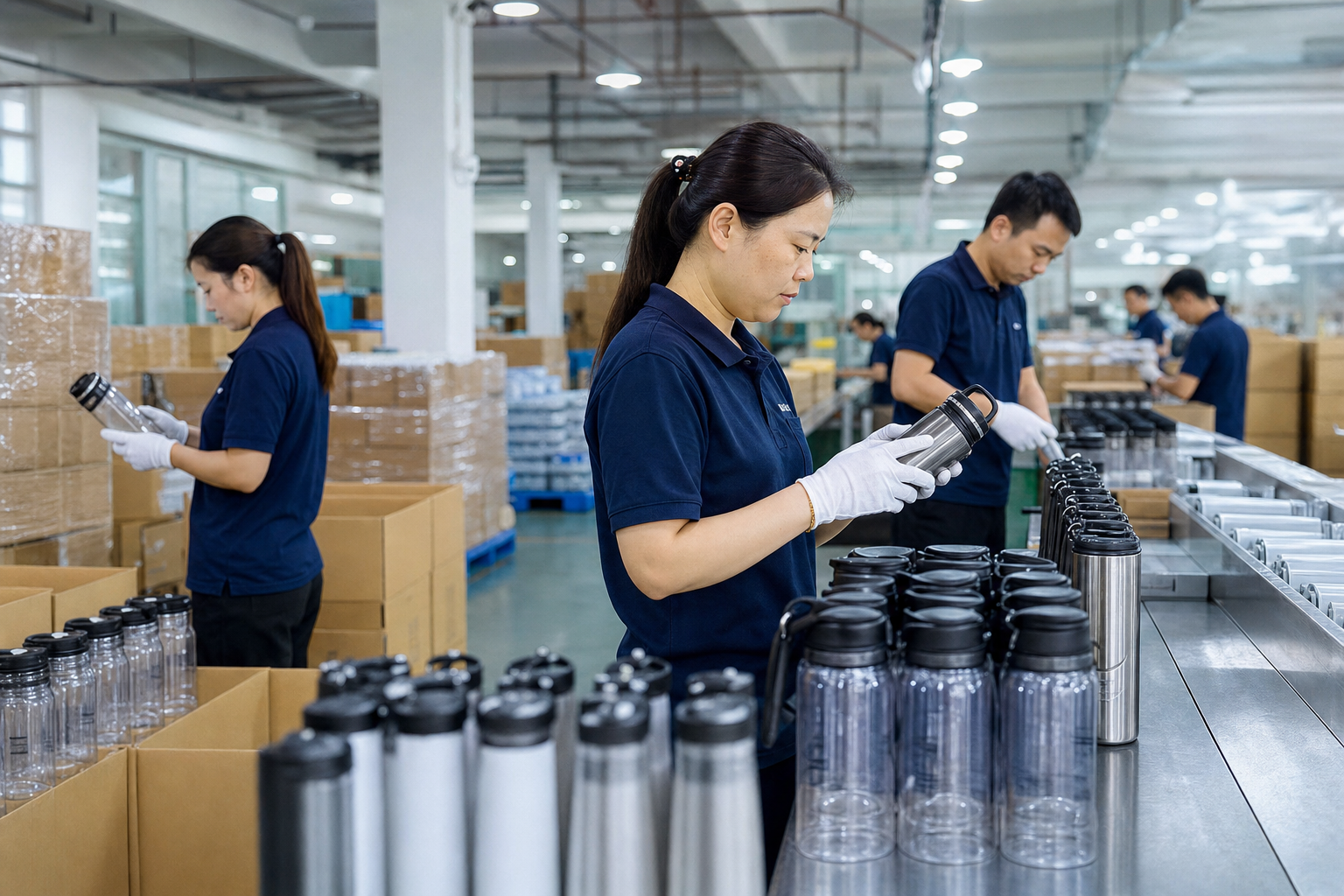
At our Zhejiang factory in China, we run up to 120,000 units per month across stainless steel, Tritan, and PET, with a typical MOQ of 500-1,000 pieces and lead times of 18-30 days depending on decoration. QC pulled the sample last week and measured a 1.2 mm wall on one run, which is the kind of detail that decides whether a carton arrives clean or gets flagged by the buyer. One PO even came in with the lid code typed wrong, and the whole order stopped for a day. If you are sourcing a drink bottle for business, for companies, or for events, the spec has to be right first. China can ship fast, but only when the product sheet is clear.
Pick the right bottle category
The first mistake buyers make is ordering a drink bottle for promotional gifts before deciding what the bottle must do. That is the wrong order. A drink bottle for sale online and a drink bottle for ecommerce needs a clean product photo and a low return rate. A drink bottle for swag or giveaways needs a low landed cost and fast dispatch. A drink bottle for fitness, athletes, runners, or cyclists needs a lid that opens with one hand and stays dry in a gym bag. A drink bottle for hotels, restaurants, or cafes is often about shelf presence, not insulation. QC pulled a sample on line 3 last week because the cap print was off by 2 mm, and that kind of miss is what buyers end up paying for.
For most B2B programs, you are choosing between three practical structures:
- Single-wall stainless steel or aluminum: lower cost, lighter shipping, good for events and conferences.
- Double-wall vacuum insulated stainless steel: better for employees, business gifting, and executive programs.
- Tritan or RPET plastic: useful for schools, students, kids, and children when weight and price matter more than thermal performance.
If you are buying for schools or students, check whether the lid has a locking flip top and a soft silicone spout. For children, insist on BPA-free material and a leak test on every design revision. We run that test at 45 degrees with 250 ml of water, and a bad hinge shows up fast. For adults using a drink bottle for hiking or outdoor work, we normally suggest 650-750 ml capacity because 500 ml feels too small and 1,000 ml gets bulky in a daypack. In China, one factory will quote the same shape in three materials, but the wall thickness, mold finish, and print result are not the same. The math does not work if you choose the body first. Start with the use case, then pick the bottle.
Know your price bands
Procurement teams often ask for a price before they define the artwork. That gives you a weak quote. We see it on the line all the time. A drink bottle for promotional gifts can swing hard on material, lid, and decoration method. For a basic plastic drink bottle for giveaways, FOB China pricing usually starts around USD 1.20-2.00 at 1,000 pcs. A simple stainless steel bottle with one-color logo is often USD 3.20-5.50. Double-wall vacuum insulated bottles with powder coating and laser logo usually sit at USD 4.80-9.50, and the number climbs if you ask for a custom lid or matte finish.
Do not compare unit price alone. Compare the landed number. A bottle that is USD 0.40 cheaper but ships in a weak carton can cost more once you add breakage, complaints, and rework. We had one buyer flag a 3 mm carton spec after QC pulled the sample and crushed it under a 12 kg stack test. For export orders, the cost stack usually includes mold or tooling, sample charge, printing setup, inner box, master carton, and sea freight or air freight. If you are sourcing a drink bottle for business or a drink bottle for companies, ask for:
- FOB unit price at 500 pcs, 1,000 pcs, and 3,000 pcs
- Print setup fee per color
- Replacement rate for defects above AQL 2.5
- Carton quantity and gross weight per carton
That is the only way to compare a drink bottle for marketing with a bottle for employees on a real procurement basis. In Zhejiang, good suppliers quote fast, then ask for artwork, target market, and test requirements. That is normal. If they do not ask, you should worry. We once caught a PO typo on a 5,000 pcs order, and the buyer tried to push the mismatch into production. The math does not work.
Choose decoration that lasts
Logo decoration is where a lot of promo orders go sideways. A drink bottle for promo can pass the sample and still look rough after 30 dishwasher cycles. For conferences, events, or giveaways, silk screen is usually the low-cost pick for one or two colors. It works on powder-coated stainless steel and flat plastic panels, but it can crack if the bottle flexes or the paint cure is off. We had one buyer flag a cracked logo after a 72-hour rub test, and the math was simple: cheap print saved a few cents, then the rework ate the margin. Laser engraving costs more at the start, yet on stainless steel it holds up best and is the safer choice for a drink bottle for employees or a drink bottle for business use.
Use a straight rule. Short-term giveaway, choose print speed and cost. Desk use for 12 months, choose durability. Logo size is usually 40-70 mm wide for one side, or 80-100 mm for wraparound art on larger bottles. Full-color UV print works for complex logos, but it needs a stable coating and proper curing on the line. On curved bottles, thin lines distort fast, so we keep line weight above 0.25 mm. QC pulled one sample last week with a 0.18 mm stroke, and it looked broken from two meters away.
Ask for print control, not just print type
Ask for a pre-production mockup, a Pantone reference, and a clear logo position measured from the bottle base and seam. If you want a drink bottle for schools or a drink bottle for children, keep decoration away from the mouth area where saliva contact is likely. For a drink bottle for athletes or runners, the logo should not sit where the hand grips the bottle. We usually send a logo proof photo before mass production and get first-article approval on the actual line, not just a PDF. That is standard here in China when the order is serious. One PO came in with the logo 5 mm off the seam, and we caught it before the pad printer started.
Check materials and safety
Material choice changes taste, odor, weight, and whether the shipment clears customs without drama. If you are buying for Europe or North America, compliance is not a paper extra. For a drink bottle for promotional gifts, ask for material declarations and test reports before you pay the balance. We usually see buyers ask for REACH on EU orders, FDA food-contact declarations for the US, and LFGB when they want stronger German-market proof. On stainless jobs, ask straight away whether the inner wall is 304 or 316. For most promo runs, 304 is the right call on cost; 316 only makes sense when the bottle sees salt, sweat, or harsher use. The wrong question is “is it safe enough?” The real question is whether the supplier can prove it, with the actual batch number on the report.
Wall thickness matters more than most buyers expect. A single-wall stainless body is often 0.4-0.5 mm, while a vacuum insulated bottle usually runs 0.35-0.45 mm on the inner and outer walls, depending on structure. We had a line sample at 0.32 mm once; QC pulled the sample after a quick dent test at the bench, and the buyer flagged the feel immediately. Too thin and you get dents and a cheap hand feel. Too thick and the bottle gets heavy, which pushes up freight. For Tritan or PET drink bottle for sale online programs, check transparency, impact resistance, and whether the lid seal is silicone or TPE. A weak seal becomes leakage claims fast, especially on a drink bottle for gyms, fitness, hiking, or travel.
“If you cannot tell me the steel grade, wall thickness, seal material, and test standard, you do not have a specification yet.”
Keep that standard. If the bottles are going to schools, students, kids, or children, ask for BPA-free confirmation and a leak test result tied to your use case. For hot-fill or insulated products, ask for the retention curve at 95°C initial fill and the test method used. We ship plenty of logo bottles, but the line does not care about the artwork if the material stack is wrong. A promo bottle can look clean and still fail on the first week of use. On one PO, the buyer missed a seal note by one line, and that typo cost us two extra days on the sample loop.
Build the order around use case
Good B2B sourcing starts with the user, not the logo. A bottle for business travelers is not the same part number as one for a cafe handing out branded merch. We run separate specs for each: hotel sets usually need a clean matte finish, rigid gift box, and sleeves that survive 2-3 handoffs in front of guests; event bottles need low breakage, stackable cartons, and a print window that turns fast. For ecommerce, the math is simpler. Keep the dimensions tight, or your FBA team will be chasing carton surprises.
If the program is for employees, the bottle has to feel personal enough that people keep it on their desk. That usually means a matte powder coat, a one-color laser logo, and 500-750 ml. For a plant order last quarter, QC pulled the sample because the coating showed scuffing after 12 abrasion cycles on the line, and the buyer flagged it right away. Schools and students usually do better with lighter plastic or aluminum than heavy insulated steel. For runners, cyclists, and hikers, we look at carabiner-ready lids, loop handles, and a body narrow enough for cage fit. Athletes care about flow rate first. Thermal retention is second.
- Employees: 500-750 ml, laser logo, gift box or mailer box
- Schools: BPA-free plastic, leak-resistant lid, 400-600 ml
- Gym and fitness: 600-750 ml, one-hand open, grip texture
- Hotels and restaurants: premium finish, custom packaging, retail-ready look
If the bottle is swag, it still has to survive shipping, unboxing, and daily use. A weak clasp can kill a campaign. We saw one buyer push back on a lid hinge after a 1.2 m drop test cracked the first ten samples in our workshop, and that was the right call. The logo can be perfect and the order can still fail if the lid flexes too much. Lock the function spec before artwork approval. Anything else is backward.
Use proper factory controls
Once the product is set, the line should run in a clear order: sample, approve, produce, inspect, ship. Real orders are messier. We start with a digital artwork proof, then a physical sample in 5-7 days. After sign-off, mass production takes 18-30 days if the bottle is stock or uses an existing mold. For a drink bottle for promotional gifts, that timing is normal. New tooling adds 25-45 days before production starts, and that is where some buyers get surprised. The math does not work if they want launch stock in two weeks.
Quality needs checkpoints you can measure. Ask for an incoming material check, in-process leak test, print adhesion check, and final inspection to AQL 2.5/4.0 based on defect severity. On one order, QC pulled the sample and found a 0.3 mm print shift before packing; that saved a reprint. For export cartons, ask for 5-ply outer boxes on heavier insulated bottles and drop-test confirmation. If the order is for Amazon FBA or another ecommerce channel, request carton labels, barcode placement, and FNSKU application at origin if needed. A drink bottle for ecommerce is handled differently from a simple giveaway.
Factories in China that do real export work know these steps. In Zhejiang, a solid supplier should show monthly capacity, machine count, and inspection records without stalling. We run 12 injection machines at one plant and still track rework by bin number, not guesswork. If the supplier cannot tell you how many units they make per month or how they separate good units from rework, you are not dealing with a production partner. You are dealing with a quote machine. For a drink bottle for companies or a drink bottle for business programs, process control protects your brand.
Match the channel to the program
Not every bottle sells or gifts the same way. A drink bottle for sale online needs sharp photos, a size chart in mm and oz, and a packed weight buyers can trust. A drink bottle for marketing campaigns needs print space for a logo and message, but the decoration should not turn the bottle into a flyer. A drink bottle for giveaways has to move by the pallet and stay cheap enough that the margin survives. A drink bottle for swag should feel chosen, not random.
If you sell to distributors, retail buyers, or procurement teams, think in program terms. One SKU can go into three channels with small changes: a school lid, a fitness lid, a hotel box, or a matte finish for corporate gifts. We run this out of Zhejiang all the time. The line can switch lid molds and cartons fast, but only if the spec sheet is tight. QC pulled the sample on a 500 ml run last month because the cap color drifted 2 shades from the PO. Three near-identical bottles is not a strategy. We’ve seen that go sideways.
For the next order, the move is simple: define the user, the channel, the decoration, and the compliance target before you ask for a quote. That is how you get a drink bottle for promotional gifts that still works after the first week in the field.
Request your custom drink bottle quote today
Send your target quantity, logo file, and market. We will match the right bottle, decoration, and compliance for China or Europe-bound orders.
Frequently asked questions
What MOQ should I expect for a custom drink bottle for promotional gifts?
For most standard factory lines in China, expect 500-1,000 pcs per design and color. Stock shapes can sometimes start at 300 pcs, but custom lids, custom colors, or special packaging usually push the MOQ higher. If you want multiple logos or mixed colors, many suppliers will still calculate MOQ per SKU. For a serious B2B order, ask for MOQ by body, lid, and decoration method separately. That helps you compare a drink bottle for promo against a drink bottle for business on real production terms, not just a headline price.
Which decoration is best for a drink bottle for employees or clients?
For long-term use, laser engraving on stainless steel is usually the most durable. It does not peel, and it survives repeated washing better than silk screen. For short campaigns, one-color silk screen is cheaper and usually fine if the bottle is for giveaways or events. UV print works if you need more colors, but you should check adhesion and curing. On a typical logo panel, keep the width around 40-70 mm unless the bottle body is large enough for a wrap. If you are buying a drink bottle for employees, premium packaging and durable marking are usually worth the extra USD 0.30-0.80.
What compliance documents should I ask for in Europe and North America?
For Europe, ask for REACH-related declarations and, when applicable, LFGB food-contact support. For the US, ask for FDA food-contact declarations. If the product is for schools, children, or kids, ask for BPA-free confirmation and any relevant child-safety testing. For insulated stainless bottles, also ask what grade of steel is used, commonly 304 or 316. A proper supplier in China should provide material declarations, sample test reports, and a packing list that matches the shipment. If they hesitate, treat that as a risk, not a minor delay.
How long does production take in China?
For a standard bottle with existing tooling, sample approval usually takes 5-7 days and mass production 18-30 days. If you need a new mold or custom lid, add 25-45 days before production begins. After that, shipping time depends on mode: air freight can be under 10 days, while sea freight to Europe or North America is usually 20-40 days port to port. In Zhejiang, many suppliers can move fast, but only if your artwork, color, and compliance details are finalized before the order is released.
What bottle type works best for schools, gyms, or events?
For schools and students, a BPA-free Tritan or PET bottle with a leak-resistant lid is usually the safest and lightest choice, often 400-600 ml. For gyms, fitness, athletes, runners, or cyclists, use 600-750 ml with one-hand opening and a body that fits cup holders or bottle cages. For events and conferences, lightweight single-wall bottles or simpler stainless models keep your cost down and reduce shipping weight. If the bottle is for hotels, restaurants, or cafes, focus on appearance and packaging because the unboxing experience matters as much as the bottle itself.