Key Takeaways
- A practical gym custom water bottle program usually starts at 1,000–3,000 pcs per SKU, not 100 pcs.
- For fitness studio bottle use, Tritan or 304 stainless is safer than low-grade PP when you need lower odor and better perceived value.
- A realistic lead time from China is 25–35 days for standard production, plus 25–40 days ocean transit to Europe or North America.
- For chainwide fitness membership gift programs, plan AQL 2.5 for major defects and 4.0 for minor defects, with pre-shipment photos and carton drop testing.
If you are buying a gym custom water bottle program for a fitness studio or a multi-site chain, the first mistake is treating it like merch instead of operations. A bottle that looks good on day one can still fail you if it leaks in a locker bag, comes in with weak print, or lands 75 days later when your membership campaign starts in 30. We had a buyer flag a PO typo on the lid code once, and that one mistake held up the whole lot.
In Zhejiang and across China, factories see this category every week: welcome gifts, retail add-ons, shaker bottle launches, corporate partnerships tied to new sign-ups. The difference between a cheap order and a usable program is simple. You need a clear spec, a realistic MOQ, and a supplier who can hold tolerances. At BottleForge in Hangzhou, we run up to 300,000 units per month, and QC pulled samples at 2 mm off-center print more than once before we signed off. Start with the basics: material, lid, logo method, carton plan.
Start with the use case
Do not start by asking for “custom bottles.” Start with where the bottle is used. A gym custom water bottle for front-desk giveaways is a different item from a retail shaker bottle next to protein powder, and both differ from a premium fitness membership gift handed out during onboarding. If the bottle stays in a locker room, the cap has to shut tight, the mouthpiece cannot hold odor, and the shape must clear cup holders and treadmill holders. For class use, weight matters more than wall thickness. We had a buyer flag a 28 mm mouth opening on a PO because it felt awkward during spin classes. They were right.
For gym franchise operators, the clean setup is three SKUs: a low-cost welcome bottle, a mid-range studio bottle, and a higher-margin retail bottle. Same logo system. Different body, lid, and box. On our line, that keeps print plates, carton size, and QC checks under control, and it avoids the usual headache where one bottle is forced to do three jobs. The math does not work. A good spec sheet should list capacity, material, lid type, intended use, and target landed cost. If you leave those out, Zhejiang suppliers will still quote you, but they will quote the version they want to run.
Practical benchmark: for large gym chains, a 750 ml bottle with single-color print, 2,000 pcs MOQ, and standard packaging often lands between USD 1.20 and 3.80 ex-works depending on material and lid complexity. QC pulled the sample, checked the 0.2 mm print offset, and it passed on the second round.
Choose the right material
Material sets the smell, weight, price, and return rate. For a fitness studio bottle, PET and low-cost PP make sense only on a short-run giveaway or a tight promo budget. If the order is for 5,000 pieces and members are expected to reuse it for 6 months, we push the buyer up the spec. Tritan copolyester sells well because it stays clear, takes drops better, and does not feel like a cheap throwaway. 304 stainless steel fits premium programs, but it lifts unit cost and changes the print method; we run a separate pad-print line for that.
For shaker bottle programs, the mixing system is where complaints start. A spring ball, whisk ball, or molded agitator changes cleaning time and what the buyer hears from the gym front desk. QC pulled a 600 ml sample last month with a screw-top lid, silicone seal, and molded mixing grid; it passed the shake test, while a thin-wall body with a loose flip cap got flagged for leakage. Wall thickness matters too. 0.8 mm to 1.0 mm is common for budget plastic bottles, while 1.2 mm to 1.5 mm gives a better hand feel and less flex. For stainless, ask for 0.4 mm or 0.5 mm gauge; that is the difference between a bottle that dents on first drop and one that survives the first season.
- Tritan: clear look, stronger retail appeal, higher cost than PP
- 304 stainless: premium feel, good for insulated bottles and longer member use
- PP/PET: lower cost, fit for giveaways and 3-month campaigns
Because you are sourcing from China, ask for material declarations and test reports, not just a sales promise. We ship these every week, and the buyer who skips documents usually gets stuck later at customs. For Europe, REACH and food-contact compliance are non-negotiable. For North America, FDA food-contact requirements matter, and if the bottle is sold as insulated steel, ask for migration and coating paperwork; we have seen PO notes miss the coating spec by one line, and that typo turns into a hold at the warehouse.
Branding that survives daily use
Logo placement is where a lot of gym programs go wrong. A centered print looks sharp in the mockup, then the bottle slides into a cup holder or gets grabbed mid-class and the mark disappears. For a gym custom water bottle, we keep side print simple on a curved body: one or two colors for pad printing or silkscreen, or a clean laser mark on stainless. If you want a premium retail bottle, ask for wrap print or UV print, but only after the supplier shows adhesion after abrasion testing. We had a buyer flag a PO once because the logo sat 18 mm too low. That mistake is easy to miss on a screen.
For fitness membership gift packs, packaging carries more weight than people expect. A rigid color box or a kraft mailer with a branded insert can make a USD 2.50 bottle feel like a USD 8 gift. Still, if the bottle gets tossed in the locker room, fancy packaging is the wrong spend. We run the carton check with one master carton spec and one retail box spec, then compare the carton cube line by line. A bad carton plan can add 12% to freight even when the unit price looks good. On one job, QC pulled the sample and the box was 6 mm wider than the PO called for. That extra space hurt the pallet count.
Ask these print questions
- How many print passes are used?
- What is the minimum line width, in mm?
- Will the logo survive 50 dishwasher cycles if applicable?
- Do you have a color tolerance of Delta E under 2.0 for brand colors?
Good factories in Zhejiang will put the print jig on the table, show the ink type, and hand over adhesion test results. If the supplier dodges that, you are buying cosmetics, not a repeatable supply chain. We’ve seen this go sideways on a 5,000-piece order when the white underbase was too thin and the black logo bled at the edges. Ask for the proof before you place the deposit.
MOQ, price, and lead time
Buyers always push for a low MOQ and a fast ship date. The math does not work that way on a custom gym bottle. A printed PP bottle with one logo and one color usually starts at 1,000 pcs per color per design. If you add a new lid, a silicone ring change, or a custom mold, we run into 3,000 pcs or more. Stainless steel needs a higher MOQ because setup, polishing, and packing all eat time. One SKU across 8 gym branches is fine. Twelve club logos on one order? QC pulled the sample, and the pricing moved up fast.
For standard production after sample approval, lead time from China is usually 25–35 days. Complex orders need another 5–7 days for carton build and mixed packing. Ocean freight to the US or Europe usually takes 25–40 days, depending on port, vessel space, and season. If the launch date is fixed, count back 70–90 days from first customer handoff. A Hangzhou or Zhejiang supplier can move fast, but only if artwork, sampling, and compliance papers are approved on time. We’ve seen this go sideways from a one-day delay on a PO typo.
| Program type | Typical MOQ | Ex-works price | Lead time |
| Simple PP fitness studio bottle | 1,000 pcs | USD 0.85–1.40 | 20–30 days |
| Tritan gym custom water bottle | 2,000 pcs | USD 1.60–3.20 | 25–35 days |
| 304 stainless shaker bottle | 3,000 pcs | USD 3.80–8.50 | 30–45 days |
Do not skip freight. A 750 ml bottle that looks cheap at USD 1.20 ex-works can get expensive when the carton pack is weak. Ask for carton dimensions, gross weight, and loading numbers before you sign the PO. One buyer flagged a 58 x 38 x 42 cm carton on a shipment last month; the cube was off, and the container plan fell apart. That is the wrong question to leave until the end.
Quality control for chain orders
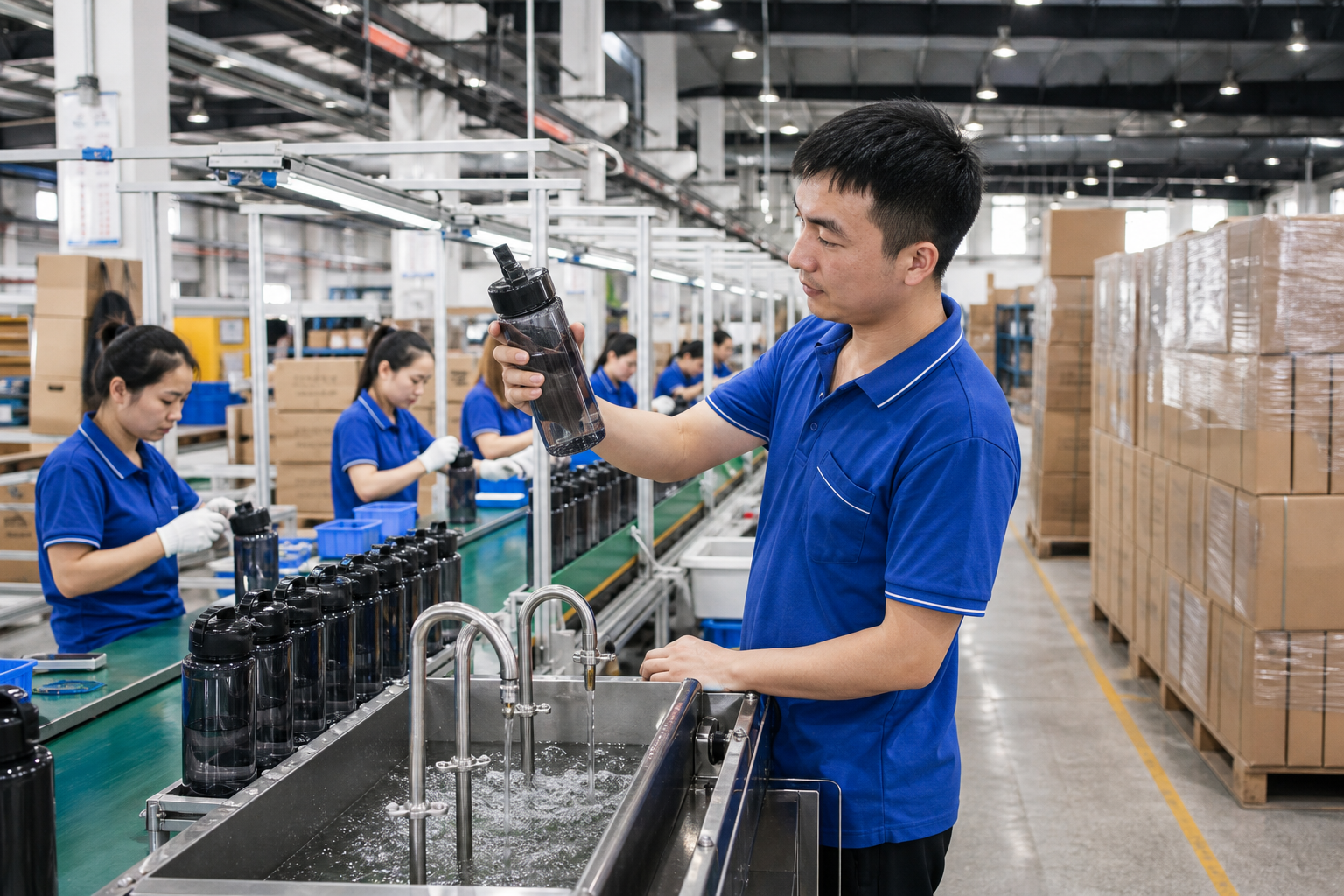
A gym chain does not get one bad batch. It gets 40 complaints in the same week. So QC must be in the PO, not left to trust. We run incoming material checks on resin or 304 stainless, in-process checks on lid torque and logo position, then pre-shipment sampling to AQL 2.5 for major defects and 4.0 for minor defects. For leak-prone bottles, add a three-step test: water fill, inverted hold, and carton shake. On one chain order, QC pulled the sample after a lid torque reading of 18 N·cm slipped below spec; the buyer flagged it before packing.
Ask the factory to state whether seals are silicone or TPR, and whether they stay batch-matched or get mixed across suppliers. Mixed seals are where the line starts drifting. For stainless bottles, request salt-spray data or coating adhesion results if you are using paint or powder coating. For flip lids, test hinge life. 1,000 cycles in the lab beats a glossy photo every time. We saw a PO last quarter with “silicon seal” typed on it, and the buyer spent two days asking why the replacement ring did not fit. That is the wrong question to ask after the shipment leaves Ningbo. If you buy from China, ask for inspection photos from the actual line, not the sample room.
- Leak test: 100% on sampled units during production
- Drop test: 1.0 m, 6 faces, if the bottle is for gym floor use
- Box test: 5–8 kg compression based on carton stack height
Factories in Zhejiang that ship export orders should quote these controls without hesitation. If they cannot, you are carrying the supplier’s risk through your own store network. We ship chain programs this way because one weak carton at 5–8 kg stack load can turn into a floor display problem, then a returns problem.
How to brief your supplier
A clean brief saves weeks on the sourcing schedule. Your RFQ needs capacity, material, lid style, logo method, color, target price, packaging, compliance destination, and whether the bottle is for retail or promotion. If you want a shaker bottle with a blending ball, say if the ball is stainless or PP, whether the bottle has measurement markings, and whether those markings are embossed or printed. For a fitness membership gift, tell the supplier if the box goes to 18 clubs one by one or to a central warehouse in one drop.
Use a format the factory can quote without guessing:
- Capacity: 500 ml, 750 ml, or 1,000 ml
- Material: Tritan, PP, PET, or 304 stainless
- Logo: 1-color silkscreen, laser engraving, or UV print
- Destination: EU, US, or Canada for compliance routing
- Qty: 1,500 pcs trial, then 10,000 pcs rollout
When you ask for samples, one prototype is not enough. Ask for pre-production samples and a production-matched sample from the same mold, same ink, and same lid batch. We had a buyer flag a lid color on a sample once, then the line ran 8,000 pcs against the wrong Pantone because the PO typo said P-293 instead of P-193. QC pulled the sample, measured the wall at 2.1 mm, and the issue showed up before shipment. That is the point. A sample-room bottle can look fine and still fail in mass production, so the better factories will quote 5–10 days for samples and tell you straight if the mold or print needs another round.
Avoid these sourcing traps
The biggest trap is buying a bottle that matches your PMS color but fails on use. We have seen gym members ignore a perfect brand match the second a lid leaks in a backpack. Another trap is over-customizing a low-margin item. A shaped body, special cap, metallic print, and gift box can double the landed cost before freight. For a 10,000-piece rollout, keep the bottle simple and put the money into a cap that seals and packaging that arrives clean.
The next mistake is leaving compliance until the final week. A bottle shipping into Europe may need REACH-related documents and a clear food-contact statement. For North America, a retailer or distributor may ask for LFGB, FDA, or Proposition 65-related support depending on the material and coating. Gyms also ask for supplier declarations and product liability wording. We got a PO once with “65” typed as “56”; that sort of typo turns into a week of back-and-forth. Get the paperwork sorted before the line starts packing cartons.
Do not approve samples by video only. Hold the sample, fill it with hot and cold water, shake it, drop it, and leave it overnight. A bottle that looks fine after 10 minutes can still fail after 10 hours. We run this on the bench with a torque wrench and a 1.5 m drop test, and QC pulled one cap that seeped at the gasket after the second shake. If your supplier is in China, ask for the same test on their side before they ship the sample. That is basic discipline.
Good gym sourcing is not about grabbing the lowest quote. The math does not work. You need a bottle program that can repeat across clubs, seasons, and promotions without creating service tickets. That is where a Zhejiang factory with export experience beats a random low bidder, because we ship the same spec again and again without drama.
Build your bottle program with fewer surprises
Send your spec, target MOQ, and delivery window. We can quote a gym custom water bottle program for China, Europe, or North America with clear QC and packaging.
Frequently asked questions
What MOQ should I expect for a gym custom water bottle?
For a standard printed plastic bottle, expect 1,000 pcs per design and color. Tritan usually starts at 2,000 pcs, while stainless steel often needs 3,000 pcs because setup and finishing are heavier. If you need a special mold, the MOQ can rise to 5,000 pcs or more. For franchise buyers, combining locations into one SKU is the easiest way to keep MOQ and unit price under control.
What is a realistic landed cost for a fitness studio bottle?
A simple PP fitness studio bottle may cost USD 0.85–1.40 ex-works, while a Tritan bottle often lands at USD 1.60–3.20 ex-works. A premium 304 stainless shaker bottle can run USD 3.80–8.50 ex-works. Add packaging, freight, duty, and domestic delivery. For Europe and North America, landed cost can increase by 25%–60% depending on carton efficiency and shipping mode.
How long does production take in China?
Standard production is usually 25–35 days after artwork and sample approval. If the order uses a special lid, extra print colors, or custom packaging, plan 35–45 days. Ocean freight to Europe or North America typically adds 25–40 days. If your launch is tied to a membership campaign, give yourself 70–90 days total from PO to warehouse delivery. That is a safer planning window for China sourcing.
Which logo method is best for a shaker bottle?
For a shaker bottle, silkscreen is the best value when you want one or two brand colors and a clean, durable look. Laser engraving works well on stainless steel and will not peel, but it cannot show color. UV print gives richer graphics, but only if the supplier controls adhesion properly. For a gym custom water bottle that will be handled daily, keep the artwork simple and ask for abrasion testing or at least a rub test before mass production.
What quality checks should I request before shipment?
Ask for AQL 2.5 for major defects and 4.0 for minor defects, plus leak testing on sampled units. For bottles with lids, request a water-fill test, inverted-hold test, and carton-shake test. If the bottle is coated or painted, ask for adhesion or wear data. Also request photos of the actual production line, carton dimensions, and gross weight. That gives you enough data to decide if the shipment is ready or needs rework.