Key Takeaways
- Typical hotel custom water bottle MOQ starts at 500-1,000 pieces, with FOB prices around USD 1.20-4.80 depending on material and printing
- For guest room bottle programs, lead time is usually 25-45 days after approval; complex packaging can add 7-10 days
- 304 stainless steel, Tritan, and glass each solve different hospitality drinkware problems; choose by refill policy, not by looks alone
- AQL 2.5 inspection, REACH, and food-contact declarations are standard asks for hotel procurement in Europe and North America
If you are sourcing a hotel custom water bottle program, the bottle is rarely the hard part. Packaging, refill cycle, print consistency, and the handoff from 200 rooms to 2,000 are where the math starts to bite. A guest sees the bottle in 5 seconds, but procurement lives with the PO for 5 months, and one bad carton spec or loose cap can turn into complaints, waste, and a messy reorder. We have seen that go sideways on a 320-room property because the refill plan was never locked.
In Zhejiang and across China, the factories that win hotel work treat guest-room drinkware as a line plan, not a single SKU. We run the logo proof, the bottle body, and the tray fit together, because a 2 mm change in cap height can make housekeeping hate the whole set. You still need a bottle that looks sharp on the nightstand, survives repeated handling, and lands at a workable FOB price. For most hotel procurement teams, that means 500 to 3,000-piece MOQ options, 25-45 day lead times, and compliance files your brand, owner, or operator will actually ask for. QC pulled the sample, checked the neck finish, and flagged a typo on a PO before it turned into a week of back-and-forth.
What hotels really need
A hotel custom water bottle is not a retail tumbler with a logo printed on it. On the room tray, it has to sit straight next to the welcome card, survive housekeeping carts, and stay dry if the cap gets twisted by a tired attendant at 6 a.m. We’ve seen the buyer flag a bottle because the base was 72 mm and it wouldn’t clear the coaster. That is why the first question is use case, not artwork.
For upscale hotels, we usually ship a 350-500 ml bottle with a narrow body so it fits a nightstand or minibar tray. A 60-70 mm diameter works better than a bulky shape in a 22 m² room. If you stock 200 rooms and put two bottles in each room, that is 400 pieces before spares, and the math does not leave much room for mistakes. A Zhejiang factory will ask whether you run replace-and-dispose service or a refill model, because that changes wall thickness, lid fit, and the cleaning spec; QC pulled a sample once at 1.2 mm and it warped after hot washing.
Good hospitality drinkware should lower service friction, not add a new task for housekeeping.
Use that test when you compare materials, closures, and packaging. A bottle that looks clean but is hard to fill or stacks badly ends up costing more on the line than a slightly higher unit price. One PO we handled had the cap type written wrong, and the buyer caught it before production; that kind of typo can burn a week.
Choosing the right material
Material choice drives guest feel, safety, breakage rate, and landed cost. For a hotel custom water bottle program, we usually look at stainless steel, Tritan copolyester, glass, and, in a few cases, aluminum with an inner coating. Each one fits a different room setup. The wrong pick shows up fast on the line.
Stainless steel
304 stainless steel is the standard choice for a reusable bottle that still looks premium. On single-wall bottles, we run 0.4-0.5 mm wall thickness; for vacuum structures, 0.35-0.45 mm is the usual range. Single-wall keeps the unit lighter and cheaper. Vacuum adds insulation, but it lifts cost by about USD 1.20-2.50 per unit. For guest rooms, full vacuum is often overkill unless the bottle is meant to leave with the guest. QC pulled a sample last month with a 0.3 mm wall, and the buyer flagged it because the dent risk was obvious.
Tritan and BPA-free copolyester
Tritan-style bottles work well when the hotel wants a clear look and less breakage than glass. We see them most often in 350-750 ml. Decoration options include silk screen, UV print, and laser marking on metal parts. At moderate quantities, pricing usually lands around USD 1.60-3.20 per unit, depending on mold complexity and lid type. A 500 ml bottle with a flip lid is a different animal from a simple straight-body room bottle, and the PO typo shows up there first.
Glass
Glass fits higher-end suites where presentation matters and housekeeping can control handling. A 250-500 ml soda-lime or borosilicate bottle with a silicone sleeve is the usual spec. The problem is breakage. If the property has fast turnover or a lot of in-room movement, glass turns into a hidden cost. The bottle itself may be cheap, but replacement, cleaning, and labor are where the bill grows. We’ve seen this go sideways in 180-room hotels where one cart bump cost more than the bottle price. If you want glass, ask for a drop test report, not a nice photo.
If you are sourcing from China, ask for material declarations, REACH confirmation, and, where needed, LFGB or FDA-aligned food-contact documents. Zhejiang factories that ship into Europe and North America should be able to produce them without drama. If a supplier hesitates on the paperwork, the math doesn’t work.
Branding that survives housekeeping
Hospitality branding has to survive heat, detergent, scuffing, and 30, 50, even 80 handlings by housekeeping. A guest-room bottle with a crisp logo that fades after 30 wash cycles is not branding; it is a write-off. We saw this on a 420 ml HDPE bottle last season, and the buyer flagged it after the first trial. Pick the decoration method by where the bottle sits, how often it gets wiped, and what the line can hold without drifting.
- Silkscreen printing: good for 1-2 spot colors and a lower unit cost; works well around 500-5,000 pieces, and we run it clean if the bottle wall is steady.
- Laser engraving: strong on stainless steel; the mark stays put and looks clean, but it only works on metallic substrates. QC pulled one sample after a 0.2 mm depth check because the burn looked uneven.
- UV printing: good for full-color logos or gradients; check abrasion resistance before sign-off, since a wet cloth test can expose weak ink fast.
- Debossed or embossed molds: the right call if you want a permanent mark on a custom body, but mold cost can add USD 800-3,500. We had one PO typo on the cavity count, and the math did not work.
For hotel procurement, the cleanest setup is one primary logo placement and no more than two decoration zones. Three zones sounds nice on paper. On the line, it brings alignment drift and more rejects at final inspection. If your brand rules are strict, ask for pre-production samples with the exact Pantone reference, cap color, and packaging insert. Zhejiang factories can match color well, but only when you give hard specs instead of saying “close to navy.” We ship better when the buyer sends a Pantone code and a signed sample card.
Housekeeping visibility matters too. A discreet logo can look right in a suite, but a clearer mark helps staff sort bottles by amenity program without mixing rooms. That matters in properties with standard rooms, club floors, and branded residences. We’ve seen this go sideways when the room attendants had to guess, and one 18 mm cap went into the wrong tray.
Packaging and in-room presentation
The bottle is only one piece of the guest room setup. Buyers often fixate on unit price and miss the paper sleeve, neck tag, and inner tray. We see it on the line all the time. A wrong insert adds 20 seconds per room, and that turns into real labor across 300 rooms.
A kraft carton with one-color print usually lands at USD 0.18-0.45 per set at volume. A rigid presentation box with foam or molded pulp insert can run USD 0.60-1.80 or more, depending on bottle shape. If the program is for midscale rooms, rigid packaging is usually the wrong question to ask. For suites or VIP arrivals, the box carries part of the value; the buyer flagged it after seeing a plain carton in a sample room, and they were right.
Common hotel logistics specs include:
- Outer carton: 5-ply export carton, 12-24 pcs per master carton
- Drop test: 80-100 cm for packed goods
- Labeling: SKU, carton count, net/gross weight, and country of origin
- Packing tolerance: keep carton dimensions consistent for shelf storage and distribution
In Zhejiang, hotel suppliers build packaging around warehouse flow as much as guest presentation. That is the practical way. If the box does not stack cleanly, the receiving team will push back before guests ever touch it. We had one PO with a 2 mm carton-length typo, and the pallet plan broke on day one. Ask for palletization data if your hotel group receives centrally. It saves hours and keeps the line moving.
Pricing and MOQ by program size
Hotel procurement lives and dies on unit economics. At 500 pieces, a bottle can look cheap on paper, then artwork, tooling, cartons, and freight push it out of range. We had a buyer flag a PO typo once—1,000 pcs written as 100 pcs—and the math changed overnight. The real price for a hotel custom water bottle depends on material, finish, and whether we ship from a stock shape or open a private mold.
At typical factory-direct FOB pricing from China, you can expect roughly:
- PP or basic Tritan guest room bottle: USD 1.20-2.20 at 1,000 pcs
- 304 stainless single-wall bottle: USD 1.80-3.60 at 1,000 pcs
- Vacuum stainless bottle: USD 3.20-5.80 at 1,000 pcs
- Glass bottle with simple cap: USD 1.10-2.40 at 1,000 pcs
MOQ comes down to tooling. A stock shape with custom print can start at 500 pieces. A new mold usually starts at 3,000-5,000 pieces, and if you want two cap styles, we run a higher number. QC pulled the sample and checked a 0.3 mm wall shift on the neck finish; that kind of detail is what moves the quote. For hotel chains, the cleaner buying model is a phased rollout: 300 sample units for pilot rooms, 1,000-2,000 for one property, then a larger annual call-off after housekeeping and F&B sign off.
Do not ignore freight. A 1,000-piece order of lightweight bottles can still get hit hard by carton volume. Ocean freight from China usually works; air freight can kill the margin on a low-value hospitality item. Ask for FOB, not just ex-works, and compare landed cost by carton dimension, not by piece alone. We’ve seen a 12-day production plan turn into 18 days because the buyer wanted a tighter cap pack-out, then blamed the line.
Quality and compliance checks
If you buy for hotels in Europe or North America, the QA checklist should be strict and dull. Good. The bottle has to clear food-contact rules, pass inspection, and land with the right carton count and print. A proper China supplier should show AQL sampling, material traceability, and the usual compliance papers without dragging the order for 3 extra days.
For finished goods, we often see buyers specify AQL 2.5 for major defects and 4.0 for minor defects. That is a fair bar for amenity programs, where logo shift of 1 mm and leak performance both get checked. Ask for a leak test, lid torque check, and, if the bottle is reusable, a dishwasher or wash-cycle statement. For vacuum insulated bottles, request thermal data at 6 hours and 12 hours. For glass, check impact resistance and carton drop results; we had one buyer flag a chipped rim after a 60 cm drop test, and that was the right call.
Relevant documents often include:
- REACH declaration for Europe
- FDA-related food-contact statement for U.S. buyers when applicable
- LFGB test support for German or EU-sensitive accounts
- ISO 9001 factory certification, if available
- BSCI or other social compliance audit if your brand requires it
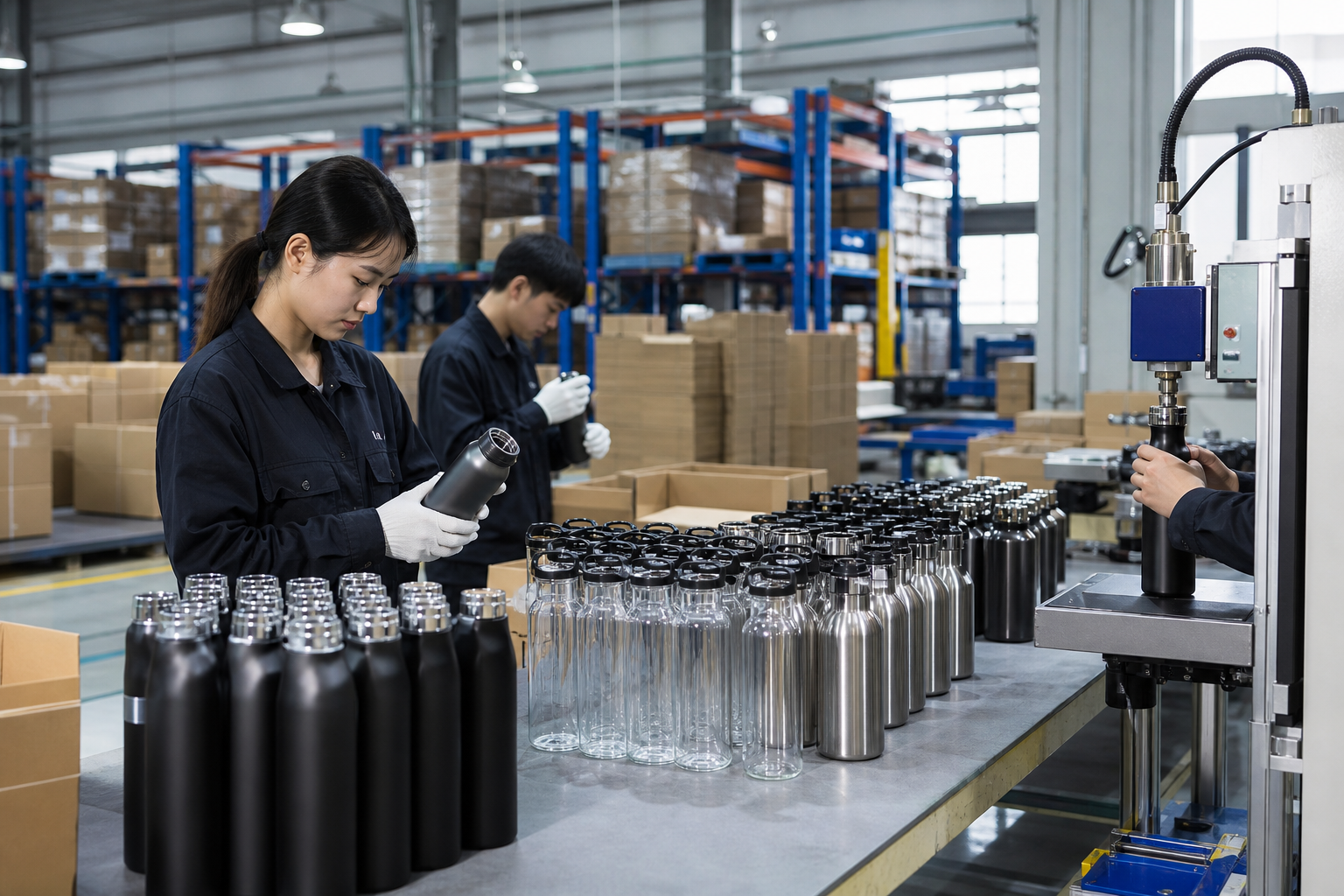
Ask for real photos of the line and the packing area, not just samples on a white table. We run assembly jigs, print QC checkpoints, and carton verification records on hospitality jobs, and QC pulled the sample again when the PO had a typo on the inner box count. If a Zhejiang factory cannot show those records, the math does not work for a small item with a lot of touchpoints.
How to brief a supplier
The result of a hotel custom water bottle order starts with the brief. Send a vague email, and the line stops for sample fixes, late answers, and fights over what “premium” means. A good brief is short, but it gives us the room type, guest use, and test standard on day one.
Put these points in your RFQ:
- Capacity: 350 ml, 500 ml, or 750 ml
- Material: 304 stainless, Tritan, glass, or other
- Decoration: silkscreen, laser, UV, or molded logo
- Closure: screw cap, bamboo lid, flip lid, or sealing ring spec
- Packing: bulk pack, gift box, sleeve, or tray-ready set
- Compliance: REACH, LFGB, FDA food-contact, BSCI if needed
- Target MOQ and annual forecast
Tell the supplier straight whether the bottle is for guest retention or for in-room use only. If guests may take it home, we spec it like a gift item, with better hand feel and cleaner decoration. If it stays in the room, stackability, low replacement cost, and easy washing matter more. Same category? No. QC pulled the sample apart on a 500 ml unit and the difference showed fast.
At our Hangzhou factory, we see the same pattern every month: the buyer who writes the use case in plain English gets first samples faster and cuts revisions. The buyer who sends “a nice bottle” usually loses 10 to 14 days. One PO had “hotle” in the room-type line, and the artwork team copied the typo into the carton file. The math does not work when the brief is loose.
Start your hotel bottle sourcing with clear specs
Send your room count, material target, and packaging brief. We’ll quote MOQ, FOB price, and lead time for your amenity program without guesswork.
Frequently asked questions
What is the usual MOQ for a hotel custom water bottle?
For stock shapes with custom printing, MOQ is often 500-1,000 pieces. If you want a new mold or a special cap, expect 3,000-5,000 pieces. For a pilot amenity program, many hotel buyers start with 300-500 sample units, then scale once housekeeping and guest feedback are confirmed.
How much should I budget per bottle for guest rooms?
A realistic FOB budget is USD 1.20-2.20 for basic Tritan or PP, USD 1.80-3.60 for 304 stainless single-wall, and USD 3.20-5.80 for vacuum insulated stainless. Packaging can add USD 0.18-1.80 depending on whether you choose a simple carton or a premium presentation box.
What lead time should I expect from China?
For standard shapes and simple branding, 25-35 days after artwork approval is common. If you need a private mold, special packaging, or a busy seasonal schedule, plan for 40-45 days. Add 7-10 days if you require revised samples, especially for exact Pantone matching or leak testing.
Which material is best for a hotel amenity program?
It depends on how the bottle is used. Stainless steel suits premium reusable programs, Tritan works well when you want a clear, durable bottle with less breakage, and glass fits higher-end rooms where appearance matters and housekeeping control is strong. For high turnover properties, avoid fragile formats unless the service model is tightly managed.
What documents should my supplier provide for Europe or North America?
Ask for REACH confirmation, food-contact declarations, and test support aligned with your market. Many buyers also request ISO 9001, BSCI, and AQL inspection records. If you sell through e-commerce or Amazon later, packaging and labeling should also support SKU control and country-of-origin marking from the start.