Key Takeaways
- For trail and camping use, 18/8 stainless steel with 0.5–0.7 mm wall thickness is the practical baseline.
- A real outdoor bottle spec should include 1.5 m drop testing, 24-hour leak testing, and coating adhesion checks.
- Expect MOQ around 500–1,000 pcs per color and 25–35 day lead time from a Zhejiang factory with 300,000 units/month capacity.
- For outdoor retail, lid design matters more than wall thickness: silicone seals, thread quality, and dust protection reduce returns fast.
If you buy outdoor water bottle wholesale for an outdoor brand, the shape and color are the easy part. Abuse is the real job. Bottles get dropped on rock, stuffed into overpacked daypacks, frozen overnight, left in a 45°C car, then banged against carabiners and tent stakes. If the spec sheet is loose, you pay later in coating peel, lid leaks, dented walls, and return claims. We’ve seen a buyer flag a PO because “matte black” showed up twice with two different finish codes. That sort of mess starts on the line.
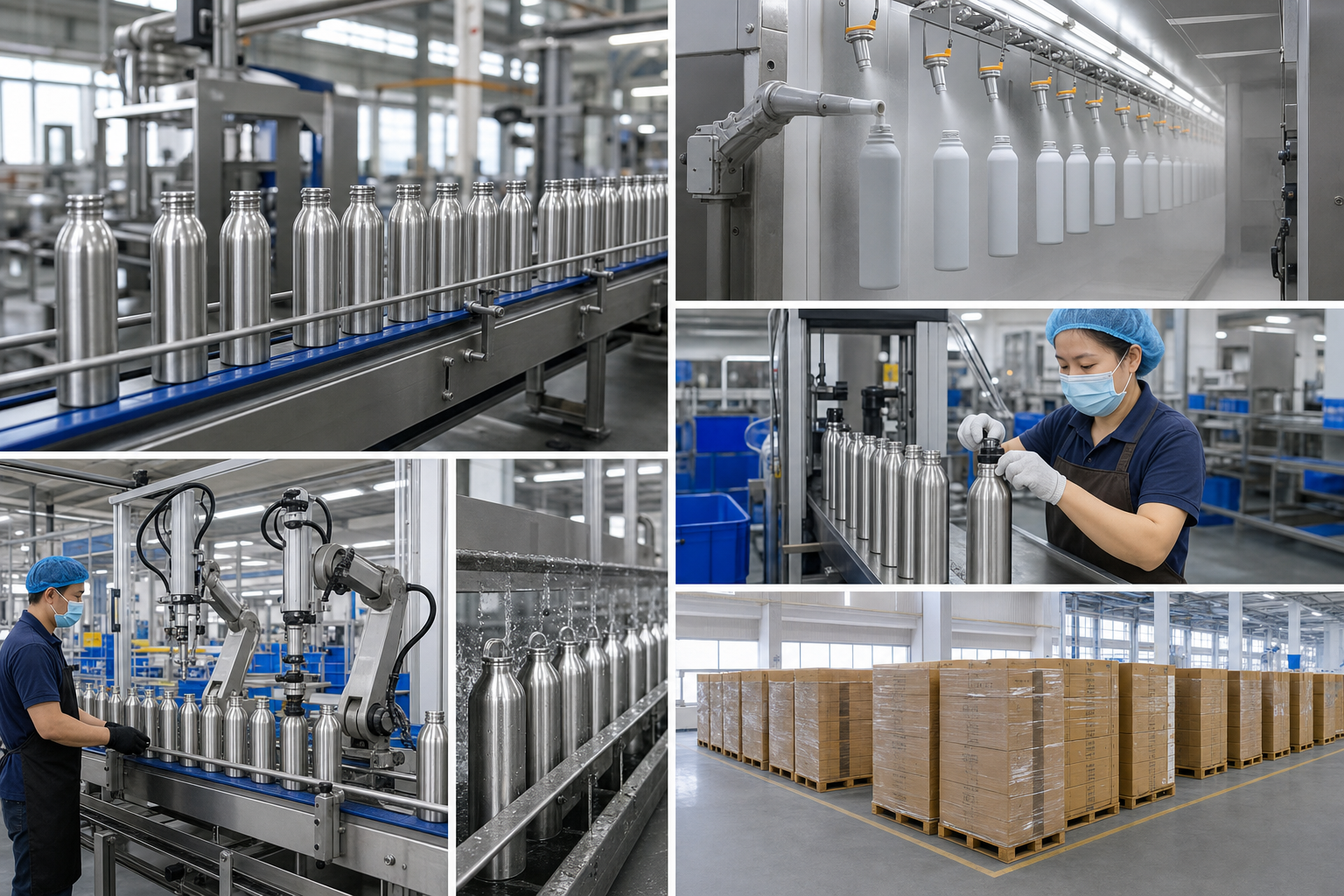
For adventure drinkware, the right question is simple: will it survive one season of actual use? “Premium” is the wrong question to ask. In Zhejiang, a good factory can make a bottle look clean on shelf, but the numbers do the real work: 18/8 steel, 0.5 mm or 0.7 mm wall thickness, 4000-cycle dishwasher tests, 1.5 m drop tests, and lids that still pass leakage after repeated thermal shock. We run those checks with gauges, torque tools, and QC pull samples at the packing table. Buy at that level, or the math does not work.
What outdoor buyers actually need
Outdoor brands do not need a generic hydration bottle. You need a bottle that works as adventure drinkware on the trail, then still looks sellable after shipping, retail handling, and customer abuse. A good camping bottle or trail water bottle has to balance weight, impact resistance, insulation, and grip with gloves on. The spec starts with the use case. A 1-day hike bottle is not the same as a winter mountaineering bottle, and a car-camping tumbler is not the same as a bike-cage bottle. We run this split every week on the line.
For most outdoor water bottle wholesale programs, the safest start is an 18/8 stainless steel body, BPA-free PP or Tritan lid parts, and a powder coat or matte paint finish that holds up to abrasion better than glossy spray. If your customer is buying from a US or EU specialty outdoor channel, they will spot a 0.35 mm wall thickness as flimsy in one hand. They will also spot a bottle that is too heavy. In practice, 0.5 mm to 0.7 mm is the sweet spot for rough carry without turning a 10-mile hike into a complaint. QC pulled the sample at 0.48 mm and the buyer flagged it as borderline.
Do not let the supplier sell you on looks alone. Ask for the drop-test height, the number of dishwasher cycles, the seal material, and whether the cap was tested at both hot-fill and cold-fill conditions. A factory in Zhejiang that knows outdoor retail should answer these in minutes, not “we can check later.” We had one PO where the buyer wrote “dish washer” on the spec sheet; the math does not work when the lid seal fails after 20 cycles.
Steel grade and wall thickness
For stainless outdoor bottles, 18/8 steel is still the standard. It gives the right balance of corrosion resistance, food safety, and forming performance on the line. If you source from China, ask whether both the inner and outer walls are 304-grade equivalents and request material certificates. We run into PO typos here all the time, like “304” on the spec sheet and “201” in the sample note. Different story.
Wall thickness matters more than first-time buyers expect. A 0.35 mm wall is light and cheap, but it dents fast and sounds hollow in hand. A 0.5 mm wall is the normal baseline for a serious trail bottle. A 0.7 mm wall gives better dent resistance and a cleaner feel, especially on 750 ml to 1 L bottles, but it adds weight and cost. If the buyer wants a backpack bottle, the math does not work on maximum thickness. We’ve seen that go sideways in QC when the bottle passes the drop test but fails the feel test.
For double-wall insulated models, ask for vacuum level, retention targets, and whether the factory uses copper coating on the outer side of the inner wall. A well-made 500 ml bottle should keep hot water above 60°C for 6–8 hours and cold water below 10°C for about 12–18 hours under normal ambient conditions. The buyer flagged it once because the test started with boiling water and a pre-chilled shell; that is not the same result. Ask for the test method, the lid type, and the starting temperature. On our side, QC pulled the sample and checked the seam with a micrometer before we signed off.
Lids and leak performance
Most outdoor bottle failures start at the lid. Not the body. The cap. On a pack test, a bottle gets flipped upside down, squeezed, and rattled for 30 minutes; that is where returns show up. A trail bottle left in a truck footwell sees heat, cold, and water on the same day. If the lid is weak, 304 stainless does nothing for you.
For outdoor use, ask for a silicone O-ring or gasket, deep thread engagement, and a hard stop that blocks cross-threading. We run into buyer pushback here all the time: they want a “simple” cap, then QC pulls a sample with a sloppy seal after 200 open-close cycles. For hikers and runners, a one-hand flip lid works if the hinge survives 3,000 cycles and the mouthpiece closes with a clean compression line. For general adventure drinkware, a screw cap with an attached loop or handle is the safer call. If the bottle has a straw lid, write down whether the straw is removable, the resin grade, and whether the mouthpiece still passes odor checks after 24 hours.
Leak testing is not a handshake promise. Ask for inverted leak tests at room temperature and again after thermal cycling. A proper factory will test 24 hours inverted, then repeat after heat-cold cycling between roughly 0°C and 60°C. If you sell through Amazon or large outdoor chains, require carton and polybag protection for the threads and seals in transit. We have seen a lot of “leaks” start with a crushed cap ring, not a mold problem.
From a procurement point of view, a strong lid spec saves more money than a polished body spec ever will.
Finish, coating, and abrasion
Outdoor buyers care about scratches because customers drag bottles across granite, bike cages, and steel picnic tables. Surface finish is not decoration. It is a working spec. Powder coating is usually the better call for outdoor water bottle wholesale programs because it gives stronger grip and better abrasion resistance than standard spray paint. A matte finish also hides scuffs longer, which matters when the bottle sits in a pack side pocket for 6 months.
Ask for coating adhesion and abrasion data. We run a tape test for adhesion and a rub test with a standardized abrasive cloth. If the supplier only says “looks nice,” move on. For laser marking or silk screen logos, state the exact placement and whether the print must survive dishwasher exposure. One buyer once sent a PO with the logo location written as “near the center” — that kind of note turns into a line-side argument fast. For premium trail gear, a clean laser-etched logo on bare steel usually ages better than printed graphics, especially on a bottle that lives inside a backpack side pocket.
Color consistency is the other trap. In Zhejiang, a well-run factory can hold Pantone targets within a narrow tolerance, but powder batches still drift if you do not lock samples. For launches above 3,000 pcs, approve one golden sample and one pre-production sample, then check the first 50 pcs for shade shift and coating pinholes before you release the full run. We’ve seen this go sideways when the buyer flagged a 1 mm color band on only the second carton, so this is the wrong question to ask after shipment.
Testing standards that protect you
If you buy from China, ask for a test pack, not photos. We run this on the line every week. For outdoor drinkware, the useful standards are not abstract paperwork; they decide whether a launch sails through or turns into 300 return claims. A credible supplier should reference AQL 2.5 for major defects and AQL 4.0 for minor defects on production inspection, plus food-contact compliance such as REACH, FDA-related material declarations for US customers, and LFGB where required for Europe. If the bottle has plastic parts, the supplier should confirm BPA-free and provide migration documentation where applicable. One typo on a PO can wreck the whole lot.
For performance, ask for:
- 1.5 m drop test on concrete or steel plate, six faces if possible
- 24-hour inverted leak test
- Vacuum retention check after thermal shock
- Dishwasher cycle resistance, ideally 200–400 cycles for premium positioning
- Coating adhesion and scratch resistance
Do not overclaim the numbers in marketing unless you have the data. Buyers in Europe and North America are skeptical of “military-grade” language without proof, and the math does not work if your cap fails after 18 cycles. A clean spec sheet with actual test methods beats sales copy. QC pulled the sample on a 0.8 mm paint-chip issue last month, and that saved a shipment. If your factory cannot document these basics, this is not an outdoor supplier; it is a general bottle seller trying to enter the category.
MOQ, price, and factory reality
Outdoor water bottle wholesale pricing comes down to body thickness, lid parts, finish, and print. A 500 ml single-wall stainless bottle with powder coat and a plain screw cap can start around USD 2.10 to 2.80 at 1,000 pcs. We quoted one buyer on a 0.4 mm body and the math held. A double-wall vacuum bottle with a better lid and custom color usually sits closer to USD 4.80 to 7.50, depending on volume and print method. Once you add a flip lid, straw system, or two-tone coating, the price climbs fast. The buyer flagged the lid stack-up on a PO once; one extra silicone ring pushed the carton count and the cost with it.
MOQ is the first hard stop for outdoor brands. A Zhejiang factory with real production discipline usually asks for 500 to 1,000 pcs per color and total order quantities of 1,000 to 3,000 pcs for a custom run. We run this every week. Some lines can go lower, but if you push a tiny run, unit cost jumps and color matching gets sloppy. A factory in Hangzhou or nearby Zhejiang industrial clusters may run 300,000 units per month across multiple bottle lines, but your order still has to fit mold capacity, decoration scheduling, and packing labor. Lead time is usually 25 to 35 days after sample approval and deposit, with another 7 to 10 days if you need new molds or custom packaging. QC pulled the sample at 72 hours on one job because the cap torque was off by 0.3 N·m. That is the kind of detail that saves a shipment.
If you are planning retail launch dates, leave room for pre-production approval, carton testing, and third-party inspection. A missed two-week window hurts more than paying a slightly higher unit price. We've seen that go sideways. One PO came in with the carton size typed as 48x38x28 mm instead of 48x38x28 cm, and the whole booking had to be redone before we could ship.
Build your outdoor bottle spec the right way
Send us your target price, size, and market. We will map the right material, lid, finish, and test plan for Zhejiang production.
Frequently asked questions
What is the best material for an outdoor water bottle?
For most outdoor use, 18/8 stainless steel is the safest choice because it resists corrosion, feels solid, and works well with powder coating. For premium coastal or high-corrosion use, SUS316 can be justified, but it usually adds cost without improving a normal trail bottle much. If you want a lighter bottle for day hikes, Tritan works, but it does not give the same dent resistance or thermal performance. For a real adventure drinkware line, stainless still wins on durability and perceived value. In wholesale, a 500 ml double-wall stainless model usually gives you the best balance of price and performance.
How do I know if a bottle is truly leakproof?
Ask for a 24-hour inverted leak test and thermal cycling results, not just a verbal promise. The lid should use a silicone O-ring or gasket, deep thread engagement, and a hard stop to prevent cross-threading. If the bottle has a straw or flip lid, request repeated open-close cycle data, ideally 3,000 to 5,000 cycles for a retail-ready product. In production, inspect to AQL 2.5 for major defects. Also check packaging, because a lid can pass factory testing and still leak after shipping damage if the neck or seal is distorted.
What wall thickness should I choose for a trail water bottle?
For most trail water bottle projects, 0.5 mm stainless wall thickness is the practical baseline. It gives a decent balance of weight, feel, and dent resistance. If you are selling a rugged premium bottle in 750 ml or 1 L sizes, 0.7 mm gives a tougher hand-feel and better impact tolerance, but it adds weight and cost. A 0.35 mm wall is usually too thin for serious outdoor retail unless you are making a very price-sensitive single-wall bottle. For insulated bottles, ask for both inner and outer wall thickness, because consistency matters more than a single headline number.
What MOQ should I expect from a China factory?
For outdoor water bottle wholesale, a realistic MOQ is 500 to 1,000 pcs per color for standard models, with 1,000 to 3,000 pcs total for a custom order. If you want a new mold, custom lid, or special packaging, the MOQ and lead time both increase. A well-organized Zhejiang factory can still support flexible orders, but low MOQ usually means higher unit price and less stable color matching. For launch planning, assume 25 to 35 days production after sample approval, plus time for inspection and freight booking.
Which tests should I ask for before placing an order?
At minimum, ask for material documentation, leak testing, drop testing, and coating adhesion results. For outdoor bottles, I would also ask for dishwasher cycle resistance, thermal shock testing, and food-contact compliance documents such as REACH for Europe and relevant material declarations for North America. If the supplier can provide AQL inspection reports, that is a good sign. For premium retail, 200 to 400 dishwasher cycles is a reasonable target, and a 1.5 m drop test on multiple faces is a practical benchmark. If they cannot document these tests, the bottle is not ready for serious outdoor channels.