Key Takeaways
- A practical water bottle drop test for e-commerce usually starts at 1.0 m to 1.2 m, but ISTA 3A may require repeated drops plus vibration, not one drop.
- ASTM D5276 is a free-fall method for packaged products; the result depends on package mass, drop orientation, and the exact drop height you select.
- For rigid bottles, the weak points are often the cap seal, neck finish, and carton corners, not the bottle body itself.
- Good pass criteria combine zero leakage, no functional closure failure, and no carton rupture after the defined number of drops.
If you buy or design drinkware, a water bottle drop test is not optional. It is the fastest way to find out whether the bottle, lid, and carton survive the real trip: pallet handling in Zhejiang, loose parcel sorting in the US, last-mile drops in Europe, and a bad unload at the warehouse. Buyers still send us “drop tested” with no standard, no height, and no pass/fail rule. That is the wrong question to ask.
That vagueness costs money. A bottle can pass a 1.0 m in-house free-fall and still fail ISTA 3A after five corner drops plus vibration. We saw that on a 24,000-piece order last quarter when QC pulled the sample and found a lid crack at the hinge after the third drop. At BottleForge Industrial in Hangzhou, Zhejiang, we treat drop testing as a packaging system check, not a cosmetic check. Our line runs 300,000 units/month, and for export jobs we lock the protocol before tooling, not after the first damage report.
What a drop test must prove
A water bottle drop test has to answer one question: after the hit your route creates, does the shipped unit still work? We run this on the bottle body, closure, liner, spout, straw, and outer pack. If you only drop the empty bottle, you miss the failure we see most often: cap loosening and micro-leakage after impact. QC pulled that sample more than once.
For filled reusable bottles, the test matrix should cover three conditions: empty, filled to nominal capacity, and filled with a defined headspace. A 500 ml stainless bottle with a 0.5 mm wall can take a body impact, while a low-cost PP flip lid may crack at the hinge after a 1.2 m corner drop. We had a buyer flag a PO typo once—“1.2 cm” instead of “1.2 m”—and the math did not work. Pass criteria belong on paper before the first drop.
Use measured endpoints, not soft words. A proper protocol should specify:
- drop surface: plywood over concrete, steel plate, or corrugated deck
- orientation: flat face, edge, corner, base, or cap-first
- sample count: usually 5 to 10 units per configuration
- acceptance: no leakage, no visible crack, cap torque retention within 20%
If you source from China, ask the factory to test the full shipment build, not just the molded bottle. We ship from Zhejiang every week, and the line can make a good body while the carton insert still fails at a 600 mm corner drop. That is the wrong question to ask if you only care about molding quality. Packaging decides whether the product arrives sellable.
ISTA 3A for parcel shipping
ISTA 3A is the published distribution test we use most often for small parcels under 70 kg. Amazon and DTC buyers ask for it because it looks like real parcel handling, not a one-time hand drop. For a finished water bottle in a retail carton, that matters.
It is a sequence, not a single hit. We usually run six packaged drops in different orientations, then vibration on the same pack. The drop height is tied to package mass, so a 1.2 kg carton does not get the same schedule as a 4.8 kg carton. For drinkware SKUs, the range often lands around 300 mm to 760 mm, but the exact table comes from the package weight band. We had one buyer flag a PO typo on carton gross weight, and the test setup changed because of that one number. Do not guess it.
Pass criteria should be tied to function and appearance:
- no product breakage
- no leak at closure or seam
- retail carton still closes and protects the item
- no severe scuffing that would trigger a customer return
If you ship to Amazon FBA, ISTA 3A is a solid internal baseline. It reflects sortation and delivery abuse better than a desk-height drop, and it gives you something a reviewer can check against. QC pulled the sample on our line after a 500 g bottle failed at the cap skirt, and that was the right call. “We tested it and it looked fine” does not carry weight in a supplier review.
ASTM D5276 and free-fall drops
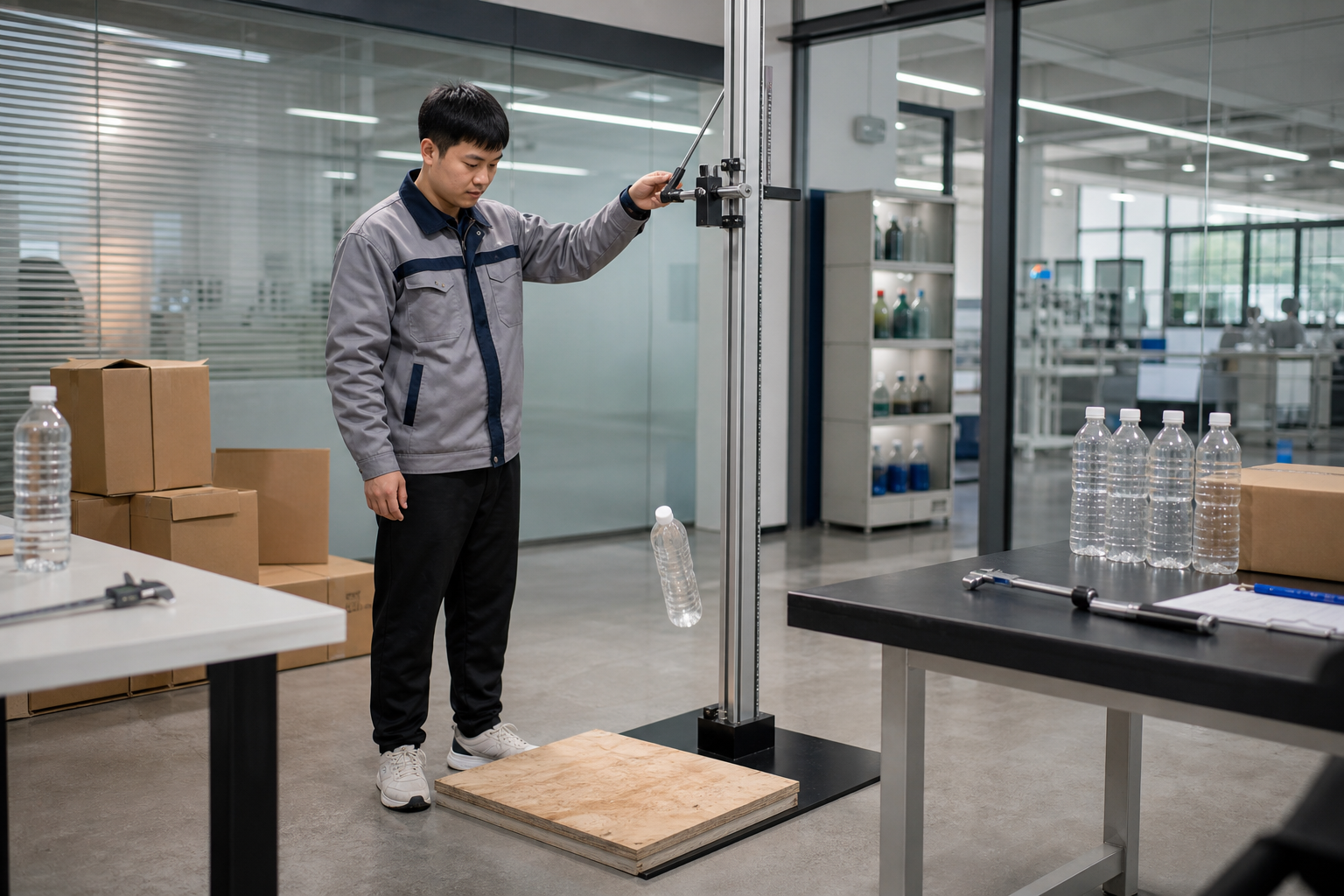
ASTM D5276 is the free-fall drop method we use when the buyer wants a controlled package test, not a warehouse stunt. We set the pack, the height, the orientation, and the drop count, then QC signs off on the photos and damage notes. Simple. The method also asks for the drop tower or guided release setup, specimen conditioning, and the acceptance limits before we run the test.
For water bottles, ASTM D5276 works well when a carton change needs proof. Swap the inner tray from pulp to EPE, or move the board from 32 ECT to 26 ECT, and we can repeat the same setup on the line. I had a buyer flag a typo on the PO once — 0.76 m was written as 7.6 m — and that kind of mistake shows why the test height must be tied to pack mass and the shipping profile, not habit. We usually see 0.76 m to 1.22 m for export cartons, but the math has to match the route.
Do not treat ASTM D5276 as a pass-fail stamp. It is a method, not the result. You still have to spell out what is allowed: dent depth, lid movement, coating rub-through, or a crack at the neck finish. On a stainless steel bottle with a 0.4 mm powder coat, a 2 mm dent may be fine for a promo order, while the same mark gets rejected on a retail SKU. That is the wrong question to ask if the spec is not written first.
Our rule in Zhejiang is simple: if the test setup is not written down, the result is just a story.
Choosing drop height and surfaces
The drop height sets the hit, but the surface decides a lot of the damage. A bottle onto a steel plate reacts nothing like one onto plywood over concrete or a corrugated edge. We see this on the line all the time. Parcel routes do not give you a clean flat floor; they throw corners, pallet gaps, and box edges at the pack. That is why corner and edge drops are the first screen in most of our in-house checks.
For a 500 ml reusable bottle in retail packaging, we usually start at 0.8 m, then go to 1.0 m, then 1.2 m if the buyer wants ecommerce abuse covered. For a 1 L thermal bottle, 0.6 m to 0.9 m is the safer band because the impact energy jumps fast with mass. We had a PO last month with “1L” typed as “10L”; the math did not work, and the sample failed at 0.9 m after the cap thread shifted. A 20% mass increase is enough to turn a dry closure into a leaker.
We also keep product drop and packed drop separate. An unpacked bottle tells you about the body and base; the packed unit tells you what the customer actually ships. QC pulled the sample after each hit and checked the silicone gasket for compression set, cut marks, and any sideways movement. If the gasket walks 0.2 mm, that matters more than a nice carton print.
- Use 3 orientations: flat, edge, corner
- Record before/after torque on threaded caps
- Check leak performance with 24-hour inverted hold after drop
That last check is where programs go sideways. A bottle can pass the impact and still creep-leak after the seal shifts by 0.2 mm.
In-house protocols that actually work
Factory in-house protocols work when the line follows them every time. Skip that, and the test turns into a photo op. For a DTC bottle, we run a 1.0 m to 1.2 m multi-orientation drop on packed cartons, then check the corner crush and cap seal. For pallet freight, the right focus is stack load, carton edge damage, and whether the tray shifts under 15 kg compression.
At our Hangzhou, Zhejiang factory, we build the protocol in three steps: prototype screening, pre-production approval, shipment audit. A normal approval run uses 10 samples per SKU, split into 5 packed units and 5 unpacked units. If the buyer flagged a new lid or gasket, QC pulled the sample for a thermal shock check or a pressure leak check after impact. That is where the real problems show up.
A pass/fail table has to be blunt:
- Critical fail: leakage, lid detachment, thread strip, liner displacement
- Major fail: crack, hinge break, carton rupture, sleeve collapse
- Minor fail: cosmetic scuff, small dent, print rub within agreed limit
Write the limits in numbers. No leakage under 30 kPa air pressure. No more than 5% torque loss. No crack visible at 300 lux from 30 cm. We had one PO typo that left out the torque limit, and the buyer pushed back hard; the math doesn't work without a number. If you ship from China with two or three sub-suppliers in the mix, that kind of detail saves the run.
How to specify pass criteria
Put the pass criteria in the RFQ. If you leave it open, each factory will quote a different standard. One line may accept a 2 mm dent; another will reject the same cup for a faint ring mark. Split the acceptance rules into functional, structural, and cosmetic items. Clean, simple, no wiggle room.
For a drinkware project, we usually set it up like this on the line:
- Functional: no leakage during inversion for 24 hours after the final drop
- Structural: no crack, no thread damage, no lid separation, no broken weld
- Packaging: carton remains sealed and retail-ready, no product escape
- Cosmetic: limited dents or print rub only if agreed by buyer
For North America and Europe, tie the drop test to the stage gate, not only final inspection. We approve structure at EVT, then run it again at DVT after artwork and tooling changes, then revalidate at PVT with the real line and the real carton. One buyer pushed back on this and said, "why test three times?" The math works out fast: 12 days of rework on a bad carton beats 18 days of shipping complaints.
Ask for the raw test record from the supplier in China: photos, drop height, orientation, sample IDs, and failure notes. QC pulled the sample list against the PO once and found a typo in the lid code; that saved a wrong-goal test. A proper factory in Zhejiang should hand over that record without a song and dance. If they cannot, the protocol is too loose to trust.
Define your drop protocol before tooling starts
Send us your bottle, closure, carton, and route details. We will map the right water bottle drop test, height, and pass criteria for your SKU.
Frequently asked questions
What is the right drop test height for a water bottle?
There is no single correct height. For unpacked product screening, 0.8 m to 1.2 m is common, while packaged consumer goods often follow ISTA 3A or ASTM D5276 schedules tied to package weight. A 500 ml bottle in a retail carton may start at 1.0 m for internal validation. Heavier 1 L bottles often use 0.6 m to 0.9 m because impact energy rises quickly with mass. The key is to define the height against your shipping channel, not guess based on what another project used. If your buyer is sending DTC parcels, test the packed unit, not just the bottle body.
Is ISTA 3A enough for water bottle shipping validation?
For most small parcel programs, ISTA 3A is a strong baseline because it includes drop and vibration, which is closer to real parcel abuse than a single impact test. But it is only enough if your bottle is sold as a packaged unit under the same weight class and route assumptions. If you have a heavy 1.2 L stainless bottle, a pump lid, or a fragile glass insert, you may need extra in-house testing. In practice, many teams use ISTA 3A for the packed SKU and add a separate cap torque and leak test after the final drop sequence.
What fails first in a water bottle drop test?
Most of the time, the closure system fails before the bottle body does. Common weak points are the thread neck, silicone gasket, flip-top hinge, straw joint, and welded seam on double-wall stainless models. Carton corners and insert trays also fail early if the board grade is too light. A bottle may look fine after impact and still leak when inverted for 24 hours because the gasket moved 0.2 mm or the cap torque dropped by 15%. That is why you need both structural inspection and a post-drop leak test.
How many samples should I test for validation?
For early engineering work, 3 to 5 samples may be enough to expose obvious design flaws. For pre-production approval, 10 units per configuration is more realistic, especially if you are testing multiple orientations or package revisions. If you change the lid, gasket, carton, or insert, treat it as a new configuration. In China, a serious supplier should be able to support this without delaying the project too much; at our Zhejiang facility we usually turn prototype drop validation in 7 to 10 days once the samples are ready.
Can I use an in-house protocol instead of ASTM D5276?
Yes, if the protocol is documented and tied to your actual shipping risk. An in-house water bottle drop test is common during development because it is faster and cheaper than full third-party testing. The protocol should still define drop height, orientation, surface, sample count, conditioning, and pass criteria. If your customer or marketplace requires a published standard, use ASTM D5276 or ISTA 3A as the formal reference and keep the in-house method as your screening tool. That gives you both speed and traceability.