Key Takeaways
- A realistic DTC drinkware launch usually needs 90 to 150 days from concept to first sellable inventory.
- For a 5,000-unit first order, expect a brand launch budget of roughly USD 18,000 to USD 65,000 before paid ads.
- China sourcing saves unit cost, but freight, customs, and packaging can add 18% to 35% to landed cost.
- A proper QC plan should include AQL 2.5 for critical defects, REACH checks, and pre-shipment inspection before balance payment.
If you are planning a DTC drinkware launch, design is not the hard part. Cash timing is. A bottle can look simple on Shopify, but the spend starts early: mold work, compliance files, sample rounds, freight, carton design, and enough stock to cover the first 60 days without a stockout.
Most founders miss the brand launch budget by 20% to 40% and miss lead time by 2 to 4 weeks. That is normal if you have not sourced from China or Zhejiang before. On our Hangzhou line, a custom bottle program usually starts at a 5,000-unit MOQ, runs 35 to 55 days after sample approval, and we ship above 800,000 units a month. QC pulled the sample, checked the lid torque, and still found one PO with a typo on the carton count. Plan the cash and the calendar first. If you do not, you pay twice.
Start with the launch math
Before you choose colors or print the logo, work backward from your target retail price. A standard 500 ml stainless steel bottle usually sits at USD 2.80 to USD 5.20 per unit at 5,000 pieces FOB China, and the spread comes from steel grade, coating, lid parts, and decoration. If you want to sell at USD 28 to USD 35, landed cost needs to stay under USD 8 to USD 10, or the budget gets eaten by cartons, payment fees, refunds, and ads.
The math is simple: landed cost + fulfillment + payment processing + CAC has to leave real gross margin. For most DTC startup brands, 65% to 75% gross margin before ads is the line we run. A bottle brand is not software. You pay a 30% deposit and 70% balance before shipment, and we’ve seen buyers get caught when they forgot freight and 60 days of cash. On one PO, the buyer flagged a typo on the shipping address and the line held the cartons for half a day; small mistake, real delay. If you are sourcing from Zhejiang or through China, build the model on factory terms, not retail optimism.
Rule of thumb: if your first purchase order is 5,000 units and your all-in landed cost is USD 6.40, you need about USD 32,000 just to put inventory into your warehouse, before ads and creative.
Map the timeline backward
A DTC drinkware launch usually needs 90 to 150 days from brief to warehouse receiving. If you start with an existing mold, one-color print, and fast decisions, you can hit the low end. Once you add a custom shape, custom lid, matte finish, Pantone match, and retail box, the clock moves. We run this every week in Zhejiang, and the line does not care about your Shopify go-live date.
Here is the sequence we use:
- Week 1 to 2: brief, target price, material choice, and MOQ discussion. We also check the first PO wording here; one buyer once typed 3,000 pcs on email and 30,000 on the draft, and QC flagged it before tooling started.
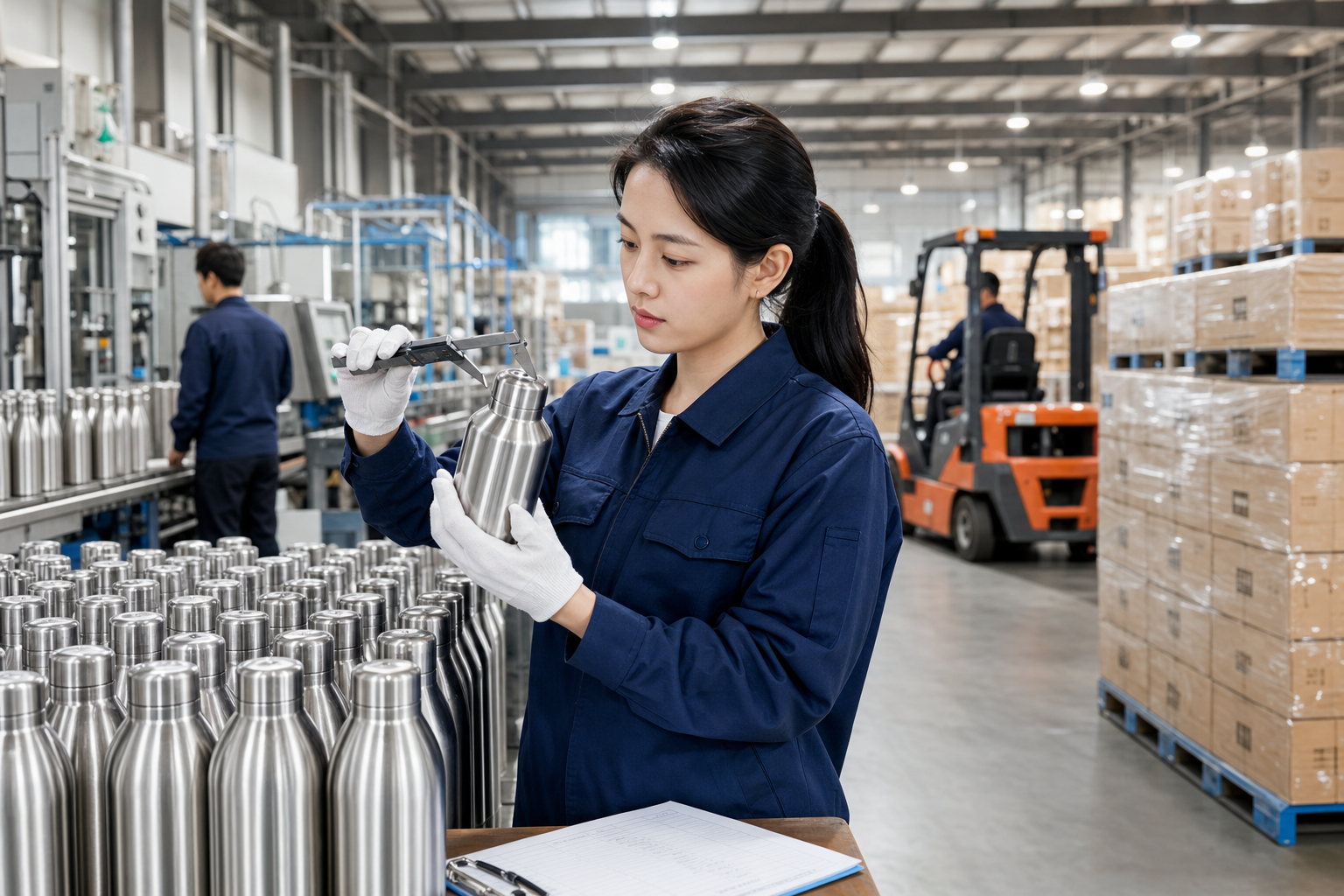
- Week 3 to 5: sampling, artwork, mold review, and packaging structure. This is when the caliper comes out and we check wall thickness, usually 1.2 mm to 1.8 mm depending on the cup body.
- Week 6 to 8: sample revision, compliance checks, and final PO. If the buyer wants FDA, LFGB, or 304 stainless paperwork, this is where the file set needs to be complete.
- Week 9 to 14: production, in-line inspection, and pre-shipment QA. We ship against AQL 2.5, and the buyer usually asks for one extra carton photo set at this stage.
- Week 14 to 18: ocean freight or air freight, customs clearance, and warehouse receiving. Air can cut the transit to about 7 to 12 days, while sea often sits closer to 18 to 32 days depending on lane and port.
If you skip sample approval discipline, the schedule falls apart. A cap gasket that misses spec or a barcode label typo can add 10 to 14 days, sometimes more if the carton art has to be reprinted. We have seen this go sideways when a founder booked product photos before sign-off; the math does not work. One factory can turn out 800,000 units a month, but your launch still waits on your approvals.
Build the budget line by line
Founders often quote one unit price and call it the budget. That is not how a brand launch budget works. For a first batch of 5,000 units, a workable line item sheet usually looks like this: product cost USD 14,000 to USD 26,000; custom packaging USD 2,500 to USD 7,500; sea freight and insurance USD 3,000 to USD 9,000, air freight runs higher; import duties and brokerage USD 1,000 to USD 3,000; photography and creative USD 1,500 to USD 6,000; samples and engineering USD 300 to USD 2,000. We run this math on a 5,000-unit PO every week, and the first buyer pushback is always the same: “why is the landed cost so far from the factory quote?” Because the factory quote is only one line.
Tooling is the line that catches people off guard. If you need a new lid mold, a new cap, or a custom body shape, mold fees can run from USD 2,000 to USD 15,000 depending on cavity count and finish. QC pulled the sample last week on a 38 mm mouth design and found the gasket seat was off by 0.3 mm; that is the kind of detail that sends the mold back for a second cut. For a DTC startup, we separate non-recurring engineering from inventory cost. The math only works that way. A simple branded stainless steel bottle with laser engraving may need no mold at all, while a custom direct to consumer bottle with a special sealing structure may need two or three molds before you can ship the first carton.
Do not ignore packaging. A sturdy mailer or gift box can add USD 0.45 to USD 1.80 per piece, but weak packaging causes dents, returns, and bad reviews. We have seen a buyer approve a 1.2 mm carton on paper, then flag the first drop test when the corners crushed on the line. That is money you would rather spend once in Zhejiang than lose twice on Amazon or your own site.
Choose the right bottle spec
Your product spec sets the pace and the burn rate. We run 304 stainless steel, double wall vacuum construction, 0.5 mm outer wall, and 0.4 mm inner wall every week on the line, and that range is a safe fit for a premium bottle. Step up to 316 stainless steel and the unit cost climbs; the buyer often flags the price before customers ever notice the metal grade, unless you sell into hot-fill or salty-use categories.
For a DTC drinkware launch, keep the first SKU tight:
- One size, usually 500 ml to 750 ml.
- One lid system, not three.
- One surface finish, such as powder coat or spray matte.
- One decoration method, usually laser engraving or one-color silk screen.
Every extra option means another sample round. We have seen a silicone sleeve, straw lid, and custom handle turn a clean schedule into 7 to 12 extra days, and that is before the pricing gets ugly. One PO typo told the story: the buyer wrote 550 ml, then changed it to 500 ml after QC pulled the sample. That kind of change is the wrong question to ask this early. Start with a structure the factory already runs in China, then put your differentiation into color, branding, and carton design. With an MOQ of 5,000 units, a narrow SKU also keeps forecasting sane when cash is tight.
Use QC as a budget item
Quality control is not a cost line to trim once the sample passes. We treat it as launch cost. For drinkware, the inspection plan should be clear: incoming material check, in-line inspection during assembly, and pre-shipment inspection against AQL 2.5 for major defects and AQL 4.0 for minor defects. For leak-proof bottles, we also run lid torque, vacuum retention, drop test, and print adhesion. One slip at the lid station, and the buyer flags it.
For a 5,000-unit order, a proper QC budget is usually USD 250 to USD 900 for third-party inspection in China, depending on scope and city. Add USD 100 to USD 400 for sample retention, test freight, or lab checks if your market asks for them. If you sell into Europe or North America, request REACH-related material declarations and food-contact documents. Some buyers still ask for ASTM-related or FDA-compliant support papers, depending on the material and route to market. We had one PO with “food contant” typed twice, and that typo cost a day of back-and-forth.
Quality problems get expensive after import. A 2% defect rate on 5,000 units means 100 units. If each bad unit costs you USD 8 landed plus repack and shipping, the math breaks fast. It is cheaper to stop the line in Zhejiang than to refund customers later. QC pulled the sample on a 0.8 mm lid gap before shipment, and that saved us a headache; we've seen this go sideways too many times.
Plan cash flow, not just revenue
Most DTC startup failures do not come from a weak product idea. They come from cash timing. We see it on the line all the time. A PO usually starts with a 30% deposit, then 40% to 50% when production is ready, with the balance paid before shipment or against documents. On a USD 24,000 order, that is about USD 7,200 up front, then another USD 9,600 to USD 12,000 before the cartons even leave China.
Then freight, duties, warehousing, and ads hit the bank account. If you fund only the factory invoice, you get squeezed fast. The math does not work. We tell buyers to keep 25% to 35% of total launch capital for post-inventory costs. That covers paid media tests, email flows, sample seeding, and a second reorder if the first drop sells through. On one 304 stainless bottle launch, QC pulled the sample at 12 days, but the founder still had to cover Meta spend and inbound fees before revenue showed up.
If you sell in the US or EU, decide the channel split early. DTC site, Amazon, and wholesale each pull inventory and margin in a different way. A buyer once flagged a PO that listed 5,000 units but had no reserve stock plan; that one came back to bite them. For a first batch of 5,000 units, we usually see 3,500 go to the site, 1,000 held for wholesale samples or retail tests, and 500 kept as replacement stock. That is cleaner than putting everything into one channel and then paying air freight later when the shelf goes bare.
What a practical first launch looks like
A practical first launch is not a 12-SKU catalog. We run one hero bottle, one size, two colors max, and one audience. If you start with 5,000 units at an FOB price of USD 3.60, product cost is USD 18,000. Add USD 4,500 for packaging, USD 5,500 for ocean freight and destination charges, USD 1,500 for QC and compliance, and USD 4,000 for creative and website work. You are at USD 33,500 before ads. That is normal. We had a buyer flag a PO once because “5000” was typed as “500”; the line still caught the mismatch before release.
The real question is not whether China is cheap. It is whether the specs hold when you scale. Zhejiang factories can run repeat orders and fast reorders, but they need clean files and tight approval. QC pulled the sample, checked cap torque at 1.2 N·m, and the buyer still pushed back on a Pantone change; fair point, because small color drift turns into a bigger headache later. If the first order lands, the reorder can often move in 25 to 40 days because the mold, artwork, and process are already set. That is where DTC gets interesting: you refine the message, not rebuild the product. Next step is tighter forecasting, AQL 2.5 checks, and a replenishment plan that keeps stock moving without freezing cash.
Plan your bottle launch with real numbers
Tell us your target price, MOQ, and market, and we will map the spec, budget, and lead time before you place a PO.
Frequently asked questions
How much money do I need for a DTC drinkware launch?
For a realistic first launch, plan on USD 18,000 to USD 65,000 total depending on customization and freight. A 5,000-unit order at USD 3.20 to USD 5.50 FOB can still become USD 6.50 to USD 10.00 landed once you add packaging, ocean freight, duties, inspections, and creative. If you want paid ads and enough cash for reorder planning, reserve another 20% to 30% beyond the product budget. That is the difference between launching and being stuck waiting for cash.
How long does a direct to consumer bottle take to make?
If you use an existing structure and approve samples quickly, 90 to 120 days is realistic from brief to warehouse receipt. Add custom mold work, complex packaging, or multiple sampling rounds and you can reach 140 to 150 days. In Zhejiang, production itself may only take 35 to 55 days after sample sign-off, but freight and customs add another 20 to 35 days by sea to North America or Europe.
What MOQ should I expect from a China factory?
For a custom drinkware program, 3,000 to 5,000 units is a common MOQ. Simple decoration on stock models can sometimes start at 1,000 to 2,000 pieces, while custom tooling may push the minimum higher. If you want a low-risk DTC startup launch, 5,000 units is often the practical sweet spot because unit cost is workable and production scheduling is easier for the factory in China.
What are the biggest hidden costs founders miss?
The most common misses are mold fees, packaging upgrades, destination charges, customs brokerage, and refunds from damage. Tooling can be USD 2,000 to USD 15,000. Packaging can add USD 0.45 to USD 1.80 per unit. Freight to the US or EU can swing by 20% or more depending on season. Many founders also forget that a 2% defect rate on 5,000 units is 100 units, which quickly becomes a real cash loss if you must reship replacements.
Should I launch with ocean freight or air freight?
If your launch date is flexible, ocean freight is usually the right choice because it protects your margin. For a 5,000-unit bottle order, sea freight is often USD 3,000 to USD 9,000 including destination handling, while air can be several times higher. Use air only for samples, emergency replenishment, or a very high-margin product. For most founders, the smart move is to build the launch calendar around sea freight from China and avoid paying premium rates to fix a planning mistake.