Key Takeaways
- A practical eastman tritan thermos order usually uses 304 stainless plus Tritan lid parts, not Tritan for the vacuum core.
- Typical MOQ is 3,000 pcs for existing tooling and 5,000 pcs or more for a new Tritan lid mold.
- A Zhejiang, China factory with 300,000 units/month still needs AQL 2.5, REACH support, and traceable lot control.
- FOB pricing for a 500 ml eastman tritan thermos bottle commonly lands around USD 3.20-7.20 depending on finish and customization.
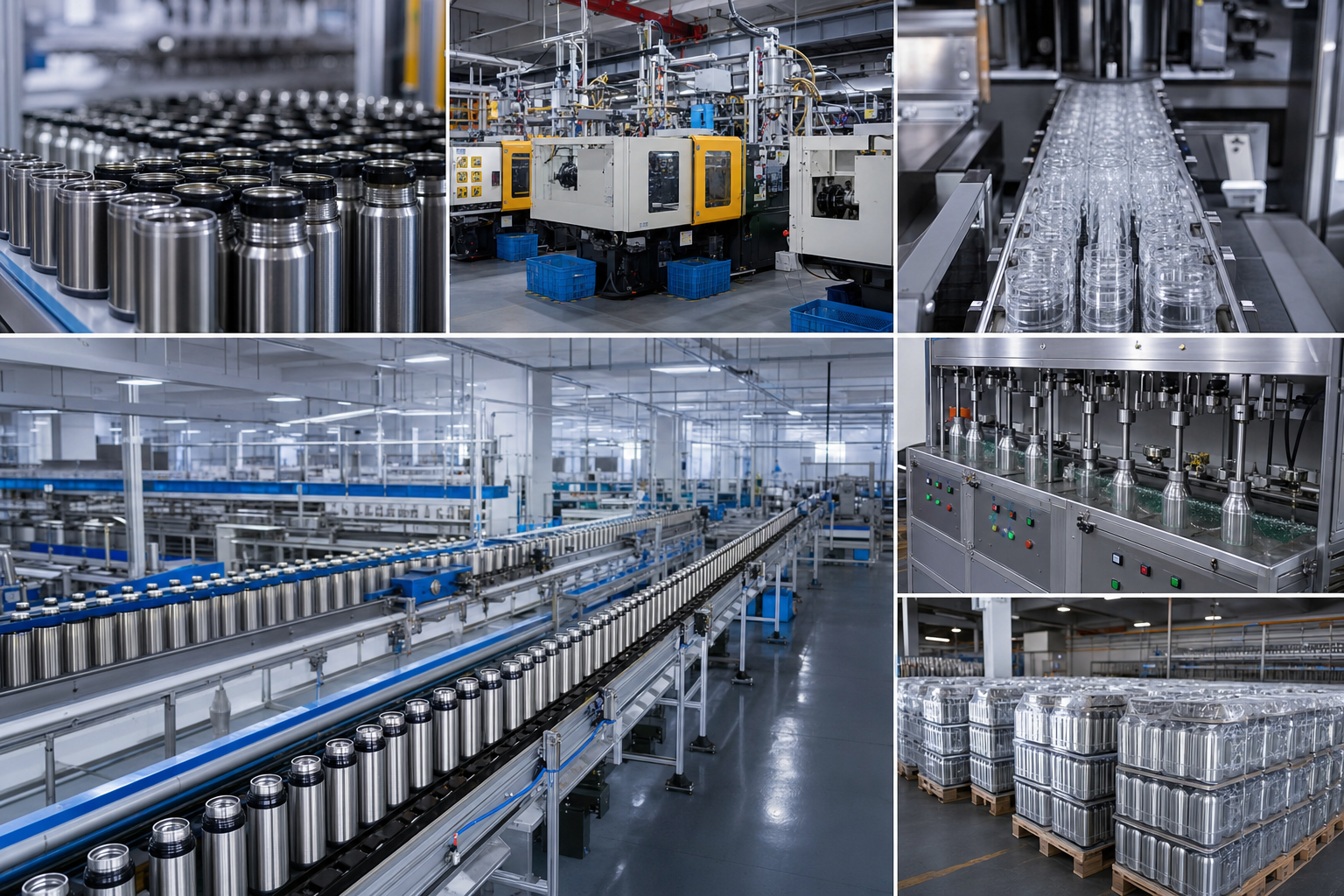
Buyers asking for eastman tritan thermos wholesale usually want a stainless vacuum bottle with Tritan on the lid, cap, spout, or sight window. They are not buying a plastic flask with weak insulation. We run samples with 18/8 steel inner, 500 ml and 750 ml sizes, and a 1.2 mm Tritan wall where the part takes impact. The real question is whether Tritan gives enough clarity, drop resistance, and shelf appeal to pay for new molds, leak tests, and tighter line control.
For brands and outdoor retailers, the sample is easy; the production run is where the math shows up. A Zhejiang factory can quote in 24 hours, but only a supplier with control over injection molding, vacuum sealing, and carton packing can hold the spec when the buyer flags a PO typo or asks for another 2,000 units. QC pulled the sample after the line ran 300 pcs, and the leak rate was still the number that mattered. If you are planning eastman tritan thermos bottle wholesale or eastman tritan thermos flask private label, ask for fill-rate data, AQL 2.5 results, and mold cycle time. This is the wrong question to ask if you only want a pretty sample.
What Tritan Really Changes
In wholesale, eastman tritan thermos usually means a vacuum-insulated stainless bottle with Tritan on the lid, cap, spout, or a clear window. That changes hand feel and shelf appeal, not the thermal core. For eastman tritan thermos bottle wholesale aimed at outdoor retail, buyers want impact resistance, clear sight lines, and a cleaner premium look. Cheap clear plastic turns cloudy and brittle fast; Tritan does not behave that way.
A serious eastman tritan thermos manufacturer will tell you exactly which parts are Tritan and which parts are 304 or 316 stainless. If the supplier stays vague, we usually assume the structure was cobbled together. We ran one sample last month where QC pulled the lid at 1,000-cycle testing and the buyer flagged a 0.3 mm gap at the spout seat. In Zhejiang, a factory can print and assemble fine, but only a proper eastman tritan thermos bottle factory keeps control on fit, sealing, and repeatability.
- Best use: lid bodies, flip caps, carry handles, spouts, and windowed drink components.
- Not Tritan's job: vacuum insulation, dent resistance, or the heat-retention system.
- Buyer benefit: easier branding and better shelf appeal for eastman tritan thermos bottle private label programs.
If your customer is a commuter or a family buyer, Tritan makes the product feel lighter and cleaner in the hand. If the target is alpine or field use, start with steel, gasket design, and seal integrity. This is the wrong question to ask if someone says Tritan alone will make the bottle “better.” We ship a lot of office and retail SKUs this way, but for a trail bottle the math does not work.
Specs That Protect Performance
The spec sheet is where a lot of eastman tritan thermos wholesale orders go off track. Start with the core: 18/8 or 304 stainless inner liner, usually 0.4 to 0.5 mm wall thickness for a normal 500 to 750 ml bottle, plus a vacuum chamber that gets leak tested, not just signed off on paper. We once had a buyer flag a PO typo on the liner spec, and that 0.05 mm gap turned into a full redraw. For premium programs, 316 inner steel is on the table, but only if the margin still works in your market.
Then move to the lid stack. Tritan has to hold up through repeated torque, dishwasher cycles, and thermal shock without whitening or cracking. Ask for the resin grade, color masterbatch compatibility, silicone gasket hardness, and whether the thread design was tested after 500 open-close cycles. We run a simple shoulder-fit check with a 0.02 mm feeler gauge on the line, because a good bottle still leaks when the cap seats badly. This is the wrong question to ask: don’t start with artwork, start with the cap.
Good thermos performance is a system result. The lid, gasket, thread pitch, and steel shell all have to work together.
For performance targets, a practical 500 ml bottle should be tested around 6 to 12 hours hot and 18 to 24 hours cold, depending on fill temperature and lid style. Ask for an inverted leak test, then a 1.2 m drop test on corners and edges. QC pulled the sample last week and the corner hit failed before the body did, which is why we keep pushing that test first. On incoming and final inspection, AQL 2.5 for major defects and AQL 4.0 for minor defects is a normal import baseline for eastman tritan thermos flask wholesale programs.
MOQ, Pricing, And Lead Time
For eastman tritan thermos bulk orders, the MOQ changes with the structure. If we use an existing stainless body and add custom print, a color ring, or a branded box, the order can start at 3,000 pcs. Once the buyer wants a new Tritan lid mold, the working MOQ usually moves to 5,000 pcs or more, because the mold cost has to be spread across the run. QC pulled the sample, checked the lid fit with a 0.2 mm gauge, and the line kept moving. That is the math, not a warning sign.
FOB pricing depends on size, finish, lid structure, and decoration. For a 500 ml unit, a simple eastman tritan thermos bottle wholesale quote may land around USD 3.20 to 4.80 FOB from a Zhejiang, China factory. A more complex eastman tritan thermos flask private label spec with matte coating, color-matched Tritan, and premium packaging can move to USD 5.50 to 7.20 FOB. Buyers often flag a quote that looks too cheap, and they should. Check whether the lid is real Tritan, whether the vacuum test passed, and whether the steel gauge is honest at 0.4 mm or 0.5 mm.
Lead time is usually 35 to 45 days after sample approval for repeat tooling. New molds, new colors, and full artwork proofing can push the schedule to 55 to 70 days. A factory with 300,000 units per month can still miss a ship date if the order depends on outsourced caps or outside decoration, so ask where each process happens. We run one UV printer on the line, and it becomes the bottleneck fast. For eastman tritan thermos bottle bulk purchases, that is the question that protects the schedule, not the lowest quote.
Compliance And Test Files
Compliance is not a box to tick after the PO is signed. For Europe or North America, we ship with food-contact declarations, REACH support, and test reports tied to the parts that touch the drink. A Tritan lid needs migration data, not a line on the brochure that says BPA-free. That line looks good on a catalog page. It does not pass a file review.
An eastman tritan thermos flask supplier in Zhejiang, China should also show ISO 9001, BSCI if the factory is export-oriented, and a clear incoming inspection flow. We run a 5-point check on the line, then QC pulls the sample before packing. For the stainless body, ask for corrosion and coating records where relevant, plus salt-spray results for painted parts if the SKU has an exterior finish. If the product goes to Amazon or a big-box program, packaging compliance counts too: drop test, carton compression, barcode placement, and FNSKU labeling if required. The buyer flagged a carton once because the barcode sat 8 mm too low. Easy fix. Ugly delay.
What you want is a document set that lets your compliance team move fast: material specs, test dates, lot numbers, and the factory stamp. If a supplier cannot tell you which batch used which gasket, that is a traceability gap. We have seen this go sideways on a 3,000-piece order when the PO had one typo on the gasket code. In China, the better eastman tritan thermos manufacturer teams keep that record at the line level, not in a spreadsheet someone updates later.
OEM, ODM, And Private Label
Private label is where eastman tritan thermos bottle custom programs make money. The easy route is logo and carton art. The stronger route is a bottle that reads as yours from 3 feet away: lid color, button shape, strap material, finish texture, and the gift box. For eastman tritan thermos bottle private label, buyers usually choose one of three looks: matte outdoor, clean commuter, or a family color set built around 2 to 4 core SKUs.
Decoration depends on the material. Stainless takes laser engraving and silk screen. Tritan takes pad print, in-mold color, or transparent tinting, and the color recipe has to be locked early or you get shade drift from batch to batch. On one 8,000-piece run, QC pulled the sample and found a 1.2 mm logo shift after the second print pass. A competent eastman tritan thermos flask manufacturer will also tell you if the logo survives dishwashers and UV. The buyer flagged it on a retail shelf test, and the math does not work if the mark fades in 60 days.
OEM Or ODM
If you need speed, ODM is faster because the mold base already exists. If you need differentiation, OEM makes sense, but only if your forecast covers tooling. An eastman tritan thermos oem program usually needs tight SKU control, because each color and each lid variant adds cost and line changeover time. Ask the eastman tritan thermos flask factory for a clean split between reusable components and one-time tooling, and check the mold sheet line by line. We once saw a PO typo that changed “2-cavity” to “20-cavity”; that sort of mistake burns a week.
For launch timing, the practical rule is simple: ODM gets you to market faster, OEM gives you a product line you can defend. If you are building a China supply chain for Europe or North America, both can work, but only if the approved sample, packaging dieline, and test reports are locked before mass production starts. We ship faster when the buyer signs off on the 3rd sample, not the 7th.
How To Vet The Supplier
Do not stop at the sample. Ask for a production video from the actual line in Zhejiang, China, not a sales room with ring lights. Check the vacuum seam under a 0.02 mm gauge, look for sink marks on the Tritan parts, press the caps by hand, and make sure the cartons still hold their shape in a 1.2 m drop test for export stacking. A factory that says 300,000 units per month should answer fast. If they cannot, the math does not work.
Use a buyer checklist that is blunt and measurable:
- Can you confirm which parts are Eastman Tritan and provide the resin source?
- What is the MOQ for eastman tritan thermos flask bulk and for eastman tritan thermos bottle private label?
- Can you provide REACH, food-contact, and any market-specific reports before deposit?
- What are your defect standards at AQL 2.5 and AQL 4.0, and how do you handle rework?
- Which terms do you quote on, FOB Ningbo, FOB Shanghai, or DDP?
If the answers come back slow or fuzzy, move on. The best eastman tritan thermos bottle manufacturer is not the one with the lowest first quote; it is the one that can repeat the same bottle lot after lot without changing the hand feel. We had a buyer flag a PO typo once, and QC pulled the sample against the drawing before the line ran 8,000 pcs. That is the difference between a one-time import and a program you can run in China for years.
Build Your Tritan Thermos Line With Real Specs
Send your target size, MOQ, and market. We will quote the right eastman tritan thermos program for China or Europe without guesswork.
Frequently asked questions
Is an Eastman Tritan thermos safe for hot drinks?
Yes, if Tritan is used in the right places and the product is tested for food contact. In a normal eastman tritan thermos bottle, the hot liquid should sit in 304 or 316 stainless, while Tritan is used for the lid, cap, or handle components. That separation matters. Ask the eastman tritan thermos manufacturer for migration reports, dishwasher-cycle data, and the exact temperature range the lid was validated for. For Europe, request REACH support and local food-contact declarations. For North America, ask for FDA-aligned material documentation. BPA-free is not enough on its own; the real answer is test data plus traceability by batch.
What MOQ should I expect for custom branding?
For eastman tritan thermos custom work, a realistic MOQ is 3,000 pcs when you use an existing bottle body and only change print, packaging, or color accents. If you want a new Tritan lid mold or a new cap structure, 5,000 pcs is more typical. For a full eastman tritan thermos bottle private label program with custom box, inserts, and color matching, 5,000 to 10,000 pcs is common in China. A lower MOQ is possible only if the factory already has the mold, the resin color is standard, and the decoration is simple. Always ask whether the quote includes tooling, testing, and packaging.
Can you make a full Tritan thermos bottle?
Not in the way most buyers mean it. A real thermos needs vacuum insulation, and that is normally stainless steel, not Tritan. When a supplier says eastman tritan thermos bottle, they usually mean a stainless vacuum bottle with Tritan parts on the lid, spout, or outer touch points. If you see a claim for a full Tritan vacuum flask, ask exactly how the insulation is built and what thermal retention numbers were tested. In practice, the best eastman tritan thermos flask manufacturer uses Tritan where impact resistance and clarity matter, then keeps the thermal core in steel. That is the commercially sensible structure.
How fast can I get samples and mass production?
For a repeat eastman tritan thermos flask supplier, samples usually take 7 to 15 days if the mold already exists and artwork is straightforward. Mass production after sample approval is often 35 to 45 days. If you need a new lid mold, custom color matching, or a new carton structure, the total schedule can stretch to 55 to 70 days. In Zhejiang, China, peak season can add delays if a factory is also handling large export programs. The best way to keep schedule control is to approve the sample, the packaging spec, and the test report set before paying the balance or releasing the order.
How do I compare two suppliers on more than price?
Compare the details that affect repeatability. Ask each eastman tritan thermos supplier for line photos, resin source, test reports, and the exact AQL standard used at final inspection. Check whether they can show ISO 9001, BSCI, and lot-level traceability. Ask how many units per month the factory really makes, not the number on a brochure. For an eastman tritan thermos factory in China, also check whether the lid molding, vacuum process, printing, and packing are all in-house or outsourced. Price matters, but a lower quote means little if the supplier cannot hold leak performance, color consistency, and delivery dates across repeat orders.