Key Takeaways
- Typical MOQ for a new private label program is 1,000-3,000 pcs per color, with 25-35 day lead times after sample approval.
- Most retail programs use 304 stainless steel, while 316 is better for acidic drinks, salt exposure, or harsher use cases.
- A good factory will quote FOB Ningbo or Shanghai, separate bottle, lid, decoration, and packaging costs, and support AQL 2.5 inspection.
- For eastman tritan vacuum insulated bottle bulk orders, the lid fit, gasket spec, and vacuum retention matter more than the logo placement.
If you are buying eastman tritan vacuum insulated bottle wholesale for outdoor retail or private label, the carton label is not the point. The bottle has to hold temperature, take a 1.2 m drop, and stay clean after logo work. We run that check before we talk print. In Zhejiang, a serious eastman tritan vacuum insulated bottle factory will bring up wall thickness, lid seals, and carton drop tests first. If a sample wall is 1.8 mm instead of 1.5 mm, the buyer feels it in weight and cost.
You also need to separate true OEM and ODM from re-badged catalog stock. A real eastman tritan vacuum insulated bottle manufacturer should quote FOB, confirm MOQ, send a pre-production sample, and show REACH, LFGB, and AQL 2.5 control. The buyer flagged a PO typo on the lid color once, and that small mistake turned into a 12-day delay. Skip the basics and the cheap bulk offer gets expensive fast, usually after leaks, color drift, and a missed ship date.
What You Are Actually Buying
When buyers say eastman tritan vacuum insulated bottle wholesale, they usually mean a vacuum-insulated bottle or flask with Tritan parts on the lid, drinking cap, window, or outer shell. That is not a simple plastic-and-steel item. The cap, gasket, and mouth finish have to match, or you get leaks; the vacuum level and weld quality set the heat retention; the coating has to survive a 1.2 m drop test and still look clean when the buyer opens the carton. QC pulled the sample, and the line showed the problem fast.
Search behavior is messy, so the same program may be labeled eastman tritan vacuum bottle wholesale, eastman tritan vacuum flask wholesale, eastman tritan vacuum bottle manufacturer, or eastman tritan vacuum flask supplier. The wrong question is the keyword. We care about the spec behind it: 304 or 316 inner liner, 0.4-0.5 mm wall thickness, Tritan or PP cap parts, and a seal structure that can pass inverted leak testing. On one PO, a typo changed the mouth finish by 1 mm, and the cap stopped seating. A good eastman tritan vacuum bottle factory will send drawings first, because the math does not work any other way.
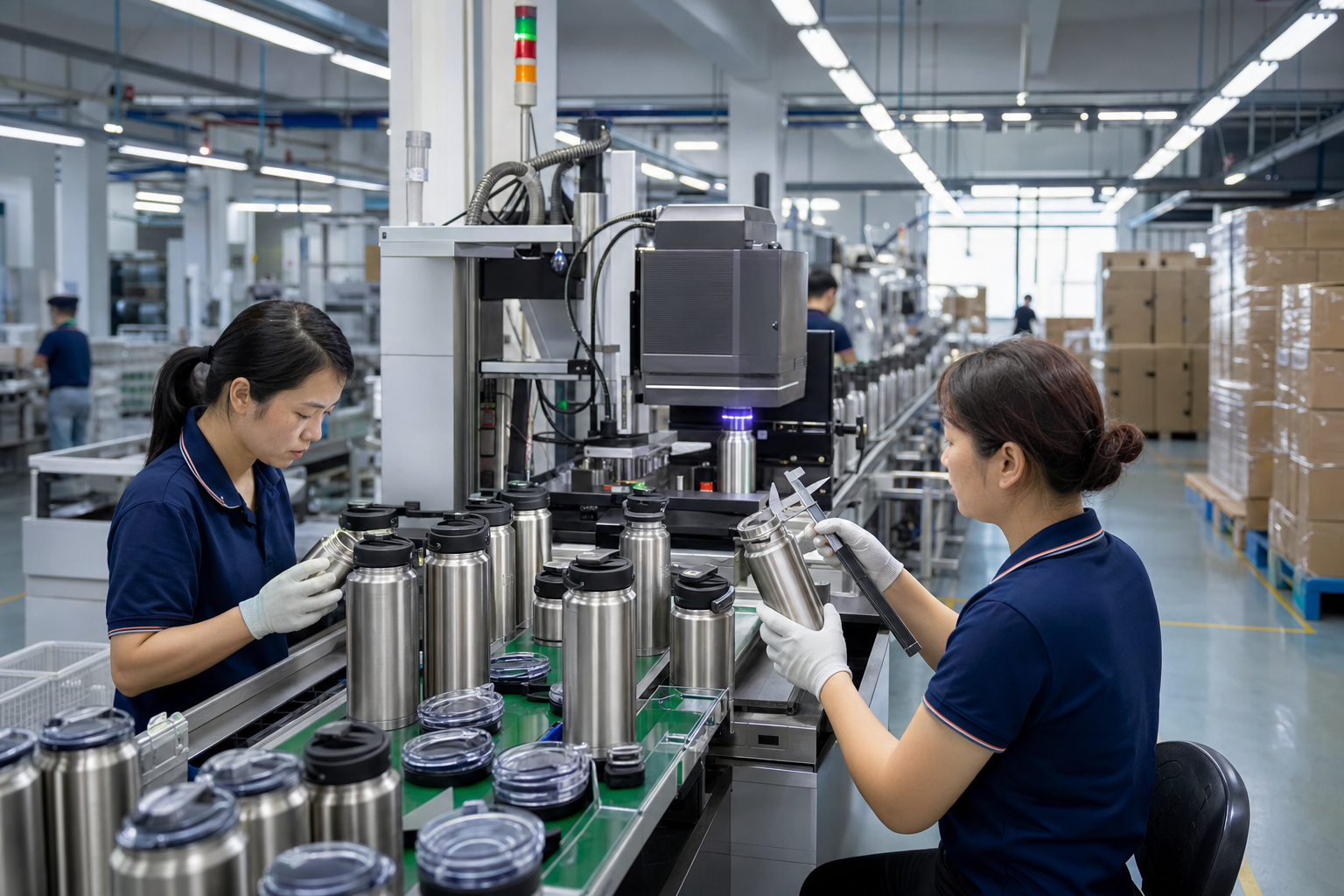
For retail buyers, the real value is repeatability. You want the second order to match the first order in color, finish, fit, and box size. We run those checks on the line with calipers and carton gauges, then we lock the same print file and foam insert for the reorder. That is where a disciplined eastman tritan vacuum insulated bottle supplier earns its margin, especially when the next shipment leaves in 12 days instead of 18 because the setup is already fixed.
Materials That Actually Matter
Tritan makes sense when you want clear caps, better impact resistance, and a cleaner premium look on lids or outer parts. It does not rescue a weak vacuum body. For the metal liner, most eastman tritan vacuum insulated bottle manufacturer programs use 304 stainless steel for mainstream retail and 316 when acidic drinks or rougher markets are in play. We ran a 500 ml sample last month; QC pulled the sample after a cap crack showed up at the 72-hour hot-water test. If the bottle will see sports use, 12°C to 95°C swings, or daily dishwasher cycles, spell out gasket material, mouth finish, and whether the cap uses Tritan, PP, or silicone overmolding.
Do not pay for features you cannot prove. That is the wrong question to ask if the buyer only wants a clean shelf look. Tritan only earns its keep when you need visible clarity, better impact resistance, or a private label finish that looks a step above plain PP. If the bottle is opaque and nobody sees the inner parts, a straight stainless vacuum flask custom program is usually the better number. The right eastman tritan vacuum insulated bottle custom spec balances perceived value and failure risk. We have seen this go sideways when a buyer flagged a PO typo—“Tritan cap” on the order, but the approved sample was full PP—and the line had to stop.
- Use 304 for most mass-market SKUs, especially 500 ml and 750 ml runs.
- Use 316 when salt, juice, or coffee acidity matters; we see the difference after 30 days of lab soak tests.
- Request gasket hardness and material by spec, not by assumption, or you will chase leaks later.
If your brand sells across Europe and North America, keep the materials story simple. The buyer does not need a chemistry lesson. You need a construction that performs, batch paperwork that matches the goods, and a supplier who knows the gap between a pretty sample and a repeatable production run. On our side, we check the mouth thread with a caliper to 0.1 mm before packing. If the documents and the carton marks do not line up, the buyer will catch it fast.
MOQ, Pricing, and Lead Times
For eastman tritan vacuum insulated bottle bulk orders, price starts with the spec sheet, not the carton count. Bottle size, steel gauge, lid structure, decoration method, and packaging all move the number. A plain 500 ml vacuum bottle with one-color silkscreen and a standard carton can sit in a low FOB range; add a Tritan viewing window, soft-touch spray, or a custom flip lid and the unit cost climbs fast. We had a buyer flag a PO typo once—“5000 pcs” turned into “50000 pcs” on the draft—and that is how people learn the math. A serious eastman tritan vacuum bottle supplier should split out bottle body, lid assembly, decoration, and packaging so you can see where margin goes.
Typical MOQ for a new eastman tritan vacuum insulated bottle private label project is 1,000-3,000 pcs per color, with 5,000 pcs giving better color matching and carton efficiency. Lead time is usually 25-35 days after sample approval, and a new mold or custom tooling adds another 10-15 days. Our Zhejiang line runs about 200,000 units per month across stainless drinkware, so we can hold capacity for repeat programs, but first orders still need a slot on the line. QC pulled the sample at 0.3 mm lid gap once, and the buyer still asked for rush ship. If a quote promises fast delivery, ask whether it includes printing, packing, and export cartons or only loose goods.
For China sourcing, FOB Ningbo or Shanghai is the cleanest starting point. It lets you compare eastman tritan vacuum bottle manufacturer offers on the same basis and avoids inland freight surprises. If you need air freight to hit a launch date, build that into your landed cost from day one, not after the container is booked. We ship from Ningbo a lot, and the freight gap can be 12 days versus 18 days depending on the route, so the wrong basis makes the quote look cheaper than it is.
OEM and Private Label Choices
OEM and ODM are not the same thing, and buyers lose money when they mix them up. In an eastman tritan vacuum insulated bottle OEM project, you send the drawing or at least the key dimensions, and the eastman tritan vacuum bottle factory builds to your spec. ODM is different: the factory already has a platform shape, and you choose logo, color, lid mix, box art, or a few function changes. For private label launches, ODM is usually faster and safer. For distributors with a clear retail position, OEM gives you more control.
The custom stack is simple: laser logo, one- or two-color silkscreen, UV print, debossed cap mark, pantone color match, and retail carton design. If you need eastman tritan vacuum flask custom features, ask whether the lid can be shared across multiple body sizes. That protects tooling cost. One lid mold can support 350ml and 500ml runs, and that matters when MOQ starts at 3,000 pcs. We once had a buyer push for a new lid on every SKU; the math did not work, and QC pulled the sample because the cap gap moved 0.6 mm. A better eastman tritan vacuum flask manufacturer will tell you which details stay stable and which ones will create defects, instead of saying yes to every sketch you send.
For eastman tritan vacuum bottle private label work, I lock three things before sampling: logo placement, cap color, and packaging structure. Those three items cause most approval delays. One typo on the PO, like a wrong pantone code or a shifted logo position, can cost a full remake. If you are building a portfolio, the same platform can often support both a thermos-style SKU and a sports-oriented bottle without rebuilding the whole project. We ship that way all the time.
Testing and Compliance
If you are selling into Europe or North America, compliance is not a checkbox. We run REACH checks for restricted substances, LFGB for EU food contact, and a material declaration that ties the Tritan resin to the exact spec on the PO. For the US market, ask for food-contact declarations, migration data where it applies, and batch paperwork that matches the production lot. If the supplier cannot tell you which resin lot went into PO #240617-03, you have a traceability problem. QC pulled the sample from the line with a 50 mL cup and a barcode scan; that is the standard, not a favor.
For the bottle itself, ask for vacuum retention, leak tests, hot and cold retention tests, and drop testing at 1.0 m or 1.2 m depending on your channel. We usually start with AQL 2.5 for major defects and 4.0 for minor defects, but for premium retail that is loose. The math does not work when the buyer wants a clean shelf set and only gives you one shot. Packaging needs the same treatment. A cracked retail box can turn a good eastman tritan vacuum flask bulk order into a claim-heavy shipment. Ask for test reports, not slogans, and insist on third-party inspection before balance payment. One buyer once flagged a 2 mm bottle cap shift on the carton photo; that saved a headache.
Rule of thumb: if a supplier cannot explain how they test seals, welds, and print adhesion, they are selling you a price, not a product.
When the factory says testing is done, ask for photos, batch records, and the inspection date. We ship from Hangzhou, and on a serious export line that paperwork lives with the production batch, not in someone’s WeChat chat. If they send a PO with the inspection date missing or the carton count typed as 1,000 instead of 10,000, slow down. That is not a small typo. It usually means the controls are weak. This is the wrong question to ask: "Can you pass?" Ask how they checked, with which fixture, and on which lot.
How To Qualify The Factory
When you vet an eastman tritan vacuum insulated bottle factory, start with the line, not the sales deck. Ask how many production lines they run, their monthly output in units, and whether vacuum welding, polishing, coating, and packing sit in-house or get pushed to outside shops. If a Zhejiang plant keeps those steps under one roof, the turnaround is usually cleaner when the buyer flags a lid color shift or asks for a replacement batch. We have seen the math go sideways fast when the container is already booked.
Then check how they handle sampling. You want a pre-production sample that matches the final wall thickness, lid fit, and logo position, not a hand-built showroom piece that no one on the line can repeat. Ask for a written spec sheet with steel grade, capacity tolerance, vacuum hold standard, and packaging BOM. If the eastman tritan vacuum bottle manufacturer cannot put that on paper, you will spend time chasing corrections later. On repeat orders, a solid eastman tritan vacuum flask factory should keep your mold, print file, and carton spec on file so the second run moves faster than the first. QC pulled the sample with a 0.3 mm lid gap, and that is the kind of miss that turns into a claim.
For buyers comparing eastman tritan vacuum flask wholesale offers across China, the lowest quote usually comes from a shop missing one of three things: stable QC, decoration control, or packaging discipline. The right eastman tritan vacuum flask supplier will cost a little more and be much easier to run. We ship from factories like this every week, and the difference shows up in fewer reprints, fewer carton tears, and fewer PO typos. That is the gap between a one-off purchase and a program you can scale.
Build Your Tritan Thermos Program
Send your size, target price, and market. We will turn it into a production spec, quote, and sample plan from Zhejiang.
Frequently asked questions
Is Tritan safe for hot drinks in a vacuum bottle?
Yes, if the Tritan parts are used in the right place and the supplier confirms the resin spec. In most eastman tritan vacuum insulated bottle projects, Tritan is used for the lid, drinking parts, or visible outer components, not as the vacuum liner itself. For tea or coffee, you should confirm the heat limit of the cap assembly and whether the seal stays stable after repeated hot fills. If you plan near-boiling use, ask for material declarations, migration documents, and a sample that has already passed leak and thermal tests. For export programs, I would also verify dishwashing performance and gasket aging before you place a 5,000 pcs reorder.
What MOQ should I expect for private label orders?
For a new eastman tritan vacuum insulated bottle private label program, a realistic MOQ is usually 1,000-3,000 pcs per color. If you want multiple cap colors, retail cartons, or special finishes, the usable MOQ rises quickly because each variation adds setup and packing cost. At 5,000 pcs and above, you usually get better pricing, smoother color control, and more efficient carton loading. For repeat orders, some factories will support lower reorders if the mold, logo, and packaging are already locked. The key is to confirm whether the MOQ applies per SKU, per color, or per decoration method, because those are not the same thing.
How long does production take in China?
For a standard eastman tritan vacuum insulated bottle bulk order, lead time is often 25-35 days after sample approval and deposit. If the project needs a new mold, custom lid tooling, or a complex decoration stack, you should expect extra time. Add another 5-10 days if the order needs third-party inspection, special export cartons, or a peak-season booking delay. A Zhejiang factory with stable production control can usually handle rushes better than a trading-only operation, but you still need realistic timing. Ask for a production schedule in writing, not a verbal promise. If your launch date is fixed, build at least one buffer week into the plan.
What tests should I request before shipment?
At minimum, ask for leak testing, vacuum retention, hot and cold holding tests, drop testing, and print adhesion checks. For an eastman tritan vacuum flask supplier, I also want batch traceability, carton drop verification, and a clear AQL standard such as 2.5 for major defects and 4.0 for minor defects. If you sell in Europe, request REACH and LFGB support where applicable. For North America, make sure the food-contact paperwork matches the exact production batch. The best factories in China will not resist these requests. If a supplier pushes back, that usually means the process is not stable enough for retail.
Can I customize logo, color, and packaging?
Yes, and you usually should. Most eastman tritan vacuum bottle private label projects start with logo placement, pantone color matching, and a retail carton that fits the brand position. The common decoration options are laser engraving, silkscreen, UV print, or debossed cap marks. If you want to keep tooling cost under control, use a shared lid platform and vary only the visible parts. For an eastman tritan vacuum flask custom order, I would lock the packaging structure early because box size affects freight, carton count, and shelf presentation. The best time to change artwork is before the first sample, not after the factory has already cut the print plates.