Key Takeaways
- Ask for real production numbers: 300,000 units/month, not “high capacity”.
- Check quality systems with AQL 2.5/4.0, not just a sample table.
- Confirm compliance documents before you discuss price: REACH, food contact, and BSCI if needed.
- A serious drinkware factory in Zhejiang should show you molding, finishing, and packing in one visit.
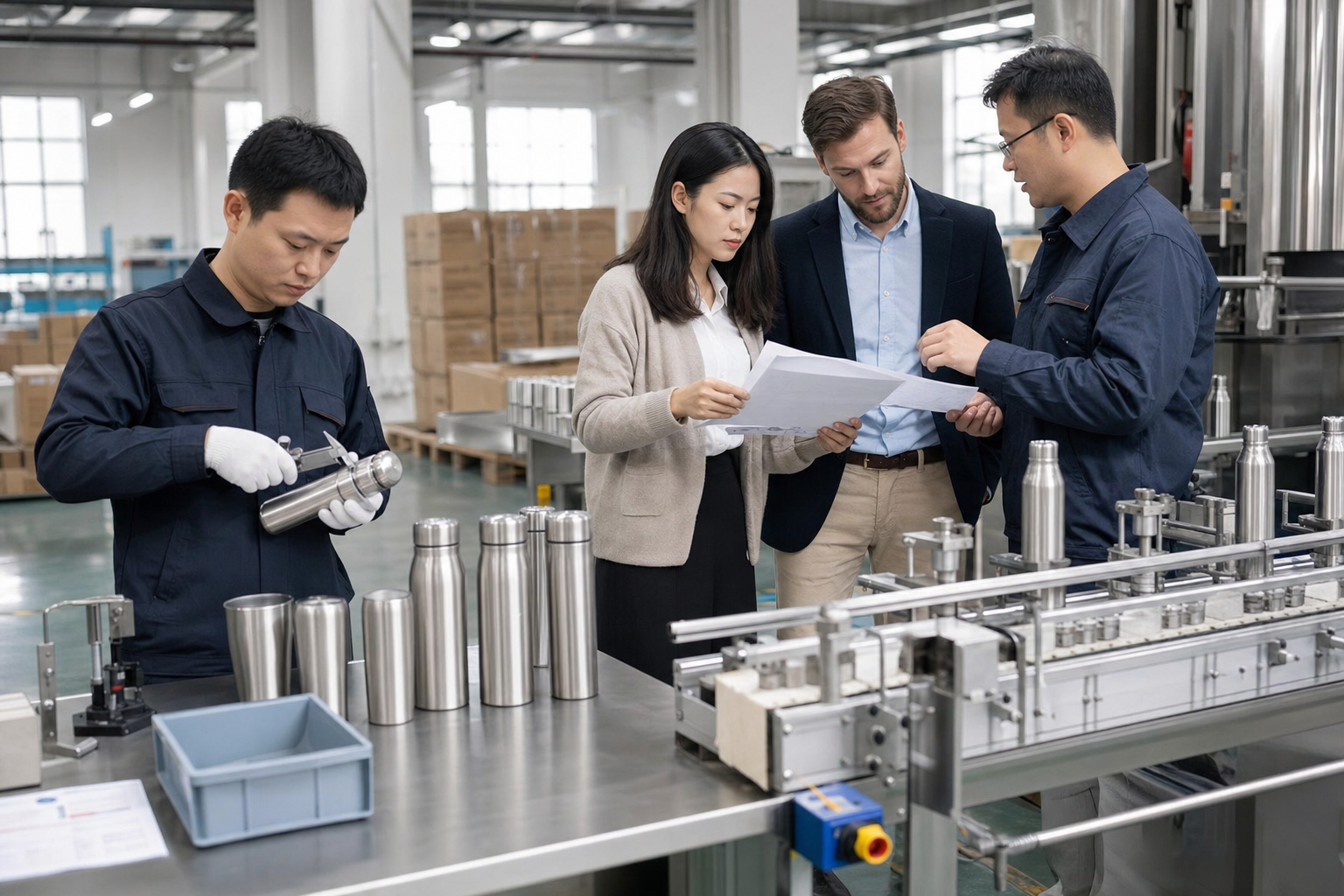
If you fly to China to check a drinkware supplier, do not treat the factory tour like a showroom stop. A clean front desk means nothing. We have seen a buyer nod through a polished reception, then find a leaking seam on the line an hour later. What matters is whether the plant can hold ±0.2 mm tolerances, keep dust out of filling and packing, and ship on time at your target MOQ and price.
This Chinese factory visit checklist is for importers who need a real supplier audit, not a sightseeing trip. Whether you are buying vacuum flasks, tumblers, or kids’ bottles, you should leave with answers on tooling, AQL inspection, REACH compliance, and monthly capacity. Last month one buyer flagged a PO typo on the MOQ line, and QC pulled the sample right there. In Zhejiang, the good factories speak in numbers. The weak ones hide behind soft talk.
Start before you board the plane
A solid factory visit starts 7 to 10 days before you land in China. Ask for the company profile, export license, product catalog, and recent audit reports before you book the flight. If you are working with a factory in Zhejiang, ask for photos or video of the actual workshop layout, not the sample room. We have seen a buyer arrive with a nice brochure and then find out the “factory” was a 6-person office with a borrowed line next door. That is the wrong question to ask after you arrive.
Send a short document request list before you fly:
- Business license and export registration
- ISO 9001 certificate, if they have it
- BSCI or Sedex audit, if your retailer requires it
- REACH, LFGB, FDA, or ASTM-related test reports for the exact product
- Monthly output by product line
- Standard lead time and peak-season lead time
Then ask one direct question: what would you change on the line if I order 50,000 units next month? The answer tells you more than a brochure. Real factories in China can talk about mold cavities, packing bottlenecks, and color-masterbatch lead time. Weak suppliers talk only about “fast delivery”. We run into this every season, and the math does not work if they cannot name the bottleneck. QC pulled a sample once and found the same answer copied into three buyer POs, with one typo on carton count, so ask the hard question early.
Questions that expose real capacity
Do not ask, “Are you busy?” Ask for numbers. How many injection machines are running? How many blow-molding machines? How many vacuum-sealing lines are on the line this week? A supplier that knows its own shop floor will answer with shifts, monthly output, and SKU split. For drinkware, a Zhejiang plant might ship 200,000 stainless tumblers a month, but only 60,000 vacuum flasks if polishing and welding slow the flow. QC pulled the sample and the bottleneck showed up fast.
This is the wrong question to ask if you want a real read on capacity. Marketing talks fast. The line does not.
- How many production lines are dedicated to my category, and how many are actually running today?
- What is the MOQ by color, logo method, and packaging? We often see 3,000 pcs for one logo method and 5,000 pcs for custom box work.
- How many days from PO to mass production start? Ask for the exact handoff date, not a vague range.
- How much of the process is in-house: forming, welding, coating, printing, packing?
- What happens when a machine fails on peak season orders? We want the backup plan, not a promise.
Watch the answer style. A factory that really handles export accounts will give you 25 days for standard orders and 35 to 45 days for custom colors, not “it depends.” If they say that, press for tooling, component stock, and line load. We once caught a PO typo on a 2,400 pcs order because the buyer flagged the lid color code after print approval. The math does not work if they cannot tie lead time to a tool, a pallet count, and what is already booked on the calendar.
Inspect the process, not just samples
Samples are the easy part. The line is the test. We run 10,000 units, or 100,000 if the PO is big, and the sample means nothing if the welders, polishers, and packers cannot repeat it shift after shift. On an audit, walk the process in order: raw material storage, forming, welding, surface treatment, decoration, assembly, testing, final packing. If they skip one station, that station is usually the problem.
For stainless steel drinkware, check wall thickness consistency with a caliper, weld seam finish, and whether the inner liner shows discoloration after forming. We once saw a 0.32 mm swing on the same body; the buyer flagged it, and the whole lot got held. For plastic bottles, look at molding flash, gate marks, and stress whitening around the neck and handle. For glass bottles, ask how they control annealing and breakage rates. A serious factory in Zhejiang will show you the reject bins. Ask to see them.
What you want to hear: “Our defect rate is 1.2% on assembly and 0.5% on packing, and we track it daily.” What you do not want to hear: “No problem, very good quality.”
Ask for the in-line inspection points. A clean process should have incoming material checks, first-article approval, hourly checks, and final random inspection. If they only inspect at the end, they are paying sorting labor to do quality control. That math does not work. QC pulled the sample, the line stopped for 20 minutes, and that is the kind of interruption you want to see on a real factory visit.
Check compliance before discussing decoration
Do not start with logo placement. Start with the compliance file. If the cup enters the EU or North America, the first questions are food-contact safety and chemical compliance, not print color. For drinkware, we check REACH, LFGB, FDA-related declarations, or migration testing based on the material and market. On stainless steel items, ask one direct question: did they test the coating, lid gasket, straw, and print ink as a full set? QC pulled a sample on one line last month, and the ink passed alone while the assembled lid stack failed.
On a proper factory audit, check these points:
- Are test reports tied to the exact SKU and material code?
- Do they use third-party labs such as SGS, Intertek, or TÜV?
- Can they show batch traceability by lot number?
- How long do they keep retention samples?
Ask for retail compliance files, carton markings, and barcode labels before you talk decoration. If you sell on Amazon, bring up FNSKU placement and carton label accuracy. We have seen buyers ignore a 2 mm label shift, then the warehouse rejected the whole carton. The math does not work. If a factory cannot keep labels consistent, the paperwork will drift too. A supplier in China that ships export orders every week should treat documents as part of the product, not an afterthought.
Look hard at packing and traceability
Packing looks boring until one carton lands damaged or mislabeled at your warehouse. We open finished cartons on the line and check the inner box, polybag, insert card, and master carton one by one. Count the units per carton. Check the carton weight against the shipping plan. A 0.3 kg error per carton turns into a freight headache fast on a 20,000-unit order.
Ask how they control traceability. A solid supplier can tell you which shift made a batch, who handled final packing, and what inspection result QC pulled before loading. You want lot coding, not guesswork. If you are buying private label, ask whether they can print serial batch numbers or QR codes directly on the carton or product base. One buyer once flagged a PO typo on the carton suffix, and that mistake sat in the warehouse until the next reprint.
Check storage too. Raw material bags should have clear labels, and finished goods should not sit open near dust, polishing residue, or forklift traffic. We see this go sideways when packaging shares space with cutting and finishing. In Zhejiang and other manufacturing hubs in China, the better factories keep those areas separated by 12 to 18 meters or at least a hard partition. That is not decoration. It keeps contamination down and rework off the schedule.
Read the people, not the pitch
Factory visits are often won or lost in the first 15 minutes after the introductions. The salesperson will talk. Watch who walks in with them. If the quality manager, production manager, and engineer show up for the right questions, that tells you the line is tight. If only sales is there and nobody can answer a tooling or tolerance question, the factory is probably thin inside.
Ask the engineer how they fixed the last defect. Ask QC how many rejects trigger a line stop. Ask production whether they can take a rush order without kicking normal orders back two weeks. A solid factory can talk trade-offs without dodging. If you need a new lid mold, they should tell you straight: tool steel, cavity count, and sample approval usually add 20 to 35 days before mass production. We had a buyer flag a PO typo on cavity count once, and it cost a full week.
Do not ignore language quality. You do not need perfect English, but you do need clean answers on AQL, tolerance, and lead time. The best supplier relationships in China are built on exact wording. If your question is sloppy, the answer will be sloppy too. Bring a checklist, and keep it tight: each answer should end with a number, a document, or a sample you can check later. QC pulled the sample on a 0.8 mm wall issue, and that saved us from a bad batch.
Book your factory audit with real numbers
We build drinkware in Zhejiang and know what buyers need to verify. Send your RFQ and get a practical, export-ready response with clear capacity and lead times.
Frequently asked questions
How long should I spend on a drinkware factory visit?
Plan for 2 to 4 hours minimum. A quick 45-minute walk-through is not enough for a real supplier audit. If you are evaluating a factory in China for a 50,000 to 100,000 unit order, you need time to inspect the production line, packing area, QC records, and document file. Add 30 minutes for a technical meeting and another 30 minutes for sample review. If the supplier cannot handle that schedule, they are probably not ready for export business.
What is a fair MOQ for custom drinkware?
It depends on product type and decoration, but a practical MOQ is often 3,000 to 5,000 units for simple printed bottles and 5,000 to 10,000 units for custom colors or new lids. For new tooling, expect more. A factory in Zhejiang may offer lower MOQs for stock molds, but if you want special packaging or laser engraving, the minimum rises. Ask for MOQ by SKU, not a vague “low MOQ” promise.
Which documents should I request during the visit?
Ask for business license, export license, ISO 9001 if available, BSCI or Sedex if your retailer needs it, and product test reports for the exact SKU. For EU-bound drinkware, request REACH or LFGB-related documentation where applicable. If you sell on Amazon, ask for carton labels, barcode format, and FNSKU handling. A good factory will also show lot traceability sheets and retention sample records. If they cannot produce documents on the spot, that is a warning sign.
How do I check if the factory really controls quality?
Look for process control, not just final inspection. Ask where first-article approval happens, how often they check dimensions, and whether they use AQL 2.5 for critical defects and AQL 4.0 for minor ones. Ask to see defect logs from the last 30 days. A real manufacturer will know their defect rates, reject reasons, and corrective actions. If they only talk about appearance, they are not running a mature manufacturing inspection system.
Should I trust samples shown in the showroom?
No, not by themselves. Showroom samples can be hand-finished, selected from the best units, or even made by a different team. Always match the sample to the production line and ask for the same material, same mold, same decoration method, and same packaging spec. If the supplier says the sample is from another factory or an old mold revision, treat it as a reference only. For a serious order, you need a signed golden sample tied to the PO.