Key Takeaways
- Typical MOQ for fruit infuser bottle wholesale starts at 1,000 pcs, with factory-direct pricing from about USD 1.15-2.90 depending on material and decoration.
- A good fruit infuser bottle factory should quote leak testing, AQL inspection, and food-contact compliance such as FDA, LFGB, and REACH where needed.
- Private label orders usually add 7-12 days for printing or laser work, while custom molds can add 25-35 days.
- Zhejiang factories with 300,000+ units/month capacity are better for repeat programs, because they can hold color consistency and packaging standards.
If you are buying a fruit infuser bottle wholesale, do not treat it like a plain water bottle. The infuser basket, cap seal, Tritan or PET body, and print method all change leakage, taste, and repeat orders. We run 28 mm and 32 mm neck finishes on the line, and a 1 mm gap in the basket clip can turn into a customer complaint after 3 days of use. For wellness brands and hydration startups, the sourcing spec has to be tighter than a generic drinkware RFQ.
At BottleForge in Zhejiang, we see buyers burn two weeks comparing fruit infuser bottle suppliers on price alone, then the sample they signed off on fails a 1.2 m drop test or gets crushed in retail cartons. That is the wrong question to ask. If you want fruit infuser bottle bulk pricing that still leaves margin, you need to know factory structure, MOQ, mold options, and what a real fruit infuser bottle manufacturer can hold in-house. We had one buyer flag a PO typo on the lid color code, and QC pulled the sample before mass production started. China has plenty of vendors; only a few are built for steady export runs.
What buyers really source
People searching for fruit infuser bottle wholesale are usually not buying one model. They are sorting three jobs: retail shelf, branded giveaway, or a subscription-box insert. Each job changes the spec. A promo bottle can run in PET with a one-color logo. A premium wellness SKU needs Tritan, a tighter cap seal, and an infuser basket that does not crack after 30 wash cycles. If you send one generic RFQ to every fruit infuser bottle supplier, the quotes come back useless because they are pricing different builds. We see this all the time on the line.
Start with the non-negotiables: capacity, material, lid type, decoration. Common sizes are 700 ml, 800 ml, and 1,000 ml. For wellness brands, 800 ml is often the sweet spot; the buyer wants it to feel substantial without becoming a 600 g carry-around. If you want fruit infuser bottle custom work, spell out whether the infuser is a center tube, basket insert, or full-length rod design. Then decide if you need fruit infuser bottle custom made packaging, not just a logo on the body. In Zhejiang, a buyer once approved the bottle and missed the carton height by 8 mm, and we had to rerun the insert tray. That is the wrong question to leave until the end.
- 700-1,000 ml: standard wholesale range
- 1,000 pcs MOQ: common for first orders
- USD 1.15-2.90: typical factory-direct range
Materials and food safety checks
Material choice is where fruit infuser bottle wholesale turns from margin into headaches. PET is cheap and clear, and it works for a 3-month promo run; it is not the first pick for a premium retail line. Tritan is the better call when the buyer wants a fruit infuser bottle customizable for repeat sell-through. It holds up better against odor, takes knocks better, and lets you price above the commodity shelf. PP is the usual material for caps, infusers, and some lids because it stays stable and keeps unit cost down. If a Europe buyer asks for compliance, do not guess. Ask the fruit infuser bottle manufacturer for the lab report, not a line in an email. On our line, we had one PO with “Tritan?” written in the spec box, and QC pulled the sample before packing.
For Europe, REACH and food-contact declarations are the documents that matter. For North America, FDA food-contact compliance is the baseline. If the bottle will take hot water or you want dishwasher claims, ask for thermal testing and cycle counts, not marketing talk. A serious fruit infuser bottle factory should also show wall thickness, usually 1.2 mm, 1.5 mm, or 2.0 mm, because that changes clarity, weight, and drop resistance. We run AQL 2.5 on major cosmetic defects and tighten the leak check on every lot. That is the gap between a real fruit infuser bottle supplier and a trading company reading from a directory. The wrong question is “Can you do it cheap?” The right one is “What failed in the last test?”
Do not buy a fruit infuser bottle in bulk until you have checked the seal, not just the print.
Factory capability and MOQ logic
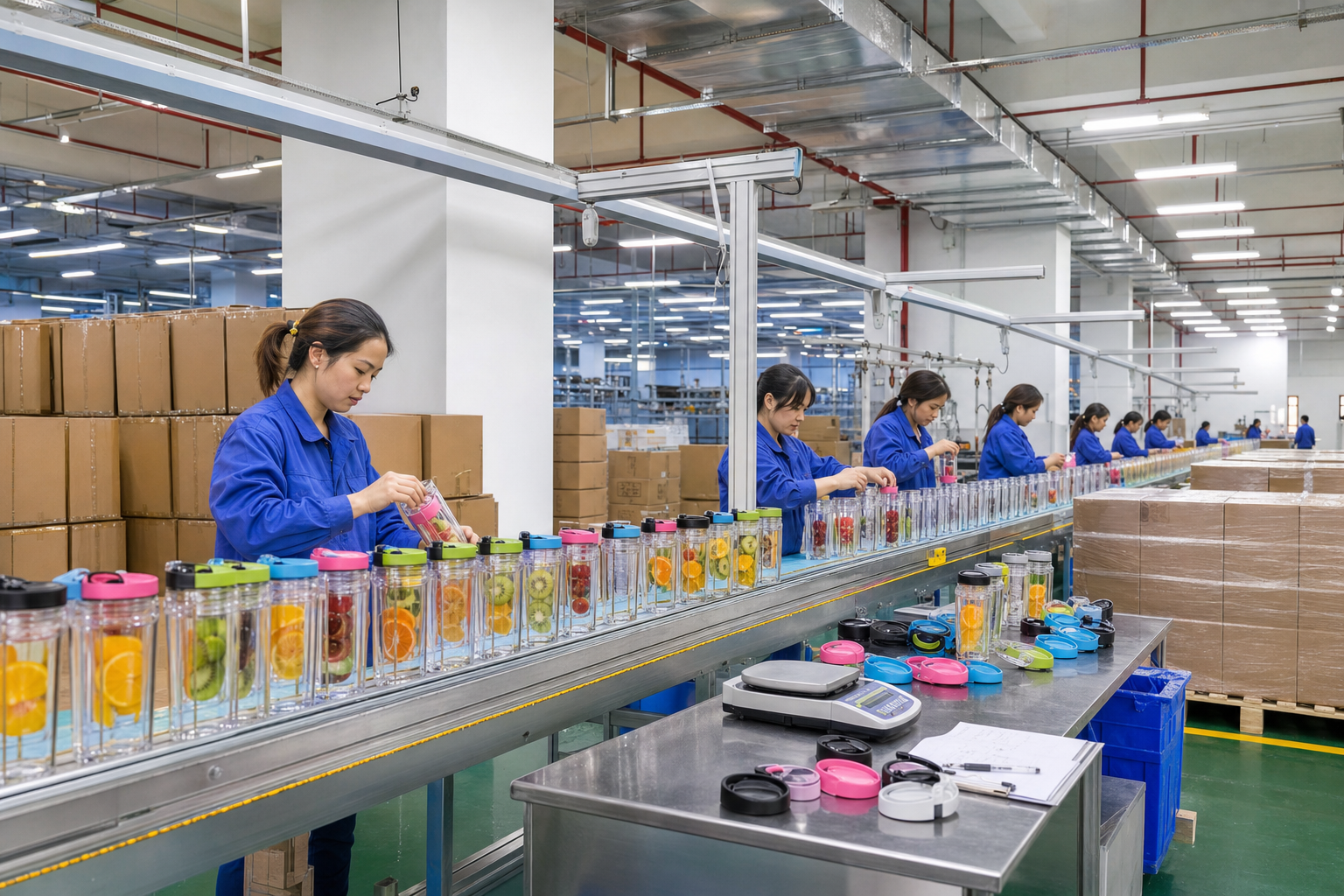
Not every fruit infuser bottle factory is set up for export volume. A small workshop can turn out samples, but a real fruit infuser bottle OEM manufacturer should cover injection molding, assembly, printing, and carton packing with traceability on every lot. At BottleForge in Zhejiang, we run 300,000 units a month across infuser and hydration lines. That matters. Color drift, lid fit, and lead times stay under control when the line is running every day. If you are comparing fruit infuser bottle manufacturers, ask how many SKUs they run per day, whether QC has a drop tester and torque gauge, and whether they can hold repeat PO scheduling without pushing the ship date.
MOQ follows decoration and pack-out, not just bottle shape. A plain bottle may start at 1,000 pcs. A fruit infuser bottle with custom logo, custom color lid, and printed retail box may move to 3,000 pcs. A full fruit infuser bottle private label program with barcode labeling, master carton marks, and insert sheets takes more setup, but it gives you a cleaner launch. We had a buyer flag a PO typo on the carton count before production, and that saved a reprint. If you plan fruit infuser bottle buy in bulk for Amazon or distributor channels, check carton cube, pallet count, and whether the factory can print FNSKU or distributor barcodes before shipment. The math does not work if the carton size is off by 5 mm.
- 1,000 pcs: basic MOQ for stock structure
- 3,000 pcs: common for private label and custom color
- 25-35 days: mold and tooling lead time if needed
Pricing structure you can audit
Good sourcing is not about chasing the lowest quote. It is about knowing what sits inside the number. We run a 1.15 USD quote on a basic PET body, one-color print, and a standard carton pack all the time. Change to Tritan, add a silicone gasket upgrade, or switch to a matte finish, and the price moves. That is normal. What is not normal is a vendor sending one line with no split for tooling, packaging, or inland charges. We had a buyer flag a PO typo on carton count last month, and the quote was the first place the mismatch showed up.
Ask for an itemized quote: unit price, printing fee, packing fee, sample fee, freight terms. FOB Ningbo or FOB Shanghai is standard for Zhejiang exporters. If you are comparing fruit infuser bottle distributors with a direct factory, the distributor usually adds margin and blurs the real factory cost. That can work if you need fast stock. For repeat quarterly orders, fruit infuser bottle factory direct sourcing is cleaner. On a 50,000-piece run, a 10% unit cost cut can decide whether the program clears margin or gets cut by finance. We see that math every week at the line.
Be careful with “cheap” numbers from a fruit infuser bottle supplier list or fruit infuser bottle supplier directory. Some quotes are ex-works from old stock, not fresh production. Others leave out custom inserts, and those add USD 0.08-0.20 per unit. Ask for the landed estimate early if your campaign price is fixed. QC pulled a sample on a 74 mm cap last week and found the insert slot was 1.5 mm off; that kind of miss turns a low quote into a bad one fast.
Customization that sells shelves
The best fruit infuser bottle promo programs stay simple. Easy to use. Easy to restock. A solid fruit infuser bottle custom job usually starts with logo placement, then color match, lid shape, and carton print. We run a 12-day sample cycle on these jobs, and the buyer usually catches the weak point fast. If you want fruit infuser bottle private labeling, don’t stop at the logo. The bottle, insert card, and outer carton need the same message, or the shelf looks off. Clean beats busy every time.
Common decoration methods are silk screen, pad print, heat transfer, and laser engraving on metal parts. For plastic bodies, silk screen is the practical choice for one or two colors. On a 58 mm logo panel, print that spreads past the curve gets rejected. For a higher MSRP, frosted walls, soft-touch lids, and a custom sleeve do the job. If this is your first fruit infuser bottle with custom logo, check print size and placement near the fill line; we’ve seen designs look fine empty and turn awkward once the bottle is loaded with fruit and water. The math doesn’t work if the artwork fights the volume mark.
What to approve in samples
- Logo opacity and scratch resistance
- Lid torque and leak performance
- Basket fit and fruit clearance
- Packaging crush resistance in transit
Quality control before shipment
A fruit infuser bottle supplier who talks about quality in vague terms is not helping you. We want numbers on the table. For export orders, the flow is simple: pre-production sample approval, in-line inspection, then final random inspection under AQL 2.5. QC checks the 0.5 mm wall thickness, print registration, seal fit, and defects like scratches or bubbles. If your fruit infuser bottle vendor outsources assembly, ask one direct question: who owns the cap-to-body match when those parts come from two plants? That handoff is where the line goes sideways.
Leak tests matter more than buyers think. A bottle can pass hand-feel checks and still fail in a hot warehouse or after a courier drop. We run at least 24-hour inverted leak testing and a drop test from 1 meter on packed cartons for retail programs. If your fruit infuser bottle customized order is for gym chains or subscription kits, ask for batch traceability by production date and shift code. One buyer once flagged a PO typo on the carton count, and the math did not work after packing. China can produce solid quality, but only if the factory keeps process discipline, not just machine capacity.
For brand owners in North America and Europe, the target is plain: keep defect rates low enough that returns stay under 1%. That is only realistic when the fruit infuser bottle manufacturer controls molding, print, and packing in one place, instead of splitting the job across subcontractors in Zhejiang or another province. We have seen that setup go sideways on a 5,000-piece run when QC pulled the sample and found a loose cap torque reading.
How to source from China safely
If you are new to China sourcing, start by narrowing the field to fruit infuser bottle manufacturers with export history, not just generic drinkware sellers. Ask for factory photos, machine list, testing equipment, and recent shipment references. A real fruit infuser bottle factory should not hide behind stock pictures. You want to see the injection machine, the assembly line, and the carton packing area. Zhejiang has a dense drinkware supply chain, which helps because lids, gaskets, and packaging are nearby. That cuts the risk of part mismatch and keeps the lead time tighter.
Use a simple vetting sequence: RFQ, sample, compliance review, order confirmation, pre-production check, shipment inspection. If the supplier resists documentation at step one, stop. We’ve seen this go sideways fast. Plenty of fruit infuser bottle suppliers can make a decent sample; far fewer can support repeat fruit infuser bottle wholesale programs with stable QC and honest lead times. For a startup, the safest path is factory direct plus a clear spec sheet. For a distributor, the key is replenishment that does not slip. In both cases, the supplier must know export packing, palletization, and labeling rules for your market. QC pulled the sample at AQL 2.5 before we ever released a batch.
If you need a fruit infuser bottle supplier that can also handle related SKUs later, ask whether they run sports bottles, travel tumblers, or kids’ bottles on the same production platform. That is often the sign they can scale with your program instead of forcing you to rebuild the relationship in six months. We run one line with interchangeable molds, and that matters when a buyer flags a PO typo on lid color or carton count.
Request a factory-direct infuser bottle quote
Send your capacity, material, and logo specs. We will quote MOQ, lead time, and compliance details without padding the numbers.
Frequently asked questions
What is the usual MOQ for fruit infuser bottle wholesale orders?
For a standard fruit infuser bottle wholesale order, 1,000 pcs is a common starting MOQ in China. If you want custom color lids, printed retail boxes, or fruit infuser bottle private label work, the MOQ often moves to 3,000 pcs. For stock shapes with simple one-color logo printing, some fruit infuser bottle suppliers can offer 500 pcs, but the unit price is usually 15-25% higher. At a Zhejiang factory with in-house molding and printing, you can usually get better repeat pricing once the first PO is completed.
How much does a fruit infuser bottle in bulk cost?
Factory-direct pricing for a fruit infuser bottle in bulk usually starts around USD 1.15 for simple PET models and can reach USD 2.90 or more for Tritan, custom color, or premium packaging. If you need a fruit infuser bottle with custom logo, expect printing to add about USD 0.03-0.12 per unit depending on colors and setup. Custom cartons can add another USD 0.10-0.25. Freight is separate. Always ask for FOB terms so you can compare fruit infuser bottle manufacturers fairly.
Which material should I choose for retail wellness branding?
For wellness brands, Tritan is usually the best choice if you want a clearer, more premium fruit infuser bottle custom made for repeated use. PET is cheaper and works for promotional campaigns, but it scratches more easily and feels less premium. PP is usually used for lids and infuser parts. If your market needs food-contact compliance and a stronger retail story, ask for FDA or LFGB documentation plus REACH where applicable. Wall thickness around 1.5 mm is a practical middle ground for clarity and durability.
Can you make fruit infuser bottle private label packaging too?
Yes. A proper fruit infuser bottle factory can handle fruit infuser bottle private labeling, retail sleeves, master cartons, barcode stickers, and carton marks. For Amazon or distributor channels, ask whether the factory can apply FNSKU labels before shipment. A good export supplier should also confirm carton size, pallet count, and whether the outer box is designed for 5-7 layer export strength. Packaging setup usually adds 7-12 days, depending on artwork approvals and print complexity.
How do I vet fruit infuser bottle suppliers in China?
Start with export experience, compliance documents, and production photos. Then check whether the fruit infuser bottle manufacturer can show test reports for leak resistance, food-contact compliance, and basic drop testing. Ask for a sample plus a pre-production approval sheet. If the supplier only acts as a fruit infuser bottle vendor or fruit infuser bottle distributor, they may be fine for one-off orders, but factory direct sourcing is better for repeat wholesale programs. In Zhejiang, serious factories will usually answer technical questions within 24 hours and quote lead times of 20-35 days.