Key Takeaways
- Direct factories cost 10–25% less than trading companies — but require more due diligence up front.
- Always pay for a custom sample. The $80–150 fee saves bulk-order disasters.
- An AQL 2.5 General Inspection Level II is the industry-standard quality terms. Insist on it in your PO.
- Build 8–12 weeks of buffer between PO and your in-market date. Rush orders are possible, but they cost stability.
Sourcing custom drinkware from China is not a transaction. It's a process — usually one that takes 8 to 12 weeks from first email to packed container, longer if your product needs new tooling. Buyers who treat it like an Amazon checkout get burned. Buyers who treat it like a small engineering project don't.
Below is the 8-step playbook we recommend to every new customer, distilled from 16 years of running an export-facing factory in Zhejiang. It assumes you're buying for resale, not for personal use, and that you want a relationship that scales past the first PO.
1. Define your "non-negotiables" before you email anyone
Before you reach out to any supplier, write down — on one page — the product specifications you cannot compromise on. Not the nice-to-haves. The non-negotiables. For drinkware, that usually means:
- Material grade. 304 vs 316 stainless. Tritan vs generic PETG. Borosilicate vs soda-lime glass. The cheap substitutes are easy to spot if you know to ask.
- Capacity, in metric. Always millilitres. "20 oz" means 591 ml in the US and 568 ml in the UK — the difference matters at scale.
- Performance claims. If you'll advertise "24 hours cold," you need lab evidence to back it. State the test method (ISO 9001, BS 7472, or AS 2070) in your PO.
- Compliance. FDA and LFGB for general food contact. CPSIA / EN-71 / Prop 65 for kids' products. REACH SVHC for the EU.
This document becomes your filter. Any supplier who tells you "we can match anything" without quoting your specific grades is selling you flexibility you don't need.
2. Vet the supplier before you vet the price
The number one mistake first-time buyers make is leading with price. The right opening question is "who are you?" — and you should be willing to spend two weeks before the first quote even comes in.
The fast filters:
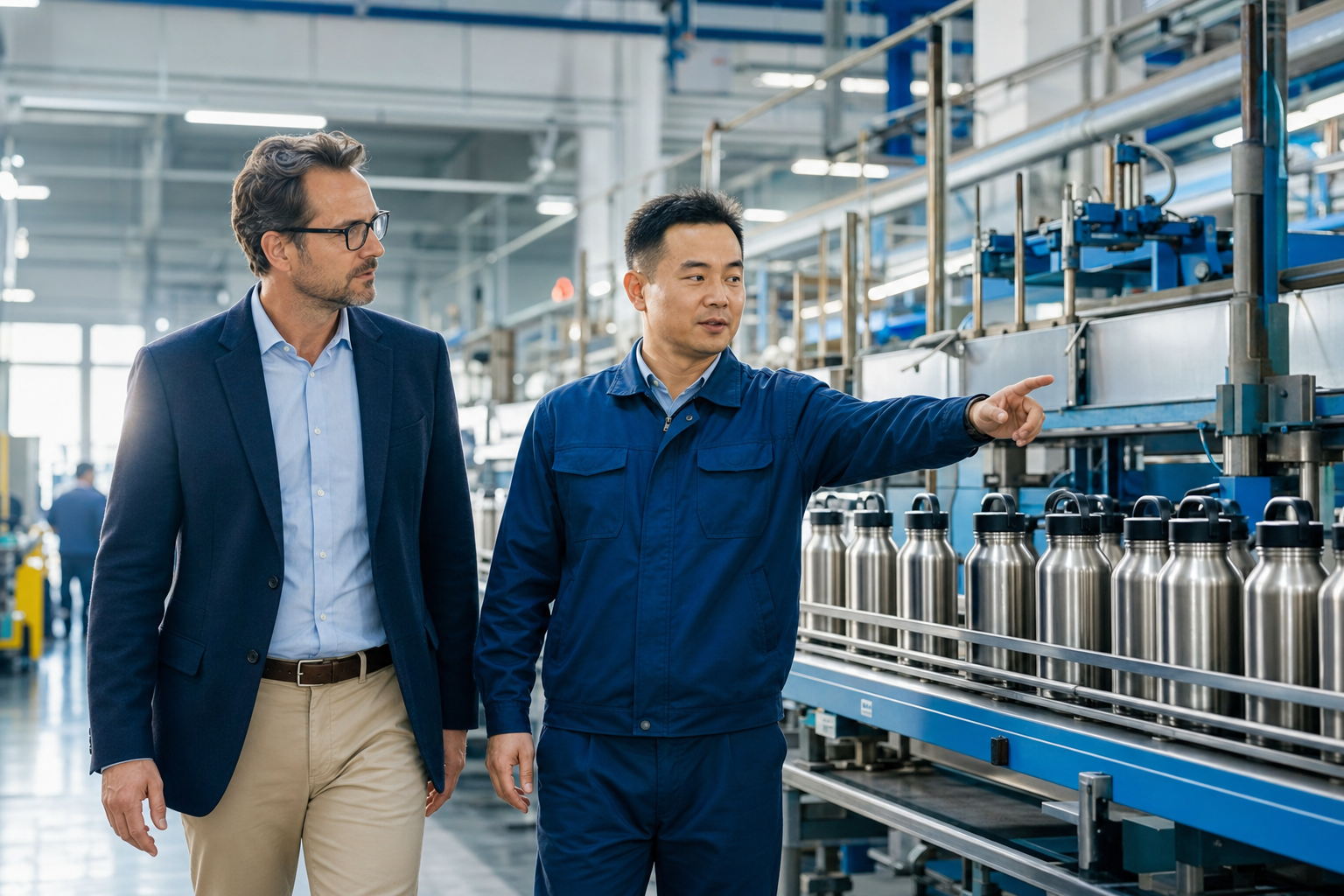
- Do they own the production line? Ask for video of their factory floor, not just photos. Trading companies will hesitate or send curated shots.
- What's their average customer tenure? A factory whose top accounts have been with them 5+ years has solved problems other factories haven't seen yet.
- Can they share a BSCI / Sedex audit report? If they say "in progress" for the third meeting in a row, move on.
- Who is your account manager, and how long have they been there? Turnover at the sales team predicts pain in your reorders.
If your supplier hesitates to put their account manager on a 30-minute video call, do not place an order with them.
3. Get a real quote, not a "starting from" price
A good quote breaks down the unit cost into components: tooling (one-time), raw material, labor, decoration, packaging, and the supplier's margin. A quote that just says "$3.20 each" is hiding things.
Decoration is where most surprises hide. Make sure your quote separately itemises:
- Setup / screen fees per color (silkscreen)
- Print position complexity (a wraparound logo costs more than a centered front print)
- Color matching ($0–$80 depending on whether Pantone-coated or a custom mix)
- Pre-production sample fees
4. Pay for the sample. Always.
The single highest-ROI thing in this entire process is the pre-production sample. It usually costs $80–$200 plus express shipping, takes 7–14 days, and saves you from approving a 5,000-unit run that turns out to have the wrong sheen, wrong logo placement, or wrong Pantone match.
What to insist on:
- Production-line conditions, not hand-finished. Ask your supplier to confirm in writing that the sample comes from the actual production tooling, not a one-off bench.
- Two identical samples — keep one, ship one. If a dispute arises later, you have your reference.
- Written sign-off, not verbal. "Approved" by email, with a photo attached, dated.
5. Specify AQL 2.5 in your PO
AQL (Acceptable Quality Limit) is the international quality-sampling standard used by every reputable inspection firm. AQL 2.5 General Inspection Level II is the drinkware industry baseline. It defines, in advance, what percentage of defects in a shipment is allowed before the shipment is rejected.
For a 5,000-unit order, AQL 2.5 means roughly:
- Critical defects (safety or compliance): 0 allowed.
- Major defects (function or appearance): 14 maximum out of a 200-unit sample.
- Minor defects (cosmetic): 21 maximum.
If your supplier won't accept AQL 2.5 in writing, that's a red flag.
6. Book a third-party pre-shipment inspection
For your first three orders with any supplier, we recommend booking an independent inspection — SGS, Bureau Veritas, Intertek, or TÜV. It usually costs $300–$500. The inspector pulls random samples, photographs defects, and signs off (or doesn't) on the shipment before it leaves the factory.
The economics: $400 to verify a $40,000 shipment. Easy math.
7. Choose your Incoterms intentionally
The three Incoterms most relevant to drinkware:
- FOB Ningbo / Shanghai: Cheapest. The supplier delivers to the port, you arrange ocean freight via your own forwarder. Best if you have a freight forwarder relationship and a regular shipping cadence.
- CIF (destination port): The supplier arranges sea freight to your nearest port. You take over for customs and inland trucking. A middle ground.
- DDP (door-to-door): The supplier handles everything — freight, customs, duties, last-mile. Most expensive, but you only see one invoice. Best for small/mid-size buyers without a forwarder.
For Amazon FBA prep, ask specifically: "Does this DDP price include the FBA prep work — labels, polybags, master carton compliance?" The answer is sometimes yes, sometimes no.
8. Plan for the reorder, not just the first order
The most expensive thing in this process is not the first order. It's the second order that has to be re-tooled because the supplier didn't keep records.
What you want your supplier to retain on file, indefinitely:
- Pantone color formulas and powder coat mix sheets
- Dielines for your decoration with measured placement coordinates
- Sample retention (one physical unit on a shelf, dated)
- Carton and packaging dielines
- QC inspection records from previous shipments
The good factories do this automatically. The mediocre ones say they do, then "lose" the files when you reorder six months later. Asking about reorder record-keeping in your initial supplier conversation is one of the best vetting questions you can ask.
Ready to start a sourcing project?
We'll send a quote and 1:1 mockup in 24 hours — no obligation.
Frequently asked questions
How long does it take to source custom drinkware from China?
From first email to packed container, plan 8–12 weeks for a standard order. Custom moulds add 3–4 weeks of tooling time. Reorders that use existing tooling typically ship in 25–35 days.
What is the typical MOQ for custom water bottles from China?
Stock-mould stainless thermoses and travel tumblers usually start at 500 units per SKU and colour. Plastic, glass, and kids' bottles start at 1,000 units. Custom moulds require 3,000+ units to amortise tooling.
Should I work with a trading company or a direct factory in China?
A direct factory is 10–25% cheaper and offers tighter quality control. Trading companies are easier to communicate with but introduce a margin layer and a quality-control gap. For orders over 1,000 units, direct factories almost always win on cost and consistency.
What is AQL 2.5 and why should I specify it in my purchase order?
AQL 2.5 (Acceptable Quality Limit) is the international quality sampling standard accepted by SGS, Bureau Veritas, Intertek, and TÜV. For a 5,000-unit order, it allows 0 critical defects, 14 major, and 21 minor defects in a random 200-unit sample. Specifying it in your PO commits both sides to a measurable quality bar.
How do I verify a Chinese drinkware factory before placing the first order?
Ask for a BSCI or Sedex audit report, a live video tour of the production line, the average tenure of their top 10 accounts, and a video call with your assigned account manager. A real factory will say yes to all four.