Key Takeaways
- A 500 ml glass bottle is the safest default for promo orders, with 2.5-3.0 mm wall thickness and a 220-380 g target weight.
- For most custom prints, MOQ starts at 3,000 pcs and mass production usually needs 25-35 days after sample approval.
- Use REACH, LFGB, AQL 2.5, and 1 m drop testing if the order ships to Europe or North America.
- A Zhejiang factory with 300,000 units/month can handle glass bottle for companies, schools, gyms, and retail programs at scale.
If you are buying a glass bottle for promotional gifts, the product has to do more than look clean in a mockup. It needs to survive 1.2m freight drops, keep the logo readable after 5 wash cycles, and stay inside the budget your finance team set for a campaign, employee kit, or retail bundle. That is where most B2B buyers get stuck: the sample looks fine, then the carton crushes, the print chips, or the lid leaks after 3 uses. We run into that on the line all the time, and it is a bad place to learn a lesson.
For buyers in Europe and North America, the useful question is not whether glass feels premium. It is which bottle spec makes sense for your glass bottle for business, your glass bottle for schools, or your glass bottle for giveaways. If you source from Zhejiang or the wider China supply base, you can keep cost tight, but only if you lock capacity, wall thickness, decoration, and packaging before production starts. QC pulled the sample on a 2.8 mm wall last week because the buyer flagged a PO typo on the cap color, and the math does not work if you fix those details after tooling.
Choose the Right Bottle Spec
The spec decides whether your glass bottle for promotional gifts feels premium or just fragile. Start with capacity, wall thickness, and lid style. For office kits and glass bottle for companies programs, 500 ml is the easiest size to place in a tote, a desk drawer, or a conference bag. For a glass bottle for kids or glass bottle for children, you usually move down to 300-350 ml so the bottle is lighter and easier to carry. For a glass bottle for gym or glass bottle for fitness use, 500-650 ml works if you want enough volume without making the bottle awkward. We ran one sample at 580 ml last season, and the buyer flagged it because it tipped over in a standard cup holder. That was the wrong spec.
Material choice matters too. Soda-lime glass is the normal, cost-efficient option for cold drinks, hydration, and most promotional use. Borosilicate is the better answer when you need thermal shock resistance, hot-fill, or a more technical product story. Ask for the actual wall thickness, not a vague promise. We check it with a caliper on the line, and 2.0-3.0 mm is the range that behaves well in packing and transit. Heavy builds land around 320-420 g for a solid hand feel; lighter ones sit near 220-280 g when the buyer wants lower carton weight and easier mailer dispatch.
- 300-350 ml for schools, students, and kids
- 500 ml for glass bottle for swag, events, and employees
- 650 ml for athletes, runners, cyclists, and hiking
- Silicone sleeve or bamboo lid when grip and perception matter
If the bottle will move through retail or ecommerce, keep the shape simple. Complex shoulders and narrow necks look nice, but they add breakage risk and often raise freight cost. QC pulled the sample from carton drop testing at 76 cm because the neck finish chipped on impact. We ship a lot of simple round bodies for that reason, and the math does not work if the design forces a thicker tray, a bigger carton, and more empty space.
Print A Logo That Lasts
Decoration decides whether a glass bottle for business looks planned or cut-rate. On promo runs, we usually start with silkscreen printing. It is controlled, cheaper, and the line can repeat it across 5,000 pcs without chasing color drift. One or two spot colors keep the quote sane and the registration clean. Full-color art needs a ceramic decal or high-temperature transfer, and the buyer usually pushes back when the unit price jumps and the lead time goes from 12 days to 18 days. Laser engraving belongs on bamboo caps or stainless lids, not on the glass body.
For glass bottle for marketing, conferences, and events, keep the logo readable from 1 to 2 meters away. Small artwork on clear glass disappears once the bottle is filled with water or tea. A matte white print on clear glass beats a tiny multicolor logo most times. We had one buyer flag a PO because the logo was set at 8 mm wide; QC pulled the sample, filled it, and the mark vanished. If the bottle is for a glass bottle for retail or glass bottle for ecommerce launch, check the decoration under real handling, not just under studio lights.
Practical rule
Use the simplest print method that still fits your brand. Every extra color, extra pass, or special finish adds cost, and it adds another place for the job to go wrong.
Ask for a wash test on the sample. A usable target is 20-30 dishwasher cycles for a promotional bottle, then inspect edge wear, logo fade, and lid fit. We run a 60°C wash test rack on site, and if the ink starts lifting at cycle 18, the math doesn't work.
Match The Use Case
A good glass bottle for promotional gifts is not one universal model. The use case decides the bottle. For a glass bottle for employees, we usually ship a 500 ml bottle with a low-key logo and a plain screw cap. That mix lands well. It feels like a desk item, not a giveaway. For a glass bottle for schools or glass bottle for students, we avoid heavy caps and sharp shoulder lines. Rounded bodies, smaller formats, and an optional silicone sleeve make it easier to stuff into a backpack. QC once flagged a 2 mm edge radius on a sample because the buyer’s safety team had zero patience for “close enough.”
For a glass bottle for hotels, restaurants, and cafes, the look beats capacity. Hospitality buyers usually ask for 350-500 ml, with a label area that prints clean and sits well on a table or in a minibar. For a glass bottle for giveaways, events, and glass bottle for swag programs, the math is simple: standard shape, simple branding, fast pack-out. We run those jobs with a plain carton and a lid that does not drive the unit price up. One PO came in with “3500 pcs” typed as “350 pcs” — the buyer flagged it before we even started carton art. A good lid does more than a fancy body.
For a glass bottle for gym, fitness, athletes, runners, cyclists, or hiking, the bottle has to hold water without leaking and still be easy to carry. A narrow-mouth build with a solid gasket and a grip-friendly sleeve beats a decorative wide-mouth design every time. Glass is heavier than Tritan or aluminum, so we say it straight. If the buyer wants daily use in a car cup holder or backpack, practicality wins. The wrong question is “can we make it look premium?” The right one is “will it survive 12 days of commuting without a complaint?”
- Employee kits: understated, durable, easy to reorder
- Schools and children: lighter format, safer silhouette
- Hotels and cafes: clean branding, premium presentation
- Sports and travel: leakproof lid, protective sleeve
Check Compliance Early
Check compliance before you approve artwork. For Europe, ask for REACH documents and, if the bottle touches food, LFGB food-contact reports. For North America, buyers usually want a written food-contact declaration and their own check against ASTM-style transport and packaging tests. We had one buyer flag a PO because the carton spec said 48 pcs, then the artwork draft still showed 50; that sort of mismatch slows the line. If the bottle is for retail, the carton, label copy, and barcode placement need the same discipline as the glass itself. For Amazon, decide the outer carton, polybag, and FNSKU spot before production starts.
Put quality control in the purchase order. Do not leave it as a verbal promise. A clean inspection plan is AQL 2.5 for major defects and 4.0 for minor defects. For fragile glass, we run carton drop tests from 1 m, random leak checks, and lid-close checks across the full run. QC pulled the sample once and found a 0.6 mm gap on two caps; that kind of miss becomes a claim later. ISO 9001 and BSCI are not magic words, but they do show the factory has traceability and social compliance on paper and on the floor.
For orders going to schools, hospitality, or corporate gifts, packaging carries real weight. A 5-ply master carton, dividers between units, and clear outer marks cut breakage more than a fancy print ever will. We ship this way for 24-bottle and 48-bottle cases, and the math works. A buyer once pushed back on a premium gift box and wanted to save 0.18 USD per unit; the sample arrived with two cracked necks out of 30 in transit, so that “saving” vanished fast.
Source From Zhejiang With Control
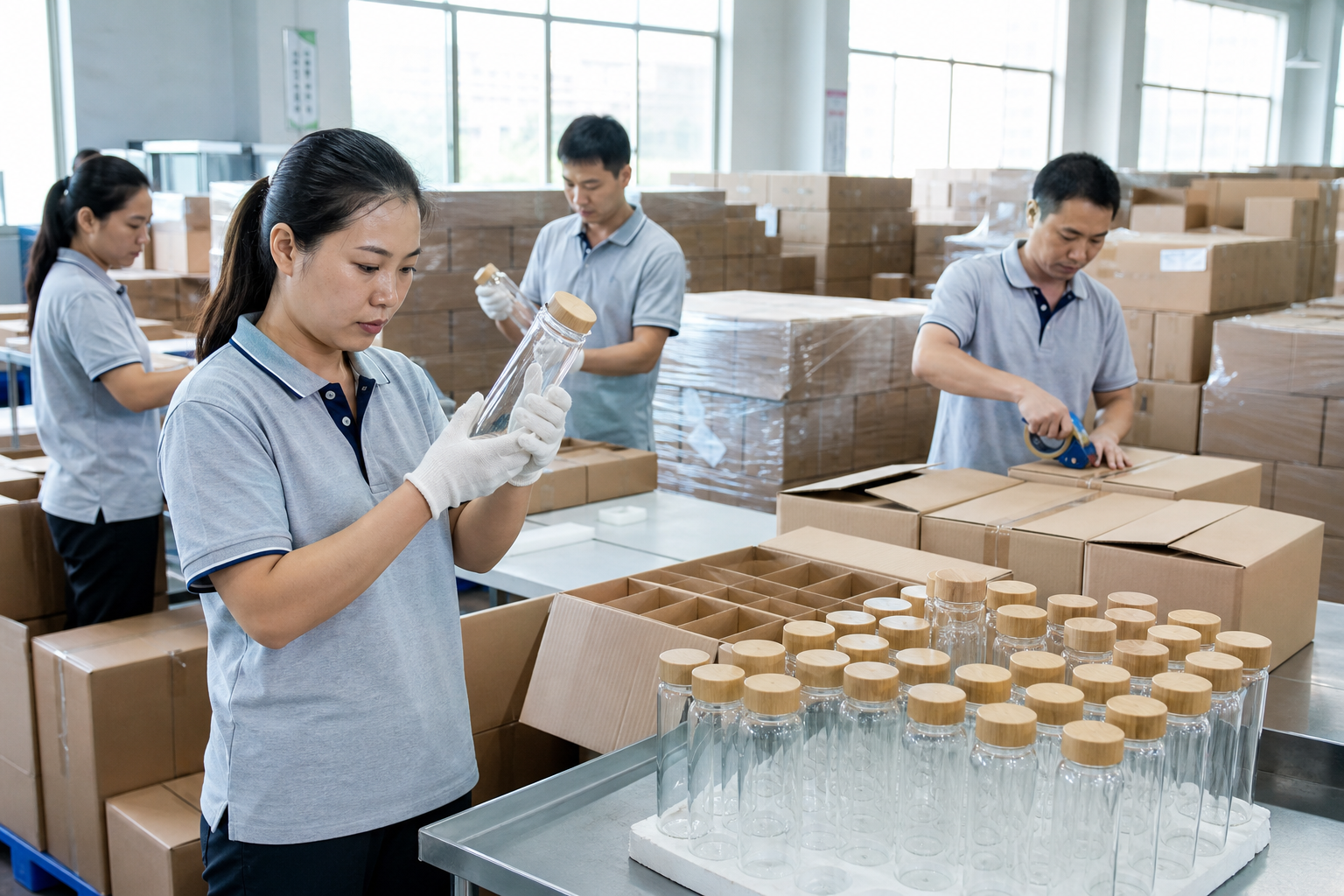
If you buy from China, the factory matters more than the pin on the map. Zhejiang has a dense drinkware chain, so we can source caps, cartons, decals, and replacement tooling without burning weeks. A factory worth your time should quote sample lead time, production lead time, and the decoration method in plain numbers, not hide behind a bottle price. At BottleForge Industrial in Hangzhou, our standard drinkware lines run about 300,000 units per month, and most printed glass bottle jobs start at an MOQ of 3,000 pcs.
Typical timing is simple: sample approval in 5-7 days for stock shapes, then 25-35 days for mass production after the sample is signed off. If you need a new mold, add tool development before the order clock starts. We had a buyer flag a PO typo on a 500 ml bottle last month, and QC pulled the sample again because the neck finish was off by 0.3 mm. FOB Ningbo is common for Zhejiang exports, but some buyers still choose Shanghai if their forwarder is set up there. Lock the shipping term early, or your landed cost is guesswork.
Ask for three things before you place the order: a dimensional drawing, a pre-production sample, and a packaging spec with carton count and gross weight. If a supplier cannot send those fast, they are not ready for a serious glass bottle for business or glass bottle for companies program. This is the wrong question to ask later, because the math does not work once cartons, pallet height, and breakage rate are already fixed. We run the line with a tape measure and a 2 kg drop test, so the paper trail has to match the glass.
Price The Campaign Properly
Price only makes sense once you split it into line items. A plain glass bottle for promotional gifts usually sits around USD 0.65-1.10 ex-works for a standard shape. Add one-color print, a premium lid, a silicone sleeve, or an individual gift box, and the quote moves fast. For a 500 ml bottle, we usually see USD 0.85-1.90 before freight, depending on print area, packaging, and order size. A retail-ready box or mailer adds another 0.20-0.80 per unit. The math does not lie.
For glass bottle for ecommerce or glass bottle for retail programs, do not squeeze the packaging budget. If the bottle ships by parcel, we run stronger cartons, extra inner partitions, and often an outer box too. On a recent 3,000-piece job, QC pulled the sample after drop testing because the 60 mm neck chip rate was too high, so we changed the insert before mass production. That adds 8-15 percent to landed cost, but it beats refund claims and breakage fights later. For glass bottle for restaurants, cafes, hotels, and conferences, a cracked carton is not just a lost unit. It is labor, repacking, and a buyer on the phone asking why the PO said "gift box" but the file showed plain brown carton.
Before you ask for quotes, lock down the size, lid, print colors, carton quantity, destination port, and whether you need retail labeling. One typo on a PO can change the whole quote; we have seen "500 ml" turned into "50 ml" and the buyer flagged it only after sampling. Once those points are fixed, comparing offers from China gets cleaner, and you can spot whether a low number is real or just a weaker spec.
Source your next glass bottle with fewer surprises
Send the spec, target market, and artwork, and we will align MOQ, decoration, compliance, and packing before production starts.
Frequently asked questions
What MOQ should I expect for a custom glass bottle for promotional gifts?
For most standard shapes, a realistic MOQ is 3,000 pcs per design when you want one-color silkscreen or a simple logo. If you add full-color decal, custom caps, or premium boxes, 5,000 pcs is more common. Stock shapes with limited branding can sometimes start lower, but unit cost rises quickly. For a pilot run, expect a surcharge of about 15-30 percent. A normal sample lead time is 5-7 days, and production usually takes 25-35 days after sample approval. If your order is for Europe or North America, keep the same bottle spec across the first run so quality is easier to control.
Which print method is best for a glass bottle for business use?
Silkscreen is usually the best balance of cost, durability, and repeatability for a glass bottle for business. It works well for one or two spot colors and keeps the logo readable without inflating the price. Ceramic decal is better when you need gradients, fine detail, or full-color artwork, but it adds cost and can extend the lead time. Laser engraving is more suitable for metal lids or bamboo caps than the glass body. If the bottles will be washed often, ask for a practical wash test after 20-30 cycles and inspect the logo edges for fade or lift.
Can a glass bottle for gym or fitness use handle hot and cold drinks?
Yes, but the spec has to match the temperature range. For cold water, iced drinks, and standard hydration, soda-lime glass is fine and usually the lower-cost choice. If you need hot-fill above 80 C or frequent temperature swings, borosilicate is the safer option because it handles thermal shock better. The lid matters too: a weak gasket will fail before the glass does. For gym, fitness, athletes, runners, cyclists, or hiking, focus on leak resistance, grip, and carrying comfort. Glass is heavier than plastic, so a 500 ml format is often the most practical compromise.
How do I reduce breakage on a glass bottle for giveaways shipment?
Use packaging as if the bottle will be handled roughly, because freight often is. A practical setup is a 5-ply master carton, dividers between bottles, and 1 m drop testing before mass production. Keep wall thickness in the 2.5-3.0 mm range for a stronger feel, and avoid very thin decorative necks. If the order is for glass bottle for swag or event kits, a silicone sleeve helps both grip and impact resistance. Ask the supplier for AQL 2.5 on major defects, random leak checks, and carton gross weight confirmation before the shipment leaves the factory.
Are glass bottles suitable for schools, hotels, and restaurants?
Yes, if you choose the right size and hardware. For schools and students, a 300-350 ml bottle is usually easier to manage, and rounded shoulders reduce the risk of chips. For hotels, restaurants, and cafes, a 350-500 ml bottle gives you a clean presentation without making the unit too heavy for service staff. In both cases, ask for food-contact compliance such as REACH and LFGB where relevant, plus clear labeling and outer cartons that are easy to store. If you want a premium feel, keep the logo small and let the glass quality and packaging do the work.