Key Takeaways
- A realistic MOQ for custom drinkware is often 500-1,000 pcs, with 30-45 days lead time after sample approval.
- 304 stainless steel is the common baseline; 316, Tritan, and borosilicate are used when the use case justifies the cost.
- Vacuum bottles need controlled welding, evacuation, and leak testing or thermal performance will drift fast.
- If you source from China, ask for REACH, LFGB or FDA food-contact documents, AQL inspection terms, and packed weight before you price freight.
If you are trying to figure out how to manufacture drinkware, start with function, not decoration. A 500 ml stainless bottle for retail, a 32 oz sports bottle for promotions, and a vacuum flask for premium gifting are not built the same way, even if they look alike on a product page. Wall thickness, lid system, sealing method, and test standard drive the cost and the failure rate.
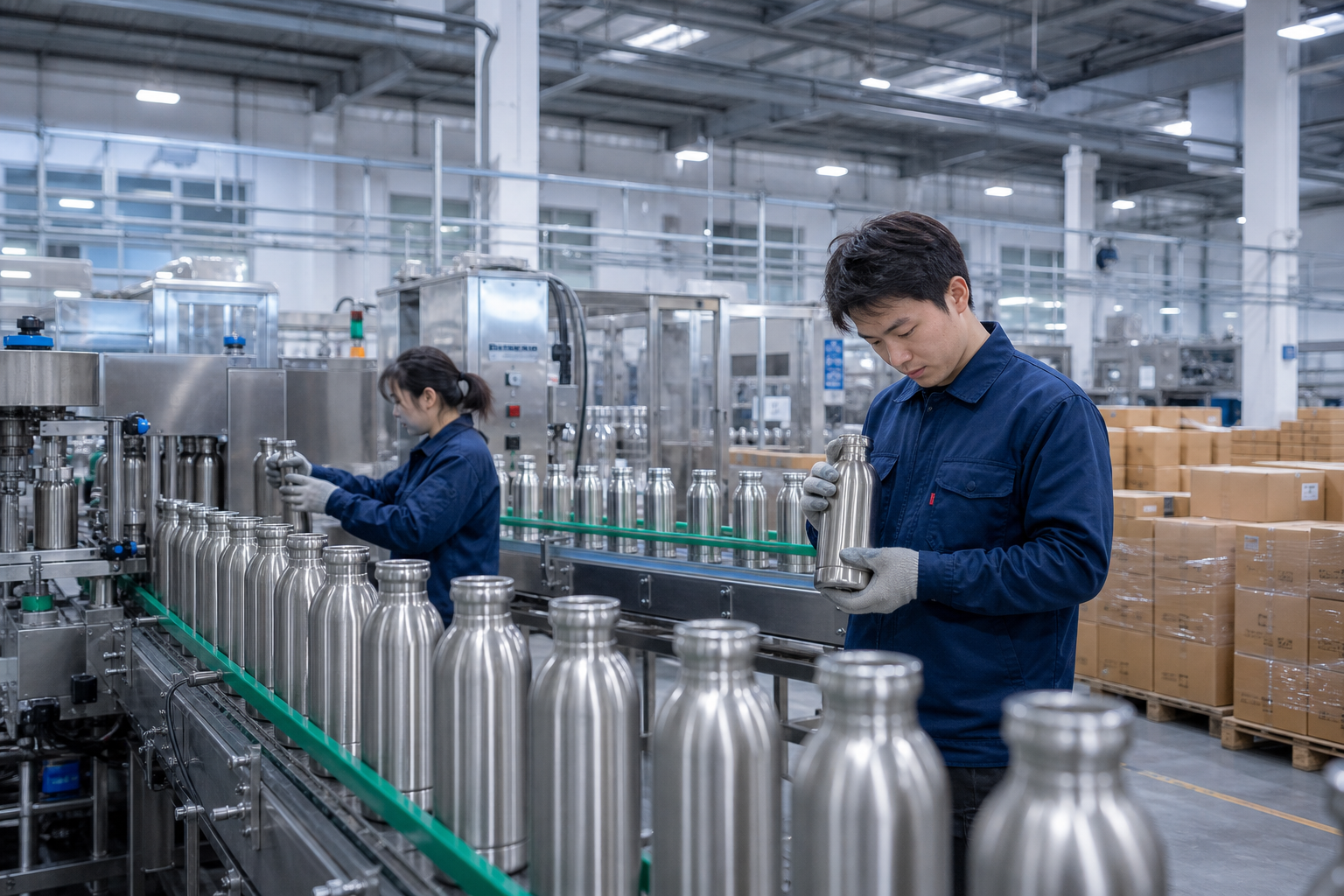
For buyers sourcing in China, the gap between a smooth program and a headache usually starts on the spec sheet. A factory in Zhejiang can run 120,000 units a month, but only if you give clear requirements on material, finish, leak protection, and carton packing. We ship with a laser welder on the line and QC pulled the sample for a 24-hour leak test before mass production. This guide shows how we manufacture drinkware from China with fewer surprises, whether you need a reusable water bottle, a thermos bottle, or a vacuum insulated bottle for the EU or North American market.
Start With the Product Spec
The fastest way to waste money is to ask a factory to quote “a bottle” with no spec. We see this every week. Before you ask how to manufacture water bottles or how to manufacture drink bottle from China, pin down the use case. Is it a commuter thermos, a gym bottle, a children's bottle, or a retail refillable water bottle? Each one fails in a different spot. A sports bottle needs one-handed opening and impact resistance. A vacuum flask needs thermal retention and a tighter seal. A glass bottle needs shock protection and a different carton layout, and the buyer will flag it if you mix those up.
Write the spec in the language the factory uses:
- Capacity: 350 ml, 500 ml, 750 ml, or 1,000 ml.
- Material: 304 stainless, 316 stainless, Tritan, borosilicate glass, or aluminum.
- Finish: powder coat, glossy paint, matte spray, or laser engraving.
- Lid type: screw cap, flip lid, straw lid, or insulated cup lid.
- Performance: leak-proof, 6-12 hour hot/cold retention, or pass drop testing at 1.2 m.
Once the spec is written this way, you are not just learning how to manufacture reusable water bottle from China. You are making the supplier quote the same item you plan to buy. The math does not work any other way. On our line, a 2 mm wall change or a typo like “500ml” turned into “550ml” has already moved MOQ and price on the same PO. A clean spec sheet also speeds sample approval, and QC pulled the sample against that sheet before we shipped the first 48 cartons.
Choose the Right Material
If you want to know how to manufacture stainless steel bottle from China, material choice is the first real decision. For most food-contact drinkware, 304 stainless steel is the baseline we run on the line. It is easy to source, resists corrosion, and fits a standard vacuum insulated bottle without drama. If the bottle goes into salty drinks or a harsher market, 316 stainless is the safer call, but the extra cost is real. For a double-wall thermos bottle, we usually spec 0.4-0.6 mm inner and outer shells, and QC pulls the gauge if the wall thickness drifts.
For non-metal products, Tritan copolyester is the usual pick for clear reusable water bottles because it stays light and takes impact well. Borosilicate glass works for premium infuser bottles and tea bottles, but the packing cost goes up fast because breakage is not theory. Aluminum bodies are lighter, yet they need the right internal lining or the buyer will flag flavor transfer and corrosion after the first sample round. If you are asking how to manufacture water bottle from China at competitive cost, do not over-spec the material. A 316 bottle with a premium finish can look nice on a quote sheet, but the math does not work if your channel cannot carry the price.
Factories in Zhejiang and across China usually quote by material grade, wall thickness, lid complexity, and coating process. That is why two bottles with the same volume can differ by 30-50% in price. We once saw a PO with “304ss” typed as “340ss”; the buyer caught it before production, and that kind of typo can waste a week. Ask for the raw-material declaration, then check the grade on the sample label and the packing list. If the supplier cannot state the material cleanly, they are not ready for export work.
Form, Weld, and Vacuum Seal
The manufacturing method changes the result. A standard stainless bottle starts on the line with sheet metal cut, deep-drawn, trimmed, and neck-formed. We run the inner shell and outer shell separately, then join them with a controlled gap, usually 1.5 mm to 2.0 mm depending on the spec. For a vacuum insulated bottle or vacuum flask, QC pulled the sample after evacuation, then the neck gets sealed under controlled conditions. That vacuum layer slows heat transfer. If the seal drifts, the bottle can look clean on the outside and still fail thermal tests.
For buyers comparing how to manufacture thermos from China versus how to manufacture vacuum bottle from China, process control is the real question. Laser welding gives a cleaner seam than manual welding, and we have seen manual beads open up after 12 days of hot-cold cycling. Some factories use copper plating on the outer wall or inner wall to improve thermal performance. After sealing, each unit needs a leak test and a temperature-retention test. A proper export-grade thermos bottle program also includes oven curing checks for coatings and a sample cross-section inspection for weld quality. The buyer flagged a PO typo once—0.8 mm became 8 mm—and the math simply did not work.
Do not judge a vacuum bottle only by sample appearance. The first batch can look clean and still fail after 20 cycles if the vacuum seal is weak or the weld is inconsistent.
If your buyer keyword is how to manufacture vacuum insulated bottle from China, this is the section you cannot skip. The bottle body is not the product. The seal is the product.
Specify Caps and Branding
A bottle that leaks through the lid fails faster than one with cosmetic scratches. The cap system needs the same attention as the body. For how to manufacture drink bottle programs, ask the factory what gasket material they use, how many cycles the lid is rated for, and whether the straw, spring, or hinge was tested under normal wear. We run 10,000-cycle checks on the lid press fixture, and QC pulled one sample with a 0.3 mm flash line at the thread root. Silicone gaskets are common, but the hardness and food-contact declaration need to be on paper. If the lid includes a PP shell or a stainless top, confirm the grade and the molding gate position, because poor tooling can leave weak threads or flash.
Branding changes cost and lead time. Silk screen is the low-cost choice for 1-2 color logos. Laser engraving gives a permanent mark on stainless steel bottle products and no ink wear. Powder coating gives grip and a cleaner hand feel, but it adds one curing step on the line. If you are planning private label work, match the decoration method with your MOQ. A 500 pcs order fits laser engraving well, while a multi-color wrap print usually needs a higher quantity to keep the unit price sane. One buyer once sent a PO with the logo code in the wrong font file, and that typo cost us a full day.
Use this rule: the more complex the lid and decoration, the more samples you need before mass production. Ask for a decorated pre-production sample, not a blank shell. If the decoration shifts the center of gravity, or the cap print rubs off in a simple abrasion test, fix it before tooling moves to full production. We've seen this go sideways when the buyer skipped the decorated sample and approved from photos only—then the lid sat 1.5 mm off-center after assembly.
Test Against Real Standards
If you are buying for Europe or North America, compliance is not optional. A supplier who knows how to manufacture drinkware should be able to show REACH paperwork, LFGB or FDA food-contact declarations where they apply, and batch traceability from raw material to packed carton. We run this every week on the line. For coated products, ask for coating composition and cure records. For insulated bottles, the 12-hour or 24-hour retention claim needs a repeatable test method, not a line on a quote sheet.
Quality control belongs in the PO, not in the complaint email after the shipment lands. A normal export program uses AQL inspection for appearance, function, and packaging, with the lot size and acceptance level written down before the first run. Ask for scratch limits, color tolerance, leak criteria, and carton drop test requirements before production starts. A buyer once pushed back on a 1.2 m drop test, then the cap cracked in transit; the math does not work if you skip the spec. For example, a retail bottle may need a 1.2 m drop test on three faces, while a premium thermos may need a tighter carton spec because the cap assembly is heavier and the box gets crushed at the corners.
- Confirm the AQL level for major, minor, and critical defects.
- Ask for incoming material checks on stainless, PP, and silicone.
- Require final random inspection photos with carton count and lot code.
- Keep one golden sample signed by both sides.
That process sounds strict, but it is cheaper than chargebacks, returns, and retailer penalties. QC pulled the sample, and the leak test caught a bad gasket before packing. If the factory in China cannot document these checks, the quote is not low. It is incomplete.
Source From China With Control
When buyers ask how to manufacture drinkware from China, they usually mean one thing: how to get a decent product without becoming the full-time QC guy. We treat supplier selection like an engineering audit. A solid Zhejiang factory should show monthly output, sample lead time, tooling setup, and test records. If a plant says 120,000 units per month but cannot state MOQ, normal lead time, or the vacuum sealing process it runs, that number is just sales talk.
Ask direct questions. Can they make how to manufacture water bottles from China programs at 500 pcs? Can they support custom logo work with a 7-10 day sample cycle? Can they ship FOB Ningbo or FOB Shanghai? Can they give packing dimensions for Amazon FBA or retail cartons? Freight, carton size, and retail checks can move landed cost more than the bottle price, and the math does not work if you skip those details. We had a buyer flag a PO for a missing carton weight once; the fix was a 2 kg change on the master carton, not a lower unit price.
For a first order, keep it tight. One body. One lid. One finish. One carton spec. That setup makes quote comparison clean and makes hidden cost drivers show up fast. We run this way on the line because it saves time when QC pulled the sample and found a 1.5 mm gap at the lid seat. If the supplier in China is open, they will split out tooling, sample fee, packaging, and testing. If they are not, you will pay later in delay, rework, or rejected cartons. Good sourcing is not about chasing the lowest number. It is about buying a process you can repeat.
Send your drinkware spec for a real quote
Share material, capacity, logo method, and target market. We will turn it into a manufacturable bottle spec with MOQ, lead time, and compliance details.
Frequently asked questions
What MOQ should I expect for custom drinkware?
For most custom drinkware orders, expect an MOQ of 500-1,000 pcs per design and color. Simple stainless bottles can sometimes start at 500 pcs, while multi-color print, special lids, or custom molds may push the minimum to 3,000 pcs. If you need one logo and one packing style, the factory can usually keep the price sharper. If you want mixed colors, gift boxes, and multiple lid types, the MOQ moves up because setup time and scrap increase. For a first order, ask for the blank sample cost, decorated sample cost, and mass-production MOQ separately so you can judge the real entry point.
How long does it take to make a vacuum bottle in China?
A normal timeline is 7-10 days for samples, 10-15 days for tooling adjustments if needed, and 30-45 days for mass production after sample approval and deposit. If the bottle uses a new lid mold, custom coating, or special packaging, add another 7-10 days. For how to manufacture vacuum insulated bottle from China projects, the vacuum sealing and leak test stage can become the bottleneck, so ask the factory how many lines they run and whether they test every unit or use batch sampling. Freight time is separate, so a buyer should still plan around the destination lane and the season.
Which material is best for a reusable water bottle?
There is no single best material. For a reusable water bottle aimed at retail or corporate gifting, 304 stainless steel is usually the safest default because it balances cost, durability, and corrosion resistance. If the bottle will see heavier use or harsher environments, 316 stainless is stronger but usually not needed for a standard program. For clear bottles, Tritan is light and impact-resistant, while borosilicate glass is better when flavor neutrality matters more than drop resistance. If you are comparing how to manufacture reusable water bottle from China options, use the channel price and target user first, then choose the material.
What quality checks should I require before shipment?
At minimum, require appearance checks, leak testing, lid cycle testing, carton drop testing, and a final AQL inspection. For stainless products, ask for confirmation of weld quality and any visible coating defects. For insulated products, request thermal retention test results on the actual production lot, not only on a prototype. If the product goes to Europe, ask for REACH-related documents; if it is for food contact in the US, ask for the relevant compliance declaration. Good factories in Zhejiang can document these steps without hesitation. If they cannot, your risk is in the shipment, not in the sample.
How do I compare factories in China without wasting time?
Compare them on the same four numbers: MOQ, sample lead time, monthly capacity, and defect control method. A useful factory will tell you whether it can produce 500 pcs, 5,000 pcs, or 50,000 pcs of the same design, and whether the line is set up for stainless steel bottle, thermos, or plastic bottle production. Ask for FOB port, carton dimensions, and test standards. If one supplier quotes a lower unit price but hides tooling, decoration, or inspection cost, the project is not actually cheaper. The best China factory is the one that quotes clearly and ships consistently.