Key Takeaways
- Typical MOQ for a lead-free glass thermos custom order is 3,000–5,000 pcs, with 35–45 days lead time.
- A real lead-free glass thermos bottle manufacturer should provide REACH, LFGB or FDA-related documentation, plus AQL 2.5 inspection.
- Wholesale pricing for a 500 ml lead-free glass thermos flask bulk order usually starts around USD 2.10–3.80 FOB China depending on lid and print.
- A good factory in Zhejiang can produce 200,000 units per month, but glass breakage control and packaging design matter more than capacity.
If you are buying lead-free glass thermos wholesale, the first mistake is treating every “glass thermos” as the same unit. It is not. The liner wall, lid gasket, outer shell coating, and the test standard behind the “lead-free” claim all change the risk. For B2B buyers, a quote only means something when it shows the material spec, sample quantity, and a real QC standard, not just a nice photo from the catalog.
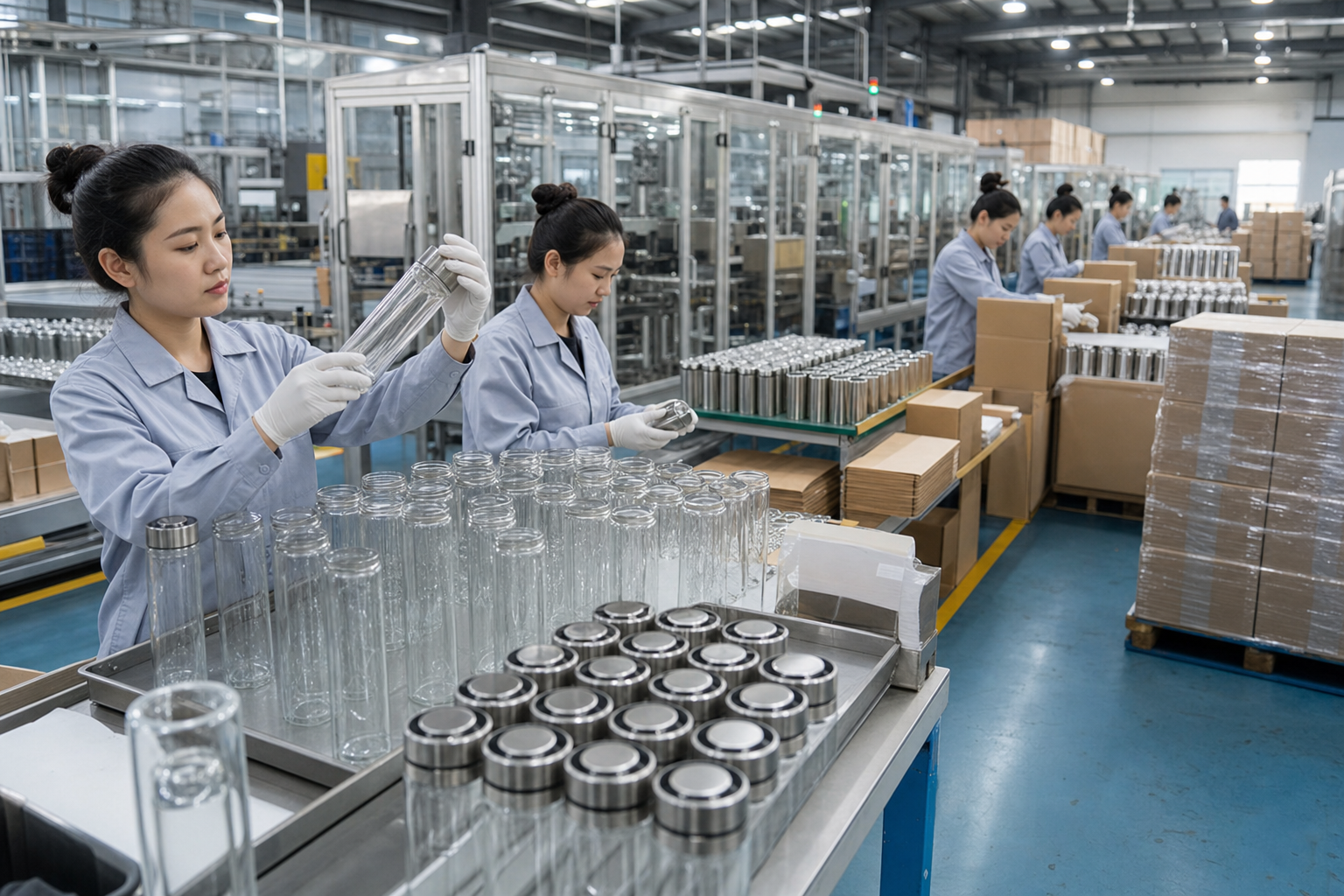
From our factory in Zhejiang, China, we see this every week on the line: a brand asks for a lead-free glass thermos bottle custom project, then the MOQ, decoration method, and breakage rate end up driving the price. QC pulled a 20-piece sample last Tuesday and found two lids with a loose seal at 0.8 mm; the buyer flagged it, and that saved a mess later. If you want a lead-free glass thermos supplier that can handle retail packaging, bulk cartons, and compliance for Europe and North America, buy by structure, not by headline price. That is the wrong question to ask.
What “lead-free” actually means
In drinkware sourcing, “lead-free” is not a marketing adjective you can leave vague. It means the glass body, pigments, decals, glaze, and any printed layer that touches the product have been checked against the claim. For a lead-free glass thermos, we want written confirmation that the glass itself has no intentionally added lead, and that decoration inks and coatings match the target market rules. If you sell into the EU, ask for the REACH declaration. For the U.S., ask which test report supports the food-contact claim, and do not accept a one-line statement with no lab report. We once saw a PO with “lead free” typed into the item name and nothing else—the buyer flagged it, and the line had to stop for paperwork.
The real problem is that buyers often check only the glass body and forget the cap, gasket, and metal parts. A lead-free glass thermos bottle supplier should be able to split the BOM by material: borosilicate or soda-lime glass, PP or Tritan lid, silicone seal, stainless outer shell, and printed logo layer. If one part carries heavy metals or a non-compliant colorant, the whole claim gets shaky. We keep batch material files in the office for export runs; ask for them. A serious lead-free glass thermos manufacturer will not push back. On our line, a 0.2 mm print offset once turned into a compliance review because the ink spec on the sample did not match the approved sheet.
Ask for the test basis before you ask for the price. If the supplier cannot name the standard, the claim is weak.
For outdoor retail, a lead-free glass thermos flask wholesale program should also include breakage testing and thermal retention data. We run drop tests from 80 cm onto a steel plate, and we ship against that result, not a sales phrase. “Lead-free” clears one gate. It does not make the product shelf-ready by itself.
Glass thermos structures buyers can source
Not every lead-free thermos is built the same way. In wholesale, we usually run a double-wall glass liner inside a stainless steel or PP outer shell, with a screw lid and a silicone ring. Some models are closer to a lead-free glass thermos flask for tea service, and some are plain daily bottles with a wide mouth that makes washing easier. For outdoor retail, that wide mouth cuts returns because customers can clean the bottle properly. We’ve seen the opposite go sideways fast.
The part buyers miss is the liner wall thickness. That number drives breakage and weight. For export-grade goods, the inner glass wall is often around 1.2–1.8 mm, depending on capacity and shape. Thicker glass takes a hit better, but it adds grams and can change heat retention. A real lead-free glass thermos bottle factory should give you the thickness range on the spec sheet, not just throw out “durable.” QC pulled the sample and measured it with a caliper.
- 350 ml tea-style flask: lighter at the hand, stronger premium feel
- 500 ml daily bottle: best balance for wholesale and private label
- 750 ml family bottle: lower unit cost, but shipping cartons get heavier
- Infuser version: better margin, more parts, more QC checks
For brands, a 500 ml lead-free glass thermos custom model is the safest start. It sells in Europe and North America, fits standard carton packs, and keeps freight under control. A Zhejiang line like ours usually has this size ready because the tooling, inner box, and drop-test setup are already proven. That matters on a first OEM run. We once caught a PO typo where the buyer wrote 550 ml, then asked why the carton count did not match.
Pricing, MOQ, and real lead times
Wholesale pricing tracks structure, decoration, and packaging. For a standard lead-free glass thermos bulk order, a plain 500 ml model in a normal carton usually starts around USD 2.10–2.60 FOB China. Add a printed logo, a color box, and an upgraded lid, and the same item moves to USD 2.80–3.80. We had one buyer push back on a metal band quote because the PO said “laser mark,” but the artwork file was a 4-color wrap. That math does not work. A lead-free glass thermos bottle private label order with gift packaging can run higher, especially when the lid spec changes from PP to stainless and the buyer wants tight pantone matching.
MOQ ties to tooling and packaging setup. A common MOQ for a lead-free glass thermos flask custom job is 3,000 pcs per color, and it jumps to 5,000 pcs if you need special surface treatment or a new mold. On one run, QC pulled the sample and found a 1.2 mm gap at the cap liner, so we held the line until the tooling was corrected. Lead time is usually 30–45 days after sample approval and deposit. If a supplier says 10 days for a custom glass thermos, they are either quoting stock goods with your logo or hiding risk in the schedule.
Our Zhejiang production line runs about 200,000 units per month across several drinkware categories, but that number means nothing if your packaging spec lands late. What matters is where your order sits: glass forming, lid assembly, logo application, or final AQL inspection. We ship faster when the carton file is clean on day one. Ask for a production calendar, not a vague promise. A serious lead-free glass thermos flask supplier will quote the ex-works date, carton dimensions, and loading plan, and they will show you the PO typo before it turns into a delay.
OEM and private label options that sell
If you are building a brand, the clean move is a lead-free glass thermos oem or lead-free glass thermos odm project, not a random stock buy. OEM means you control the artwork, carton copy, and sometimes the lid color or sleeve. ODM means we run a proven body shape and you tune it for your market. For a first order, ODM is usually the safer call because the mold is already paid for and QC has logged the weak points from past runs. We once had a buyer push for a full new mold on a 1,000-piece trial; the math did not work.
A strong lead-free glass thermos private label program should cover body color, logo method, and packaging. You do not need to redesign the whole line. Over-design usually means a higher MOQ and slower ship date. For a lead-free glass thermos bottle private label launch, we usually keep one body style, two lid colors, and one carton spec. That is enough to look branded without tying up cash in dead stock. On the line, a 2 mm print shift or a wrong Pantone sample can start a new round of approvals, so keep the spec tight.
What you can customize
- Logo method: silk screen, pad print, laser on metal parts, or UV transfer
- Cap material: PP, Tritan, stainless outer cap, or bamboo-look accent
- Colorway: Pantone match within practical tolerance
- Packaging: mailer box, retail box, or gift set
If you need a lead-free glass thermos bottle manufacturer that can support Amazon or retail channels, ask whether the factory can print FNSKU labels, add polybags, and do barcode verification. Those jobs sound basic, yet they are where chargebacks start. QC pulled the sample last week and found one barcode sticker placed 8 mm off-center; the buyer flagged it before shipment. A lead-free glass thermos bottle custom project works when we ship the product and the package as one job, with one owner, from carton to pallet.
Testing, compliance, and QC standards
Any lead-free glass thermos supplier worth your time talks in test data, not slogans. For Europe and North America, ask for the batch file: material declaration, food-contact statement, REACH status, and FDA-related support docs from the material side if the buyer asks. We’ve had a retailer flag a PO because the declaration said “glass cup” instead of “glass thermos.” Small typo. Big delay. If you sell into retail, drop testing, thermal shock, and leak testing matter too, because those issues drive returns faster than a paperwork gap.
For QC, ask for AQL by defect class. A practical start is AQL 2.5 for major defects and 4.0 for minor defects on a lead-free glass thermos bottle bulk order. Major defects cover cracked liners, leaking lids, and missing parts. Minor defects cover print misalignment and carton scuffing. If the supplier has no written QC standard, the math does not work, and “wholesale” becomes a gamble.
In our Zhejiang export line, we check the glass liner, lid torque, seal fit, thermal retention, and carton drop performance before shipment. Torque gets measured with a digital torque meter at 0.35 N·m, not by hand feel. If you are buying a lead-free glass thermos flask factory program, ask whether the packaging passed ISTA-style transport testing or at least internal drop tests from 80 cm. We run the test after the foam insert is packed, because a weak pack will show up on the truck, and sea freight from Ningbo makes the damage bill worse.
When you source from China, compliance is a chain: materials, production, inspection, packaging, shipping docs. That chain should be visible before you place the deposit. We’ve seen this go sideways when a buyer approved the sample but skipped the pre-shipment photo set. QC pulled the sample, checked the weld seam and liner mouth, then found a 1.2 mm chip at the rim. The shipment stopped. Better a pause in the warehouse than a claim after loading.
How to choose a supplier in China
The gap between a solid lead-free glass thermos factory and a risky trading quote shows up in the first 5 minutes. Ask where the glass comes from, whether they own the assembly line, and how many export SKUs they ship each month. If the reply stays vague, you are talking to a middle layer, not a plant. A direct lead-free glass thermos bottle factory or lead-free glass thermos flask manufacturer should walk you through forming, annealing, assembly, inspection, and packing. We once had a buyer flag a PO typo on the lid color code, and that kind of mistake is cheap to catch early.
China has capable drinkware plants, but the better ones in Zhejiang keep batch control tight. Check whether they hold the same gasket hardness, print color, and lid torque across repeat orders. If they cannot, your private label line drifts fast. Ask for a sample from the last mass-production batch, not just a polished pre-production sample. QC pulled the sample at 18.2 mm neck fit once and found the real issue in 3 minutes.
A practical supplier scorecard looks like this:
- Production capacity: 200,000 units/month or more
- MOQ: clear by color and by package format
- Lead time: 30–45 days for custom, shorter only for stock
- Compliance: REACH, food-contact declarations, and traceable batches
- Service: artwork support, carton layout, and shipment booking from China
If you need a lead-free glass thermos flask wholesale partner that can keep reorder quality steady, Zhejiang is a sensible base. The cluster helps with lid sourcing, carton printing, and freight booking. We've seen this go sideways when a buyer chased the lowest quote and skipped the carton test; the math doesn't work. For a run of 5,000 pcs, that factory-floor coordination matters more than a pretty offer sheet.
Packaging and shipping for retail channels
Glass breaks in transit when packing is left to the last minute. A lead-free glass thermos bottle wholesale order needs inner trays, corner blocks, and a carton that can take the trip from line to port, then 12,000 km of ocean freight, then warehouse hands. For North America and Europe, we run carton tests around 15 kg drop handling and keep damage under 1.5%–2.0%; once QC pulled the sample, the weak point was the divider cut, not the bottle itself.
For Amazon FBA or retail distribution, ask for carton size, gross weight, and barcode位置 before production starts. If the item is a lead-free glass thermos flask private label run, the outer carton may need a retail window or hang-tag, but the inner pack still has to survive a 1.2 m drop. A clean print job does not save a cracked liner. The buyer flagged a PO typo on the carton count once, and we caught it before the line ran 8,000 pcs.
We usually ship glass thermos in master cartons that balance cube rate with breakage. Put 12 units in when the box is only built for 10, and the math doesn't work; cut it to 6, and freight cost jumps. A proper factory in China should give you a carton loading plan, not just a unit price. If your supplier cannot show how many pcs fit in one 20GP or 40HQ, they are guessing. We’ve seen that go sideways on a 14-day sailing.
For a lead-free glass thermos bottle supplier working with outdoor retailers, the best packout is plain, protective, and easy to repeat. Fancy outer art may win the first PO, but the reorder lives or dies on carton consistency. We ship better that way.
Request a quote for custom thermos sourcing
Send your capacity, target price, and market. We’ll match the right lead-free glass thermos structure, MOQ, and compliance path from China.
Frequently asked questions
What is the usual MOQ for lead-free glass thermos wholesale?
For a standard lead-free glass thermos wholesale order, MOQ is usually 3,000 pcs per design, and often 3,000 pcs per color. If you request new tooling, special lid parts, or custom gift packaging, the MOQ can rise to 5,000 pcs. In Zhejiang, many factories can support mixed packaging after the first run, but the first order still needs enough volume to cover setup and QC. For stock items with logo only, some suppliers can start lower, around 1,000–2,000 pcs, but that is not the same as true lead-free glass thermos custom production.
How much does a lead-free glass thermos cost in bulk?
A basic lead-free glass thermos bulk order in a 500 ml format often lands around USD 2.10–2.60 FOB China. Add private label printing, color box, upgraded seal, or a better lid and you are more likely at USD 2.80–3.80. If you want a premium finish, metal accents, or infuser parts, the price can go above USD 4.00. Freight, duty, and local warehousing are separate. Always ask the lead-free glass thermos bottle supplier for a full BOM-based quote so you can compare true landed cost, not just factory price.
What documents should a lead-free glass thermos manufacturer provide?
At minimum, ask for material declarations, food-contact statements, and current batch test evidence. For Europe, REACH declaration is important. For North America, ask what supporting paperwork exists for food-contact materials and decoration inks. A good lead-free glass thermos manufacturer should also provide packing specs, carton dimensions, and QC standards such as AQL levels. If the product is sold through retail or e-commerce, ask for drop-test or transport-test records. A supplier in China that works with export customers should be able to provide these without hesitation.
Can I do private label on a lead-free glass thermos bottle?
Yes. A lead-free glass thermos bottle private label project usually changes logo, lid color, packaging, and sometimes the sleeve or band design. The fastest route is ODM with minor OEM changes, because the mold is already proven. If you want a fully custom body, expect higher MOQ and longer lead time. Most buyers start with one body shape, one or two lid colors, and one retail box. That keeps inventory manageable while still giving you a brandable lead-free glass thermos private label product for Europe and North America.
How long is production lead time from a China factory?
For a standard lead-free glass thermos custom order, the normal production lead time is 30–45 days after sample approval and deposit. If your artwork is late, packaging is special, or the factory is in peak season, add time. Stock items with only logo changes can be faster, often 15–25 days. A lead-free glass thermos flask factory in Zhejiang may have strong monthly capacity, but your schedule still depends on the slowest step: sample approval, carton proofing, and final inspection. Always build in a buffer before launch or seasonal shipment.