Key Takeaways
- Typical MOQ for lead-free glass vacuum insulated bottle bulk is 1,000-3,000 pcs, with 30-45 days lead time from approved samples.
- Well-run Zhejiang factories can ship 300,000+ units/month and still support lead-free glass vacuum insulated bottle custom decoration.
- Expect FOB pricing around USD 2.20-5.80 depending on size, lid, print, and packaging.
- For Europe and North America, ask for REACH, LFGB where applicable, and drop-test data before you place a PO.
If you are sourcing a lead-free glass vacuum insulated bottle wholesale program, the first mistake is assuming all “vacuum” bottles are built the same. They are not. On the line, the gap shows up in glass wall thickness, stopper fit, coating adhesion, and whether the factory can hold the same result after 3,000 units, not just 300 samples. We ship these from Zhejiang every week, and the difference between a clean export lot and a headache usually appears after the first carton drop test.
You also have to separate marketing language from engineering. A real lead-free glass vacuum bottle supplier should give you the glass composition, vacuum chamber data, lid gasket material, and test method, not just product photos. QC pulled the sample last Thursday and found a PO typo on the lid color code; that sort of mistake turns into a buyer complaint fast. For outdoor retail and private label, the math has to work: REACH for Europe, AQL 2.5 on packing, and an MOQ that stays around 1,000 to 3,000 pieces without leaving you buried in slow stock. That is the wrong question to ask if you only look at price per unit—factory control matters more.
What “lead-free” really means
“Lead-free” is not a sales sticker. For a lead-free glass vacuum bottle wholesale order, check what touches the drink and what stays outside the beverage path. In our shop, that means the glass body, inner liner, and any printed coating are controlled for heavy metals, while the cap uses food-contact plastic, silicone, or stainless parts that match export rules. A serious lead-free glass vacuum flask manufacturer will hand over material declarations and, if you ask, third-party test reports for heavy metals, BPA where relevant, and overall migration. We had one buyer flag a PO that said “lead free cup” but gave no spec on the lid. That order sat for 3 days.
The lid is where the trouble starts. The glass rarely gets blamed. Cheap gaskets can smell, warp at 60-70°C dishwasher water, or lose seal after 200 cycles. If the bottle is for daily use, ask the lead-free glass vacuum flask supplier for the lid build, silicone hardness, and heat-aging data. We run a durometer check on incoming silicone, and QC pulled one sample that dropped 8 Shore A after aging. That is the wrong question to skip. China has plenty of factories that can copy a sample; far fewer can explain why a gasket fails after cold-chain shipping into Canada in February.
What to request before sampling
- Material spec for glass, lid, and gasket
- Food-contact compliance documents for EU and US market entry
- Migration or heavy metal test reports from a recognized lab
- Assembly drawings showing the sealing path
Lead-free is not a logo. It is a materials and testing conversation.
Factory capability decides quality
Buyers often start with price and only then ask about capacity. That order is backwards. If a factory cannot hold furnace temperature, neck finish tolerance, and seal compression, repeat orders drift. On our line, a 2 mm neck finish swing is enough for the buyer to flag it before shipment. A proper lead-free glass vacuum insulated bottle factory in Zhejiang should show line balance, defect rates, and monthly throughput without dodging. At BottleForge, we run over 300,000 units per month across multiple bottle categories, with a standard MOQ of 1,000 pcs for stocked structures and 3,000 pcs for custom color or logo work.
For outdoor retailers, consistency pays the bill. A sample that looks clean in photos but lands with 4% cracked shoulders on the first container load will chew through margin fast. Ask the lead-free glass vacuum bottle factory how they inspect incoming raw glass, which AQL level they use for final inspection, and whether they do 100% lid torque checks. If they give you a soft answer, walk. We had one PO with “vacuum cup” typed three different ways, and that kind of sloppiness shows up in packing too. Zhejiang factories that ship regularly know AQL 2.5 for major defects and AQL 4.0 for minor defects; nobody should need to teach them that.
Look for process signals, not slogans:
- Clear monthly capacity by SKU, not just “high output”
- Defined lead time: sample 7-10 days, production 30-45 days
- Documented carton drop test, ideally 80 cm to 100 cm
- Export history to Europe and North America
Custom options that sell
A lead-free glass vacuum insulated bottle custom project should start with the sales channel, not with decoration. If you sell through outdoor retailers, we push for a tougher lid, graphics that do not scratch in transit, and cartons that survive a 1.2 m drop test. If you are building a lead-free glass vacuum insulated bottle private label line, the buyer usually cares more about logo placement, pantone match, and shelf facing. Different job. The factory should give structure choices, not just print choices. That is the gap between a real lead-free glass vacuum bottle custom partner and a trading desk that only forwards files.
Common OEM and ODM choices include 350 ml, 500 ml, and 750 ml formats; matte spray, frosted surface, or UV print; bamboo-look lids, stainless caps, or PP/silicone hybrid lids; and single-color pad print or 360-degree screen print. For a lead-free glass vacuum flask custom order, setup costs usually sit around USD 60-120 per color or print position, depending on the jig and the artwork count. We had one PO with a typo on the lid code, and QC pulled the sample before the line ran. If you need a lead-free glass vacuum insulated bottle OEM project with exclusive artwork, plan on 2 pre-production rounds and a signed color tolerance standard. The math does not work any other way.
Practical rule: if your brand wants premium positioning, put money into the lid and carton first, then spend on ink. A clean lid mold and a 3-ply export carton sell better than a loud graphic that chips after one week on shelf.
Wholesale pricing and MOQ
Most buyers ask for lead-free glass vacuum flask wholesale pricing before they know what sits behind the number. That is the wrong question to ask. The glass body is only one part of it. We run forming, vacuum sealing, cap injection, decoration, QC, packaging, inland trucking, and export docs on the same order, and each step adds cost. For lead-free glass vacuum bottle bulk orders, a realistic FOB China range is usually USD 2.20-3.40 for simple 350 ml models and USD 3.60-5.80 for larger, better-decorated, or premium-lid versions. If someone comes in far below that, ask which step was cut. On one 350 ml run, the buyer flagged a PO typo on the lid color code, and that one line changed the proofing cost before we even started the line.
MOQ changes with the customization level. A standard lead-free glass vacuum flask supplier may offer 1,000 pcs for stock shapes with logo print, 3,000 pcs for color lids, and 5,000 pcs if you want a new mold or unusual packaging. Lead time is usually 30-45 days after sample approval and deposit, and urgent orders only work if the factory already has base inventory. We had a case where QC pulled the sample at 18 mm on the cap ring when the spec called for 20 mm, and the buyer pushed back until we rechecked the mold cavity. For a distributor, a lead-free glass vacuum flask bulk order also needs carton counts, palletization, and destination duty in the math. For Europe, landed cost can rise 18-30% above FOB once freight, duty, and local handling are added. This is why the cheapest quote often fails once the shipment hits port.
If you are comparing offers, compare these line items:
- FOB price at the same quantity
- Sample cost and whether it is refundable
- Print setup and color matching fees
- Master carton spec and drop-test readiness
Testing for export markets
Testing is where a lead-free glass vacuum bottle supplier shows they are export-ready. For North America, ask for food-contact compliance, CPSIA declarations when the bottle is for kids, and packaging traceability down to the carton mark. For Europe, REACH and migration files matter, and if the lid or collar uses stainless parts, we check metal release limits too. We keep the file set ready before the buyer asks twice. A PO typo on the outer carton code can stall customs for a week.
Do not stop at paperwork. A lead-free glass vacuum bottle wholesale program needs thermal retention, leak testing, vacuum hold, lid torque, and drop impact. On a 500 ml bottle, we run 95°C hot fill and about 5°C cold fill, then check at 6, 12, and 24 hours, depending on the claim. If the box says vacuum flask, the claim has to match the test curve. The math does not work any other way. On the line, we have seen a 2 mm lid gap turn into a leak after the third drop test.
Good factories in China also run pre-shipment inspection by lot, usually AQL 2.5 major and 4.0 minor, with photo records for carton sealing and pallet loading. QC pulled the sample, checked the neck finish, and flagged two loose lids before loading. That is the difference between shipping clean and sending a container of split necks to Rotterdam or Los Angeles.
How to choose the right supplier
There is a clear difference between a lead-free glass vacuum insulated bottle supplier and a lead-free glass vacuum insulated bottle manufacturer, even if both say they can “do everything.” A manufacturer owns the furnace schedule, the QC checks, and the tooling change when you need a 1.5 mm thicker lid gasket or a new seal spec. A supplier may still work if they combine orders from 3 or 4 factories, but you give up control. For branded programs, I trust the Zhejiang factory that can show production photos from the line, IQC records, and past PO history. A polished sales deck does not tell me whether the line is stable.
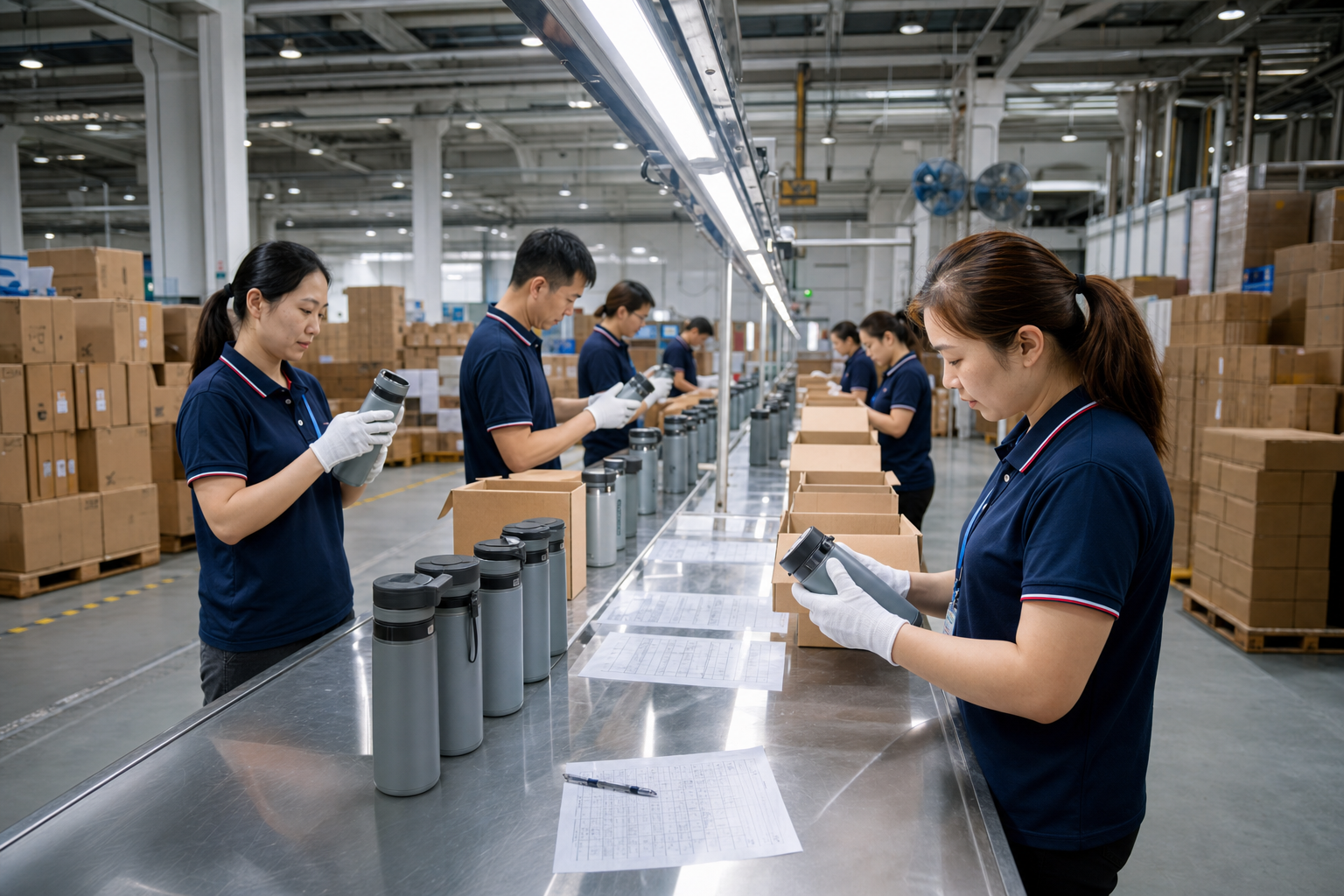
Use a simple filter. Ask who owns the mold, who signs the sample, and who pays if a batch leaks after shipment. Ask for a photo of the packing table and a recent inspection report with AQL 2.5 called out. Then ask whether they support lead-free glass vacuum bottle private label programs with barcode labeling, carton marks, and FNSKU-ready packing for Amazon or other e-commerce channels. We once found a PO typo on “FNSKU” that would have sent 12,000 cartons to the wrong label, so this is not a side issue. A serious partner answers straight. A weak one keeps saying “good quality” and “best price.”
If you are building a long-term channel, choose a factory that can grow with you. China has scale, but not every Chinese factory is built for export-grade consistency. We run 2 shifts in peak season, and the best ones in Zhejiang keep the same fill line setting, the same carton drop test, and the same repeat order result. That is the point. When your reorder lands in December, you want a factory that ships on time, not one that has to relearn the job.
Send your spec and get a factory quote
Share capacity, lid style, artwork, and target market. We will quote MOQ, FOB, and lead time for your lead-free glass vacuum program.
Frequently asked questions
What MOQ should I expect for lead-free glass vacuum insulated bottle wholesale?
For stocked shapes, 1,000 pcs is a realistic starting point. If you want custom lid color, logo print, or private label packaging, 3,000 pcs is more common. New mold work or exclusive structure changes can push MOQ to 5,000 pcs or more. In Zhejiang, a well-organized factory can still keep sample lead time at 7-10 days and production at 30-45 days after approval. If a quote promises 300 pcs with full customization, the price will usually be inflated or the factory will cut corners somewhere else.
What FOB price range is normal for this product?
For a lead-free glass vacuum insulated bottle wholesale order, expect roughly USD 2.20-3.40 FOB for simpler 350 ml units and USD 3.60-5.80 for larger or better-finished models. Decoration, lid material, carton quality, and testing all move the number. If the quote is below USD 2.00, check whether the supplier removed proper testing, used thinner glass, or substituted a weak lid. For Europe and North America, saving USD 0.15 on the unit can cost much more in claims later.
Can I get private label and OEM together?
Yes. A lead-free glass vacuum insulated bottle private label program usually means you use your brand name, artwork, and retail packaging, while the factory uses an existing structure. Lead-free glass vacuum insulated bottle OEM or ODM goes further and can include lid redesign, capacity changes, or custom surface treatment. Most buyers start with private label to control risk, then move into OEM once the sales channel proves itself. Expect a sample cycle of 2 rounds if you want logo placement, carton layout, and color matching to all line up.
What tests should I ask for before ordering?
At minimum, request leak testing, thermal retention data, vacuum hold checks, lid torque testing, and a drop test. For export, also ask for REACH-related material declarations for Europe and food-contact compliance documents for your target market. If the product is going to be sold to outdoor retailers, I would also ask for carton drop test results around 80-100 cm and a simple cycle test for the lid gasket. A good lead-free glass vacuum flask factory should have these records ready, not scramble after you ask.
How do I know if a supplier is actually a factory?
Ask for the production line, monthly output, and QC documents. A real lead-free glass vacuum bottle factory should be able to give you a capacity figure, such as 300,000+ units per month across multiple drinkware lines, plus a standard MOQ and lead time. If they cannot name their AQL standard, sampling plan, or who owns the mold, you are probably dealing with a trading layer. In Zhejiang and across China, the real factories are usually direct about process, while weak suppliers rely on vague promises and stock photos.